

100,000 images in, Mars is still full of surprises
Beautiful views of the distant planet.
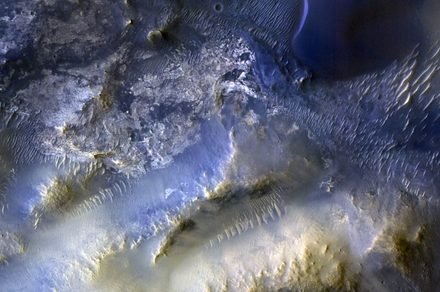
The 100,000th image captured by NASA’s Mars Reconnaissance Orbiter.
NASA/JPL-Caltech/University of Arizona
NASA’s Mars Reconnaissance Orbiter (MRO) has been flying our the red planet for the last 20 years, beaming back images of its surface captured by its High Resolution Imaging Science Experiment (HiRISE) camera.
This week, NASA’s Jet Propulsion Laboratory (JPL), which oversees Mars missions, shared the 100,000th image taken by HiRISE and posted it along with a selection of other Mars images snapped by the camera over the last two decades.
You can see them in the post below.
The remarkable images include everything from impact craters and sand dunes to ice deposits and even potential landing sites for future human missions. It’s worth noting that many HiRISE images don’t show Mars’ expected reddish hue because color processing balances the surface tones with the camera’s blue-green and infrared bands.
The 100,000th image, which we’ve embedded at the top of this page, was captured in October and shows mesas (flat-topped hills or plateaus with steep sides) and dunes within Syrtis Major, a region about 50 miles (80 kilometers) southeast of Jezero Crater, which is currently being explored by NASA’s Perseverance rover.
Scientists are now analyzing the image in a bid to better understand the source of windblown sand that gets trapped in the region’s landscape, and which eventually form dunes.
“HiRISE hasn’t just discovered how different the Martian surface is from Earth, it’s also shown us how that surface changes over time,” MRO project scientist Leslie Tamppari said on the space agency’s website, adding: “We’ve seen dune fields marching along with the wind and avalanches careening down steep slopes.”
The subject of the milestone image was suggested by a high school student through the HiWish site, which allows anyone to suggest parts of Mars to study.
“Rapid data releases, as well as imaging targets suggested by the broader science community and public, have been a hallmark of HiRISE,” said the camera’s principal investigator, Shane Byrne, of the University of Arizona in Tucson. “One hundred thousand images just like this one have made Mars more familiar and accessible for everyone.”
The MRO has enough fuel to support operations until the mid-2030s, so we can look forward to seeing plenty more stunning images from the spacecraft, giving scientists the chance to learn even more about the distant planet.
Not so many moons ago, Trevor moved from one tea-loving island nation that drives on the left (Britain) to another (Japan)…
NASA astronaut to achieve a first in Thursday’s launch to ISS
There’s something special about Chris Williams’ launch to the ISS.
NASA is about to send one of its astronauts to the International Space Station (ISS) in what appears to be the first-ever Thanksgiving Day launch of an American crew member.
Blasting off early on Thursday ET from the Baikonur Cosmodrome in Kazakhstan, Chris Williams will ride to orbit alongside Roscosmos cosmonauts Sergey Kud-Sverchkov and Sergei Mikaev aboard a Russian Soyuz rocket.
Watch these future moon travelers test their space kitchen
The Artemis II astronauts will be eating meals aboard the Orion spacecraft for 10 days as they fly around the moon.
It might be cool to be an astronaut, but life in orbit has its downsides. The food, for example, will be somewhat limited compared to what you can enjoy back on terra firma, though it’s true that over the years, scientists have found ways to broaden the food options for astronauts.
While early space food was limited to unappetizing tubes of slop and bland freeze‑dried powders, astronauts can now enjoy varied, flavorful menus that can even resemble regular meals on Earth.
How to watch the Geminid meteor shower, and other skywatching tips for December
The meteor shower will peak toward the middle of the month.
December is an exciting month for those who like to look up, with a comet, a meteor shower, and a conjunction between the moon and Jupiter all featuring over the coming weeks.
Comet 3I/ATLAS
