

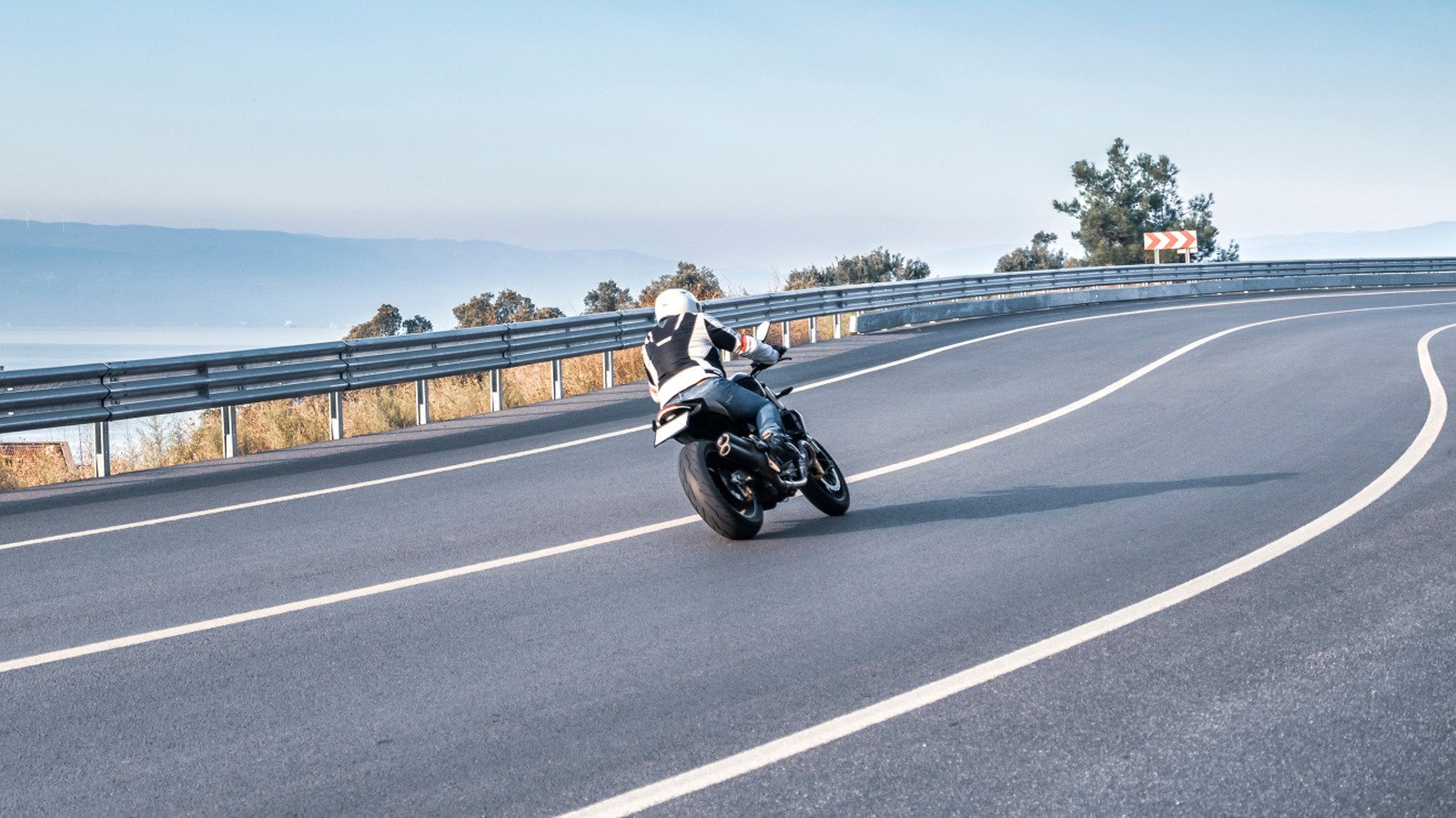
15 Of The Fastest Motorcycles From The 2000s
ozkan ulucam/Shutterstock
The early 2000s marked a golden age for motorcycle performance. It was a time when manufacturers were locked in an all-out race to build the fastest and most technologically advanced machines to touch pavement. Brands like Suzuki, Honda, Kawasaki, Yamaha, and Ducati were pushing engineering to new limits, refining aerodynamics, shaving weight with aluminum frames, and introducing electronic fuel-injection systems that paved the way for the throttle response and efficiency seen in today’s bikes. Kawasaki and Suzuki led the way with the ZX-12R and Hayabusa, each gunning for the 200 mph barrier before an industry-wide speed truce capped top speeds at 186 mph. Meanwhile, Honda’s precision-built CBRs and Yamaha’s agile R1s showcased a nice balance between control and chaos, giving riders confidence when riding at high speeds.
This era was defined by raw, analog power. It was before traction control, cornering ABS, and ride-by-wire, which reined things in a bit more. It was a time when motorcycles demanded respect, rewarding skill and nerve. Riders either favored the refinement of a sport-tourer like the FJR1300 or the sheer dominance of a Hayabusa. Overall, the early 2000s offered something for every rider. Here are 15 of the fastest motorcycles from an unforgettable decade in motorcycle history.
Suzuki GSX‑1300R Hayabusa
The Suzuki GSX-1300R Hayabusa was originally launched in 1999, but didn’t become a true namesake until the early 2000s. It redefined the superbike scene and was named after the peregrine falcon, a bird known for diving at over 200 mph. The Hayabusa lived up to its name by becoming the first production motorcycle to break the 190 mph barrier, clocking 194 mph before the gentleman’s agreement capped top speeds across the industry. Its 1,298 cc inline-four engine delivered strong acceleration and power, and its distinctive aerodynamic silhouette remains recognizable among longtime riders decades later. Suzuki’s blend of stability, torque, and everyday usability made it a surprisingly refined long-distance performer as well, and many riders hail it as one of the best-sounding bikes Suzuki has ever built.
Early-2000s models have aged into cult classics. Some clean examples today from 2008 can command $8,000 to $12,000 on the used market, with unmodified, low-mileage units fetching even more than that. The Hayabusa remains a symbol of an era when motorcycle engineering pushed the limits of speed.
Honda CBR1100XX Super Blackbird
Up next on our list of contenders is the Honda CBR1100XX Super Blackbird. It was introduced in 1996 and later became a common commodity among riders in the 2000s. It was Honda’s answer to the growing superbike speed race. For a time, it essentially ruled the world. Longtime owners say it hits a top speed of around 175 mph, and Cycle World’s contemporaneous road test clocked it at 179.8 mph. The Super Blackbird dethroned Kawasaki’s ZX-11 as one of the fastest production motorcycles ever built (at the time), blending raw performance with trademark Honda refinement. Its 1,137 cc inline-four engine delivered smooth, linear power across the rev range. Not to mention, its aerodynamics provided exceptional stability at triple-digit speeds. What made it special, however, wasn’t just how fast it went, but how effortlessly it achieved high speeds. Riders could cruise all day, then unleash superbike power on command.
The CBR1100XX offered remarkable value for its performance class. Today, clean used examples often sell for $4,000 to $7,000, with collectors increasingly eyeing them as a pivotal option from the pre-electronic era. The Super Blackbird remains a legend of precision, balance, and speed that helped shape the modern sport-touring class.
Ducati 1098
The Ducati 1098, introduced in 2007, marked the Italian brand’s triumphant return to pure performance after the more complex 999 series. It came with an aggressive twin underseat exhaust and a minimalist trellis frame. With that, the 1098 delivered both beauty and brutality. A 1,099 cc Testastretta Evoluzione L-twin produces 160 horsepower and drives it to a top speed of around 174 mph, making it one of the fastest and most powerful Ducatis and V-twins of its era
Ducati stripped the bike down to essentials. There are lightweight components, razor-sharp geometry, and a visceral riding experience that rewards skill and precision. Priced around $14,995 at launch, it offered a blend of race-proven engineering and Italian design flair that set it apart from its Japanese rivals. Today, well-kept examples often sell for $8,000 to $15,000.
Kawasaki ZZR1200
The first Kawasaki on the list is the ZZR1200, released in 2002. It was a true sleeper hit from the early 2000s, a sport-tourer with superbike DNA. Beneath its sleek, understated fairing is a 1,164 cc inline-four engine producing roughly 160 horsepower, capable of pushing the bike to an impressive 186 mph — though we wonder how fast it could have gone without the speed agreement in place. It was fast, smooth, stable, and surprisingly comfortable, built for devouring long stretches of highway. The ZZR1200 combined the speed of Kawasaki’s Ninja lineage with the long-distance comfort of a touring machine.
At around $10,499 at launch, it offered serious performance at a bargain compared to European rivals. Today, enthusiasts still seek it out as one of the best-balanced big bikes of its era, with used models typically fetching $3,500 to $9,000. The ZZR1200 remains a shining example of Kawasaki’s early-2000s mastery in refined, underrated, and endlessly capable speed.
Suzuki GSX‑R1000
The Suzuki GSX-R1000, first introduced in 2001, instantly set a new benchmark for superbike performance in the early 2000s. It packed a 999 cc inline-four engine that produced around 160 horsepower. That’s some blistering acceleration wrapped up with precision handling and a top speed of roughly 180 mph, according to experienced riders. Suzuki engineered the GSX-R1000 to be lighter, faster, and sharper than anything in its class. It earned accolades and honors from industry publications such as Cycle World and Motorcycle News. Its aluminum twin-spar frame, advanced suspension, and aggressive power-to-weight ratio made it as capable on the racetrack as it was on a winding backroad.
Previously priced around $10,399, it was considered a performance bargain that could outrun bikes costing far more. Today, early-2000s models still hold strong collector and track-day appeal, typically selling for $4,000 to $7,000, and even as high as $14,000 depending on condition.
Yamaha YZF‑R1
Yamaha also made some fast bikes in the 2000s. The YZF-R1, which hit the market in 1998 and entered the new millennium with a 2002 redesign, stood as the ultimate expression of Yamaha’s no-compromises superbike philosophy. With a 998 cc inline-four engine producing roughly 152 horsepower, the 2002 R1 could reach a competitive 172 mph, making it one of the fastest that Yamaha has ever made. Engineers focused on balance and precision with an ultra-light aluminum Deltabox frame, razor-sharp steering, and near-perfect weight distribution, making it a masterclass in agility. Explosive acceleration while maintaining stability at high speed was the key, setting the standard for liter-class performance throughout the 2000s.
Pricing came in at around $10,299 back in 2002. The R1 delivered MotoGP-inspired thrills for a fraction of the cost of European rivals. Today, early-2000s models can be found for around $3,000 to $6,000, with pristine examples steadily gaining value.
Kawasaki Ninja ZX‑12R
Also on our list of the fastest is the Kawasaki Ninja ZX-12R, first unveiled in 2000. It was Kawasaki’s all-out attempt to dethrone Suzuki’s Hayabusa as the world’s fastest production motorcycle. For a brief moment, it nearly succeeded. Powered by a 1,199 cc inline-four producing around 178 horsepower, the ZX-12R was capable of 186 mph, with some early, unrestricted tests pushing 190 mph before the industry-wide agreement that capped top speeds. Its radical monocoque aluminum frame and wind-tunnel-sculpted fairings gave it both strength and aerodynamics unlike anything else on the road. Despite its brute force, the bike offered refined handling, thanks to Kawasaki’s focus on chassis rigidity and weight distribution.
With a sale price of around $10,999 in 2004, the ZX-12R was a high-speed bargain for riders chasing the Hayabusa’s crown. Today, clean examples demand between $3,000 and $9,000.The ZX-12R’s legend continues among collectors as one of the last great unrestricted hyperbikes, typically recommended for only experienced riders to own and operate.
Kawasaki Z1000
The 2003 Kawasaki Z1000 brought a sort of muscle-bike attitude to the modern era, given its design. Under the hood was a 953 cc inline-four derived from the ZX-9R, which delivered around 120 horsepower and a top speed near 150 mph. While a bit slower than some of those mentioned already, it’s impressive for a naked bike with minimal aerodynamics. What also made the Z1000 special was its balance of aggression and practicality. It’s got upright ergonomics for daily comfort, but enough raw power to shred backroads and highways with ease.
The Z1000’s exposed aluminum frame, sharp lines, and signature quad exhausts gave it a bold, industrial aesthetic that likely turned heads wherever it went. Kawasaki set the initial price of $8,499, and it remains one of the best-value performance bikes of its time. Today, early-2000s models are appreciated by enthusiasts and currently sell for $3,000 to $7,000, according to J.D. Power. The Z1000 remains a defining early example of the naked sportbike. It’s pure, mechanical, and built to thrill.
MZ 1000S
The MZ 1000S was introduced in 2004 by the German manufacturer Motorradwerk Zschopau (MZ). It was honestly one of the most overlooked superbikes of its era, a precision-built machine that never quite got the spotlight it deserved. The MZ 1000S is powered by a 998 cc parallel-twin engine producing around 117 horsepower, and it could hit a top speed of roughly 140 mph, putting it squarely in competition with bigger Japanese rivals despite what some might deem boutique origins. Its lightweight steel-trellis frame, aerodynamic fairing, and premium suspension gave it exceptional stability and cornering confidence as well, while its unique twin-cylinder layout delivered torque-rich midrange power that made it surprisingly versatile.
Priced at around $11,000 for the 2005 model brand new, it was expensive for a small brand but offered high-end craftsmanship and exclusivity. Today, the MZ 1000S has become something of a cult classic, with used examples ranging from $4,000 to $6,000. It stands as a hidden gem from the early 2000s, a rare European superbike that combined character, engineering precision, and performance.
Suzuki B‑King
This wouldn’t be a complete list without the Suzuki B-King, launched in 2008. It was a brute in every sense of the word, a naked bike built around the same fearsome engine as the Hayabusa. The 1,340 cc inline-four pumped out nearly 181 horsepower, propelling it to a top speed of about 157 mph, making it one of the fastest production naked motorcycles ever made. With muscular bodywork, twin under-seat exhausts, and a commanding riding position, the B-King looked as aggressive as it performed. Suzuki designed it for riders who wanted superbike power without full fairings, resulting in a raw, torque-heavy machine that delivered instant throttle response and unrelenting acceleration.
At the time of its introduction, the price was $12,899. This was considered expensive at the time, but today enthusiasts recognize it as a modern classic and one of Suzuki’s coolest-looking motorcycles. It often sells for $7,000 to $10,000 in clean condition. The B-King is a stripped-down powerhouse that proved Suzuki’s engineering excess could be both thrilling and bold.
Triumph Daytona 955i
The Triumph Daytona 955i was produced from 1997 to 2006 and was Britain’s proud entry into the early-2000s superbike wars. It’s a machine that combines character, performance, and unmistakable style. Powered by a 955 cc three-cylinder engine producing around 147 horsepower, it could reach a top speed of about 165 mph, putting it right alongside the Japanese liter bikes of its time. The Daytona’s signature triple engine delivered a uniquely broad powerband and raspy exhaust note, offering both torque-rich midrange and exhilarating top-end pull. Triumph designed it to stand apart, blending European craftsmanship with everyday rideability and long-distance comfort.
It was priced around $9,999 in the 2005 model year, and it offered premium performance without Ducati-level costs. The Dayton was always a little under the radar compared to the Japanese supersorts, but it was far from a slouch. Today, clean examples typically sell for $3,000 to $5,235, offering a balanced mix of personality and performance. The Daytona 955i remains one of Triumph’s most beloved sportbikes.
Suzuki SV1000S
We couldn’t forget the Suzuki SV1000S. It was introduced in 2003 as a versatile V-twin sportbike that blended real-world comfort with serious performance. Powered by a 996 cc liquid-cooled V-twin derived from the TL1000R, it brought around 120 horsepower, 75 lb-ft of torque, and a top speed near 143 mph, giving riders liter-bike thrills with a friendlier, more manageable character. The SV1000S was built for balance and agile handling, a comfortable semi-upright riding position, and torque-rich power delivery that made it a joy to ride in nearly any scenario.
Suzuki positioned it as a budget-conscious alternative to European twins, and at around $8,599 new in 2005, it undercut competitors like Ducati’s SuperSport series while delivering comparable excitement. Today, well-maintained versions can be found for $3,000 to $10,000, and the model has earned a loyal following for its reliability and fun factor. The SV1000S remains a twin-powered standout from the early 2000s.
Yamaha FJR1300
Next on our list is the Yamaha FJR1300, introduced in 2001. It was the sport-touring machine that proved you could have long-distance comfort without sacrificing speed. Powered by a 1,298 cc inline-four producing roughly 142 horsepower, it could hit a top speed of around 155 mph, making it one of the fastest touring bikes of the decade. Yamaha engineered the FJR1300 for effortless power delivery and highway composure, pairing its strong engine with aerodynamic fairings, an adjustable windscreen, and plush ergonomics for all-day comfort.
Despite its size, the bike is known to have good handling, with sportbike-like agility in the twists and turns. Priced at around $11,499 in 2005, it appealed to riders who wanted both adrenaline and practicality. In 2025, early models typically sell for $3,000 to $7,000, depending on mileage and condition. The FJR1300 remains a legend among sport-touring riders for its ability to carve canyons in the morning and crush interstate miles by afternoon.
Honda CBR600RR
The Honda CBR600RR was initially introduced in 2003 as a purebred supersport that brought MotoGP-inspired engineering to the middleweight class. Its 599 cc inline-four engine produced about 118 horsepower, pushing the lightweight machine to a top speed near 155 mph. That’s some blistering performance for a 600 cc bike. Honda designed the CBR600RR with precision and agility in mind. It has a compact chassis, mass-centralized engine placement, and razor-sharp suspension geometry, which gives it unmatched cornering confidence. It was equally at home on track days and twisty backroads, earning a reputation for its balance of power, control, and reliability.
At around $9,000 when launched, the CB600RR quickly became a favorite among riders who valued finesse over just force. Today, early models typically sell for $4,000 to $6,000, depending on condition and mileage. The CBR600RR remains one of the most respected 600-class bikes ever built.
Kawasaki ZZR1400
To round it all out, we have the Kawasaki ZZR1400. It’s known in some markets as the Ninja ZX-14, and debuted in 2006, immediately joining the elite ranks of the world’s fastest production motorcycles. Powered by a monstrous 1,352 cc inline-four, it produced around 197 horsepower and could reach a top speed of 187 mph. Kawasaki designed the ZZR1400 as the ultimate hyperbike, combining brutal acceleration with remarkable smoothness and stability. Its aerodynamic bodywork, long wheelbase, and advanced chassis engineering gave it exceptional composure even at extreme speeds. Despite its power, the ZZR1400 was surprisingly refined and comfortable enough for touring. Still, it’s a savage when unleashed.
With a launch price of around $11,499, it offered superbike performance for less than many competitors. Today, early models often sell for $4,000 to over $8,000, depending on condition. The ZZR1400 remains one of the definitive speed icons of the 2000s. It’s effortlessly fast, beautifully balanced, and still capable of humbling modern machines.
Methodology
Artistgndphotography/Getty Images
To create this list of the fastest motorcycles from the 2000s, we focused on production models released between 2000 and 2009, excluding concept bikes and modified machines. Each selection was chosen based on verified top-speed data, factory specs, real-world test results from trusted rider reports and industry publications, and first-hand experience wherever possible. We prioritized bikes that largely defined the era’s speed competition, from superbikes to sport-tourers. Making these considerations helped capture how manufacturers pushed limits before electronic restrictions became standard. Every motorcycle here represents the engineering peak of the decade, bikes that were fast enough to influence performance standards for years.
