

5 Of The Fastest Motorcycles From The 1980s
For those who have ridden motorcycles from the 1980s, you would definitely understand Visor Down’s sentiments when they say the “1980s was the best decade for motorcycles.”
Several motorcycles from the 1980s became iconic. Pop culture’s impact was also seen in popularising the speed and style a part of the motorcycle industry in the U.S. Who can forget Tom Cruise using the Kawasaki GPZ900R in “Top Gun” (1986), Prince riding his Hondamatic CB400A in “Purple Rain” (1984), or Sylvester Stallone’s John Rambo escaping on a Yamaha XT 250 in “First Blood” (1982).
During that time, motorcycles were built with passion, and you could see it in the variety of bikes in the market. The decade gave us some of the iconic bikes we still praise today, and some of these machines were extremely fast, with some capable of breaching the 150 mph speed mark. While most of the fastest motorcycles ever built had the modern advantages and safety aids, motorcycles from the 1980s were fast in a raw, mechanical way. Even the 1970s did not shy away from producing some of the quickest motorbikes of their era.
Some of the things that made motorcycles from the 1980s a joy to ride were that they demanded skill, focus, and confidence — because without those, your insurance provider would have been very busy, and your career would have been abbreviated. Here are five of the fastest motorcycles from the 1980s.
Yamaha V-Max (149 -150 mph)
Yamaha’s reputation for innovation and successful bikes started on race tracks. In 1972, the company secured its first win at the Daytona 200 with its TR3 bike. In 1975, it introduced the YZ250, the world’s first single-shock motocross bike. Then came 1985, when Yamaha launched the iconic V-Max motorcycle solely for the U.S. market. The bike brought aggressive power, bold cruiser looks, and the speed that Americans were familiar with. While the bike may be one of our picks for the ugliest motorcycles from Yamaha, it was also one of the highest-horsepower motorcycles from the company — a tradeoff we’re willing to make.
The Yamaha V-Max rose to fame after its launch and went on to claim the coveted “Bike Of The Year” title from Cycle Guide magazine. This Japanese behemoth came with styling similar to that of Harley’s, as Yamaha was aiming to claim some of the market share that Harley-Davidson had. It was equipped with a 1,200cc, double-overhead-cam, four-valve, liquid-cooled engine that produced 145 hp. The bike was also fitted with the largest rear rubber ever fitted to a mass-produced motorcycle at that point, in its massive 150/95 series rear tire.
The Yamaha V-Max could reach a top speed of 150mph, which was pretty damn good for a bike weighing north of 600 pounds. Cycle World praised the handling of the 1985 Yamaha V-Max, noting that the bike handles turns very well and feels stable despite its monster power.
Honda VF1000R (150 mph)
Another motorcycle that made waves during the 1980s came from Honda. While motorcycle manufacturers were pushing boundaries in terms of design, variety, and performance, Japanese makers were at the forefront, as European and American brands could not match the quality and performance set by Japanese motorcycle makers. Among some of the fast bikes, Honda launched the VF1000R in Europe and the VF1000F in America in 1984.
Since the VF1000R was more racetrack-oriented, the VF1000F was viewed in the U.S. as a second-best option, and did not make the sales impression Honda had hoped for. To tackle this, Honda launched the VF1000R in the U.S. a year later and quickly rose to fame. But what made it really amazing was the fact that it was the first motorcycle ever to breach the 150 mph mark. The bike featured a 998cc DOHC liquid-cooled engine that produced 117 hp and 63.7 lb-ft of torque.
The Honda VF1000R came with air-assist 3-way adjustable suspension on the front with Torque Reactive Anti-Dive Control (TRAC), which was very advanced for its era, and is even used in current superbikes. However, reviewers highlighted some issues with the ergonomics of the Honda VF1000R and also observed that the bike’s heaviness can impact its road feel. The price became the enemy of this motorcycle, and despite being a fast machine, people were more inclined towards the much lighter Honda VF750, which weighed 125 pounds less and was $1,000 cheaper.
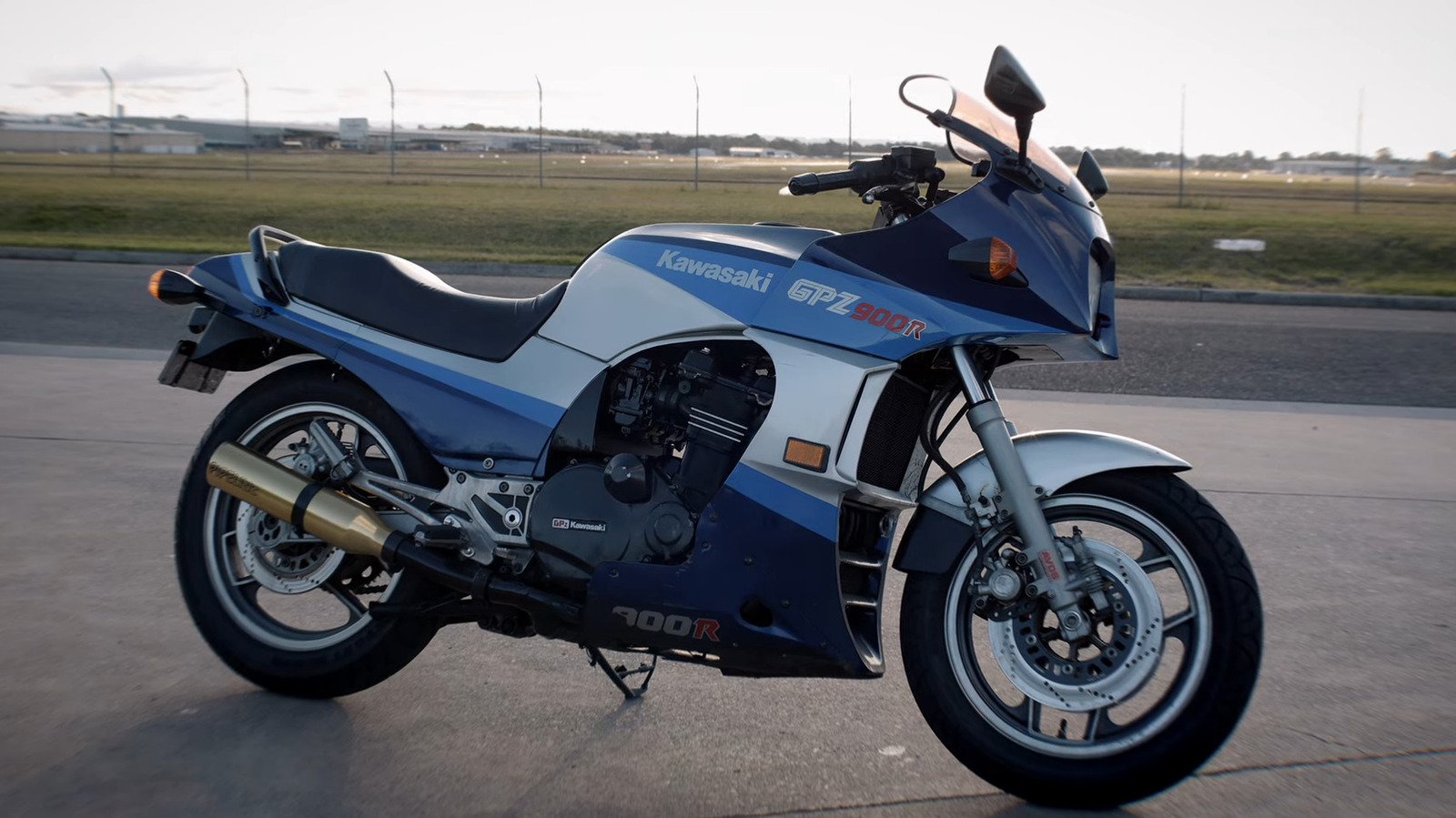
Kawasaki GPZ900R (150-154 mph)
Remember Tom Cruise’s famous movie scene where he, as Maverick, paces an F-14 Tomcat on a superbike in the original “Top Gun” (1986)? Well, it was the Kawasaki GPZ900R, also known as the first Ninja motorcycle, a name that, as humorously put by Cycle World, “has been striking fear into mothers and glee into the hearts of insurance adjusters” for decades. The Kawasaki GPZ900R was an instant hit among riders and went on to claim legendary status. The 900cc engine was built from the ground up, and it was the first liquid-cooled 16-valve motorcycle engine.
The bike produced 115 hp and 66 lb-ft of torque, propelling it to a top speed of 154 mph. Though some reviews claimed a 157 mph top speed. One thing is for sure — everyone was impressed with GPZ’s performance. The bike’s new steel spine design (dubbed the Diamond Frame) allowed for increased ground clearance and reduced weight by incorporating the engine as a stress-bearing member. The bike was analog, engineered, gorgeous, and had pop culture cache while supplying a thrilling and visceral experience for the hardcore rider. As said by Cycle News, “GPZ900R lacks in high-tech hardware, it more than makes up for in down-to-earth performance.” The comfortable riding position, the ability to breach the 150 mph mark, smooth power delivery, and sufficient torque really make the 1980s Kawasaki GPZ900R a thrill to ride, even after 40 years.
Suzuki GSX-R1100 (155 mph)
Suzuki introduced the elder sibling of the GSX-R750, the GSX-R1100, in 1986. The R1100 came equipped with a big 1,052 cc oil-cooled engine; it was 44 pounds heavier than the R750, but still one of the lightest superbikes of its time, and it made up for the increased weight with 137 hp and 74.5 lb-ft of maximum torque.
The one thing that made the GSX-R1100 stand out from its rivals was its high-end performance. The bike was launched with the title of the fastest in the world, claiming a top speed of 155 mph. One reviewer reported a drag strip speed of 172.4 mph with a later model. In 1989, the GSX-R1100 got a makeover with an upgraded engine and chassis. The bike was now 29 pounds heavier than the original GSX-R1100, which was designed to handle the big-bore 1,127 cc oil-cooled inline four-cylinder DOHC four-valve engine. The GSX-R1100 maintained its top speed, with Cycle World saying that ” the GSX-R invites you to go fast” with its impressive torque.
The bike began to feel dated during the mid-’90s, as more performance-oriented and lighter motorcycles were already available. Suzuki produced the GSX-R1100 from 1986 to 1998, replaced by the GSX-R1000 in 2000. It came with a new engine displacement of 1,000 cc. Suzuki also launched the GSXR750WT with the same goal in mind — to build lighter bikes that could hit higher speeds.
Kawasaki Ninja ZX-10 Tomcat (165 mph)
During the 1980s, motorcycle manufacturers, especially Japanese makers, were pushing the boundaries, not only in terms of design and technology but also in terms of speed. This era saw riders engage in a power race to build the fastest motorcycles, one of which was the Kawasaki Ninja ZX-10R, also known as the Tomcat. It took the world by storm by becoming the world’s fastest production bike in 1988. Moreover, it was the first Kawasaki motorcycle to bear the ZX-10 moniker.
Cycle World praised the bike by saying, “It is the new Sultan of Speed, a sportbike insuperable …. Nothing else mass-produced on two wheels even comes close.” The Ninja ZX-10 Tomcat gained its nickname from the famous American fighter jet, the F-14, which was also displayed in Tom Cruise’s “Top Gun”. The Tomcat couldn’t take off, but it did have a 997 cc engine that produced 137 hp at 10,000 rpm. The bike could reach a top speed of 165 mph, something no other motorcycle in the 1980s could match.
Kawasaki did a good job with its handling, thanks to the chassis geometry and the lightweight body. The Kawasaki ZX-10 Tomcat was produced from 1988 to 1990, and during its reign, it remained at the top of the sports bike world with its blistering speed and performance. It was eventually replaced by a much faster ZZ-R1100, but not until the 1990s, leaving the Tomcat king of the walk.
