

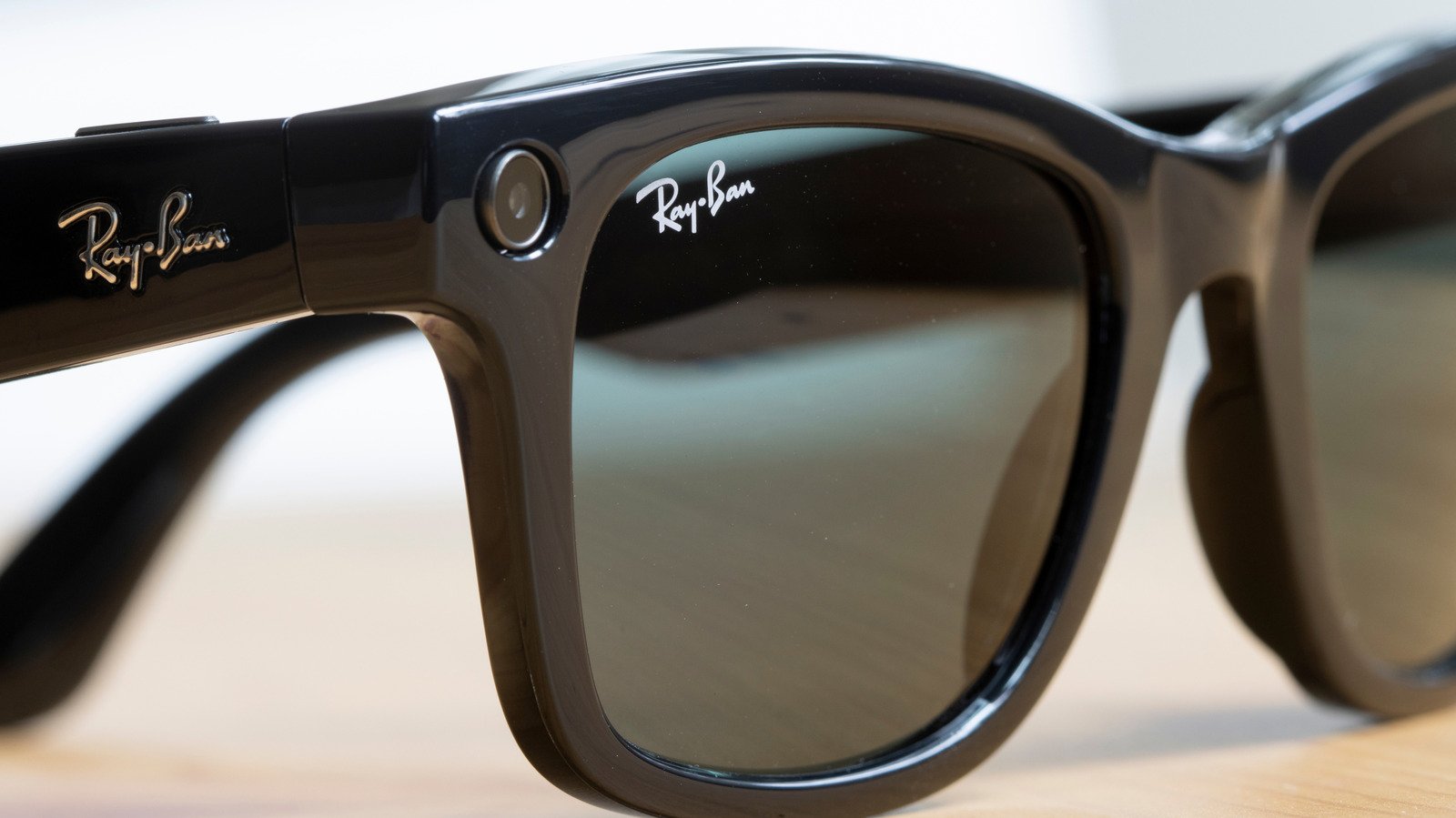
5 Places Where Smart Glasses Like Meta Ray-Bans Should Never, Ever Be Worn
Tada Images/Shutterstock
The first time with full-on VR tech really does feel revolutionary. The thing about this kind of technology, though, is that it can be rather unwieldy, with headsets, special haptic gloves, and other potential accessories. Smart glasses, such as Meta Ray-Bans, are a very different sort of technological advancement. With these, the accessibility of powerful AI tools becomes literally hands-free, and that’s very exciting.
Paired with it, though, are significant security and privacy concerns. The recording capabilities of these devices are subtle and sophisticated too, and whether in active use or not, this functionality is always there. Recently, the U.S. Air Force banned this popular new tech primarily for this reason, and the potential for a high-security operation to be compromised is easy to imagine. This isn’t to say, of course, that usage of such glasses is wrong in and of itself. On the contrary, they are perhaps one of the most significant developments in productivity and entertainment yet, in the way they present information and provide functionality for users.
Some of the dangers of smart glasses, however, emerge without any ill intent on the user’s part, or even without their knowledge. As a result, their use is heavily restricted, if not outright forbidden, in many places. It’s a developing technology, and the response to it is ever-adapting too. Let’s take a look at some prominent places, scenarios, and events to which your smart glasses really probably shouldn’t be brought along.
1. The locker rooms at gyms
king ajyad/Shutterstock
Gyms and photography often don’t go very well together. In November 2023, The Guardian reported that PureGym, a large U.K. chain, made its policy on such very clear. A spokesperson for the company told the newspaper, “Our gym rules clearly state that people should not take photographs or videos on the premises unless they have permission.” It’s for this reason that smart glasses are inevitably going to be controversial in such an environment. After all, many wearers of regular glasses keep them on all the time. It’s also true that some sets of smart glasses are almost indistinguishable from their regular counterparts. As they become more common, it becomes increasingly likely that anyone you encounter could be wearing a pair. Whether Ray-Ban’s Meta AI glasses are worth the cost is up to the individual, after all, but the tech is becoming popular.
In December 2025, Kingdom Gyms of Birmingham, England, shared an Instagram post detailing a significant policy change. The glasses would be banned at the establishment: “Due to a few recent complaints, recording glasses (such as Meta smart glasses) will not be permitted in our gyms.” Though it went on to state that conventional photography could still be used there, the gym added, “always be respectful of other members who may not want to appear in the background.” It is not necessarily the case that a smart-glasses wearer did anything wrong, but the very fact of wearing them may understandably make people feel uneasy. Gyms should be inclusive spaces, and, on the flipside, harassment of smart glasses wearers could also be a risk if it turns out (or is suspected) that somebody’s wearing them.
2. During standardized testing
Carlos Barquero Perez/Getty Images
It seems that, as long as there have been exams, there have been sneaky ways to try to cheat. Written notes are generally a less-than-subtle idea, but there’s no need to be so low-tech in the brave new world of smart glasses. Except, of course, that those holding standardized tests soon got wise to the threat and took action.
Fortunately for those in charge of anti-cheating efforts, while it may be difficult to tell the difference between regular glasses and smart glasses in most cases, there are ways to do so. College Board senior vice president of college readiness assessments, Priscilla Rodriguez, reports to Inside Higher Ed that you just need to know what to look for in some cases. “It’s a noticeable light, so if someone were taking a video, a photo, having someone talk to them through the glasses, etc., the light shines.” This can be a subtle tell, though, and it isn’t always so easy to be sure.
The College Board, though, purports to always be several steps ahead. Literally, in fact. Rodriguez went on to note that the professionals there “were monitoring the pre-launch announcements of these kinds of glasses and gadgets well before they hit the market, so we were ready.” It just goes to show that as cheating technology advances, those committed to foiling it will advance right back, and so the cycle continues. Some efforts will be more sophisticated than others in this area, but it’s a good enough reason to prevent the use of smart glasses during examinations.
3. Hospitals
Caiaimage/robert Daly/Getty Images
In hospitals, clinics, and similar settings, patients can reasonably expect to have their privacy respected. The difficulty here, though, is that during peak times, a hospital can get extremely busy. Treatment rooms themselves, though, should be sacrosanct, as dictated by doctor-patient confidentiality. One thing we often don’t consider, though, is that this privacy goes both ways. Caregivers, as always, have the right to fulfil their duties comfortably and without being bothered, and the potential additions of smart glasses into the equation could pose an issue.
The LBMC makes clear how serious such a matter could be. “It wouldn’t just be the individual wearing the glasses at fault. Hospitals could face legal liability and significant fines if they fail to create a secure environment.” A user may not intend to record such sensitive events or information, but by wearing glasses that can capture it, they’re still posing a significant risk. Patients do tend to spend a lot of their time in a hospital waiting for a consultation or for treatment, and
for outpatients, this can mean a lot of time spent in a communal area like a waiting room. When taken to a private room for treatment, however, expectations differ.
People may simply object to any kind of recording equipment being focused on them without their consent, and this sort of public area isn’t any different in that regard, but the additional pressures of a medical environment make things so much more complicated. The Health Insurance Portability and Accountability Act of 1996, the CDC explains, “establishes federal standards protecting sensitive health information from disclosure without a patient’s consent.” Hospitals have an enormous responsibility to protect such information, and using such equipment could jeopardize this commitment.
4. In courts of law that don’t allow recording devices
Brianajackson/Getty Images
Much like hospitals, courts of law are hotbeds of personal information. Strict controls on the types of technology that are brought into them are necessary because unauthorized intruders could leak crucial information or evidence, which could derail a case. With smart glasses’ potential to record where they shouldn’t, even possibly without the user’s knowledge, then, you may not want to buy models like Meta’s new AI glasses, regardless of how great they look.
In February 2026, Meta’s Mark Zuckerberg appeared at the Los Angeles Superior Court to testify on social media addiction. The case, which could potentially set a significant precedent for industry CEOs like Zuckerberg, was interrupted when it was revealed that Meta smart glasses (seemingly of the Wayfarer variety, according to SFGate) were worn by two members of the team escorting Zuckerberg into the court for the trial. Recording devices of any kind are strictly forbidden within this L.A. courtroom. As such, preceding Judge Carolyn Kuhl addressed the issue in no uncertain terms. On the possibility of recording Zuckerberg’s speech with the glasses, Judge Kuhl, according to CNBC, remarked, “If you have done that, you must delete that, or you will be held in contempt of the court […] this is very serious.”
It is not necessarily the case that recording devices are always banned in courtrooms, but tolerance is rapidly shrinking. Outright bans on the devices in these settings are gaining traction in the United States, with North Carolina’s Forsyth County Court and the District of Hawaii’s District Court being two prominent examples of courts taking this extreme action.
5. Certain areas aboard specific cruise lines’ ships
Ceri Breeze/Getty Images
There are certain things you can often count on with a cruise vacation, such as stunning views, great food, and a busy ship full of hundreds of your fellow holidaymakers. Along with that, of course, come plenty of opportunities to capture videos and photos of your trip. You’ll need to be wary of how you do this, though, because some cruise lines have begun to ban the use of smart glasses in certain areas on board.
MSC Cruises notes that, while potential dangers such as firearms can’t be brought aboard at all, “devices capable of covertly or discreetly recording or transmitting data” can also potentially pose a significant threat to the comfort and safety of guests. They have their own restrictions, then, with smart glasses permitted on the ship but only for guests in their own private quarters.
MSC’s fellow industry titan, Royal Caribbean, is another that holds this view. According to an FAQ from the cruise line about prohibited items, smart glasses are not outright forbidden everywhere but “cannot be worn in the casino, spa service areas, restrooms, locker rooms, medical facilities, security screening locations, youth facilities, during back-of-house tours, in crew areas, or anywhere there is a reasonable expectation of guest and crew privacy.”
Vast cruise ships, essentially, function as their own floating communities and holiday resorts. As Royal Caribbean points out, they house a lot of the same kinds of facilities where smart glasses have been deemed by some to be an ill fit on land, as well as simply crowded public areas. For the comfort of both users and those who may not wish to encounter smart glasses users, these decisions are made.
