

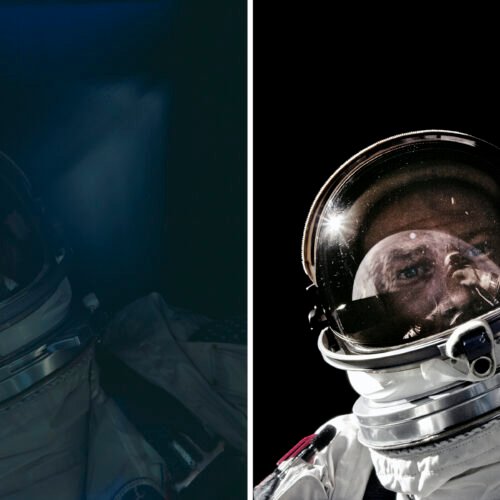
60 years after Gemini, newly processed images reveal incredible details
“It’s that level of risk that they were taking. I think that’s what really hit home.”
Before / after showing the image transformation. Buzz Aldrin is revealed as he takes the first selfie in space on Gemini 12, November 12, 1966.
Credit:
NASA / ASU / Andy Saunders
Before / after showing the image transformation. Buzz Aldrin is revealed as he takes the first selfie in space on Gemini 12, November 12, 1966.
Credit:
NASA / ASU / Andy Saunders
Six decades have now passed since some of the most iconic Project Gemini spaceflights. The 60th anniversary of Gemini 4, when Ed White conducted the first US spacewalk, came in June. The next mission, Gemini 5, ended just two weeks ago, in 1965. These missions are now forgotten by most Americans, as most of the people alive during that time are now deceased.
However, during these early years of spaceflight, NASA engineers and astronauts cut their teeth on a variety of spaceflight firsts, flying a series of harrowing missions during which it seems a miracle that no one died.
Because the Gemini missions, as well as NASA’s first human spaceflight program Mercury, yielded such amazing stories, I was thrilled to realize that a new book has recently been published—Gemini & Mercury Remastered—that brings them back to life in vivid color.
The book is a collection of 300 photographs from NASA’s Mercury and Gemini programs during the 1960s, in which Andy Saunders has meticulously restored the images and then deeply researched their background to more fully tell the stories behind them. The end result is a beautiful and powerful reminder of just how brave America’s first pioneers in space were. What follows is a lightly edited conversation with Saunders about how he developed the book and some of his favorite stories from it.
Ars: Why put out a book on Mercury and Gemini now?
Andy Saunders: Well, it’s the 60th anniversaries of the Gemini missions, but the book is really the prequel to my first book, Apollo Remastered. This is about the missions that came before. So it takes us right back to the very dawn of human space exploration, back to the very beginning, and this was always a project I was going to work on next. Because, as well as being obviously very important in spaceflight history, they’re very important in terms of human history, the human evolution, even, you know, the first time we were able to escape Earth.
For tens of thousands of years, civilizations have looked up and dreamt of leaving Earth and voyaging to the stars. And this golden era in the early 1960s is when that ancient dream finally became a reality. Also, of course, the first opportunity to look back at Earth and give us that unique perspective. But I think it’s really the photographs specifically that will just forever symbolize and document at the beginning of our expansion out into the cosmos. You know, of course, we went to the Moon with Apollo. We’ll go back with Artemis. We spent long periods on the International Space Station. We’ll walk on Mars. We’ll eventually become a multi-planetary species. But this is where it all began and how it all began.
Ars: They used modified Hasselblad cameras during Apollo to capture these amazing images. What types of cameras were used during Mercury and Gemini?
Saunders: Mercury was more basic cameras. So on the very first missions, NASA didn’t want the astronaut to take a camera on board. The capsules were tiny. They were very busy. They’re very short missions, obviously very groundbreaking missions. So, the first couple of missions, there was a camera out of the porthole window, just taking photographs automatically. But it was John Glenn on his mission (Mercury-Atlas 6) who said, “No, I want to take a camera. People want to know what it’s going to be like to be an astronaut. They’re going to want to look at Earth through the window. I’m seeing things no humans ever seen before.” So he literally saw a $40 camera in a drugstore on his way after a haircut at Cocoa Beach. He thought, “That’s perfect.” And he bought it himself, and then NASA adapted it. They put a pistol grip on to help him to use it. And with it, he took the first still photographs of Earth from space.
So it was the early astronauts that kind of drove the desire to take cameras themselves, but they were quite basic. Wally Schirra (Mercury-Atlas 8) then took the first Hasselblad. He wanted medium format, better quality, but really, the photographs from Mercury aren’t as stunning as Gemini. It’s partly the windows and the way they took the photos, and they’d had little experience. Also, preservation clearly wasn’t high up on the agenda in Mercury, because the original film is evidently in a pretty bad state. The first American in space is an incredibly important moment in history. But every single frame of the original film of Alan Shepard’s flight was scribbled over with felt pen, it’s torn, and it’s fixed with like a piece of sticky tape. But it’s a reminder that these weren’t taken for their aesthetic quality. They weren’t taken for posterity. You know, they were technical information. The US was trying to catch up with the Soviets. Preservation wasn’t high up on the agenda.
This is not some distant planet seen in a sci-fi movie, it’s our Earth, in real life, as we explored space in the 1960s. The Sahara desert, photographed from Gemini 11, September 14, 1966. As we stand at the threshold of a new space age, heading back to the Moon, onward to Mars and beyond, the photographs taken during Mercury and Gemini will forever symbolize and document the beginning of humankind’s expansion out into the cosmos.
NASA / ASU / Andy Saunders
Ars: I want to understand your process. How many photos did you consider for this book?
Saunders: With Apollo, they took about 35,000 photographs. With Mercury and Gemini, there were about 5,000. Which I was quite relieved about. So yeah, I went through all 5,000 they took. I’m not sure how much 16 millimeter film in terms of time, because it was at various frame rates, but a lot of 16 millimeter film. So I went through every frame of film that was captured from launch to splashdown on every mission.
Ars: Out of that material, how much did you end up processing?
Saunders: What I would first do is have a quick look, particularly if there’s apparently nothing in them, because a lot of them are very underexposed. But with digital processing, like I did with the cover of the Apollo book, we can pull out stuff that you actually can’t see in the raw file. So it’s always worth taking a look. So do a very quick edit, and then if it’s not of interest, it’s discarded. Or it might be that clearly an important moment was happening, even if it’s not a particularly stunning photograph, I would save that one. So I was probably down from 5,000 to maybe 800, and then do a better edit on it.
And then the final 300 that are in the book are those that are either aesthetically stunning, or they’re a big transformation, or they show something important that happened on the mission, or a historically significant moment. But also, what I want to do with the book, as well as showing the photographs, is tell the stories, these incredible human stories that, because of the risks they were taking. So to do that, I effectively reconstructed every mission from launch to splashdown by using lots of different pieces of information in order to effectively map the photography onto a timeline so that it can then tell the story through the captions. So a photograph might be in there simply to help tell part of the story.
Ars: What was your favorite story to tell?
Saunders: Well, perhaps in terms of a chapter and a mission, I’d say Gemini 4 is kind of the heart of the book. You know, first US space walk, quite a lot of drama occurred when they couldn’t close the hatch. There’s some quite poignant shots, particularly of Ed White, of course, who later lost his life in the Apollo 1 fire. But in terms of the story, I mean, Gemini 9A was just, there needs to be a movie about just Gemini 9A. Right from the start, from losing the prime crew, and then just what happened out on Gene Cernan’s EVA, how he got back into the capsule alive is quite incredible, and all this detail I’ve tried to cover because he took his camera. So he called it the spacewalk from hell. Everything that could go wrong went wrong. He was incredibly exhausted, overheated. His visor steamed over. He went effectively blind, and he was at the back of the adapter section. This is at a point when NASA just hadn’t mastered EVA. So, simply how you maneuver in space, they just haven’t mastered, so he was exhausted. He was almost blind. Then he lost communication with Tom Stafford, his command pilot. He tore his suit, because, of course, back then, there were all kinds of jagged parts on the spacecraft.
And then when he’s finally back in the hatch, he was quite a big chap, and they couldn’t close the hatch, so he was bent double trying to close the hatch. He started to see stars. He said, Tom, if we don’t close this hatch now and re-pressurize, I am going to die. They got it closed, got his helmet off, and Tom Stafford said he just looked like someone that had spent far too long in a sauna. Stafford sprayed him with a water hose to kind of cool him down. So what happened on that mission is just quite incredible. But there was something on every mission, you know, from Gus Grissom sinking of the Liberty Bell and him almost drowning, the heat shield coming loose, or an indicator that suggested the heat shield was loose on Glenn’s mission. There’s an image of that in the book. Like I said, I mapped everything to the timeline, and worked out the frame rates, and we’ve got the clock we can see over his shoulder. So I could work out exactly when he was at the point of maximum heating through reentry, when part of the strapping that kept the retro pack on, to try and hold a heat shield on that hit the window, and he’s talking, but no one was listening, because it was during radio blackout.
After being informed his heat shield may have come loose, John Glenn is holding steadfast in the face of real uncertainty, as he observes the retro pack burn up outside his window, illuminating the cabin in an orange glow, during re-entry on February 20, 1962. “This is Friendship Seven. I think the pack just let go … A real fireball outside! … Great chunks of that retro pack breaking off all the way through!”
Credit:
NASA / Andy Saunders
After being informed his heat shield may have come loose, John Glenn is holding steadfast in the face of real uncertainty, as he observes the retro pack burn up outside his window, illuminating the cabin in an orange glow, during re-entry on February 20, 1962. “This is Friendship Seven. I think the pack just let go … A real fireball outside! … Great chunks of that retro pack breaking off all the way through!”
Credit:
NASA / Andy Saunders
The process I used for this, on the low-quality 16 mm film, was to stack hundreds and hundreds of frames to bring out incredible detail. You can almost see the pores in his skin. To see this level of detail, to me, it’s just like a portrait of courage. There he is, holding steadfast, not knowing if he’s about to burn up in the atmosphere. So that was quite a haunting image, if you like, to be able to help you step on board, you know, these tiny Mercury spacecraft, to see them, to see what they saw, to look out the windows and see how they saw it.
Ars: What was new or surprising to you as you spent so much time with these photos and looking at the details?
Saunders: The human side to them. Now that we can see them this clearly, they seem to have an emotional depth to them. And it’s that level of risk that they were taking. I think that’s what really hit home. The Earth shots are stunning. You know, you can almost feel the scale, particularly with a super wide lens, and the altitudes they flew to. And you can just imagine what it must have been like out on an EVA, for example. I think Gene Cernan said it was like sitting on God’s front porch, the view he had on his EVA. So those Earth shots are stunning, but it’s really those the human side that really hits home for me. I read every word of every transcript of every mission. All the conversations were recorded on tape between the air and the ground, and between the astronauts when they were out of ground contact, and reading those it really hits home what they were doing. I found myself holding my breath, and, you know, my shoulders were stiff.
Ars: So what’s next? I mean, there’s only about 100 million photos from the Space Shuttle era.
Saunders: Thankfully, they weren’t all taken on film. So if I wanted to complete space on film, then what I haven’t yet done is Apollo-Soyuz, Skylab, and the first, whatever it is, 20 percent of the shuttle. So maybe that’s next. But I would just like a rest, because I’ve been doing this now since the middle of 2019, literally nonstop. It’s all I’ve done with Apollo and now Mercury and Gemini. The books make a really nice set in that they’re exactly the same size. So it covers the first view of the curvature of Earth and space right through to our last steps on the Moon.
Eric Berger is the senior space editor at Ars Technica, covering everything from astronomy to private space to NASA policy, and author of two books: Liftoff, about the rise of SpaceX; and Reentry, on the development of the Falcon 9 rocket and Dragon. A certified meteorologist, Eric lives in Houston.
