

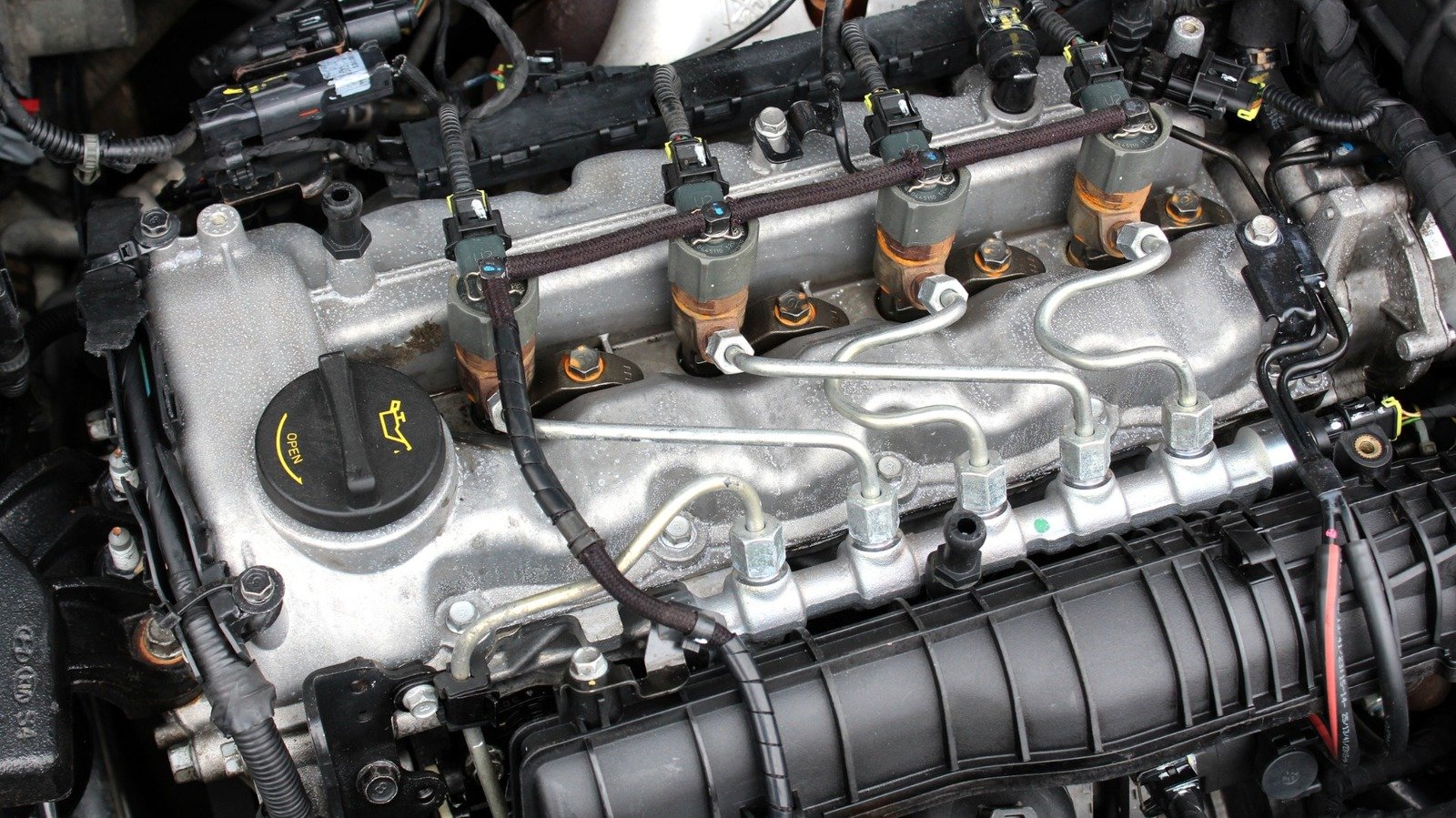
7.3 PowerStroke Vs. 5.9 Cummins Vs. 6.6 Duramax: How Do The Diesel Engines Compare?
Best Auto Photo/Shutterstock
When it comes to heavy-duty diesels, enthusiasts and truck owners inevitably circle back to the best American diesel engines: Ford’s 7.3L PowerStroke, Dodge’s 5.9L Cummins, and GM’s 6.6L Duramax. If there were a Mount Rushmore of diesel engines, they would be carved into the rock with soot-stained glory, so it’s hard to resist comparing these three engines. They have different but rich histories and are founded on different but unique mechanical philosophies. And, in reality, they possess different weaknesses and strengths.
The 7.3 PowerStroke, for example, is a Ford and Navistar collaboration, known for its robustness in earlier years. The 5.9 Cummins had an especially long production run but a simple inline-six design. Then, the 6.6 Duramax has evolved over more recent decades, balancing newer emissions rules with performance and reliability.
An attempt at comparing these titans of industry boils down to certain key components. From these components, a comparison criterion emerges. They include power output, longevity, reliability, maintenance and repair cost, and towing and hauling capability. There are also the trade-offs as to emissions or evolving regulations. This isn’t about crowning a single winner, as the best choice depends on what you need from a truck. What it is about is understanding why the 7.3 PowerStroke, 5.9 Cummins, and 6.6 Duramax still fuel heated debates decades after their debuts. Here’s how they match up.
How each engine built its reputation
Wirestock Creators/Shutterstock
The 1990s and early 2000s were the golden age of diesel engine innovation in America. Ford, Dodge, and GM were all fighting to dominate the heavy-duty pickup market, and each brand brought its own unique weapon to the battle. Ford’s 7.3 PowerStroke debuted in 1994, replacing the 7.3 IDI, and was built in partnership with Navistar. Together, they manufactured a direct injection system and a turbocharger, giving Ford trucks new levels of pulling power and efficiency. It also quickly became a favorite among farmers, contractors, and anyone who needed a truck that could take punishment. By the time it bowed out in 2003, the 7.3 had cemented its place as one of the most reliable diesels ever built.
Dodge turned heads in 1989 when it dropped the 5.9 Cummins into its Ram trucks. Unlike Ford’s V8, the Cummins was an inline-six. It started modestly, but through updates, it grew into a powerhouse, giving Dodge something it hadn’t had before. That was a serious, competitive diesel that could match or beat Ford and GM.
GM was late to the diesel party but caught up fast. The 6.6 Duramax, launched in 2001 as a collaboration with Isuzu. It replaced GM’s aging 6.5L diesel and immediately impressed with smooth operation and strong power. The Duramax came in multiple versions, including the LB7, LLY, LBZ, LMM, LML, and later L5P. Each had distinct performance, reliability, and emissions compliance, but the early LB7 and later LBZ are still considered sweet spots for buyers.
Power and torque define these engines’ muscles
TURBO.CGI/Shutterstock
Power in diesels always comes with caveats: the torque curves, the RPM behavior, how well the turbocharger behaves, and so on. But on paper, there are numbers that help set expectations. From 1989 and 1993, the 5.9 Cummins made around 160 hp and 400 lb-ft of torque. However, by the end of production in 2004, its output had increased to 325 hp and 610 lb-ft.
The 7.3 PowerStroke started in 1994 with 210 hp and 425 lb-ft torque and by 2003, it peaked at about 275 hp and 525 lb-ft. So, the 5.9 Cummins managed to outdo it in torque and horsepower in its later years. This was despite the fact that the Cummins was smaller in displacement. It also goes to show the quality of its design, turbocharging, and incremental enhancements.
The 6.6 Duramax is in an entirely different league when it comes to power and torque, as it provides a modern balancing act. Its 2006-2007 LBZ version can go up to 360 hp and 650 lb-ft torque, and those produced between 2001 and 2004 came in at around 300 hp and 560 lb-ft torque. Meanwhile, the more recent Duramaxes blow past those figures. They push well into the 900+ lb-ft torque realm in some configurations, which can be found on the 2017 to 2023 L5P models. In fact, GM’s 6.6L L5P Duramax V8 Turbo is one of the highest-horsepower diesel engines, pushing out 445 horsepower and 910 lb-ft of torque.
Longevity, life expectancy, and engine staying power
Hrach Hovhannisyan/Shutterstock
While power is exciting, durability is essential. If you’ve paid for a beast of a truck, you’ll want it to last. If you buy one with the 5.9 Cummins and care for it properly, then you can expect durability. It has a reputation for pushing past 600,000 miles, and some owners even get well beyond that with a few major overhauls. Cummins leans heavily into this as it runs a High Mileage Club. But keep an eye out for the killer dowel pin issue. This is a timing cover alignment peg that can work loose and cause damage, and it was an issue most common in its pre-2002 engines.
The Duramax LB7 is capable of going between 200,000 and 300,000 miles with regular maintenance, but this is just the starting point. Many owners claim to exceed 300,000 miles easily, and one couple has even claimed 1.2 million miles on the LB7 over the period of a decade. Being one of the most reliable V8 engines ever made, this claim is not so far-fetched. Note that later models introduced more complex systems, so this sometimes makes emission system malfunctions an expensive fix.
The 7.3 PowerStroke also boasts a strong reputation, with owners reporting well over 300,000 miles if the engine is maintained. However, by comparison, it had a shorter production run, which can affect parts availability. A common problem experienced in later models was with noise in the split-shot fuel injectors. These post-2001 models also had reported issues with the camshaft position sensor and the fuel filter housing.
Where each engine trips up
Patrish Jackson/Shutterstock
Regardless of longevity, every engine is prone to certain issues, as even the best engines have an Achilles’ heels. Understanding those can save you from buying lemons, and the 5.9 Cummins suffers from the aforementioned killer dowel pin in pre-2002 engines. But aside from that, there are other issues that are less dramatic. These include wear on the turbo and issues with fuel system maintenance. Cummins tends to be simpler mechanically, especially in older 5.9L units, which helps reliability. Also, fewer emission controls in earlier years means fewer downstream issues.
With the 7.3 PowerStroke, there are a few areas of concern. It’s a robust engine, but Ford’s changes over time introduce more sensors, which means more points of failure. After about 2001, Ford’s 7.3 became known for being louder. The split-shot injectors contribute to that, and the camshaft position sensor is known to frequently experience failure. The same happens to its sensor housings and exhaust back pressure sensor. Furthermore, because it’s older, replacement parts may be harder to come by. You may struggle to find spare parts in good and clean condition. This can be a problem as buying a remanufactured engine is expensive.
The 6.6 Duramax has more complicated fuel systems and after-treatment systems, which are potential weak links. In the 2011 to 2016 LML generation, the CP4.2 injection pump was introduced. And, compared to the earlier CP3, it is more failure-prone under certain loads. Also, cooling lines and crankshaft integrity in some later models caused issues, especially if heavily modified.
Maintenance, repairs, and the cost of ownership
Matveev Aleksandr/Shutterstock
Owning one of these beasts is more than engine specs, as fuel, parts, downtime, and ease of repair can add up. You want to know how they compare for ownership cost, so you know what you’re bargaining for. For upfront and replacement costs, a remanufactured 7.3 PowerStroke long-block can be brutal price-wise. Recent data shows just under $13,000 plus a core charge of $3,200. The other engine parts cost depends heavily on emissions gear and aftermarket support. Early Cummins and early Duramax tend to have simpler parts at a lower cost.
If we examine the maintenance and repair frequency of each engine, nothing stands out. Diesel engines generally require less frequent maintenance than gas engines, and this is one of the reasons diesel engines actually last longer than gasoline engines. The 7.3 PowerStroke is relatively affordable to maintain compared to newer engines, but major repairs are costly. Fuel economy is decent for its era, usually in the mid-teens, depending on load.
The 5.9 Cummins has a reputation for being easy to work on, and its inline-six layout makes sure of this. Parts are widely available, and aftermarket support is huge, so maintenance costs are reasonable. Its fuel economy is even better than the 7.3, especially in later versions. The 6.6 Duramax can be more expensive to own, especially in generations with complex emissions systems. Injector replacements, pump failures, and emissions-related issues add to costs. That said, the Duramax often delivers the best balance of fuel efficiency and power, making it attractive for long-haul towing.
