Close Menu

    Subscribe to Updates

    Get the latest creative news from FooBar about art, design and business.

    What's Hot

    TSA Allows You To Add Your Passport To This Apple Wallet Alternative

    OpenAI taps Tata for 100MW AI data center capacity in India, eyes 1GW

    OpenAI deepens India push with Pine Labs fintech partnership

    Facebook X (Twitter) Instagram
    • Artificial Intelligence
    • Business Technology
    • Cryptocurrency
    • Gadgets
    • Gaming
    • Health
    • Software and Apps
    • Technology
    Facebook X (Twitter) Instagram Pinterest Vimeo
    Tech AI Verse
    • Home
    • Artificial Intelligence

      Read the extended transcript: President Donald Trump interviewed by ‘NBC Nightly News’ anchor Tom Llamas

      February 6, 2026

      Stocks and bitcoin sink as investors dump software company shares

      February 4, 2026

      AI, crypto and Trump super PACs stash millions to spend on the midterms

      February 2, 2026

      To avoid accusations of AI cheating, college students are turning to AI

      January 29, 2026

      ChatGPT can embrace authoritarian ideas after just one prompt, researchers say

      January 24, 2026
    • Business

      The HDD brand that brought you the 1.8-inch, 2.5-inch, and 3.5-inch hard drives is now back with a $19 pocket-sized personal cloud for your smartphones

      February 12, 2026

      New VoidLink malware framework targets Linux cloud servers

      January 14, 2026

      Nvidia Rubin’s rack-scale encryption signals a turning point for enterprise AI security

      January 13, 2026

      How KPMG is redefining the future of SAP consulting on a global scale

      January 10, 2026

      Top 10 cloud computing stories of 2025

      December 22, 2025
    • Crypto

      Wall Street Moves Into Prediction Markets With Election-Contract ETF Filings

      February 18, 2026

      Tectonic to Host Inaugural Quantum Summit at ETHDenver 2026 Focused on Post-Quantum Cryptography Readiness for Web3

      February 18, 2026

      Ki Young Ju Says Bitcoin May Need to Hit $55K Before True Recovery Begins

      February 18, 2026

      MYX Finance Is Oversold For The First Time Ever, Yet No Relief In Sight

      February 18, 2026

      Everyone is Talking about the SaaSpocalypse, But Why Does it matter for Crypto?

      February 18, 2026
    • Technology

      TSA Allows You To Add Your Passport To This Apple Wallet Alternative

      February 19, 2026

      OpenAI taps Tata for 100MW AI data center capacity in India, eyes 1GW

      February 19, 2026

      OpenAI deepens India push with Pine Labs fintech partnership

      February 19, 2026

      Etsy sells secondhand clothing marketplace Depop to eBay for $1.2B

      February 19, 2026

      Hacking conference Def Con bans three people linked to Epstein

      February 19, 2026
    • Others
      • Gadgets
      • Gaming
      • Health
      • Software and Apps
    Check BMI
    Tech AI Verse
    You are at:Home»Technology»How 3D printing could make better cooling systems
    Technology

    How 3D printing could make better cooling systems

    TechAiVerseBy TechAiVerseApril 3, 2025No Comments5 Mins Read2 Views
    Facebook Twitter Pinterest Telegram LinkedIn Tumblr Email Reddit
    How 3D printing could make better cooling systems
    Share
    Facebook Twitter LinkedIn Pinterest WhatsApp Email

    How 3D printing could make better cooling systems

    A new 3D-printed design could make an integral part of cooling systems like air conditioners or refrigerators smaller and more efficient, according to new research.  

    Heat exchangers are devices that whisk away heat, and they’re everywhere—used in data centers, ships, factories, and buildings. The aim is to pass as much heat as possible from one side of the device to the other. Most use one of a few standard designs that have historically been easiest and cheapest to make. 

    “Heat exchangers are at the center of the industrial economy. They’re an essential part of every machine and every system that moves energy,” says William King, a professor at the University of Illinois Urbana-Champaign and one of the authors of the new study. Existing designs tend to favor straight lines, right angles, and round tubes, he adds.  

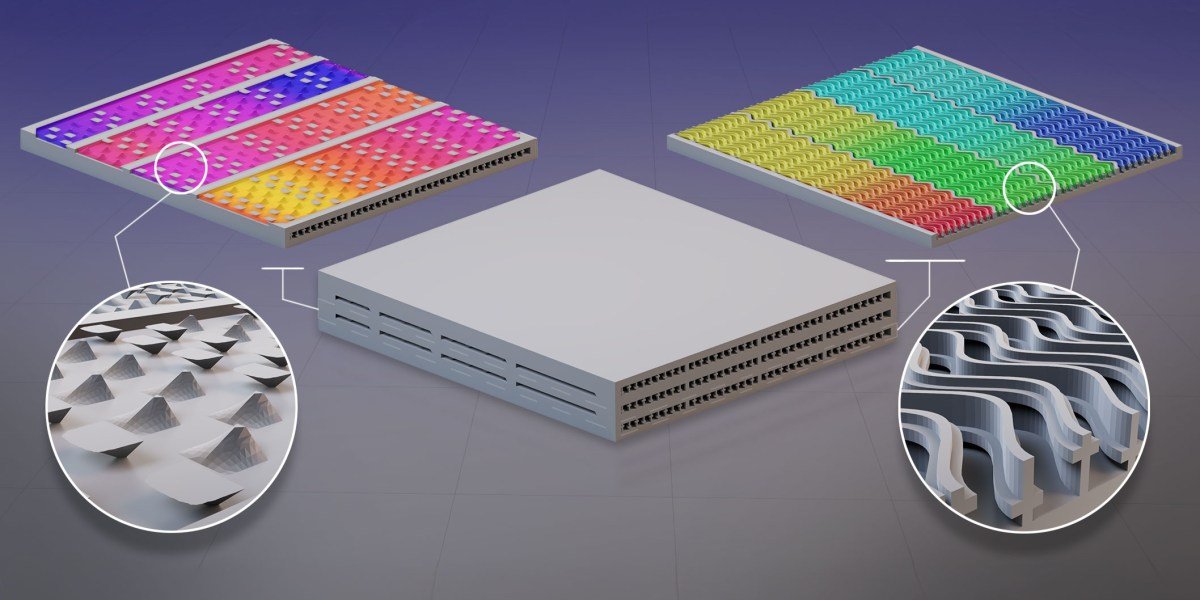
    King and his colleagues used 3D printing to design a heat exchanger that includes features to optimize heat movement, like wavy walls and pyramid-shaped bumps, which wouldn’t be possible to make using traditional manufacturing techniques.  

    The team had set out to design a system based on a common refrigerant called R-134a, which is commonly used in devices like air conditioners and refrigerators. When cold water lowers the temperature of the refrigerant, it changes from a gas to a liquid on its path through the device. That liquid refrigerant can then go on to other parts of the cooling system, where it’s used to lower the temperature of anything from a room to a rack of servers. 

    The best way to cool the refrigerant tends to involve building very thin walls between the two sides of the device and maximizing the amount of contact that the water and the refrigerant make with those walls. (Think about how much colder you’d get wearing a thin T-shirt and pants and lying down on ice than simply touching it with your gloved hands.)

    To design the best possible heat exchanger, researchers used simulations and developed machine-learning models to help predict the performance of different designs under different conditions. After 36,000 simulations, the researchers landed on the one they decided to develop.

    Among the key components: small fins that jut out on the side of the device that touches the water, increasing the surface area to maximize heat transfer. The team also designed wavy passageways for the water to pass through—once again helping to maximize surface area. Simulations helped the researchers figure out exactly how curvy the passages should be and where precisely to place the fins.

    On the side of the devices where the refrigerant passes through, the design includes small pyramid-shaped bumps along the walls. These not only maximize the area for cooling but also help mix the refrigerant as it passes through and prevent liquid from coating the wall (which would slow down the heat transfer).

    After settling on a design, the researchers used a 3D-printing technique called direct metal laser sintering, in which lasers melt and fuse together a metal powder (in this case, an aluminum alloy), layer by layer.

    In testing, the researchers found that the heat exchanger created with this technique was able to cool down the refrigerant more efficiently than other designs. The new device was able to achieve a power density of over six megawatts per meter cubed—outperforming one common traditional design, the shell-tube configuration, by between 30% and 50% with the same pumping power. The device’s power density was similar to that of brazed plate heat exchangers, another common design in industry.  

    Overall, this device doesn’t dramatically outperform the state-of-the-art technology, but the technique of using modeling and 3D printing to produce new heat exchanger designs is promising, says Dennis Nasuta, director of research and development at Optimized Thermal Systems, a consulting firm that works with companies in the HVAC industry on design and research. “It’s worth exploring, and I don’t think that we know yet where we can push it,” Nasuta says.

    One challenge is that today, additive manufacturing techniques such as laser sintering are slow and expensive compared with traditional manufacturing; they wouldn’t be economical or feasible to rely on for all our consumer cooling devices, he says. For now, this type of approach could be most useful in niche applications like aerospace and high-end automotives, which could more likely bear the cost, he adds. 

    This particular study was funded by the US Office of Naval Research. Next-generation ships have more electronics aboard than ever, and there’s a growing need for compact and efficient systems to deal with all that extra heat, says Nenad Miljkovic, one of the authors of the study. 

    Energy demand for cooling buildings alone is set to double between now and 2050, and new designs could help efficiently meet the massive demand forecast for the coming decades. But challenges including manufacturing costs would need to be overcome to help innovations like the one designed by King and his team make a dent in real devices.

    Another barrier to adopting these new techniques, Nasuta says, is that current standards don’t demand more efficiency. Other technologies already exist that could help make our devices more efficient, but they’re not used for the same reason. 

    It will take time for new manufacturing techniques, including 3D printing, to trickle into our devices, Natsua adds: “This isn’t going to be in your AC next year.”

    Share. Facebook Twitter Pinterest LinkedIn Reddit WhatsApp Telegram Email
    Previous ArticleGenetic data site openSNP to close and delete data over privacy concerns
    Next Article The Download: how to make better cooling systems, and farming on Mars
    TechAiVerse
    • Website

    Jonathan is a tech enthusiast and the mind behind Tech AI Verse. With a passion for artificial intelligence, consumer tech, and emerging innovations, he deliver clear, insightful content to keep readers informed. From cutting-edge gadgets to AI advancements and cryptocurrency trends, Jonathan breaks down complex topics to make technology accessible to all.

    Related Posts

    TSA Allows You To Add Your Passport To This Apple Wallet Alternative

    February 19, 2026

    OpenAI taps Tata for 100MW AI data center capacity in India, eyes 1GW

    February 19, 2026

    OpenAI deepens India push with Pine Labs fintech partnership

    February 19, 2026
    Leave A Reply Cancel Reply

    Top Posts

    Ping, You’ve Got Whale: AI detection system alerts ships of whales in their path

    April 22, 2025684 Views

    Lumo vs. Duck AI: Which AI is Better for Your Privacy?

    July 31, 2025272 Views

    6.7 Cummins Lifter Failure: What Years Are Affected (And Possible Fixes)

    April 14, 2025156 Views

    6 Best MagSafe Phone Grips (2025), Tested and Reviewed

    April 6, 2025117 Views
    Don't Miss
    Technology February 19, 2026

    TSA Allows You To Add Your Passport To This Apple Wallet Alternative

    TSA Allows You To Add Your Passport To This Apple Wallet Alternative Ilona Titova/Getty Images…

    OpenAI taps Tata for 100MW AI data center capacity in India, eyes 1GW

    OpenAI deepens India push with Pine Labs fintech partnership

    Etsy sells secondhand clothing marketplace Depop to eBay for $1.2B

    Stay In Touch
    • Facebook
    • Twitter
    • Pinterest
    • Instagram
    • YouTube
    • Vimeo

    Subscribe to Updates

    Get the latest creative news from SmartMag about art & design.

    About Us
    About Us

    Welcome to Tech AI Verse, your go-to destination for everything technology! We bring you the latest news, trends, and insights from the ever-evolving world of tech. Our coverage spans across global technology industry updates, artificial intelligence advancements, machine learning ethics, and automation innovations. Stay connected with us as we explore the limitless possibilities of technology!

    Facebook X (Twitter) Pinterest YouTube WhatsApp
    Our Picks

    TSA Allows You To Add Your Passport To This Apple Wallet Alternative

    February 19, 20262 Views

    OpenAI taps Tata for 100MW AI data center capacity in India, eyes 1GW

    February 19, 20262 Views

    OpenAI deepens India push with Pine Labs fintech partnership

    February 19, 20262 Views
    Most Popular

    7 Best Kids Bikes (2025): Mountain, Balance, Pedal, Coaster

    March 13, 20250 Views

    VTOMAN FlashSpeed 1500: Plenty Of Power For All Your Gear

    March 13, 20250 Views

    This new Roomba finally solves the big problem I have with robot vacuums

    March 13, 20250 Views
    © 2026 TechAiVerse. Designed by Divya Tech.
    • Home
    • About Us
    • Contact Us
    • Privacy Policy
    • Terms & Conditions

    Type above and press Enter to search. Press Esc to cancel.