

How Nissan Hopes to Navigate Trump’s Tariffs and Make Its EVs Great Again
The Nissan Leaf was once the number-one selling EV in the world. Unveiled in 2009, it hit the road in 2010, beating Tesla to market as the first mass-produced EV and topping sales charts for a decade. It was a bold move, and one that should have cemented the company as one of the world’s premier EV players. So what happened?
Some 15 years later, in the United States, the automaker has floundered. It didn’t predict the rise of hybrids, and it’s still dealing with the PR aftermath of a very public failed merger with Honda. Add in years of mismanagement and an outright neglect of its EV portfolio, and the former king of EV sales has been scrambling to find its footing. A chaotic market reeling from threats of tariffs really isn’t helping.
Still, Nissan is at least attempting to claw its way back to its former glory. It has a new CEO, upcoming EVs and a hybrid for the US market, and the self-awareness to know it needs to adapt how it does business. Nissan is ready for change. Oh, and those talks with Honda aren’t over yet.
The Heart of Nissan
“This is the heart of Nissan,” the automaker’s former chief planning officer and shiny new CEO, Ivan Espinosa, tells media gathered at the Nissan Technical Center, located just outside of Yokohama in Atsugi, Japan. Notably absent from this event is outgoing CEO Makoto Uchida. This is the introduction to Espinosa as the boss—but more importantly, the automaker wants to share its plans for the future.
We’re seated in a large design studio with a screen that fills an entire wall; executives address the crowd with a mix of renewed focus and humility. In an industry full of bravado, Nissan is refreshingly forthcoming about its issues.
Chief performance officer Guillaume Cartier begins the two-day event by expressing that the company would be an open book, and be honest about the external and internal issues that have plagued the brand in recent years. The Nissan/Honda merger fell apart largely due to the Nissan leadership’s unwillingness to concede that in the automotive world, Nissan and Honda are not equals. This time round, there’s a promise for better transparency.
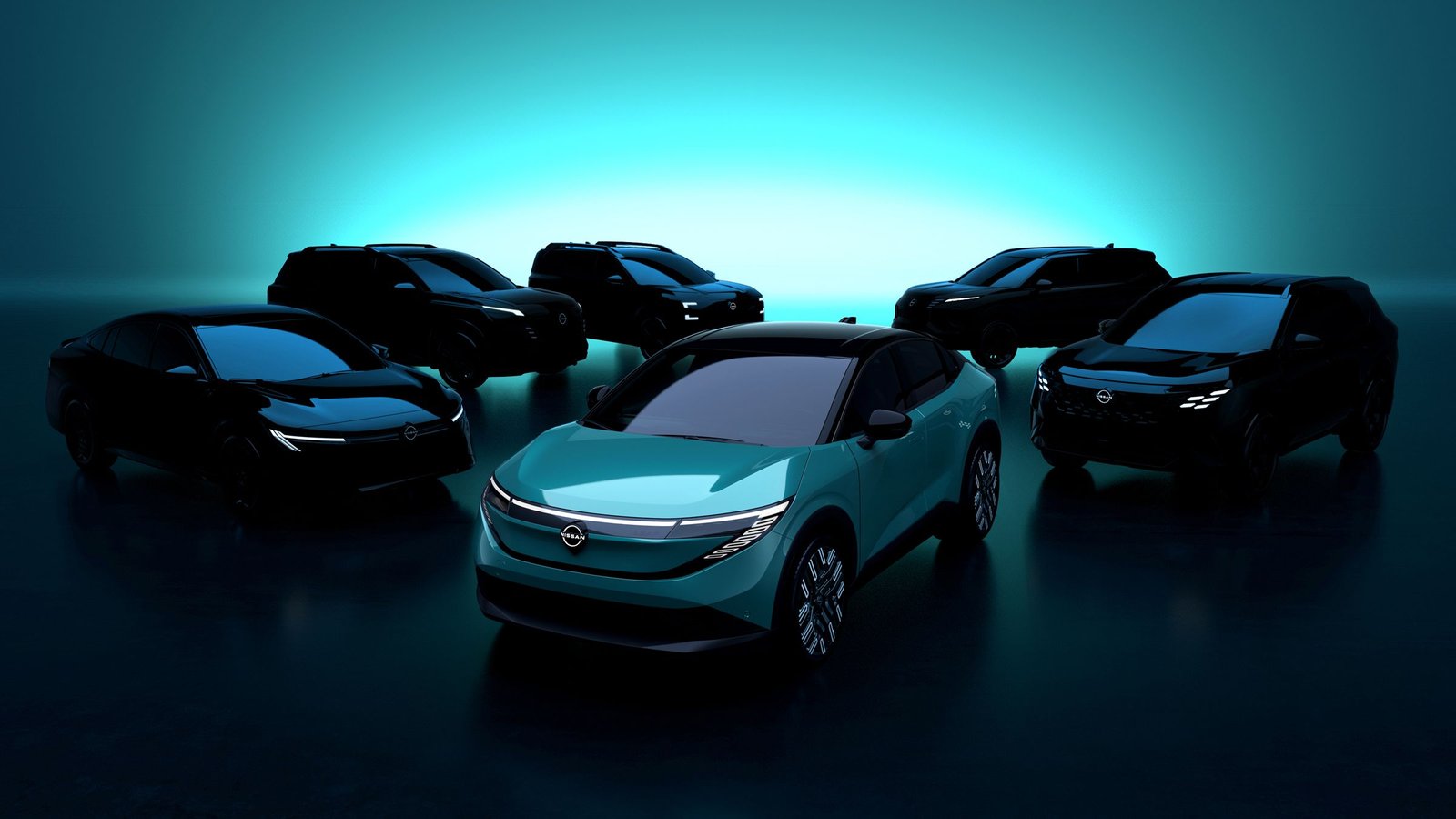
The news Nissan wants everyone to now focus on is the unveiling of the third-generation Leaf. Gone is the hatchback—the Leaf has morphed into a sporty but handsome crossover. And after all, the US market loves a crossover.
Powered by Nissan’s 400-volt CMF-EV platform, the Leaf will rest on the same architecture as the Ariya. Outside of smart design and repeated insistence that the team focused on efficiency, the automaker shared no information about range, battery capacity, or price. The vehicle will be available first in the United States and Canada beginning in 2025.
The new Nissan Leaf.
Courtesy of Nissan
For Europe, the automaker unveiled a new all-electric Micra, an urban runabout that senior vice president of global design Alfonso Albaisa refers to as “charming.” The wide eyes of the Micra have returned and are now powered by electrons instead of petroleum. It’s built on the CMF-B EV platform that also underpins the Renault 5 E-Tech. Like the Leaf, Nissan was silent on details about range, price, and battery capacity, but we do know that Europe will get both the Micra and Leaf in 2025.
The new Nissan Micra.
Courtesy of Nissan
In a move that will attempt to fix its previous huge market oversight, Nissan will begin production of an all-new hybrid Rogue in 2026, while a PHEV is also in the works. The automaker’s midsize SUV competes directly with the wildly popular Honda CR-V and Toyota Rav4, both of which have hybrid powertrain options.
The Rogue will use the third generation of Nissan’s e-Power series hybrid technology. Unlike typical hybrids, an e-Power’s wheels are only powered by the electric motor, while a specially tuned gas engine acts as a generator. The second generation of the technology is currently in use in the Nissan Qashqai, but this upcoming version combines the powerplants, gearbox, and inverter into a single 5-in-1 unit, using the same electric motor and other components found in Nissan’s EV. A clever way to lower costs.
Nissan says that this system delivers the attributes of an EV—increased lower-end torque, smoother acceleration, real-time motor-based torque vectoring (Nissan calls this e-4orce), and a quieter ride. At Nissan’s Granddrive test track in Yokosuka, Japan, I was able to test the second and upcoming third-generation e-Power system, and I found it compelling, and, in many cases, superior to traditional hybrid systems. Although the small 1.8-kWh-capacity battery pack means drivers will still have to endure the rumble of an engine on a regular basis, even if it is quieter.
After a keynote, Nissan led us into a courtyard to look at (but not photograph) a series of vehicles in various states of development. The most intriguing was a rugged electric SUV that oozed X-Terra vibes. The light-offroader will begin production in Nissan’s Canton, Mississippi, plant in 2027, deftly escaping the latest tariffs announced by President Trump.
Nissan sees the vehicle as a way to differentiate itself from competitors. “You saw an outdoorsy EV, which is not what you see today. The reason to do that is to be different, because the market will get very crowded very fast. We want to come in with an offer that is more unique,” Espinosa says.
Sometimes, however, there is good reason why a certain category of EV “is not what you see today,” and while trying to be different is certainly laudable, it is not always advisable. We’ll see soon enough if Espinosa’s strategy pans out. Regardless, this Canton-built rugged electric SUV will beat Scout’s offerings to market, and will go head-to-head with Rivian’s R2. That is, if everything goes according to plan for both automakers.
Nissan has big plans and an intriguing upcoming lineup that, on paper, seems to give it the automotive firepower to be a true competitor in the electrified vehicle market. Bringing those proposals to fruition requires leadership willing to aggressively move forward while taking a long, hard look at the current situation and making drastic changes.
New Boss, Old Lineup
There’s a tinge of frustration in Espinosa’s voice as the new Nissan CEO explains the current situation with Honda. “The fact that the integration talks stopped is in no way meaning that we are not collaborating with them,” Espinosa said.
“The future of the industry is going to be very challenging, and it’s clear that the name of the game is how you build efficient partnerships that add value to your company,” Espinosa told reporters during a roundtable event. For automakers, sharing a platform reduces both parties’ financial commitment. Parts procurement also benefits. Suppliers will always prioritize the customer who places the largest order. If a part is used in multiple vehicles across multiple brands, it’s built sooner and at a lower cost.
It’s the economies of scale in action. The issue? Nissan’s scale has dropped dramatically. In 2018, the automaker was producing 5.8 million units a year. Currently, that number has dropped to 3.5 million units. Its US factories are currently underutilized, and its lineup, while slowly undergoing a refresh over the past few years, in some cases still lags behind competitors. Recent moves to rectify the situation have come with their own issues.
The Ariya was a fine reboot of the automaker’s electric vehicle strategy, but the vehicle itself hasn’t taken off like EV offerings from other automakers. Ponz Pandikuthira, Nissan’s chief planning officer for North America tells WIRED how timing hurt the vehicle’s launch. As it was introduced, Tesla began cutting prices to ward off new competitors in the market, and suddenly, the Ariya was 20 percent more expensive than a similarly equipped Tesla.
The Ariya also isn’t eligible for the $7,500 EV tax credit unless the vehicle is leased. Then, add in manufacturing delays of eight to ten months, and the result is a vehicle hitting the market after any hype that had been generated died down.
Pandikuthira also explains the reason behind Nissan’s lack of a hybrid in the coveted midsize SUV segment. With the vehicle price increases during the Covid lockdowns, Nissan (and other automakers) believed that this was the new normal. A rise in overall vehicle value would make EVs seem more affordable at the price points an automaker would need to sell an electric vehicle at to make a profit.
Like many manufacturers, Nissan had bold plans to introduce a fleet of EVs, and at the time, to add a hybrid to its lineup would mean making one less EV. So the automaker gambled on an inflated marketplace. Suddenly, the prices of vehicles came back down to earth, and Nissan’s future lineup wouldn’t generate much-needed profits. It’s tough to be nimble without capital.
According to Espinosa, Nissan has 1 trillion yen ($6.65 billion) in cash. The issue is that the company has $1.5 billion in debt due this year, and $5.6 billion in debt due in 2026. “We’re not in the situation in which we have an urgent need for cash,” Espinosa said. “What we have to work on is the free cash-flow generation, which is different. So we have to accelerate revenue generation. We have to get our sales pace in better shape, and we need to work on cost.”
A big part of that is its work to reduce development time from 55 months to 37 months. Then 30 months on each vehicle iteration based on the platform. “We need to show what we’re capable of doing,” the new CEO says.
Tariff Chaos
At the multiday event in Japan, Auto Pacific president and chief analyst Ed Kim tells WIRED, “One of the big takeaways I got from all this was that I don’t think even Nissan knows how they’re going to get there.” However, Nissan’s willingness to partner with others, the introduction of a hybrid to compete with the Rav4 and CR-V, and its upcoming lineup are all good moves, Kim says. “Oftentimes, when an automaker has their backs against the wall, sometimes they pull out some of their best design work,” he adds.
But all of this meticulous planning and good intention could quickly be derailed by the chaotic financial situation in the US market. Nissan needs to win big in the United States, and the Trump administration’s tariff chaos isn’t helping.
“We are working on multiple scenarios to be ready when some clarity comes. It’s changing every other day,” Espinosa tells WIRED. Of course, Espinosa said this mere hours before Trump announced the 25 percent tariff on all imported vehicles and parts, and an even more recent 24 percent reciprocal tariff on other goods from Japan. Whether Nissan was planning for that kind of clarity is unclear.
WIRED reached out to Nissan for an update. The automaker wouldn’t comment directly, but pointed us to a comment from Jennifer Safavian, president and CEO of Autos Drive America, a trade association that represents international automakers. “At a time when cost is the number one concern for American car buyers, US automakers are working to provide a range of affordable vehicles for consumers,” she says. “The tariffs will make it more expensive to produce and sell cars in the United States, ultimately leading to higher prices, fewer options for consumers, and fewer manufacturing jobs in the US.”
Sam Abuelsamid, automotive analyst and vice president of market research for Telemetry, believes these costs could hit Nissan hardest. “Of the three largest Japanese automakers operating in the US, Nissan will likely face some of the biggest challenges with the tariffs,” he says. “They only have two plants in the US and import a significant percentage of their products from either Mexico or Japan.”
Like many automakers, Nissan may spread the cost of the tariffs across its entire lineup of vehicles to keep the vehicles that are imported to the US from being prohibitively expensive—although each vehicle will soon undoubtedly cost more.
For Espinosa, in the face of such economic turmoil, the inconvenient truth is that Nissan could do everything right and still struggle because of forces beyond its control. “From a product perspective, they’re definitely headed in the right direction. But the big question mark is really on the business side,” Kim says. Indeed, it’s the big question for every automaker right now. Except, for Nissan, the results could be catastrophic.
