

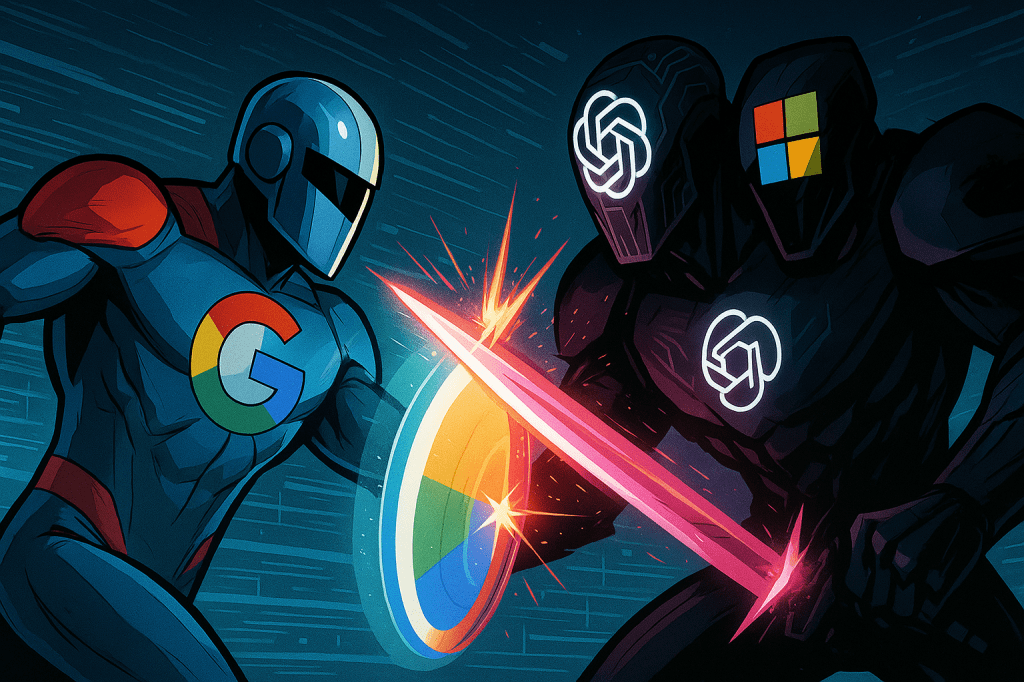
The new AI calculus: Google’s 80% cost edge vs. OpenAI’s ecosystem
Image Credit: VentureBeat via ChatGPT
Join our daily and weekly newsletters for the latest updates and exclusive content on industry-leading AI coverage. Learn More
The relentless pace of generative AI innovation shows no signs of slowing. In just the past couple of weeks, OpenAI dropped its powerful o3 and o4-mini reasoning models alongside the GPT-4.1 series, while Google countered with Gemini 2.5 Flash, rapidly iterating on its flagship Gemini 2.5 Pro released shortly before. For enterprise technical leaders navigating this dizzying landscape, choosing the right AI platform requires looking far beyond rapidly shifting model benchmarks
While model-versus-model benchmarks grab headlines, the decision for technical leaders goes far deeper. Choosing an AI platform is a commitment to an ecosystem, impacting everything from core compute costs and agent development strategy to model reliability and enterprise integration.
But perhaps the most stark differentiator, bubbling beneath the surface but with profound long-term implications, lies in the economics of the hardware powering these AI giants. Google wields a massive cost advantage thanks to its custom silicon, potentially running its AI workloads at a fraction of the cost OpenAI incurs relying on Nvidia’s market-dominant (and high-margin) GPUs.
This analysis delves beyond the benchmarks to compare the Google and OpenAI/Microsoft AI ecosystems across the critical factors enterprises must consider today: the significant disparity in compute economics, diverging strategies for building AI agents, the crucial trade-offs in model capabilities and reliability and the realities of enterprise fit and distribution. The analysis builds upon an in-depth video discussion exploring these systemic shifts between myself and AI developer Sam Witteveen earlier this week.
1. Compute economics: Google’s TPU “secret weapon” vs. OpenAI’s Nvidia tax
The most significant, yet often under-discussed, advantage Google holds is its “secret weapon:” its decade-long investment in custom Tensor Processing Units (TPUs). OpenAI and the broader market rely heavily on Nvidia’s powerful but expensive GPUs (like the H100 and A100). Google, on the other hand, designs and deploys its own TPUs, like the recently unveiled Ironwood generation, for its core AI workloads. This includes training and serving Gemini models.
Why does this matter? It makes a huge cost difference.
Nvidia GPUs command staggering gross margins, estimated by analysts to be in the 80% range for data center chips like the H100 and upcoming B100 GPUs. This means OpenAI (via Microsoft Azure) pays a hefty premium — the “Nvidia tax” — for its compute power. Google, by manufacturing TPUs in-house, effectively bypasses this markup.
While manufacturing GPUs might cost Nvidia $3,000-$5,000, hyperscalers like Microsoft (supplying OpenAI) pay $20,000-$35,000+ per unit in volume, according to reports. Industry conversations and analysis suggest that Google may be obtaining its AI compute power at roughly 20% of the cost incurred by those purchasing high-end Nvidia GPUs. While the exact numbers are internal, the implication is a 4x-6x cost efficiency advantage per unit of compute for Google at the hardware level.
This structural advantage is reflected in API pricing. Comparing the flagship models, OpenAI’s o3 is roughly 8 times more expensive for input tokens and 4 times more expensive for output tokens than Google’s Gemini 2.5 Pro (for standard context lengths).
This cost differential isn’t academic; it has profound strategic implications. Google can likely sustain lower prices and offer better “intelligence per dollar,” giving enterprises more predictable long-term Total Cost of Ownership (TCO) – and that’s exactly what it is doing right now in practice.
OpenAI’s costs, meanwhile, are intrinsically tied to Nvidia’s pricing power and the terms of its Azure deal. Indeed, compute costs represent an estimated 55-60% of OpenAI’s total $9B operating expenses in 2024, according to some reports, and are projected to exceed 80% in 2025 as they scale. While OpenAI’s projected revenue growth is astronomical – potentially hitting $125 billion by 2029 according to reported internal forecasts – managing this compute spend remains a critical challenge, driving their pursuit of custom silicon.
2. Agent frameworks: Google’s open ecosystem approach vs. OpenAI’s integrated one
Beyond hardware, the two giants are pursuing divergent strategies for building and deploying the AI agents poised to automate enterprise workflows.
Google is making a clear push for interoperability and a more open ecosystem. At Cloud Next two weeks ago, it unveiled the Agent-to-Agent (A2A) protocol, designed to allow agents built on different platforms to communicate, alongside its Agent Development Kit (ADK) and the Agentspace hub for discovering and managing agents. While A2A adoption faces hurdles — key players like Anthropic haven’t signed on (VentureBeat reached out to Anthropic about this, but Anthropic declined to comment) — and some developers debate its necessity alongside Anthropic’s existing Model Context Protocol (MCP). Google’s intent is clear: to foster a multi-vendor agent marketplace, potentially hosted within its Agent Garden or via a rumored Agent App Store.
OpenAI, conversely, appears focused on creating powerful, tool-using agents tightly integrated within its own stack. The new o3 model exemplifies this, capable of making hundreds of tool calls within a single reasoning chain. Developers leverage the Responses API and Agents SDK, along with tools like the new Codex CLI, to build sophisticated agents that operate within the OpenAI/Azure trust boundary. While frameworks like Microsoft’s Autogen offer some flexibility, OpenAI’s core strategy seems less about cross-platform communication and more about maximizing agent capabilities vertically within its controlled environment.
- The enterprise takeaway: Companies prioritizing flexibility and the ability to mix-and-match agents from various vendors (e.g., plugging a Salesforce agent into Vertex AI) may find Google’s open approach appealing. Those deeply invested in the Azure/Microsoft ecosystem or preferring a more vertically managed, high-performance agent stack might lean towards OpenAI.
3. Model capabilities: parity, performance, and pain points
The relentless release cycle means model leadership is fleeting. While OpenAI’s o3 currently edges out Gemini 2.5 Pro on some coding benchmarks like SWE-Bench Verified and Aider, Gemini 2.5 Pro matches or leads on others like GPQA and AIME. Gemini 2.5 Pro is also the overall leader on the large language model (LLM) Arena Leaderboard. For many enterprise use cases, however, the models have reached rough parity in core capabilities.
The real difference lies in their distinct trade-offs:
- Context vs. Reasoning Depth: Gemini 2.5 Pro boasts a massive 1-million-token context window (with 2M planned), ideal for processing large codebases or document sets. OpenAI’s o3 offers a 200k window but emphasizes deep, tool-assisted reasoning within a single turn, enabled by its reinforcement learning approach.
- Reliability vs. Risk: This is emerging as a critical differentiator. While o3 showcases impressive reasoning, OpenAI’s own model card for 03 revealed it hallucinates significantly more (2x the rate of o1 on PersonQA). Some analyses suggest this might stem from its complex reasoning and tool-use mechanisms. Gemini 2.5 Pro, while perhaps sometimes perceived as less innovative in its output structure, is often described by users as more reliable and predictable for enterprise tasks. Enterprises must weigh o3’s cutting-edge capabilities against this documented increase in hallucination risk.
- The enterprise takeaway: The “best” model depends on the task. For analyzing vast amounts of context or prioritizing predictable outputs, Gemini 2.5 Pro holds an edge. For tasks demanding the deepest multi-tool reasoning, where hallucination risk can be carefully managed, o3 is a powerful contender. As Sam Witteveen noted in our in-depth podcast about this, rigorous testing within specific enterprise use cases is essential.
4. Enterprise fit & distribution: integration depth vs. market reach
Ultimately, adoption often hinges on how easily a platform slots into an enterprise’s existing infrastructure and workflows.
Google’s strength lies in deep integration for existing Google Cloud and Workspace customers. Gemini models, Vertex AI, Agentspace and tools like BigQuery are designed to work seamlessly together, offering a unified control plane, data governance, and potentially faster time-to-value for companies already invested in Google’s ecosystem. Google is actively courting large enterprises, showcasing deployments with firms like Wendy’s, Wayfair, and Wells Fargo.
OpenAI, via Microsoft, boasts unparalleled market reach and accessibility. ChatGPT’s enormous user base (~800M MAU) creates broad familiarity. More importantly, Microsoft is aggressively embedding OpenAI models (including the latest o-series) into its ubiquitous Microsoft 365 Copilot and Azure services, making powerful AI capabilities readily available to potentially hundreds of millions of enterprise users, often within the tools they already use daily. For organizations that are already standardized on Azure and Microsoft 365, adopting OpenAI can be a more natural extension. Furthermore, the extensive use of OpenAI APIs by developers means many enterprise prompts and workflows are already optimized for OpenAI models.
- The strategic decision: The choice often boils down to existing vendor relationships. Google offers a compelling, integrated story for its current customers. OpenAI, powered by Microsoft’s distribution engine, offers broad accessibility and potentially easier adoption for the vast number of Microsoft-centric enterprises.
Google vs OpenAI/Microsoft has tradeoffs for enterprises
The generative AI platform war between Google and OpenAI/Microsoft has moved far beyond simple model comparisons. While both offer state-of-the-art capabilities, they represent different strategic bets and present distinct advantages and trade-offs for the enterprise.
Enterprises must weigh differing approaches to agent frameworks, the nuanced trade-offs between model capabilities like context length versus cutting-edge reasoning and the practicalities of enterprise integration and distribution reach.
However, looming over all these factors is the stark reality of compute cost, which emerges as perhaps the most critical and defining long-term differentiator, especially if OpenAI doesn’t manage to address it quickly. Google’s vertically integrated TPU strategy, allowing it to potentially bypass the ~80% “Nvidia Tax” embedded in GPU pricing that burdens OpenAI, represents a fundamental economic advantage, potentially a game-changing one.
This is more than a minor price difference; it impacts everything from API affordability and long-term TCO predictability to the sheer scalability of AI deployments. As AI workloads grow exponentially, the platform with the more sustainable economic engine — fueled by hardware cost efficiency — holds a powerful strategic edge. Google is leveraging this advantage while also pushing an open vision for agent interoperability.
OpenAI, backed by Microsoft’s scale, counters with deeply integrated tool-using models and an unparalleled market reach, although questions remain about its cost structure and model reliability.
To make the right choice, enterprise technical leaders must look past the benchmarks and evaluate these ecosystems based on their long-term TCO implications, their preferred approach to agent strategy and openness, their tolerance for model reliability risks versus raw reasoning power, their existing technology stack and their specific application needs.
Watch the video where Sam Witteveen and I break things down:
Daily insights on business use cases with VB Daily
If you want to impress your boss, VB Daily has you covered. We give you the inside scoop on what companies are doing with generative AI, from regulatory shifts to practical deployments, so you can share insights for maximum ROI.
Read our Privacy Policy
Thanks for subscribing. Check out more VB newsletters here.
An error occured.
