

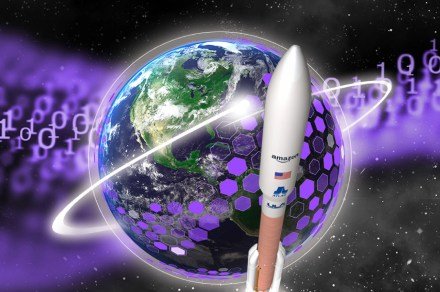
Amazon ready for debut Project Kuiper launch, but one thing could get in the way (again)
Atlas V Flight Path: Lifting Project Kuiper from Earth to LEO
Amazon is champing at the bit to get its first Project Kuiper satellites into orbit so that it can start building a service that will one day rival SpaceX’s Starlink, which offers broadband connectivity to more than five million customers globally.
The web giant is planning to launch 27 Project Kuiper internet satellites on a United Launch Alliance (ULA) Atlas V rocket from Cape Canaveral in Florida on Monday evening.
The first Project Kuiper satellites were supposed to head to orbit on April 9, but unstable weather conditions forced the mission team to halt the countdown clock shortly before launch.
And the weather could disrupt Monday’s mission, too.
The latest forecast from the mission’s weather team indicates a 75% chance of acceptable conditions for launch.
While the weather has been pretty good over the weekend, scattered showers and isolated thunderstorms are expected to hit central Florida on Monday.
“The window could see coastal shower activity from onshore flow and afternoon/early evening thunderstorm activity, primarily inland and over west Florida, from interactions with the sea breeze,” the weather team said, adding: “Thunderstorm development may also occur over the gulf stream. Although the steering flow appears likely to keep most thunderstorm activity away from [Cape Canaveral], anvil clouds could be an issue.”
If the weather is deemed too bad for launch, there is a backup opportunity on Tuesday, with forecasters suggesting a 90% chance of liftoff on that day.
“For the backup day, high pressure with drier air is expected to return to the Space Coast,” the weather team said.
ULA has shared a visibility map (below) showing how folks on the East Coast will be able to see the Atlas V blasting to orbit — clear skies permitting, of course.
Wondering how you can see the #AtlasV launch of the #Kuiper1 mission for #Amazon? This visibility map shows when and where your best chances are to see the rocket as it lifts off on Monday at 7 p.m. EDT and heads northeasterly into space.
Live updates and webcast:… pic.twitter.com/Yk6KoJmsFw
— ULA (@ulalaunch) April 27, 2025
Over the next four years, Amazon plans to deploy just over 3,000 Project Kuiper internet satellites into low-Earth orbit to provide fast, reliable internet for customers around the world, particularly those in unserved and underserved communities.
To expedite the deployment, Amazon will not only use ULA’s Atlas V rocket, but also its newer Vulcan vehicle, which can carry up to 45 Amazon satellites in one flight. Blue Origin’s New Glenn rocket will also perform Project Kuiper satellite deployments.
Interested in watching Amazon get its first Project Kuiper satellites into orbit? Digital Trends has all you need to know.
Not so many moons ago, Trevor moved from one tea-loving island nation that drives on the left (Britain) to another (Japan)…
Could this exoplanet be ‘teeming with life’? Hints of life outside solar system
In a striking new finding, astronomers have uncovered what they say is the strongest evidence yet of life existing beyond our solar system. Using the James Webb Space Telescope, researchers from the University of Cambridge, UK have detected a compound on planet K2-18b that is produced by microbial life.
The research shows that planet K2-18b is most likely a type called a Hycean planet, which is located within the habitable zone of its star and is covered in a liquid water ocean. This type of planet is thought to be a good place to look for life, as it has plentiful water and a hydrogen atmosphere.
An expert’s advice on how to see the Lyrid meteor shower this weekend
The next week will be a fun one for skywatchers, as the Lyrid meteor shower will be visible over the weekend and peak on Monday night. If you’re hoping to catch sight of this charming cosmic event, then Robert Massey, Deputy Executive Director of the Royal Astronomical Society, has shared tips on how to get the best view from wherever you live.
The Lyrids will be visible from 17 to 26 April, and will peak on the evening of 21 to 22 April. You won’t see long, bright streaks like you do with other meteor showers, but you might see brief flashes called fireballs.
Amazon reveals new date for debut Project Kuiper launch
Amazon’s inaugural launch of its Project Kuiper internet satellites on April 9 turned out to be nothing of the sort when poor weather conditions prompted the mission team to postpone liftoff.
Up until Thursday, we’d heard nothing from Amazon and United Launch Alliance (ULA) — the operator of the Atlas V rocket carrying the satellites to orbit — about a new target launch date. But on Friday, they finally revealed a schedule.
