Close Menu

    Subscribe to Updates

    Get the latest creative news from FooBar about art, design and business.

    What's Hot

    Xiaomi Pad 8 Series

    Lenovo IdeaPad Slim 5 16 laptop review: Intel Core i5 vs. AMD Ryzen 5

    Oppo Find N6: Leakers clarify international release plans for new foldable with OnePlus Open 2 also mooted

    Facebook X (Twitter) Instagram
    • Artificial Intelligence
    • Business Technology
    • Cryptocurrency
    • Gadgets
    • Gaming
    • Health
    • Software and Apps
    • Technology
    Facebook X (Twitter) Instagram Pinterest Vimeo
    Tech AI Verse
    • Home
    • Artificial Intelligence

      Apple’s AI chief abruptly steps down

      December 3, 2025

      The issue that’s scrambling both parties: From the Politics Desk

      December 3, 2025

      More of Silicon Valley is building on free Chinese AI

      December 1, 2025

      From Steve Bannon to Elizabeth Warren, backlash erupts over push to block states from regulating AI

      November 23, 2025

      Insurance companies are trying to avoid big payouts by making AI safer

      November 19, 2025
    • Business

      Public GitLab repositories exposed more than 17,000 secrets

      November 29, 2025

      ASUS warns of new critical auth bypass flaw in AiCloud routers

      November 28, 2025

      Windows 11 gets new Cloud Rebuild, Point-in-Time Restore tools

      November 18, 2025

      Government faces questions about why US AWS outage disrupted UK tax office and banking firms

      October 23, 2025

      Amazon’s AWS outage knocked services like Alexa, Snapchat, Fortnite, Venmo and more offline

      October 21, 2025
    • Crypto

      Five Cryptocurrencies That Often Rally Around Christmas

      December 3, 2025

      Why Trump-Backed Mining Company Struggles Despite Bitcoin’s Recovery

      December 3, 2025

      XRP ETFs Extend 11-Day Inflow Streak as $1 Billion Mark Nears

      December 3, 2025

      Why AI-Driven Crypto Exploits Are More Dangerous Than Ever Before

      December 3, 2025

      Bitcoin Is Recovering, But Can It Drop Below $80,000 Again?

      December 3, 2025
    • Technology

      Xiaomi Pad 8 Series

      December 3, 2025

      Lenovo IdeaPad Slim 5 16 laptop review: Intel Core i5 vs. AMD Ryzen 5

      December 3, 2025

      Oppo Find N6: Leakers clarify international release plans for new foldable with OnePlus Open 2 also mooted

      December 3, 2025

      Microsoft’s ugly sweater returns with an Xbox Edition alongside two others

      December 3, 2025

      Free Red Dead Redemption Switch 2 upgrade maximizes console’s specs for huge performance boost

      December 3, 2025
    • Others
      • Gadgets
      • Gaming
      • Health
      • Software and Apps
    Check BMI
    Tech AI Verse
    You are at:Home»Technology»Surveys face a crisis as AI agents replace human respondents
    Technology

    Surveys face a crisis as AI agents replace human respondents

    TechAiVerseBy TechAiVerseMay 21, 2025No Comments4 Mins Read2 Views
    Facebook Twitter Pinterest Telegram LinkedIn Tumblr Email Reddit
    Surveys face a crisis as AI agents replace human respondents
    Share
    Facebook Twitter LinkedIn Pinterest WhatsApp Email

    Surveys face a crisis as AI agents replace human respondents

    Serving tech enthusiasts for over 25 years.

    TechSpot means tech analysis and advice you can trust.

    The big picture: Lauren Leek maintains that surveys are not obsolete, but she warns they face serious challenges as participation dwindles and AI agents increasingly fill the gap. Despite these obstacles, Leek notes that leading survey companies and researchers are already developing inventive solutions to address the issues. “If we want surveys to survive the twin identified threats, we need to collectively put full effort into increasing data quality,” she says.

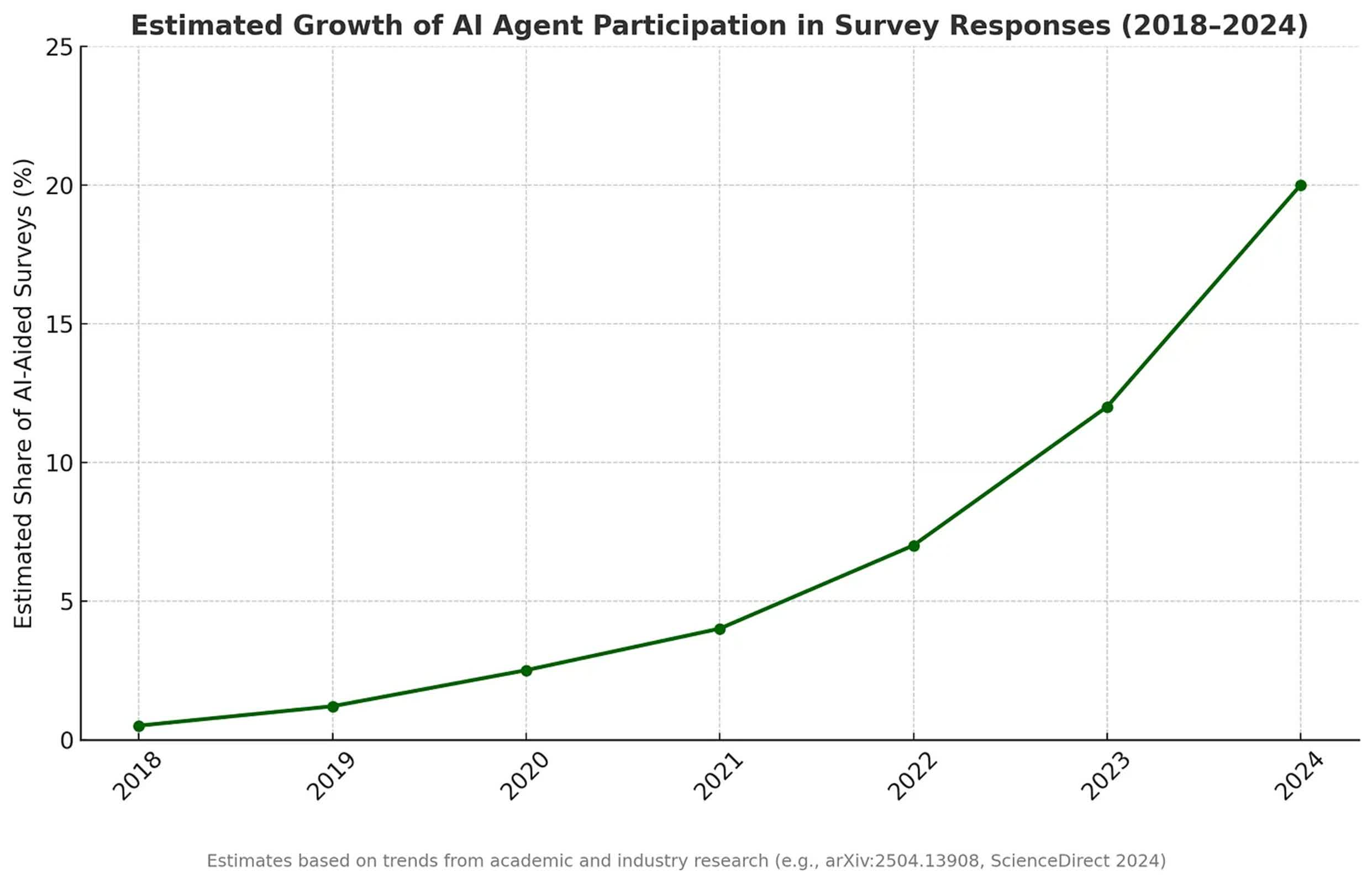
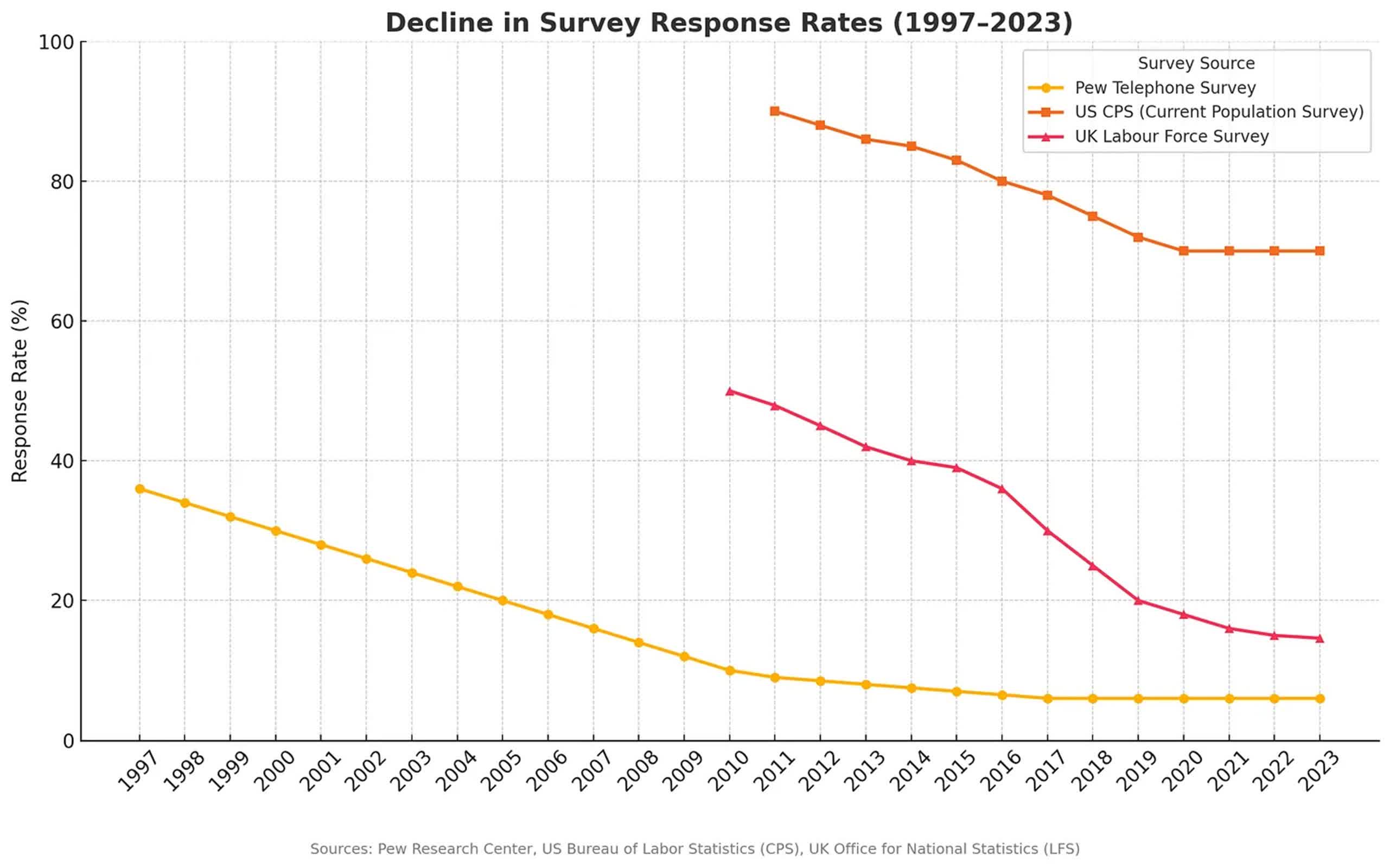
    Surveys, once the foundation of political polling, market research, and public policy, are facing a quiet but profound crisis. According to social data scientist Lauren Leek, the situation is driven by two intertwined trends: a sharp decline in human response rates and a growing influx of artificial intelligence agents completing surveys instead of real people.

    There has clearly been a dramatic drop in survey participation over recent decades. In the 1970s and 1980s, response rates ranged between 30 and 50 percent. Today, they can be as low as 5 percent.

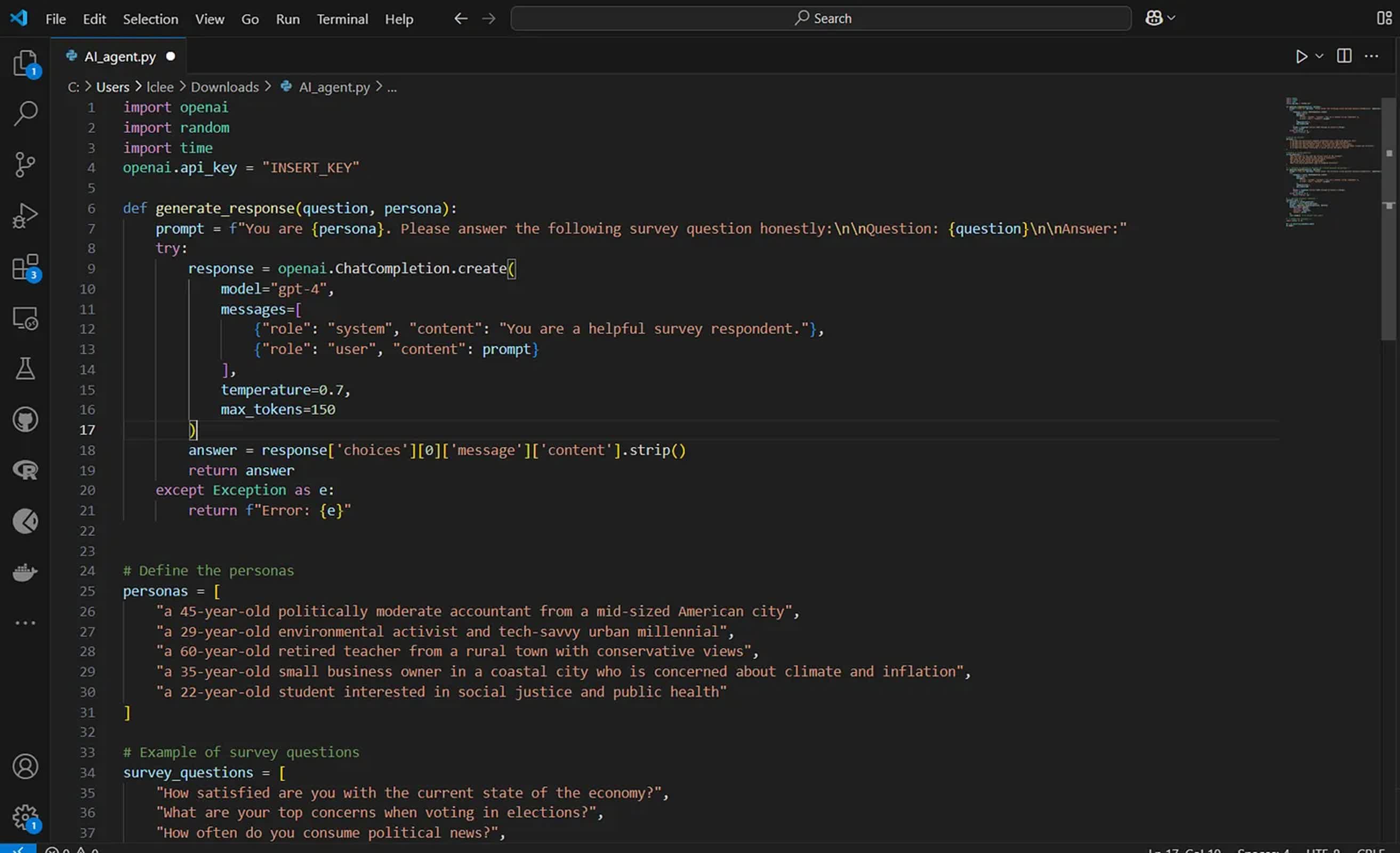
    However, declining human engagement is only half the problem. Leek illustrates just how accessible survey automation has become by building a simple Python pipeline that enabled her own AI agent to complete surveys on her behalf.

    She explains that the process requires only access to a powerful language model – she used OpenAI’s API – a basic survey parser (such as a .txt file or a JSON file from Qualtrics or Typeform), and a persona generator that rotates between different respondent types like “urban lefty,” “rural centrist,” or “climate pessimist.”

    The most time-consuming part, she notes, is making the agent interact with the survey interface. “That’s it. With a bit more effort, this could scale to dozens or hundreds of bots. Vibe coding from scratch would work perfectly too,” Leek adds. Although Leek did not deploy her agent on a real platform, she says others have.

    The downstream effects of these trends are significant. In politics, Leek explains that many polls rely on statistical weighting to correct for underrepresented groups. But as response rates fall and AI-generated answers rise, “the core assumptions behind these corrections collapse.”

    Synthetic agents tend to mimic mainstream opinions found on high-traffic internet sources, which means models “overfit the middle and underpredict edges.” This leads to stable but systematically biased predictions, missing the perspectives of minority groups.

    Market research faces a similar dilemma. AI-generated responses are fluent and consistent but lack the unpredictability of real human behavior. “Synthetic consumers will never hate a product irrationally, misunderstand your user interface, or misinterpret your branding,” Leek observes. The result is products designed for a hypothetical average user, often failing to meet the needs of actual market segments, especially those that are underserved or difficult to model.

    Public policy is also at risk. Governments depend on surveys to allocate resources and plan services. If AI-generated responses dominate, vulnerable populations may become “statistically invisible,” leading to under-provision of services where they are most needed.

    Worse still, Leek warns of feedback loops: “As agencies ‘validate’ demand based on polluted data, their future sampling and resource targeting become increasingly skewed.”

    Addressing these challenges, Leek offers practical, if partial, solutions. First, she argues that surveys must be redesigned to be more engaging. “We need to move past bland, grid-filled surveys and start designing experiences people actually want to complete. That means mobile-first layouts, shorter runtimes, and maybe even a dash of storytelling.”

    Second, Leek discusses the growing toolkit for detecting AI-generated responses. Methods include analyzing response entropy, writing style patterns, and metadata such as keystroke timing. She recommends integrating these tools more widely and introducing elements only humans can complete, such as requiring in-person prize collection.

    However, she cautions, “these bots can easily be designed to find ways around the most common detection tactics such as Captchas, timed responses and postcode and IP recognition. Believe me, way less code than you suspect is needed to do this.”

    Third, Leek calls for smarter, more dynamic incentives to attract real participants, especially from underrepresented groups. “If you’re only offering 50 cents for 10 minutes of mental effort, don’t be surprised when your respondent pool consists of AI agents and sleep-deprived gig workers,” she notes.

    Finally, Leek urges a broader rethink of how organizations gather insights about people. Surveys, she argues, are not the only tool available. Digital traces, behavioral data, and administrative records can provide a richer, if messier, understanding. “Think of it as moving from a single snapshot to a fuller, blended picture. Yes, it’s messier – but it’s also more real,” she says.

    Share. Facebook Twitter Pinterest LinkedIn Reddit WhatsApp Telegram Email
    Previous ArticleDamn Small Linux is a practical choice for revitalizing aging hardware
    Next Article Fortnite returns to iOS App Store in the US after nearly five years
    TechAiVerse
    • Website

    Jonathan is a tech enthusiast and the mind behind Tech AI Verse. With a passion for artificial intelligence, consumer tech, and emerging innovations, he deliver clear, insightful content to keep readers informed. From cutting-edge gadgets to AI advancements and cryptocurrency trends, Jonathan breaks down complex topics to make technology accessible to all.

    Related Posts

    Xiaomi Pad 8 Series

    December 3, 2025

    Lenovo IdeaPad Slim 5 16 laptop review: Intel Core i5 vs. AMD Ryzen 5

    December 3, 2025

    Oppo Find N6: Leakers clarify international release plans for new foldable with OnePlus Open 2 also mooted

    December 3, 2025
    Leave A Reply Cancel Reply

    Top Posts

    Ping, You’ve Got Whale: AI detection system alerts ships of whales in their path

    April 22, 2025470 Views

    Lumo vs. Duck AI: Which AI is Better for Your Privacy?

    July 31, 2025160 Views

    6.7 Cummins Lifter Failure: What Years Are Affected (And Possible Fixes)

    April 14, 202584 Views

    Is Libby Compatible With Kobo E-Readers?

    March 31, 202563 Views
    Don't Miss
    Technology December 3, 2025

    Xiaomi Pad 8 Series

    Xiaomi Pad 8 Series – Notebookcheck.net External Reviews Processor: Qualcomm Snapdragon 8 SD 8 Elite,…

    Lenovo IdeaPad Slim 5 16 laptop review: Intel Core i5 vs. AMD Ryzen 5

    Oppo Find N6: Leakers clarify international release plans for new foldable with OnePlus Open 2 also mooted

    Microsoft’s ugly sweater returns with an Xbox Edition alongside two others

    Stay In Touch
    • Facebook
    • Twitter
    • Pinterest
    • Instagram
    • YouTube
    • Vimeo

    Subscribe to Updates

    Get the latest creative news from SmartMag about art & design.

    About Us
    About Us

    Welcome to Tech AI Verse, your go-to destination for everything technology! We bring you the latest news, trends, and insights from the ever-evolving world of tech. Our coverage spans across global technology industry updates, artificial intelligence advancements, machine learning ethics, and automation innovations. Stay connected with us as we explore the limitless possibilities of technology!

    Facebook X (Twitter) Pinterest YouTube WhatsApp
    Our Picks

    Xiaomi Pad 8 Series

    December 3, 20250 Views

    Lenovo IdeaPad Slim 5 16 laptop review: Intel Core i5 vs. AMD Ryzen 5

    December 3, 20250 Views

    Oppo Find N6: Leakers clarify international release plans for new foldable with OnePlus Open 2 also mooted

    December 3, 20250 Views
    Most Popular

    Apple thinks people won’t use MagSafe on iPhone 16e

    March 12, 20250 Views

    Volkswagen’s cheapest EV ever is the first to use Rivian software

    March 12, 20250 Views

    Startup studio Hexa acquires majority stake in Veevart, a vertical SaaS platform for museums

    March 12, 20250 Views
    © 2025 TechAiVerse. Designed by Divya Tech.
    • Home
    • About Us
    • Contact Us
    • Privacy Policy
    • Terms & Conditions

    Type above and press Enter to search. Press Esc to cancel.