

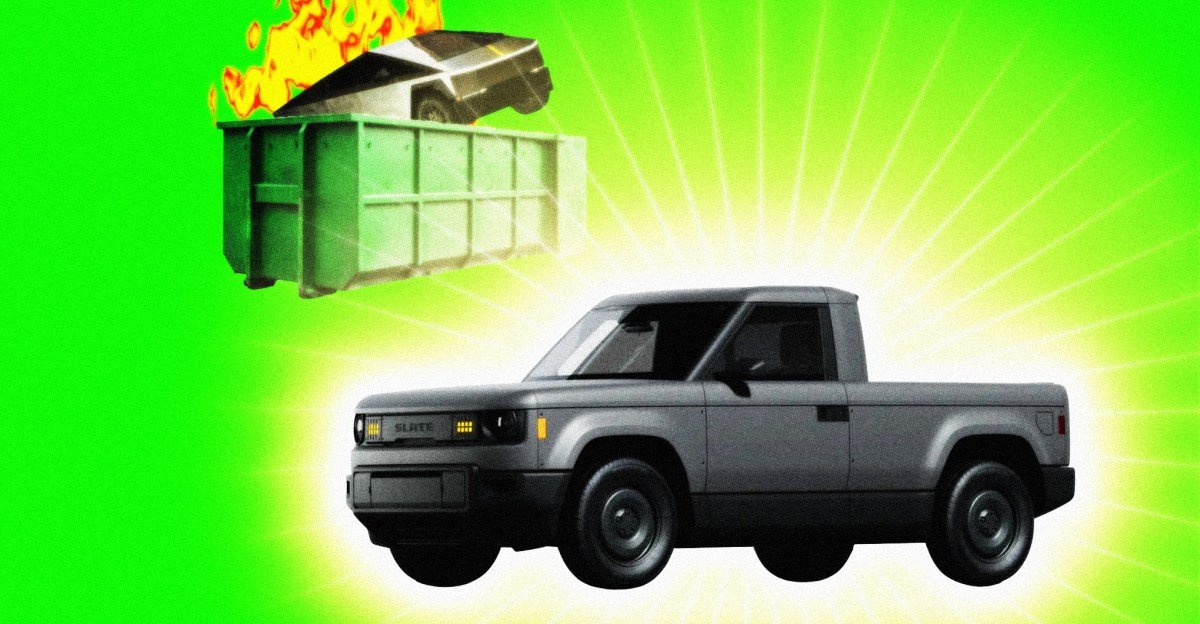
What if Tesla made a Slate-like EV instead of the Cybertruck?
At last month’s rapturously received Slate debut, it took an executive’s quip that “Slate” and “Tesla” use the same five letters to shift my brain into high gear. I’ve covered the EV world for 15-plus years, and I virtually never spend time on counterfactuals. There’s quite enough to cover in the real world.
But … I’m of the opinion Tesla could, and should, have launched a small, simple, cheap compact pickup truck—in other words, what Slate debuted—rather than the pickup it did produce, the Cybertruck. That expensive and polarizing vehicle has been, to put it bluntly, a sales disaster. Over 18 months, Tesla has sold only about 50,000, versus projections of many times that volume. Worse, while EV crossover utilities sell tens of thousands a month, the more expensive EV pickup trucks to date have not.
The path not taken
The company that led the world in EV production for more than a decade could have launched an inexpensive small pickup that would have democratized EVs to a whole new class of buyers. Tesla likely could have offered more range at the same price due to its in-house battery cell production. And it would have been a global product, likely to be sold in Europe and China from launch.
Most important, it would have given Tesla the $25,000 EV that CEO Elon Musk had promised since 2020—and simultaneously pioneered a new vehicle in a “white space” in the market where no other entry existed. Now, Tesla is no longer targeting a $25,000 EV: Musk abruptly said in October 2024 the company had walked away from the ”$25,000 Tesla” idea entirely. He went on to suggest the idea of selling any $25,000 Tesla that wasn’t a robotaxi was both “pointless” and “silly.”
Why exactly should Tesla have done a Slate? I see four factors: first and foremost, the hugely appealing idea of a truly affordable EV. Tesla could well have made a small, cheap EV pickup a huge hit, given its existing assembly plants, lower-cost batteries, plus the chance to sell globally right out of the box.
A “$25,000 EV” to catapult Tesla into the major leagues
The excitement over an unexpected product from an unknown maker likely reflects intense market desire for truly affordable EVs. That was historically what Tesla intended to do, over time: grow its volume by producing higher numbers of less costly EVs via economies of scale.
In 2024, Tesla delivered roughly 1.789 million cars globally—20,000 fewer than its 2023 total of 1.808 million. That makes the company larger than Mitsubishi (945,000) Subaru (976,000), and Mazda (1.170 million), but smaller than BMW (2.45 million) and BYD (4 million-plus).
Tesla likely could have offered more range at the same price due to its in-house battery cell production.
With Musk’s hopes to sell hundreds of thousands of Cybertruck a year dashed for good, Tesla’s volume mainstays are now in their sixth and ninth model years (the Model Y and Model 3 respectively). Those vehicles now face competitors in all their main markets, which certainly wasn’t the case in 2020 or 2017 when those cars launched. More than 20 new EVs, both from existing automakers and startups like Lucid and Rivian, have hit the market since those years.
The classic way to boost volume is to offer new products in new segments—and from 2020, the long-promised “$25,000 Tesla” was to be that product. Even before tariffs, the U.S. vehicle market suffered from an affordability crisis: the sales-weighted average transaction price of a new vehicle has stayed at $47,000 to $48,000 since the pandemic. If EVs are to take off, their prices have to be equal to—or cheaper than—their nearest gasoline counterparts. A truly affordable EV could sell like gangbusters. And if any company were well-placed to deliver it, it would be Tesla.
Instead, Musk has doubled down on his vision of Tesla becoming a company whose products are robotaxis and humanoid robots. Soon we’ll know more about the substitutes for that $25,000 model, the promised “lower-cost Teslas.” They’re widely expected to be “decontented” (stripped-down) versions of today’s compact Model 3 sedan and Model Y crossover. They probably won’t start at $25,000, but we’ll find out soon enough. And, to be honest, they hardly seem likely to generate the same excitement and buzz as the Slate unveiling produced.
Existing assembly plants
Slate is now where Tesla was in 2011 and 2012, as it struggled to get the Model S into production in its newly acquired former GM-Toyota plant in Fremont, California. More than a decade later, Tesla has learned a great deal about building vehicles in volume. The company now has four plants: Fremont; Austin; Shanghai, China; and outside Berlin in Germany. That experience is something Slate’s production execs, with experience all over the auto industry, will have to impart to the new employees they hire to build cars in its own factory, a 1.4-million-square-foot former printing plant in Warsaw, Indiana.
A truly affordable EV could sell like gangbusters. And if any company were well-placed to deliver it, it would be Tesla.
With that experience, a Tesla Slate might have used conventional stamped-steel construction. Slate chose a nonstandard construction technique: molded gray polypropylene panels bolted onto a metal substructure. That saves Slate several hundred million dollars on the steel-stamping presses and paint shop it doesn’t have to build. Want a Slate in a different color? Simply wrap it—just as Tesla used to offer to do for the Cybertruck.
To be fair, the Cybertruck too uses nonstandard materials, which contributed to some of the significant production delays before deliveries started in late November 2023. They were due not only to its brand-new assembly plant in Austin, Texas, but also the special tooling for its flat, angular stainless-steel design and the extraordinary challenges of reaching acceptable levels of quality in a vehicle built in that metal. We’ll see how Slate does in turn.
Lower-cost batteries
Elon Musk identified the need for what he dubbed a “gigafactory” to produce huge volumes of battery cells as early as 2013. Tesla brought its cell partner, Panasonic, into the Reno gigafactory while every other automaker was still buying cells shipped from battery suppliers. Reno started supplying 2170 cells for Model 3 production in January 2017.
Tesla is now rumored to have the lowest battery cost per kilowatt-hour of any non-Chinese maker. Globally, it produces cells for roughly 1.8 million EVs a year as well as more for its growing energy-storage business. (Though it’s worth noting that last year, GM produced cells with higher total energy through its Ultium Cells joint venture than Tesla did—at least in North America.)
Slate, on the other hand, will buy assembled battery modules from Korean maker SK-On, which also supplies batteries to Ford for its F-150 Lightning electric pickup, and assemble them into battery packs in its factory. Are they the same module? A spokesperson for Slate did not respond to a request for comment.
We’d bet Slate’s cost-per-kWh is higher than Tesla’s. So Tesla could have done a Slate-style pickup with either more range (from more battery capacity at the same price) or an even lower price if it stuck with Slate’s projected ranges. Tesla may have offered only the higher-range (240-mile) model, of course; from the start it has said its EVs had to have 200 miles.
Global sales potential
One of the biggest drawbacks of the Tesla Cybertruck is that, at least for the moment, it remains a North America-only vehicle. It is a few inches short of 19 feet long — more than two feet longer than a Model S — and weighs 6,600 pounds. That’s just too large to use comfortably on many European and UK roads. Analysts express doubts over the stainless-steel truck’s ability to comply with European Union pedestrian-protection impact and crush standards.
As for China, Tesla said in December it had no plans to sell the truck there “for now.” So the Cybertruck now appears limited to North America. For a much-touted new product that supposedly received one million or more reservations from across the globe, that can only be a missed opportunity.
A Slate-alike compact or C-segment two-door pickup from Tesla, on the other hand, could be designed from scratch to sell in all three major markets — just like every Tesla model was before the Cybertruck. Small pickups are a known and accepted quantity there, and the news that Slate has a cargo-box accessory kit under development for use as a small van would put such a vehicle directly into competition with the European makers now launching electric compact vans. Except this one would have had the cachet Tesla enjoyed until quite recently.
Reasons this idea is idiotic
There are, of course, lots of reasons why a Slate-like vehicle might have been exactly the wrong thing for Tesla to launch instead of the Cybertruck.
The first and most important is that, in the words of the old industry saying, “Low price equals low profits.” After 2020, when the company became profitable for the first time, its margins on Model 3 and Model Y sales grew to impressive percentages. Even at high volumes, a lower-priced vehicle with a battery of 80 kWh is likely to have slim margins despite Tesla’s low cell costs. The Cybertruck, sold in the volumes claimed, may not have posed that challenge.
Second, any Tesla virtually has to have a central touchscreen and advanced telematics. It’s part of the brand DNA. That clearly adds cost, as would a camera suite to let Tesla continue to aggregate visual data for its hopes of a self-driving future.
There are, of course, lots of reasons why a Slate-like vehicle might have been exactly the wrong thing for Tesla
Third, again to the brand image, a small, cheap, square, very basic pickup is hardly what we would envision as a “Tesla.” It would require expanding the concept of what a Tesla is—though so did the Cybertruck. Side note: a Slate-like pickup might not do well in China, where a small pickup is viewed as a commercial vehicle for low-wage laborers.
Finally, a Slatelike truck–or any two-door vehicle–is an impractical vehicle to turn into a robotaxi, even assuming it were fitted with the appropriate camera and sensor suite. As long as five years ago, that was clearly the direction in which Musk was driving the company.
As noted, I almost never deal in counterfactuals. I made an exception here, considering the road not taken, because it seems to me more in line with what the world expected of Tesla from 2012 to 2020. Not to mention a lot more aligned with The Secret Tesla Motors Master Plan of 2006, specifically its third point: “Use that money [from building affordable cars] to build an even more affordable car.” Still, affordable cars have to be desirable to make a difference; the Cybertruck is neither, as the market has shown. But a Slate-like Tesla small pickup could have been. Sic transit gloria mundi.
