

A new atomic clock in space could help us measure elevations on Earth
In 2003, engineers from Germany and Switzerland began building a bridge across the Rhine River simultaneously from both sides. Months into construction, they found that the two sides did not meet. The German side hovered 54 centimeters above the Swiss side.
The misalignment occurred because the German engineers had measured elevation with a historic level of the North Sea as its zero point, while the Swiss ones had used the Mediterranean Sea, which was 27 centimeters lower. We may speak colloquially of elevations with respect to “sea level,” but Earth’s seas are actually not level. “The sea level is varying from location to location,” says Laura Sanchez, a geodesist at the Technical University of Munich in Germany. (Geodesists study our planet’s shape, orientation, and gravitational field.) While the two teams knew about the 27-centimeter difference, they mixed up which side was higher. Ultimately, Germany lowered its side to complete the bridge.
To prevent such costly construction errors, in 2015 scientists in the International Association of Geodesy voted to adopt the International Height Reference Frame, or IHRF, a worldwide standard for elevation. It’s the third-dimensional counterpart to latitude and longitude, says Sanchez, who helps coordinate the standardization effort.
Now, a decade after its adoption, geodesists are looking to update the standard—by using the most precise clock ever to fly in space.
That clock, called the Atomic Clock Ensemble in Space, or ACES, launched into orbit from Florida last month, bound for the International Space Station. ACES, which was built by the European Space Agency, consists of two connected atomic clocks, one containing cesium atoms and the other containing hydrogen, combined to produce a single set of ticks with higher precision than either clock alone.
Pendulum clocks are only accurate to about a second per day, as the rate at which a pendulum swings can vary with humidity, temperature, and the weight of extra dust. Atomic clocks in current GPS satellites will lose or gain a second on average every 3,000 years. ACES, on the other hand, “will not lose or gain a second in 300 million years,” says Luigi Cacciapuoti, an ESA physicist who helped build and launch the device. (In 2022, China installed a potentially stabler clock on its space station, but the Chinese government has not publicly shared the clock’s performance after launch, according to Cacciapuoti.)
From space, ACES will link to some of the most accurate clocks on Earth to create a synchronized clock network, which will support its main purpose: to perform tests of fundamental physics.
But it’s of special interest for geodesists because it can be used to make gravitational measurements that will help establish a more precise zero point from which to measure elevation across the world.
Alignment over this “zero point” (basically where you stick the end of the tape measure to measure elevation) is important for international collaboration. It makes it easier, for example, to monitor and compare sea-level changes around the world. It is especially useful for building infrastructure involving flowing water, such as dams and canals. In 2020, the international height standard even resolved a long-standing dispute between China and Nepal over Mount Everest’s height. For years, China said the mountain was 8,844.43 meters; Nepal measured it at 8,848. Using the IHRF, the two countries finally agreed that the mountain was 8,848.86 meters.
ESA-T. PEIGNIER
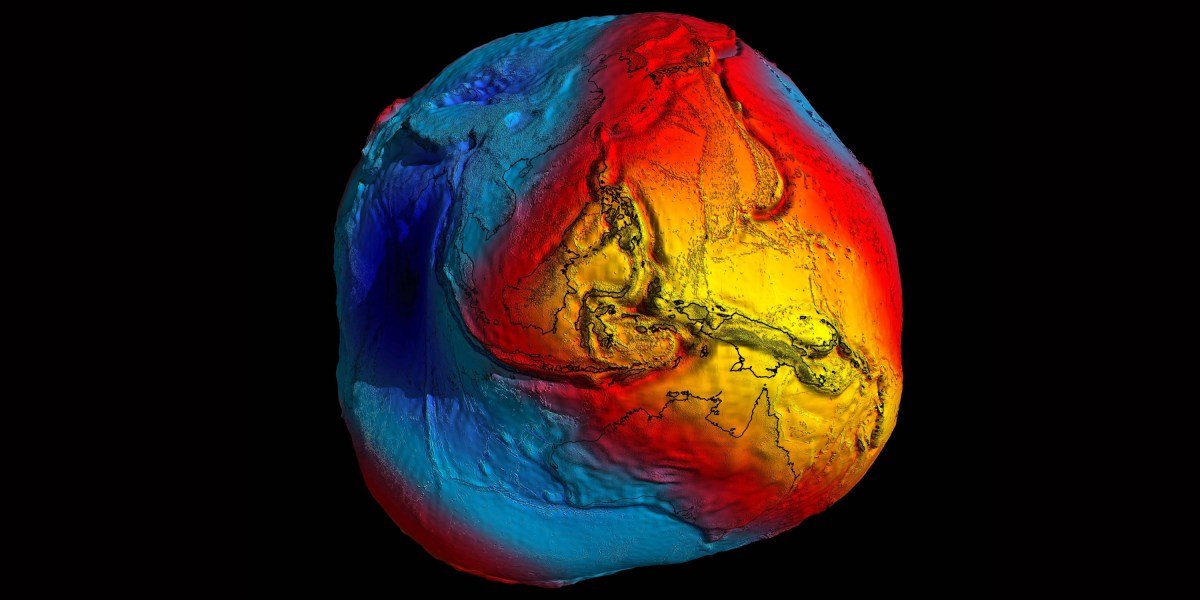
To create a standard zero point, geodesists create a model of Earth known as a geoid. Every point on the surface of this lumpy, potato-shaped model experiences the same gravity, which means that if you dug a canal at the height of the geoid, the water within the canal would be level and would not flow. Distance from the geoid establishes a global system for altitude.
However, the current model lacks precision, particularly in Africa and South America, says Sanchez. Today’s geoid has been built using instruments that directly measure Earth’s gravity. These have been carried on satellites, which excel at getting a global but low-resolution view, and have also been used to get finer details via expensive ground- and airplane-based surveys. But geodesists have not had the funding to survey Africa and South America as extensively as other parts of the world, particularly in difficult terrain such as the Amazon rainforest and Sahara Desert.
To understand the discrepancy in precision, imagine a bridge that spans Africa from the Mediterranean coast to Cape Town, South Africa. If it’s built using the current geoid, the two ends of the bridge will be misaligned by tens of centimeters. In comparison, you’d be off by at most five centimeters if you were building a bridge spanning North America.
To improve the geoid’s precision, geodesists want to create a worldwide network of clocks, synchronized from space. The idea works according to Einstein’s theory of general relativity, which states that the stronger the gravitational field, the more slowly time passes. The 2014 sci-fi movie Interstellar illustrates an extreme version of this so-called time dilation: Two astronauts spend a few hours in extreme gravity near a black hole to return to a shipmate who has aged more than two decades. Similarly, Earth’s gravity grows weaker the higher in elevation you are. Your feet, for example, experience slightly stronger gravity than your head when you’re standing. Assuming you live to be about 80 years old, over a lifetime your head will age tens of billionths of a second more than your feet.
A clock network would allow geodesists to compare the ticking of clocks all over the world. They could then use the variations in time to map Earth’s gravitational field much more precisely, and consequently create a more precise geoid. The most accurate clocks today are precise enough to measure variations in time that map onto centimeter-level differences in elevation.
“We want to have the accuracy level at the one-centimeter or sub-centimeter level,” says Jürgen Müller, a geodesist at Leibniz University Hannover in Germany. Specifically, geodesists would use the clock measurements to validate their geoid model, which they currently do with ground- and plane-based surveying techniques. They think that a clock network should be considerably less expensive.
ACES is just a first step. It is capable of measuring altitudes at various points around Earth with 10-centimeter precision, says Cacciapuoti. But the point of ACES is to prototype the clock network. It will demonstrate the optical and microwave technology needed to use a clock in space to connect some of the most advanced ground-based clocks together. In the next year or so, Müller plans to use ACES to connect to clocks on the ground, starting with three in Germany. Müller’s team could then make more precise measurements at the location of those clocks.
These early studies will pave the way for work connecting even more precise clocks than ACES to the network, ultimately leading to an improved geoid. The best clocks today are some 50 times more precise than ACES. “The exciting thing is that clocks are getting even stabler,” says Michael Bevis, a geodesist at Ohio State University, who was not involved with the project. A more precise geoid would allow engineers, for example, to build a canal with better control of its depth and flow, he says. However, he points out that in order for geodesists to take advantage of the clocks’ precision, they will also have to improve their mathematical models of Earth’s gravitational field.
Even starting to build this clock network has required decades of dedicated work by scientists and engineers. It took ESA three decades to make a clock as small as ACES that is suitable for space, says Cacciapuoti. This meant miniaturizing a clock the size of a laboratory into the size of a small fridge. “It was a huge engineering effort,” says Cacciapuoti, who has been working on the project since he began at ESA 20 years ago.
Geodesists expect they’ll need at least another decade to develop the clock network and launch more clocks into space. One possibility would be to slot the clocks onto GPS satellites. The timeline depends on the success of the ACES mission and the willingness of government agencies to invest, says Sanchez. But whatever the specifics, mapping the world takes time.
