

Penguin poop may help preserve Antarctic climate
Ammonia aerosols from penguin guano likely play a part in the formation of heat-shielding clouds.
This article originally appeared on Inside Climate News, a nonprofit, non-partisan news organization that covers climate, energy, and the environment. Sign up for their newsletter here.
New research shows that penguin guano in Antarctica is an important source of ammonia aerosol particles that help drive the formation and persistence of low clouds, which cool the climate by reflecting some incoming sunlight back to space.
The findings reinforce the growing awareness that Earth’s intricate web of life plays a significant role in shaping the planetary climate. Even at the small levels measured, the ammonia particles from the guano interact with sulfur-based aerosols from ocean algae to start a chemical chain reaction that forms billions of tiny particles that serve as nuclei for water vapor droplets.
The low marine clouds that often cover big tracts of the Southern Ocean around Antarctica are a wild card in the climate system because scientists don’t fully understand how they will react to human-caused heating of the atmosphere and oceans. One recent study suggested that the big increase in the annual global temperature during 2023 and 2024 that has continued into this year was caused in part by a reduction of that cloud cover.
“I’m constantly surprised at the depth of how one small change affects everything else,” said Matthew Boyer, a coauthor of the new study and an atmospheric scientist at the University of Helsinki’s Institute for Atmospheric and Earth System Research. “This really does show that there is a deep connection between ecosystem processes and the climate. And really, it’s the synergy between what’s coming from the oceans, from the sulfur-producing species, and then the ammonia coming from the penguins.”
Climate survivors
Aquatic penguins evolved from flying birds about 60 million years ago, shortly after the age of dinosaurs, and have persisted through multiple, slow, natural cycles of ice ages and warmer interglacial eras, surviving climate extremes by migrating to and from pockets of suitable habitat, called climate refugia, said Rose Foster-Dyer, a marine and polar ecologist with the University of Canterbury in New Zealand.
A 2018 study that analyzed the remains of an ancient “super colony” of the birds suggests there may have been a “penguin optimum” climate window between about 4,000 and 2,000 years ago, at least for some species in some parts of Antarctica, she said. Various penguin species have adapted to different habitat niches and this will face different impacts caused by human-caused warming, she said.
Foster-Dyer has recently done penguin research around the Ross Sea, and said that climate change could open more areas for land-breeding Adélie penguins, which don’t breed on ice like some other species.
“There’s evidence that this whole area used to have many more colonies … which could possibly be repopulated in the future,” she said. She is also more optimistic than some scientists about the future for emperor penguins, the largest species of the group, she added.
“They breed on fast ice, and there’s a lot of publications coming out about how the populations might be declining and their habitat is hugely threatened,” she said. “But they’ve lived through so many different cycles of the climate, so I think they’re more adaptable than people currently give them credit for.”
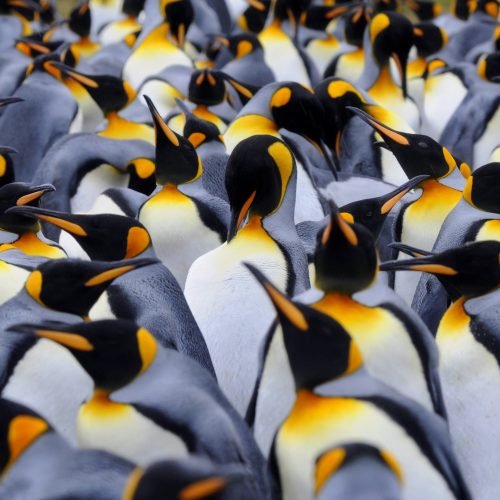
In total, about 20 million breeding pairs of penguins nest in vast colonies all around the frozen continent. Some of the largest colonies, with up to 1 million breeding pairs, can cover several square miles.There aren’t any solid estimates for the total amount of guano produced by the flightless birds annually, but some studies have found that individual colonies can produce several hundred tons. Several new penguin colonies were discovered recently when their droppings were spotted in detailed satellite images.
A few penguin colonies have grown recently while others appear to be shrinking, but in general, their habitat is considered threatened by warming and changing ice conditions, which affects their food supplies. The speed of human-caused warming, for which there is no precedent in paleoclimate records, may exacerbate the threat to penguins, which evolve slowly compared to many other species, Foster-Dyer said.
“Everything’s changing at such a fast rate, it’s really hard to say much about anything,” she said.
Recent research has shown how other types of marine life are also important to the global climate system. Nutrients from bird droppings help fertilize blooms of oxygen-producing plankton, and huge swarms of fish that live in the middle layers of the ocean cycle carbon vertically through the water, ultimately depositing it in a generally stable sediment layer on the seafloor.
Tricky measurements
Boyer said the new research started as a follow-up project to other studies of atmospheric chemistry in the same area, near the Argentine Marambio Base on an island along the Antarctic Peninsula. Observations by other teams suggested it could be worth specifically trying to look at ammonia, he said.
Boyer and the other scientists set up specialized equipment to measure the concentration of ammonia in the air from January to March 2023. They found that, when the wind blew from the direction of a colony of about 60,000 Adélie penguins about 5 miles away, the ammonia concentration increased to as high as 13.5 parts per billion—more than 1,000 times higher than the background reading. Even after the penguins migrated from the area toward the end of February, the ammonia concentration was still more than 100 times as high as the background level.
“We have one instrument that we use in the study to give us the chemistry of gases as they’re actually clustering together,” he said.
“In general, ammonia in the atmosphere is not well-measured because it’s really difficult to measure, especially if you want to measure at a very high sensitivity, if you have low concentrations like in Antarctica,” he said.
Penguin-scented winds
The goal was to determine where the ammonia is coming from, including testing a previous hypothesis that the ocean surface could be the source, he said.
But the size of the penguin colonies made them the most likely source.
“It’s well known that sea birds give off ammonia. You can smell them. The birds stink,” he said. “But we didn’t know how much there was. So what we did with this study was to quantify ammonia and to quantify its impact on the cloud formation process.”
The scientists had to wait until the wind blew from the penguin colony toward the research station.
“If we’re lucky, the wind blows from that direction and not from the direction of the power generator,” he said. “And we were lucky enough that we had one specific event where the winds from the penguin colony persisted long enough that we were actually able to track the growth of the particles. You could be there for a year, and it might not happen.”
The ammonia from the guano does not form the particles but supercharges the process that does, Boyer said.
“It’s really the dimethyl sulfide from phytoplankton that gives off the sulfur,” he said. “The ammonia enhances the formation rate of particles. Without ammonia, sulfuric acid can form new particles, but with ammonia, it’s 1,000 times faster, and sometimes even more, so we’re talking up to four orders of magnitude faster because of the guano.”
This is important in Antarctica specifically because there are not many other sources of particles, such as pollution or emissions from trees, he added.
“So the strength of the source matters in terms of its climate effect over time,” he said. “And if the source changes, it’s going to change the climate effect.”
It will take more research to determine if penguin guano has a net cooling effect on the climate. But in general, he said, if the particles transport out to sea and contribute to cloud formation, they will have a cooling effect.
“What’s also interesting,” he said, “is if the clouds are over ice surfaces, it could actually lead to warming because the clouds are less reflective than the ice beneath.” In that case, the clouds could actually reduce the amount of heat that brighter ice would otherwise reflect away from the planet. The study did not try to measure that effect, but it could be an important subject for future research, he added.
The guano effect lingers even after the birds leave the breeding areas. A month after they were gone, Boyer said ammonia levels in the air were still 1,000 times higher than the baseline.
“The emission of ammonia is a temperature-dependent process, so it’s likely that once wintertime comes, the ammonia gets frozen in,” he said. “But even before the penguins come back, I would hypothesize that as the temperature warms, the guano starts to emit ammonia again. And the penguins move all around the coast, so it’s possible they’re just fertilizing an entire coast with ammonia.”
