

Cinematography of “Andor”
Cinematography of “Andor” by Christophe Nuyens. Courtesy of Lucasfilm/Disney+.
Cinematography of “Andor” by Christophe Nuyens. Courtesy of Lucasfilm/Disney+.
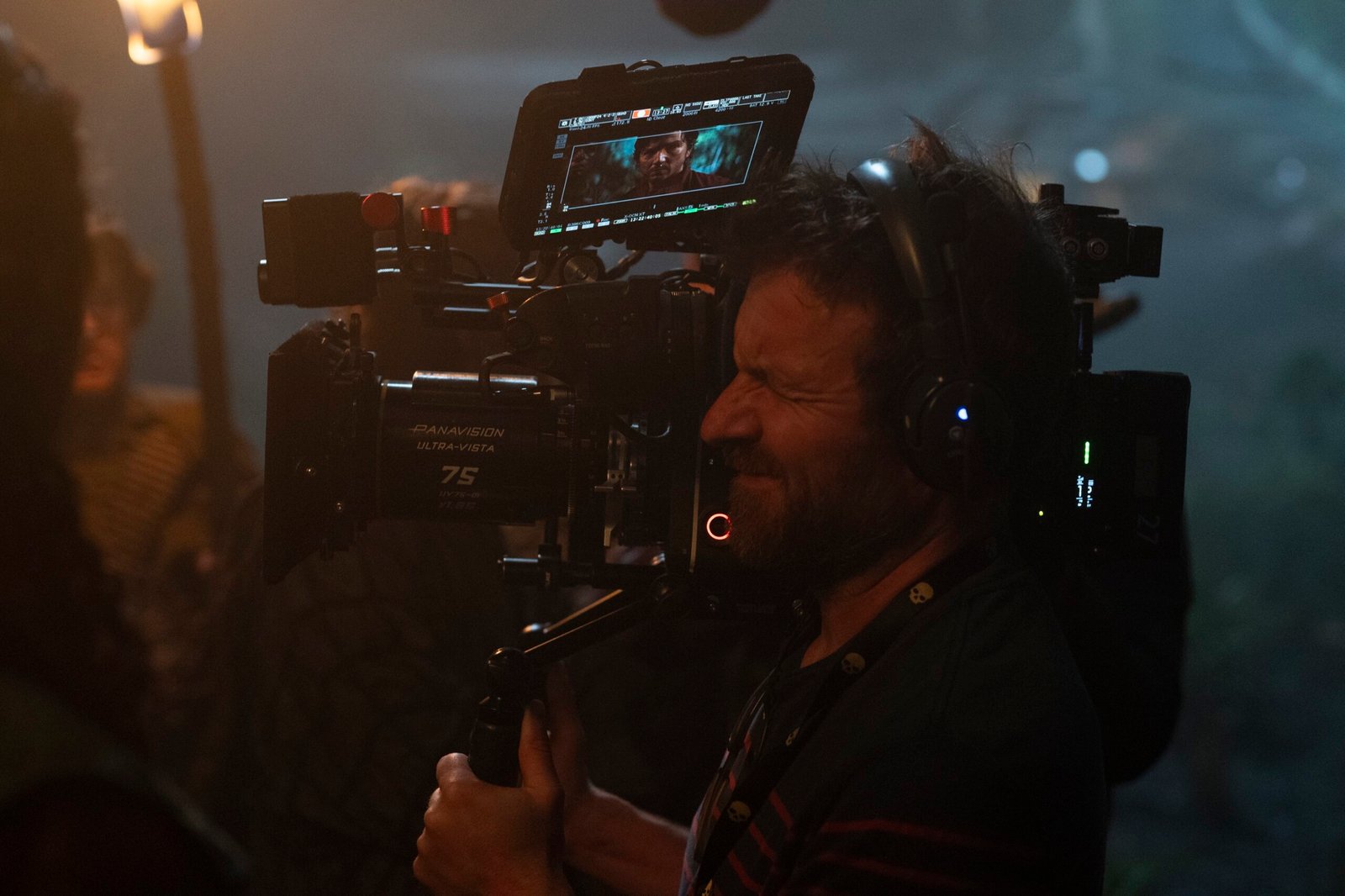
Continuing the ongoing series of interviews with creative artists working on various aspects of movie and TV productions, it is my pleasure to welcome Christophe Nuyens. In this interview, he talks about the transition of this creative field from film to digital, bridging the gap between feature films and episodic productions, learning from different cultures, and what advice he’d give to his younger self. Between all these and more, Christophe dives deep into his work on the second season of “Andor”.
Christophe Nuyens on the set of “Andor”. Courtesy of Lucasfilm/Disney+.
Kirill: Please tell us about yourself and the path that took you to where you are today.
Christophe: I finished a trade school as a general electrician, but I wanted to do something more, and I went to film school. During your first year you can choose between editing, sound and image – which is light and camera. So we had our first workshop, and I had the camera in my hands, and I knew this was it. I really loved the mix of technical and creative.
Kirill: Do you feel that you can teach the technical part, but the artistic part comes from within a person, and if one doesn’t have it, it can’t be learned?
Christophe: No, I think you can teach both. When I was growing up, I didn’t have a lot of cultural influences in my life, at home or at school. It is something that I grew over the years. When I started at the film school, I noticed that I needed to catch up on it. I spent a lot of evenings around that time watching movies with my friends, and it grew on me.
You can cultivate it the same way you cultivate the technical skills. There are also people who are more artistic than technical. Maybe I am more naturally inclined to be better at the technical side, but I grew and worked on my creative side over the years. I really believe you can grow the creative part of your brain.
Kirill: Is there such a thing as universally good art vs universally bad art, or is it all subjective?
Christophe: It’s subjective. There’s so many forms and styles of art. And that is good, because there’s something for everybody. Everything can be art, and people with different taste can find things that they appreciate.
Christophe Nuyens on the set of “Andor”. Courtesy of Lucasfilm/Disney+.
Kirill: Was film still a thing when you were in film school?
Christophe: We did most of our projects on 16mm, either Bolex or Arriflex SR2. We did a few things on video, but it was really basic at the time. I remember those assignments to film something and edit it ourselves, and it was a nightmare. The computers were slow, the Video cards didn’t work, the software was basic. It’s incredible to see how all of that progressed since then. These days I teach at that same school, and the difference is night and day. They can edit it in DaVinci, they can grade it, and it’s so accessible. Sometimes I’m a bit jealous to see that [laughs].
Kirill: How was the transition from film to digital for you after you finished the film school?
Christophe: When I graduated, most of the productions were still on film. I was exposed to both mediums, and I’m happy about it. I know how to light for film. I still have an analog still camera, and I use it a lot.
But at the same time, I’m so happy that the digital revolution happened. It’s a bigger toolbox for your creativity, especially for night scenes. It’s much easier to light something natural, and to do something with less. I started my career in Belgium, and it’s a smaller market with smaller budgets for TV shows and films – but you still want to make good things. I did a TV show called “Cordon” about 10 years ago. It was an ambitious project for its small budget, and that project started my international career. I don’t think it would have been possible to make that project on film. We had a lot of night scenes on it, and it’s so much different to light a night scene on a digital camera.
Cinematography of “Andor” by Christophe Nuyens. Courtesy of Lucasfilm/Disney+.
Kirill: There’s a lot of ongoing technological advances in the field, from lights to lenses to sensors. Is it hard to stay up to date on all the latest developments?
Christophe: Not for me, because that’s my technical side that I’m interested in. I follow everything, and if there’s something new, I want to test it. But at the same time, I’m a fan of old glass. I like to dig into old equipment and to test new equipment.
Right now there’s a lot of interesting things happening with lights. Camera sensors are getting bigger and we’re getting more pixels, but I don’t think it matters that much. And the camera sensibility has been at a good level for a while now. The latest breakthroughs are all in the LED light space. I used a lot of LED lights on “Andor”. All the lights are RGBW (red, green, blue, white), and you can choose any color you want. There’s someone next to you controlling those lights on their iPad, and you’re almost painting the scene with these controllable lights. You can control the color of each one, you can control the intensity of each one, and you can do it all in real time.
When I graduated, it was all with gel filters, tungsten lights and HMIs. Those lights were shifting their color as they aged, and it was a more time consuming process to tweak the colors. Now you have such fine grained control over LEDs, and it’s the biggest positive change for me in the last few years. Sometimes I still use tungsten lights, but my first preference is LED.
Cinematography of “Andor” by Christophe Nuyens. Courtesy of Lucasfilm/Disney+.
Kirill: Is there anything today that is a big gap on the technology side?
Christophe: Right now everything is going wireless. Video is wireless. Lights are wireless. Sound is wireless. It’s all good, but there’s a lot of congestion on sets with all those things combined. Sometimes those nice tools don’t work because there’s too much technology on set [laughs]. That’s my only complaint.
Kirill: Getting closer to “Andor”, you’ve spent around 15 years now working on various episodic productions. How do you see audience expectations and production ambitions evolving over that period of time? I look back at how it was in the ’90s, where we had the feature world and the TV world, and there was an almost unbridgeable gap between the two. And now in 2025 that gap is pretty much gone.
Christophe: It’s nice that you say that, because it’s something I fought against for years. Up until about 5 years ago people would say that if you do TV shows, you can’t do feature film work. If you wanted to do something creative on a show, with lights or with a camera, they would push back on it. They would say that it’s a TV show and that it doesn’t need that.
Right now, the audiences watching episodic shows accept and expect a higher level of quality. It’s such a good transition. There are TV shows that look better than films. I worked on some French TV shows where they gave us a lot of freedom even as the budget was not that big, and I’m so happy with what we were able to do there. I’ve been fighting against it for a long time in discussions with agents. They used to push me to go into the feature film world, and I’m happy with where these episodic productions are these days.
On the set of “Andor”. Courtesy of Lucasfilm/Disney+.
Kirill: Getting to “Andor”, what brought you to it?
Christophe: Thanks to David Meanti who is a producer on “Andor”. I knew him from the show “Riviera” that we did a few years ago in the south of France. He was an assistant director on that show, and we had a great working relationship. We kept in touch after that show, as he moved to the UK and started working as a producer. He tried to introduce me to the producers on the first season of “Andor”, but it didn’t work back then. But he kept on trying for the second season, and I’m grateful to David for that. At first I was offered the first 3 episodes, and after that it was extended to the next 3 episodes.
Kirill: How did you approach bridging this arc between Season 1 and “Rogue One”?
Christophe: “Rogue One” is one of the best Star Wars films, and because of that I was so happy when they called me to work on “Andor”. “Rogue One” has a great story and great visuals.
I wanted to elevate “Andor”. The first season was shot on Panavision C lenses on VENICE camera with a cropped sensor. I wanted to use a full frame sensor with a full frame anamorphic lens to get a bit closer to “Rogue One” which was shot on Alexa 65 with anamorphic lenses. A bigger sensor gives you a different feeling, and you see it when you watch a movie in IMAX. With lighting, I wanted to have a natural approach to it.
Cinematography of “Andor” by Christophe Nuyens. Courtesy of Lucasfilm/Disney+.
Kirill: How much time did you have in pre-production to talk about ideas, visuals and inspirations?
Christophe: We had a lot of time, and it’s a rare thing. The director Ariel Kleiman and I went through the same process for each episode. We were reading the scripts together, and throwing ideas and brainstorming. We did that twice for each episode, and then we started making moodboards. After that we did another read through, and then we started blocking the scenes. We had a lot of 3D pre-viz with ILM, with our camera and lenses in those virtual sets. That allowed us to start looking for shots and to refine everything.
Kirill: How difficult is it to stay practical, to capture as much as you can in camera on sets that are literally out of this world?
Christophe: On some sets it was more difficult, especially the ones with a lot of green screens. You have to imagine what’s behind as you’re lighting it and trying to see through it. There are limitations when working with green screens. You can’t use too much smoke or haze. You can’t use flares. It becomes less natural for me.
This is why for some sets we used either LED walls or painted backdrops. The wedding scene in episode 3 was time-lapsed. Every time we come back to the wedding, the light was slightly different as the Sun was getting lower and we were getting atmospheric effects. We wanted to create a feeling of an estate with the views on the mountains. Eventually we decided to not use green screens. They painted a nice backdrop of the mountains we used in Barcelona, and that was great. You see the final result in camera, and you can light it more naturally. Another set where we used painted backdrops was when Krennic gives his speech to take control of Ghorman. We had a painted backdrop of snowy mountains, and it worked well.
Cinematography of “Andor” by Christophe Nuyens. Courtesy of Lucasfilm/Disney+.
Kirill: How was your collaboration with VFX? Was it mainly in post-production, or an ongoing process?
Christophe: It was ongoing. We were all in one office, including the art department and VFX. We had a lot of meetings to discuss how this planet should look, what we can do in pre-viz, etc. We had full VFX shots of the TIE fighter flying integrated into the larger sequences. Mohen Leo was the VFX supervisor, and he wanted every VFX shot to be physically grounded. You see that in every VFX shot, including the lighting. Some shots started full VFX and then became sets. Luke Hull, our production designer, was always in those meetings. It was a close collaboration between Ariel the director, myself, the art department and the VFX crew from ILM.
Kirill: In terms of sets, how much was built on stage and how much was built on location?
Christophe: There was a lot built on the stage and back lots at Pinewood and Longcross. Yavin, for example, was all at Longcross. It’s an old military test track, with some buildings and a lot of forest. We used that forest to build Yavin’s landing areas for the fighters. The Ghorman city and plaza were built on a back lot at Pinewood, including most of the interiors.
Cinematography of “Andor” by Christophe Nuyens. Courtesy of Lucasfilm/Disney+.
Kirill: How much time did you spend shooting the wedding ceremony?
Christophe: It was about a week and a half, but we also had a set strike as we were getting close to the finish line. The last bit when they all start dancing like crazy was filmed six months later.
Kirill: How many countries did this show take you to?
Christophe: We were in Barcelona where we shot the Coruscant Senate, and in London where we shot at Barbican and Lloyd’s building.
Cinematography of “Andor” by Christophe Nuyens. Courtesy of Lucasfilm/Disney+.
Kirill: For some of the bigger sets, is it a combination of a physical build and then digital extensions?
Christophe: Some of them were fully physical, and some were extended. The Plaza at Ghorman was built physically as one story, and everything above that is a digital extension. I remember how astonished I was the first time I arrived on that set. It was so big. Another example of combining the two was the Ghorman heist sequence. They built quite a bit of those streets, and then above it we had green screens for extensions. The VFX crew was so good at making extensions look so natural.
We had a great collaboration on this show. We knew how we wanted these places to look before we started shooting. I could plan my lighting ahead of time, including the VFX pieces.
Kirill: The show spends a lot of time at the apartment with Bix. How big was it?
Christophe: The nice thing about that set is that everything you see is captured in camera, including the view outside which was an LED wall. That wall allowed us to be more creative and find some extra shots. You have shots from the outside where you see the city below in reflection with raindrops on the window. You see cars passing and light coming in.
Cinematography of “Andor” by Christophe Nuyens. Courtesy of Lucasfilm/Disney+.
Kirill: Did you want to use different colors for different planets or different sets?
Christophe: We wanted every arc of three episodes to feel like its own movie. Our first block was episodes 4 through 6, and we wanted that block to feel cold. Our visual reference for it was the city of Turin in Italy, which is a mountain city. We wanted the feeling of that winter light when the Sun is already behind the mountains, but there’s still light, and it’s all blue. And if the Sun is out, it should be low, with a warm magenta feel to it. We have a lot of rain in these three episodes as well. And then when we shot the next block of the first three episodes, we wanted it to be sunny. It all has a summer feel, with lots of sunlight, including Dedra’s apartment.
Then, within each block you have different planets. Some places are more cold with not a lot of colors. The wedding had a more classical look, and I used tungsten lights there to create that look. Yavin feels like an old Star Wars movie. It was such a nice exercise to play with different looks and moods. It’s a gift to be able to do that.
Kirill: Was there any color you wanted to stay away from?
Christope: Yes for certain sets, but not for the whole show. We used a mix of cold moonlight and warm sources on Yavin for consistency, for example.
Cinematography of “Andor” by Christophe Nuyens. Courtesy of Lucasfilm/Disney+.
Kirill: What was your most memorable moment, and what was your most challenging moment on this show?
Christophe: The most challenging was Mina-Rau and its grain fields. They planted the grain fields, and we had a window of 3-4 weeks to shoot it. And then, just before we started shooting, we had a set strike and we lost half of our actors. We decided to keep on shooting with non-SAG actors, but pretty much every scene was a mix of SAG and non-SAG. So we started shooting bits and pieces of the scenes, also fighting with the elements [laughs], and then we completed the reverse shots six months later, on a stage during winter time.
Our greens department was cutting all those grain stalks to put on stage, but my main challenge was to keep the lighting consistent and natural. Back when we were shooting in the field, I was already thinking about what would happen later on. I was really meticulous, measuring the light of the field, the light of the Sun, the light of the clouds, and noting all the color temperatures. Then when we came to that stage, we had lots of LED fixtures on the ceiling, and we were able to match those color temperatures everywhere. Another interesting challenge was to recreate the feeling of the air with all of the field particles.
It’s easy when you have one scene outside and then another on the stage, but here we were matching shots within the same scenes. I like those kinds of challenges.
As for the most memorable scene, I loved shooting Yavin. I like being outside, and it also reminded me of the old Star Wars movies. Another one was the heist on the streets of Ghorman. We spent about four weeks, mostly during the night, in the UK winter. It was freezing. We had rain machines. It was hard, but it paid off in the end. It was also my first big set to light. It was a big challenge, and I was so happy with the end result.
Cinematography of “Andor” by Christophe Nuyens. Courtesy of Lucasfilm/Disney+.
Kirill: How does it feel to see these weeks and months of work compressed into a few hours on the screen?
Christophe: Before the episode is shown to the public, I see multiple cuts of it. That’s when I see all the faults. That’s when I think of all the things that I could have done better. And then some months later it hits the streaming network, and now I can see it from a distance – and it’s really nice to see it in its final form.
Kirill: How was Covid for you and how is it today?
Christophe: I’m so happy that it’s all behind me. We still had Covid restrictions when we started working on this season. It was a lot of testing, and it was cumbersome for the entire production. Also, when you work in a mask, it takes away a big part of the human interaction on set. I want to see people that I work with. When you talk with someone and you have a mask on, you lose half of the conversation. From the moment we could work without a mask, it really opened up. Everything became more relaxed. Communication became easier and warmer. It was hard for me to not have the same human interaction with the restrictions in place.
Kirill: What are your top three favorite movies of all time?
Christophe: One of my favorites is “Apocalypse Now”. It’s incredible, and it’s also maybe another reason why I loved shooting Yavin – it’s the same atmosphere. I love “No Country for Old Men” and “Children of Men” with its incredible camera work.
Cinematography of “Andor” by Christophe Nuyens. Courtesy of Lucasfilm/Disney+.
Kirill: If you had a time machine, and you could go back in time to give your younger self a piece of advice, what would it be?
Christophe: Be patient. I was really impatient with everything, as it was so difficult to get into doing fiction. Everything else comes along. I don’t regret any twists and turns of the path that I took.
Kirill: What keeps you going? You get to travel the world and work on these great productions, but it also involves long hours and sleepless nights, and being away from your family and friends for long periods of time.
Christophe: It’s really hard for the family, and it’s a demanding job. As long as I feel that I keep on learning, that I keep on evolving, that I keep on meeting really nice people I work with, I’m happy. When it starts to feel that it’s becoming a routine and that I’m doing the same things all over again, then I’ll stop and see what’s next. There are several other things I would love to do in my life outside of movies, but for now I still love it.
I’m getting to know new people. I’m learning a lot, be it on a bigger project like “Andor” or on smaller ones. When you travel, you get exposed to other cultures. I was on a production that took us to Ukraine and Kazakhstan, and the locals have a different way of working. I worked a lot in the UK, and their way is different from how they do it in France. I’m about to do two French movies, and I’m looking forward to that. The French way is the artists’ way. They spend the whole day talking about it. In the UK it’s a bit more efficient, maybe [laughs].
As long as I have this feeling, it’s good for me. But if I feel that I’m doing the same thing over and over again, I’d want to stop.
Kirill: From all the places you’ve traveled to so far, what’s your favorite cuisine?
Christophe: French. When I work in France, I gain 5 kilos every time. The food is so good, and they take a full hour to eat. If you don’t take an hour to eat and production decides to do continuous days, they will strike. It’s too much [laughs]. The UK crews don’t like to stop. They keep on going so they can go home on time to spend at least a bit of time with the family. As far as the food goes, I prefer to work in France.
On the set of “Andor”. Courtesy of Lucasfilm/Disney+.
And here I’d like to thank Christophe Nuyens for taking the time to talk with me about the art and craft of cinematography. I also want to thank Nathalie Retana and Jamie Miller for making this interview happen. “Andor” is streaming on Disney+. Finally, if you want to know more about how films and TV shows are made, click here for additional in-depth interviews in this series.
