Close Menu

    Subscribe to Updates

    Get the latest creative news from FooBar about art, design and business.

    What's Hot

    “You don’t have to tell me Pyramid Head’s backstory” – Poppy Playtime’s George Krstic on why less is more in horror

    Amazon Games boss Hartmann reportedly leaving as firm retreats from PC and console

    QA staff report layoffs at NetEase Games Montréal

    Facebook X (Twitter) Instagram
    • Artificial Intelligence
    • Business Technology
    • Cryptocurrency
    • Gadgets
    • Gaming
    • Health
    • Software and Apps
    • Technology
    Facebook X (Twitter) Instagram Pinterest Vimeo
    Tech AI Verse
    • Home
    • Artificial Intelligence

      AI, crypto and Trump super PACs stash millions to spend on the midterms

      February 2, 2026

      To avoid accusations of AI cheating, college students are turning to AI

      January 29, 2026

      ChatGPT can embrace authoritarian ideas after just one prompt, researchers say

      January 24, 2026

      Ashley St. Clair, the mother of one of Elon Musk’s children, sues xAI over Grok sexual images

      January 17, 2026

      Anthropic joins OpenAI’s push into health care with new Claude tools

      January 12, 2026
    • Business

      New VoidLink malware framework targets Linux cloud servers

      January 14, 2026

      Nvidia Rubin’s rack-scale encryption signals a turning point for enterprise AI security

      January 13, 2026

      How KPMG is redefining the future of SAP consulting on a global scale

      January 10, 2026

      Top 10 cloud computing stories of 2025

      December 22, 2025

      Saudia Arabia’s STC commits to five-year network upgrade programme with Ericsson

      December 18, 2025
    • Crypto

      Ethereum Price Is 10% From Falling Below $2,000, but There’s a Silver Lining to it

      February 2, 2026

      Not Tom Lee’s BitMine: This Firm Faces Potential $1.33 Billion ETH Liquidation Amid 26% Price Drop

      February 2, 2026

      ZOOMEX Introduces February XAUT Initiative Aimed at Simplifying Platform Access

      February 2, 2026

      Tether Dominance Signals the Market May Not Have Found a Bottom Yet

      February 2, 2026

      Ripple Releases 1 Billion XRP as Price Weakness Extends Into February

      February 2, 2026
    • Technology

      Apex Legends won’t be playable on Nintendo Switch after its next season

      February 2, 2026

      Apple is already thinking about its second foldable iPhone, and it may be a clamshell

      February 2, 2026

      Apple’s online store now lets you build a new Mac exactly the way you want

      February 2, 2026

      Enterprises are measuring the wrong part of RAG

      February 2, 2026

      What Most People Miss About Getting Promoted – By Yue Zhao

      February 2, 2026
    • Others
      • Gadgets
      • Gaming
      • Health
      • Software and Apps
    Check BMI
    Tech AI Verse
    You are at:Home»Technology»These VA Tech scientists are building a better fog harp
    Technology

    These VA Tech scientists are building a better fog harp

    TechAiVerseBy TechAiVerseJune 15, 2025No Comments6 Mins Read2 Views
    Facebook Twitter Pinterest Telegram LinkedIn Tumblr Email Reddit
    These VA Tech scientists are building a better fog harp
    Share
    Facebook Twitter LinkedIn Pinterest WhatsApp Email

    These VA Tech scientists are building a better fog harp


    Skip to content

    Combining vertical “strings” with periodic horizontal wires stops clogging and clumping, boosts efficiency.


    Credit:

    Alex Parrish for Virginia Tech

    A fog harp prototype collects water vapor. Credit: Virginia Tech

    A fog harp prototype collects water vapor. Credit: Virginia Tech

    Arid coastal regions that are also prone to fog are prime locations for fog-harvesting devices as a water source, especially during prolonged droughts. But the standard technology is prone to clogging. Scientists at Virginia Tech have created an improved version of their earlier “fog harp” alternative design to address that issue, according to a new paper published in the Journal of Materials Chemistry A.

    Fog harvesting (or dew catching) is an ancient practice dating as far back as the Incas, who placed buckets under trees to collect condensation. It’s also practiced by certain insects, notably Namib desert beetles, which survive on the water that condenses onto their wings. The wings have alternating hydrophilic and hydrophobic regions to enhance the condensation. Today’s fog harvesters are usually mesh nets mounted onto frames with a trough or basin underneath. Like the beetle’s wings, the mesh filaments are chemically coated to be either hydrophobic or hydrophilic.

    The efficiency of these water harvesters depends on decreasing the size of the filaments and the mesh holes. “If the holes were too big, the microscopic droplets would pass through it, and it wouldn’t harvest much water,” co-author James Kaindu, a student in researcher Jonathan Boreyko’s lab at Virginia Tech, told Ars. The trade-off is that smaller filaments and holes are more prone to clogging. “If it was too small, the droplets would coalesce and create a water film on it,” said Kaindu. “It would impede the flow and act as a barrier that would dramatically affect its capture efficiency.”

    That’s why Boreyko’s group came up with the fog harp in 2018. As the name implies, the fog harp consists of a frame holding vertical wires with no criss-crossing horizontal ones. It was inspired by California redwoods, which derive as much as 35 percent of their annual water intake from fog dripping from the parallel arrays of the trees’ needle-like leaves.

    Jonathan Boreyko (l) and Brook Kennedy (r) in 2018 with the original fog harp.


    Credit:

    Peter Means for Virginia Tech

    The design performed very well in the laboratory during scale model testing, collecting between two to seven times the amount of water as mesh nets. But then they tested their design in Monterey Bay. That real-world deployment required larger versions on the order of 1 meter by 1 meter (or 3×3 feet). At that larger scale, surface tension becomes an issue, and the vertical strands start to clump together, “like your hair when it gets clumped up with water,” said Kaindu. And once again, there are reduced harvesting efficiencies.

    Best of both worlds

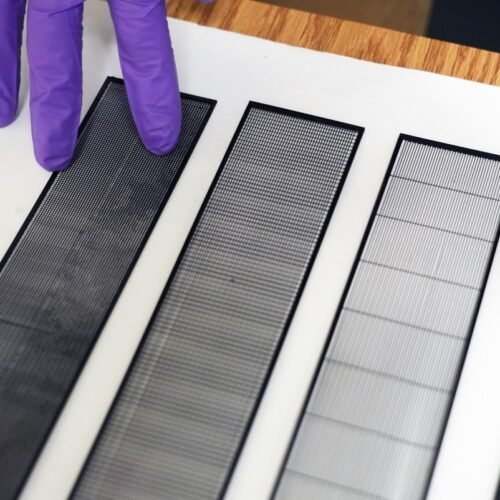
    So the team decided upon a happy medium, combining elements of the traditional mesh with the fog harp to create a hybrid version: essentially a series of small-scale model fog harps stacked on top of each other, separated by the occasional cross-support wire. Boreyko likens the structure to a guitar neck with clearly demarcated frets. This eliminated the clumping problem to get the desired water harvesting efficiency.

    Per Kaindu, the team tested variations of the concept in the lab, from standard mesh nets on one end, with their many interconnects, up to the original fog harp on the other extreme, with none. In between were versions with a hundred interconnects, 10 interconnects, five interconnects, and three interconnects. All were suspended in the air and blasted with fog from ultrasonic humidifiers.

    Next they measured the mass of collected water after a specified time period to arrive at the overall efficiency—the fraction of all the fog water in the air relative to how much was captured—for each variation. The improved hybrid fog harp increased fog harvesting efficiency by a factor of between two and eight compared to pure mesh fog harvesters and the original fog harp, depending on other variables. The designs with three and five interconnects proved to be the sweet spot for the highest efficiency.

    Unlike standard fog harvesting technologies, “We’re trying to use clever geometric designs in place of chemistry,” Boreyko told Ars. “When I first came into this field, virtually everyone was using nets, but they were just trying to make more and more clever chemical coatings to put on the nets to try to reduce the clogging. We found that simply going from a net to a harp, with no chemicals or coatings whatsoever—just the change in geometry solved the clogging problem much better.”

    Jimmy Kaindu inspects a new collecting prototype beside the original fog harp.


    Credit:

    Alex Parrish for Virginia Tech

    For their scale prototypes in the lab, Boreyko’s team 3D printed their harp “strings” out of a weakly hydrophobic plastic. “But in general, the harp works fantastic with uncoated stainless steel wires and definitely doesn’t require any kind of fancy coating,” said Boreyko. And the hybrid harp can be scaled up with relative ease, just like classic nets. It just means stringing together a bunch of harps of smaller heights, meter by meter, to get the desired size. “There is no limit to how big this thing could be,” he said.

    Scaling up the model is the next obvious step, along with testing larger prototypes outdoors. Boreyko would also like to test an electric version of the hybrid fog harp. “If you apply a voltage, it turns out you can catch even more water,” he said. “Because our hybrid’s non-clogging, you can have the best of both worlds: using an electric field to boost the harvesting amount in real-life systems and at the same time preventing clogging.”

    While the hybrid fog harp is well-suited for harvesting water in any coastal region that receives a lot of fog, Boreyko also envisions other, less obvious potential applications for high-efficiency fog harvesters, such as roadways, highways, or airport landing strips that are prone to fog that can pose safety hazards. “There’s even industrial chemical supply manufacturers creating things like pressurized nitrogen gas,” he said. “The process cools the surrounding air into an ice fog that can drift across the street and wreak havoc on city blocks.”

    Journal of Materials Chemistry A, 2025. DOI: 10.1039/d5ta02686e  (About DOIs).

    Jennifer is a senior writer at Ars Technica with a particular focus on where science meets culture, covering everything from physics and related interdisciplinary topics to her favorite films and TV series. Jennifer lives in Baltimore with her spouse, physicist Sean M. Carroll, and their two cats, Ariel and Caliban.


    50 Comments

    Share. Facebook Twitter Pinterest LinkedIn Reddit WhatsApp Telegram Email
    Previous ArticleGoogle can now generate a fake AI podcast of your search results
    Next Article The “online monkey torture video” arrests just keep coming
    TechAiVerse
    • Website

    Jonathan is a tech enthusiast and the mind behind Tech AI Verse. With a passion for artificial intelligence, consumer tech, and emerging innovations, he deliver clear, insightful content to keep readers informed. From cutting-edge gadgets to AI advancements and cryptocurrency trends, Jonathan breaks down complex topics to make technology accessible to all.

    Related Posts

    Apex Legends won’t be playable on Nintendo Switch after its next season

    February 2, 2026

    Apple is already thinking about its second foldable iPhone, and it may be a clamshell

    February 2, 2026

    Apple’s online store now lets you build a new Mac exactly the way you want

    February 2, 2026
    Leave A Reply Cancel Reply

    Top Posts

    Ping, You’ve Got Whale: AI detection system alerts ships of whales in their path

    April 22, 2025648 Views

    Lumo vs. Duck AI: Which AI is Better for Your Privacy?

    July 31, 2025242 Views

    6.7 Cummins Lifter Failure: What Years Are Affected (And Possible Fixes)

    April 14, 2025144 Views

    6 Best MagSafe Phone Grips (2025), Tested and Reviewed

    April 6, 2025111 Views
    Don't Miss
    Gaming February 2, 2026

    “You don’t have to tell me Pyramid Head’s backstory” – Poppy Playtime’s George Krstic on why less is more in horror

    “You don’t have to tell me Pyramid Head’s backstory” – Poppy Playtime’s George Krstic on…

    Amazon Games boss Hartmann reportedly leaving as firm retreats from PC and console

    QA staff report layoffs at NetEase Games Montréal

    Ubisoft unions call for four-day strike: “It is time for management to understand that they cannot do whatever they want”

    Stay In Touch
    • Facebook
    • Twitter
    • Pinterest
    • Instagram
    • YouTube
    • Vimeo

    Subscribe to Updates

    Get the latest creative news from SmartMag about art & design.

    About Us
    About Us

    Welcome to Tech AI Verse, your go-to destination for everything technology! We bring you the latest news, trends, and insights from the ever-evolving world of tech. Our coverage spans across global technology industry updates, artificial intelligence advancements, machine learning ethics, and automation innovations. Stay connected with us as we explore the limitless possibilities of technology!

    Facebook X (Twitter) Pinterest YouTube WhatsApp
    Our Picks

    “You don’t have to tell me Pyramid Head’s backstory” – Poppy Playtime’s George Krstic on why less is more in horror

    February 2, 20260 Views

    Amazon Games boss Hartmann reportedly leaving as firm retreats from PC and console

    February 2, 20262 Views

    QA staff report layoffs at NetEase Games Montréal

    February 2, 20262 Views
    Most Popular

    A Team of Female Founders Is Launching Cloud Security Tech That Could Overhaul AI Protection

    March 12, 20250 Views

    7 Best Kids Bikes (2025): Mountain, Balance, Pedal, Coaster

    March 13, 20250 Views

    VTOMAN FlashSpeed 1500: Plenty Of Power For All Your Gear

    March 13, 20250 Views
    © 2026 TechAiVerse. Designed by Divya Tech.
    • Home
    • About Us
    • Contact Us
    • Privacy Policy
    • Terms & Conditions

    Type above and press Enter to search. Press Esc to cancel.