

See the stunning first images from the Vera C. Rubin Observatory
The first spectacular images taken by the Vera C. Rubin Observatory have been released for the world to peruse: a panoply of iridescent galaxies and shimmering nebulas. “This is the dawn of the Rubin Observatory,” says Meg Schwamb, a planetary scientist and astronomer at Queen’s University Belfast in Northern Ireland.
Much has been written about the observatory’s grand promise: to revolutionize our understanding of the cosmos by revealing a once-hidden population of far-flung galaxies, erupting stars, interstellar objects, and elusive planets. And thanks to its unparalleled technical prowess, few doubted its ability to make good on that. But over the past decade, during its lengthy construction period, “everything’s been in the abstract,” says Schwamb.
Today, that promise has become a staggeringly beautiful reality.
Rubin’s view of the universe is unlike any that preceded it—an expansive vision of the night sky replete with detail, including hazy envelopes of matter coursing around galaxies and star-paved bridges arching between them. “These images are truly stunning,” says Pedro Bernardinelli, an astronomer at the University of Washington.
During its brief perusal of the night sky, Rubin even managed to spy more than 2,000 never-before-seen asteroids, demonstrating that it should be able to spotlight even the sneakiest denizens, and darkest corners, of our own solar system.
NSF-DOE VERA C. RUBIN OBSERVATORY
Today’s reveal is a mere amuse-bouche compared with what’s to come: Rubin, funded by the US National Science Foundation and the Department of Energy, is set for at least 10 years of planned observations. But this moment, and these glorious inaugural images, are worth celebrating for what they represent: the culmination of over a decade of painstaking work.
“This is a direct demonstration that Rubin is no longer in the future,” says Bernardinelli. “It’s the present.”
The observatory is named after the late Vera Rubin, an astronomer who uncovered strong evidence for dark matter, a mysterious and as-yet-undetected something that’s binding galaxies together more strongly than the gravity of ordinary, visible matter alone can explain. Trying to make sense of dark matter—and its equally mysterious, universe-stretching cousin, dubbed dark energy—is a monumental task, one that cannot be addressed by just one line of study or scrutiny of one type of cosmic object.
That’s why Rubin was designed to document anything and everything that shifts or sparkles in the night sky. Sitting atop Chile’s Cerro Pachón mountain range, it boasts a 7,000-pound, 3,200-megapixel digital camera that can take detailed snapshots of a large patch of the night sky; a house-size cradle of mirrors that can drink up extremely distant and faint starlight; and a maze of joints and pistons that allow it to swivel about with incredible speed and precision. A multinational computer network permits its sky surveys to be largely automated, its images speedily processed, any new objects easily detected, and the relevant groups of astronomers quickly alerted.
All that technical wizardry allows Rubin to take a picture of the entire visible night sky once every few days, filling in the shadowed gaps and unseen activity between galaxies. “The sky [isn’t] static. There are asteroids zipping by, and supernovas exploding,” says Yusra AlSayyad, Rubin’s overseer of image processing. By conducting a continuous survey over the next decade, the facility will create a three-dimensional movie of the universe’s ever-changing chaos that could help address all sorts of astronomic queries. What were the very first galaxies like? How did the Milky Way form? Are there planets hidden in our own solar system’s backyard?
Rubin’s first glimpse of the firmament is predictably bursting with galaxies and stars. But the resolution, breadth, and depth of the images have taken astronomers aback. “I’m very impressed with these images. They’re really incredible,” says Christopher Conselice, an extragalactic astronomer at the University of Manchester in England.
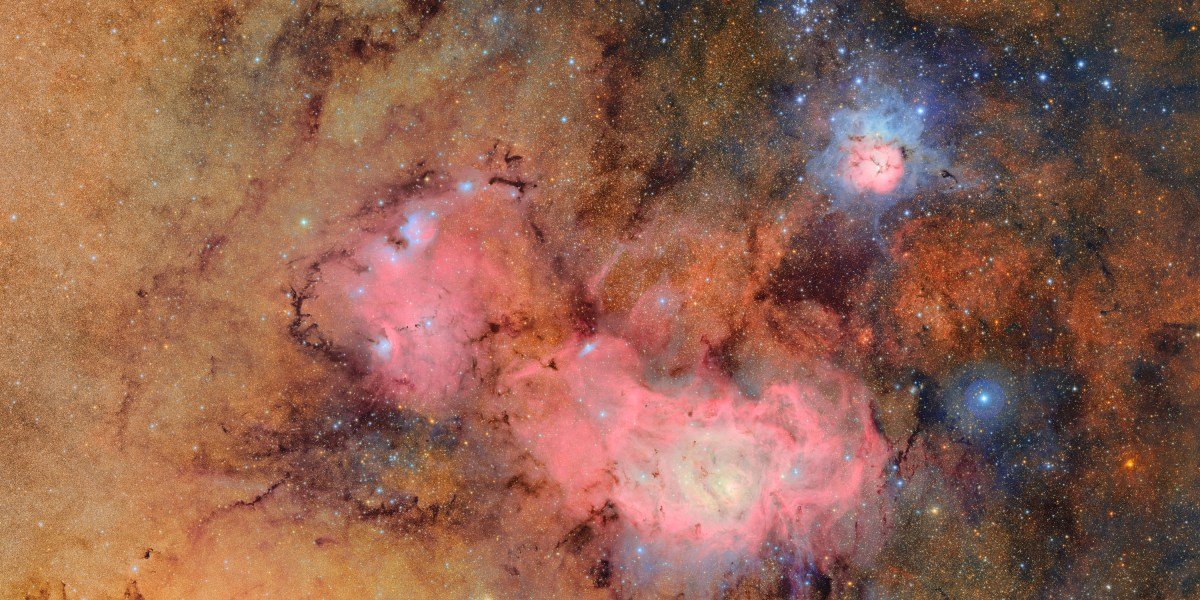
One shot, created from 678 individual exposures, showcases the Trifid and Lagoon nebulas—two oceans of luminescent gas and dust where stars are born. Others depict a tiny portion of Rubin’s view of the Virgo Cluster, a zoo of galaxies. Hues of blue are coming from relatively nearby whirlpools of stars, while red tints emanate from remarkably distant and primeval galaxies.
The rich detail in these images is already proving to be illuminating. “As galaxies merge and interact, the galaxies are pulling stars away from each other,” says Conselice. This behavior can be seen in plumes of diffuse light erupting from several galaxies, creating halos around them or illuminated bridges between them—records of these ancient galaxies’ pasts.
Images like these are also likely to contain several supernovas, the explosive final moments of sizable stars. Not only do supernovas seed the cosmos with all the heavy elements that planets—and life—rely on, but they can also hint at how the universe has expanded over time.
Anais Möller, an astrophysicist at the Swinburne University of Technology in Melbourne, Australia, is a supernova hunter. “I search for exploding stars in very far away galaxies,” she says. Older sky surveys have found plenty, but they can lack context: You can see the explosion, but not what galaxy it’s from. Thanks to Rubin’s resolution—amply demonstrated by the Virgo Cluster set of images—astronomers can now “find where those exploding stars live,” says Möller.
NSF-DOE VERA C. RUBIN OBSERVATORY
While taking these images of the distant universe, Rubin also discovered 2,104 asteroids flitting about in our own solar system—including seven whose orbits hew close to Earth’s own. This number may sound impressive, but it’s just par for the course for Rubin. In just a few months, it will find over a million new asteroids—doubling the current known tally. And over the course of its decadal survey, Rubin is projected to identify 89,000 near-Earth asteroids, 3.7 million asteroids in the belt between Mars and Jupiter, and 32,000 icy objects beyond Neptune.
Finding more than 2,000 previously hidden asteroids in just a few hours of observations, then, “wasn’t even hard” for Rubin, says Mario Jurić, an astronomer at the University of Washington. “The asteroids really popped out.”
Rubin’s comprehensive inventorying of the solar system has two benefits. The first is scientific: All those lumps of rocks and ice are the remnants of the solar system’s formative days, which means astronomers can use them to understand how everything around us was pieced together.
The second benefit is security. Somewhere out there, there could be an asteroid on an Earthbound trajectory—one whose impact could devastate an entire city or even several countries. Engineers are working on defensive tech designed to either deflect or obliterate such asteroids, but if astronomers don’t know where they are, those defenses are useless. In quickly finding so many asteroids, Rubin has clearly shown that it will bolster Earth’s planetary defense capabilities like no other ground-based telescope.
Altogether, Rubin’s debut has validated the hopes of countless astronomers: The observatory won’t just be an incremental improvement on what’s come before. “I think it’s a generational leap,” says Möller. It is a ruthlessly efficient, discovery-making behemoth—and a firehose of astronomic delights is about to inundate the scientific community. “It’s very scary,” says Möller. “But very exciting at the same time.”
It’s going to be a very hectic decade. As Schwamb puts it, “The roller-coaster starts now.”
