Close Menu

    Subscribe to Updates

    Get the latest creative news from FooBar about art, design and business.

    What's Hot

    Oppo Find N6 shown globally with ‘least noticeable foldable crease’

    Motorola to deliver privacy-focused phones by offering GrapheneOS as alternative to Android

    TCL unveils Nxtpaper 70 Pro smartphone with a flicker-free, paper-like display to help minimize headaches and eye strain

    Facebook X (Twitter) Instagram
    • Artificial Intelligence
    • Business Technology
    • Cryptocurrency
    • Gadgets
    • Gaming
    • Health
    • Software and Apps
    • Technology
    Facebook X (Twitter) Instagram Pinterest Vimeo
    Tech AI Verse
    • Home
    • Artificial Intelligence

      What the polls say about how Americans are using AI

      February 27, 2026

      Tensions between the Pentagon and AI giant Anthropic reach a boiling point

      February 21, 2026

      Read the extended transcript: President Donald Trump interviewed by ‘NBC Nightly News’ anchor Tom Llamas

      February 6, 2026

      Stocks and bitcoin sink as investors dump software company shares

      February 4, 2026

      AI, crypto and Trump super PACs stash millions to spend on the midterms

      February 2, 2026
    • Business

      These ultra-budget laptops “include” 1.2TB storage, but most of it is OneDrive trial space

      March 1, 2026

      FCC approves the merger of cable giants Cox and Charter

      February 28, 2026

      Finding value with AI and Industry 5.0 transformation

      February 28, 2026

      How Smarsh built an AI front door for regulated industries — and drove 59% self-service adoption

      February 24, 2026

      Where MENA CIOs draw the line on AI sovereignty

      February 24, 2026
    • Crypto

      Bitcoin Bear Market Could Get Worse Despite the Latest Relief Rally

      March 1, 2026

      Crypto Scammers Have Been Quiet in February, Hacks Fall by 90%

      March 1, 2026

      Vitalik Buterin Signals Major Ethereum Wallet Overhaul

      March 1, 2026

      Why is Hyperliquid Price Rallying Amid the US-Iran War

      March 1, 2026

      Arbitrum Price Under Pressure: 60 Million ARB Whale Sale Sparks ATL Fear

      March 1, 2026
    • Technology

      Oppo Find N6 shown globally with ‘least noticeable foldable crease’

      March 2, 2026

      Motorola to deliver privacy-focused phones by offering GrapheneOS as alternative to Android

      March 2, 2026

      TCL unveils Nxtpaper 70 Pro smartphone with a flicker-free, paper-like display to help minimize headaches and eye strain

      March 2, 2026

      Qi2.2 charging boost

      March 2, 2026

      What if the real risk of AI isn’t deepfakes — but daily whispers?

      March 1, 2026
    • Others
      • Gadgets
      • Gaming
      • Health
      • Software and Apps
    Check BMI
    Tech AI Verse
    You are at:Home»Technology»Figuring out why a nap might help people see things in new ways
    Technology

    Figuring out why a nap might help people see things in new ways

    TechAiVerseBy TechAiVerseJuly 7, 2025No Comments7 Mins Read7 Views
    Facebook Twitter Pinterest Telegram LinkedIn Tumblr Email Reddit
    Figuring out why a nap might help people see things in new ways
    Share
    Facebook Twitter LinkedIn Pinterest WhatsApp Email

    Figuring out why a nap might help people see things in new ways

    An EEG signal of sleep is associated with better performance on a mental task.

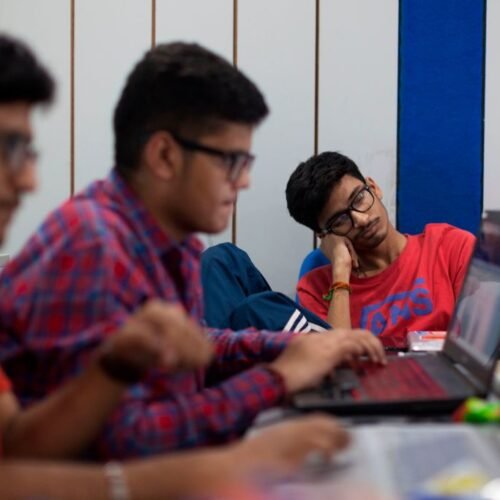
    The guy in the back may be doing a more useful activity.


    Credit:

    XAVIER GALIANA


    Dmitri Mendeleev famously saw the complete arrangement of the periodic table after falling asleep on his desk. He claimed in his dream he saw a table where all the elements fell into place, and he wrote it all down when he woke up. By having a eureka moment right after a nap, he joined a club full of rather talented people: Mary Shelley, Thomas Edison, and Salvador Dali.

    To figure out if there’s a grain of truth to all these anecdotes, a team of German scientists at the Hamburg University, led by cognitive science researcher Anika T. Löwe, conducted an experiment designed to trigger such nap-following strokes of genius—and catch them in the act with EEG brain monitoring gear. And they kind of succeeded.

    Catching Edison’s cup

    “Thomas Edison had this technique where he held a cup or something like that when he was napping in his chair,” says Nicolas Schuck, a professor of cognitive science at the Hamburg University and senior author of the study. “When he fell asleep too deeply, the cup falling from his hand would wake him up—he was convinced that was the way to trigger these eureka moments.” While dozing off in a chair with a book or a cup doesn’t seem particularly radical, a number of cognitive scientists got serious about re-creating Edison’s approach to insights and testing it in their experiments.

    One of the recent such studies was done at Sorbonne University by Célia Lacaux, a cognitive neuroscientist, and her colleagues. Over 100 participants were presented with a mathematical problem and told it could be solved by applying two simple rules in a stepwise manner. However, there was also an undescribed shortcut that made reaching the solution much quicker. The goal was to see if participants would figure this shortcut out after an Edison-style nap. The scientists would check whether the eureka moment would show in EEG.

    Lacaux’s team also experimented with different objects the participants should hold while napping: spoons, steel spheres, stress balls, etc. It turned out Edison was right, and a cup was by far the best choice. It also turned out that most participants recognized there was a hidden rule after the falling cup woke them up. The nap was brief, only long enough to enter the light, non-REM N1 phase of sleep.

    Initially, Schuck’s team wanted to replicate the results of Lacaux’s study. They even bought the exact same make of cups, but the cups failed this time. “For us, it just didn’t work. People who fell asleep often didn’t drop these cups—I don’t know why,” Schuck says.

    The bigger surprise, however, was that the N1 phase sleep didn’t work either.

    Tracking the dots

    Schuck’s team set up an experiment that involved asking 90 participants to track dots on a screen in a series of trials, with a 20-minute-long nap in between. The dots were rather small, colored either purple or orange, placed in a circle, and they moved in one of two directions. The task for the participants was to determine the direction the dots were moving. That could range from easy to really hard, depending on the amount of jitter the team introduced.

    The insight the participants could discover was hidden in the color coding. After a few trials where the dots’ direction was random, the team introduced a change that tied the movement to the color: orange dots always moved in one direction, and the purple dots moved in the other. It was up to the participants to figure this out, either while awake or through a nap-induced insight.

    Those dots were the first difference between Schuck’s experiment and the Sorbonne study. Lacaux had her participants cracking a mathematical problem that relied on analytical skills. Schuck’s task was more about perceptiveness and out-of-the-box thinking.

    The second difference was that the cups failed to drop and wake participants up. Muscles usually relax more when sleep gets deeper, which is why most people drop whatever they’re holding either at the end of the N1 phase or at the onset of the N2 phase, when the body starts to lose voluntary motor control. “We didn’t really prevent people from reaching the N2 phase, and it turned out the participants who reached the N2 phase had eureka moments most often,” Schuck explains.

    Over 80 percent of people who reached the deeper, N2 phase of sleep found the color-coding solution. Participants who fell into a light N1 sleep had a 61 percent success rate; that dropped to just 55 percent in a group that stayed awake during their 20-minute nap time. In a control group that did the same task without a nap break, only 49 percent of participants figured out the hidden trick.

    The divergent results in Lacaux’s and Schuck’s experiments were puzzling, so the team looked at the EEG readouts, searching for features in the data that could predict eureka moments better than sleep phases alone. And they found something.

    The slope of genius

    The EEG signal in the human brain consists of low and high frequencies that can be plotted on a spectral slope. When we are awake, there are a lot of high-frequency signals, and this slope looks rather flat. During sleep, these high frequencies get muted, there are more low-frequency signals, and the slope gets steeper. Usually, the deeper we sleep, the steeper our EEG slope is.

    The team noticed that eureka moments seemed to be highly correlated with a steep EEG spectral slope—the steeper the slope, the more likely people were to get a breakthrough. In fact, the models based on the EEG signal alone predicted eureka moments better than predictions made based on sleep phases and even based on the sleep phases and EEG readouts combined.

    “Traditionally, people divided sleep EEG readouts down into discrete stages like N1 or N2, but as usual in biology, things in reality are not as discrete,” Schuck says. “They’re much more continuous, there’s kind of a gray zone.” He told Ars that looking specifically at the EEG trace may help us better understand what exactly happens in the brain when a sudden moments of insight arrives.

    But Shuck wants to get even more data in the future. “We’re currently running a study that’s been years in the making: We want to use both EEG and [functional magnetic resonance imaging] at the same time to see what happens in the brain when people are sleeping,” Schuck says. The addition of the fMRI imaging will enable Schuck and his colleagues to see which areas of the brain get activated during sleep. What the team wants to learn from combining EEG and fMRI imagery is how sleep boosts memory consolidation.

    “We also hope to get some insights, no pun intended, into the processes that play a role in generating insights,” Schuck adds.

    PLOS Biology, 2025.  DOI: 10.1371/journal.pbio.3003185

    Jacek Krywko is a freelance science and technology writer who covers space exploration, artificial intelligence research, computer science, and all sorts of engineering wizardry.


    43 Comments

    Share. Facebook Twitter Pinterest LinkedIn Reddit WhatsApp Telegram Email
    Previous ArticleNYT to start searching deleted ChatGPT logs after beating OpenAI in court
    Next Article Meteorologists Say the National Weather Service Did Its Job in Texas
    TechAiVerse
    • Website

    Jonathan is a tech enthusiast and the mind behind Tech AI Verse. With a passion for artificial intelligence, consumer tech, and emerging innovations, he deliver clear, insightful content to keep readers informed. From cutting-edge gadgets to AI advancements and cryptocurrency trends, Jonathan breaks down complex topics to make technology accessible to all.

    Related Posts

    Oppo Find N6 shown globally with ‘least noticeable foldable crease’

    March 2, 2026

    Motorola to deliver privacy-focused phones by offering GrapheneOS as alternative to Android

    March 2, 2026

    TCL unveils Nxtpaper 70 Pro smartphone with a flicker-free, paper-like display to help minimize headaches and eye strain

    March 2, 2026
    Leave A Reply Cancel Reply

    Top Posts

    Ping, You’ve Got Whale: AI detection system alerts ships of whales in their path

    April 22, 2025701 Views

    Lumo vs. Duck AI: Which AI is Better for Your Privacy?

    July 31, 2025284 Views

    6.7 Cummins Lifter Failure: What Years Are Affected (And Possible Fixes)

    April 14, 2025164 Views

    6 Best MagSafe Phone Grips (2025), Tested and Reviewed

    April 6, 2025124 Views
    Don't Miss
    Technology March 2, 2026

    Oppo Find N6 shown globally with ‘least noticeable foldable crease’

    Oppo Find N6 shown globally with ‘least noticeable foldable crease’ – NotebookCheck.net News ⓘ OppoThe…

    Motorola to deliver privacy-focused phones by offering GrapheneOS as alternative to Android

    TCL unveils Nxtpaper 70 Pro smartphone with a flicker-free, paper-like display to help minimize headaches and eye strain

    Qi2.2 charging boost

    Stay In Touch
    • Facebook
    • Twitter
    • Pinterest
    • Instagram
    • YouTube
    • Vimeo

    Subscribe to Updates

    Get the latest creative news from SmartMag about art & design.

    About Us
    About Us

    Welcome to Tech AI Verse, your go-to destination for everything technology! We bring you the latest news, trends, and insights from the ever-evolving world of tech. Our coverage spans across global technology industry updates, artificial intelligence advancements, machine learning ethics, and automation innovations. Stay connected with us as we explore the limitless possibilities of technology!

    Facebook X (Twitter) Pinterest YouTube WhatsApp
    Our Picks

    Oppo Find N6 shown globally with ‘least noticeable foldable crease’

    March 2, 20262 Views

    Motorola to deliver privacy-focused phones by offering GrapheneOS as alternative to Android

    March 2, 20262 Views

    TCL unveils Nxtpaper 70 Pro smartphone with a flicker-free, paper-like display to help minimize headaches and eye strain

    March 2, 20262 Views
    Most Popular

    7 Best Kids Bikes (2025): Mountain, Balance, Pedal, Coaster

    March 13, 20250 Views

    VTOMAN FlashSpeed 1500: Plenty Of Power For All Your Gear

    March 13, 20250 Views

    Best TV Antenna of 2025

    March 13, 20250 Views
    © 2026 TechAiVerse. Designed by Divya Tech.
    • Home
    • About Us
    • Contact Us
    • Privacy Policy
    • Terms & Conditions

    Type above and press Enter to search. Press Esc to cancel.