

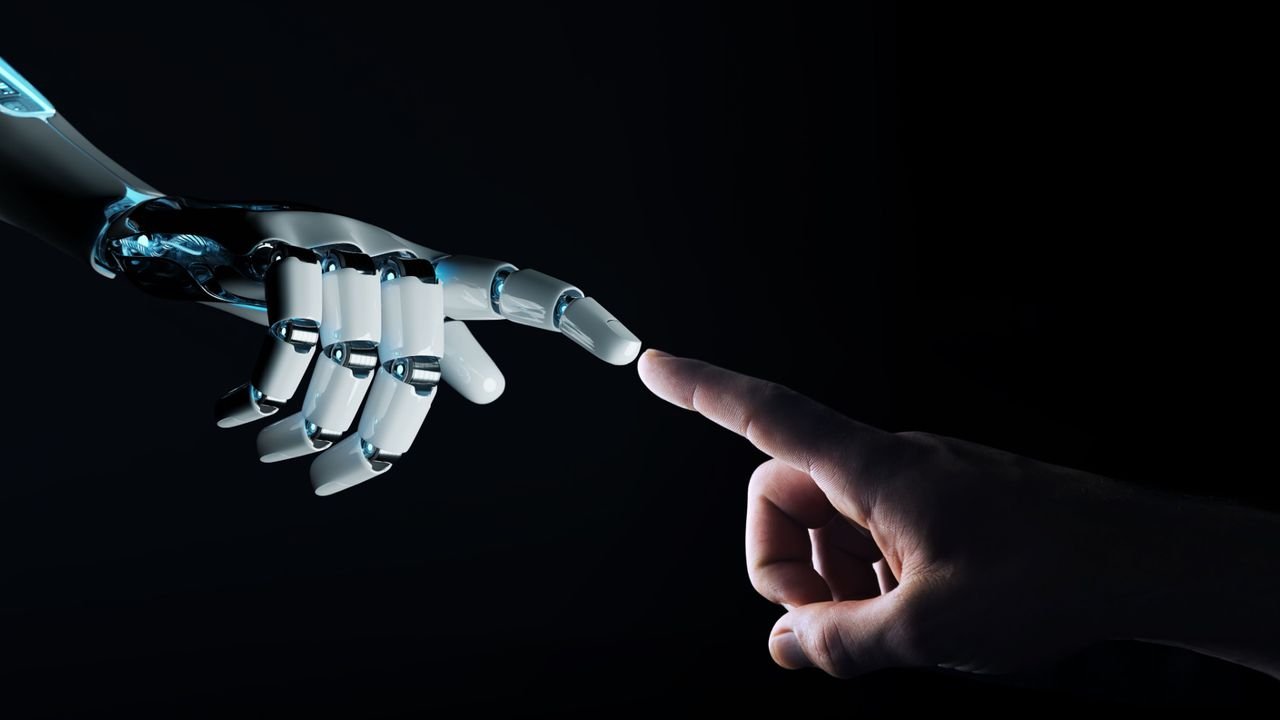
Enabling the rise of responsible robots
When I first started as an engineer in the semiconductor industry, we worked on pretty boring electronics. Laptops, portable phones, gaming computers – not the most exciting stuff by today’s standards. Then some smart engineer on the U.S. West Coast took a portable mobile phone and a portable computer, stuffed them into each other and called it a smartphone. It’s basically a data display device. And we were super proud of our smartphones.
And when these data display devices were combined with big storage and big compute in the cloud, well that’s what enabled an on-demand world. A world that allows us to order whatever we want with only a couple of clicks.
Now, after decades of technology advancements, we are moving from an on-demand world, to one that anticipates our needs and automates to address them. In this world an ever-growing number of connected systems – cars, smart homes, factory floor sensors, healthcare devices – process data right where it’s captured.
At the intelligent edge, manual devices transform into autonomous and responsible robots. These robots will be powered by engineering innovations, new design processes, and advances in sensors and AI.
What can we expect in this new world? Think about this for a minute. Over the next few decades, our homes will be able to predict maintenance needs, keep our families safe, and even order food for the fridge. Sound more like dream than reality? I am telling you – it is not. And it’s more than just our homes. Driving will be entirely automated too, and cars themselves will be convenience spaces where you can relax or work while you ride.
This intelligent world is closer than you think. But how will we get there?
CTO and EVP at NXP Semiconductors.
Creating our digital twins
One of the most important steps toward autonomous and responsible robots has been underway for decades: the creation of digital twins. These are virtual models of physical objects, located within the cloud. For an individual, that might be the state of your health, wealth, and your physical presence. It also applies to homes, businesses, hospitals, and even cars.
But simply digitizing the physical world will only take us so far. We need to enable this digital world to reach out to its physical counterpart. In doing so, these digital twins will be able to connect with each other, optimize and learn from each other. Then, and this is the critical part, they apply that knowledge in the real world. Only once we achieve this, can autonomous robots truly become a reality.
From manual machines to autonomous robots
We need to enable machines to sense, think, connect, and act in our physical world. And what is most important, we need to make sure they always do so responsibly – with safety and security at the core of everything they do. Because you will never hand over control to a robot that you do not trust.
Largely, building acting machines has been achieved over the past 140 years. These machines have just always required a human to provide input or oversight. More recently, connectivity challenges have been solved in the 1990s and early 2000s. Now our real challenges lie in enabling machines to sense and think.
The automotive industry is a clear example of where we’ve fallen short here so far. Around 2016, everyone thought that self-driving cars were around the corner. Theoretically, we had the technology to make them work. Yet fully autonomous driving still remains out of reach. So, what went wrong?
The gap between the autonomous driving future that was predicted, and today’s reality comes from a fundamental misunderstanding of AI systems. We thought that simply having an AI system that’s trained on how we drive would be enough.
It’s like expecting to be able to hand the keys to your teenager and letting them drive simply because they’d been in the car with you for years. In the real world, people need to train and pass deterministic tests before they are given a driver’s license. That layer of trust, safety, and security is what was missing.
Enabling the brain shift
To get the safety and security part right, today’s AI (the brain of the robot) requires a new approach. And where better to look for inspiration than the human brain itself.
Our brains are largely broken into three areas: the cerebrum facilitates perception, the cerebellum coordinates action and vital functions, and the brain stem regulates real time functions and powers reflexes. For humans, all of these are crucial. But for robots, it depends on their use.
Back to the autonomous car example, the highest priority is function and safety. For this, we need reflexes and coordination in conjunction with sensors. For a self-driving car, that translates at a base level to functional and safe power management and a real-time neural information transportation system.
Or in other words, reliable Power Management Integrated Circuits (PMIC) and processors that can handle all the information that comes in from a vast array of sensors.
Beyond that, you need modular software building blocks. This is because it’s software that defines how autonomous vehicles function. Having pre-built blocks of software also means that production can be adapted even at scale.
If you’ve got building blocks for compute, networking, power management, and more, you can minimize the time spent on basic functionality. With that, you can invest more effort into bringing products to market or solving difficult challenges.
While self-driving cars are the most familiar example today, this brain shift taking place is laying the groundwork for other intelligent machines in the future.
Building on intelligent foundations
Re-engineering the robot brain is important, but it’s not only thing needed for a world that anticipates and automates. We also need ongoing improvements to sensors, along with a common language to enable interoperability across these robots. These are all areas where we are making rapid progress: with high-resolution radar, ultra-wideband signals, and the Matter standard to name just a few innovations.
A better world built around autonomous and proactive robots might feel like a concept from science fiction. But if you look at the advances making our vehicles, our homes and our factories smarter and safer today, it’s clear we’re laying the right foundations.
We have kicked the door open towards a world that anticipates and automates – now industry players, academia, researchers, engineers, and policy makers have the chance to bring this “robot awakening” to reality – and create a truly intelligent and trusted future.
We list the best Robotic Process Automation (RPA) software.
This article was produced as part of TechRadarPro’s Expert Insights channel where we feature the best and brightest minds in the technology industry today. The views expressed here are those of the author and are not necessarily those of TechRadarPro or Future plc. If you are interested in contributing find out more here: https://www.techradar.com/news/submit-your-story-to-techradar-pro
