

Hackers Went Looking for a Backdoor in High-Security Safes—and Now Can Open Them in Seconds
About two years ago, security researchers James Rowley and Mark Omo got curious about a scandal in the world of electronic safes: Liberty Safe, which markets itself as “America’s #1 heavy-duty home and gun safe manufacturer,” had apparently given the FBI a code that allowed agents to open a criminal suspect’s safe in response to a warrant related to the January 6, 2021, invasion of the US Capitol building.
Politics aside, Rowley and Omo were taken aback to read that it was so easy for law enforcement to penetrate a locked metal box—not even an internet-connected device—that no one but the owner ought to have the code to open. “How is it possible that there’s this physical security product, and somebody else has the keys to the kingdom?” Omo asks.
So they decided to try to figure out how that backdoor worked. In the process, they’d find something far bigger: another form of backdoor intended to let authorized locksmiths open not just Liberty Safe devices, but the high-security Securam Prologic locks used in many of Liberty’s safes and those of at least seven other brands. More alarmingly, they discovered a way for a hacker to exploit that backdoor—intended to be accessible only with the manufacturer’s help—to open a safe on their own in seconds. In the midst of their research, they also found another security vulnerability in many newer versions of Securam’s locks that would allow a digital safecracker to insert a tool into a hidden port in the lock and instantly obtain a safe’s unlock code.
Security researchers James Rowley and Mark Omo.Photograph: Ronda Churchill
At the Defcon hacker conference in Las Vegas today, Omo and Rowley made their findings public for the first time, demonstrating onstage their two distinct methods for opening electronic safes sold with Securam ProLogic locks, which are used to protect everything from personal firearms to cash in retail stores to narcotics in pharmacies.
While both their techniques represent glaring security vulnerabilities, Omo says it’s the one that exploits a feature intended as a legitimate unlock method for locksmiths that’s the more widespread and dangerous. “This attack is something where, if you had a safe with this kind of lock, I could literally pull up the code right now with no specialized hardware, nothing,” Omo says. “All of a sudden, based on our testing, it seems like people can get into almost any Securam Prologic lock in the world.”
Omo and Rowley demonstrate both their safecracking methods in the two videos below, which show them performing the techniques on their own custom-made safe with a standard, unaltered Securam ProLogic lock:
Security Update? No, Buy a New Lock
Omo and Rowley say they informed Securam about both their safe-opening techniques in spring of last year, but have until now kept their existence secret because of legal threats from the company. “We will refer this matter to our counsel for trade libel if you choose the route of public announcement or disclosure,” a Securam representative wrote to the two researchers ahead of last year’s Defcon, where they first planned to present their research.
Only after obtaining pro bono legal representation from the Electronic Frontier Foundation’s Coders’ Rights Project did the pair decide to follow through with their plan to speak about Securam’s vulnerabilities at Defcon. Omo and Rowley say they’re even now being careful not to disclose enough technical detail to help others replicate their techniques, while still trying to offer a warning to safe owners about two different vulnerabilities that exist in many of their devices.
When WIRED reached out to Securam for comment, the company’s CEO, Chunlei Zhou, responded in a statement. “The specific ‘vulnerabilities’ alleged by Omo and Rowley are already well known to industry professionals and in fact, also affect other safe lock providers that use similar chips,” Zhou writes. “Delivering any attack based on these vulnerabilities does require specialized knowledge, skills, and equipment, and we have no record of any customer that has ever had even a single safe lock defeated through a use of this attack.”
Zhou’s statement goes on to point to other ways safes’ locks can be opened from drilling and cutting to the use of a locksmith device called a Little Black Box that exploits vulnerabilities in some brands of electronic safe locks.
Omo and Rowley respond that the vulnerabilities they found were not previously known to the public; one of the two does not require any special equipment, despite Zhou’s claim; and none of the other techniques Zhou mentions represents as serious a security flaw as their findings about the Securam ProLogic locks. The brute-force safecracking methods Zhou points to, like cutting and drilling are far slower and less stealthy—or, like the Little Black Box, are available only to locksmiths and haven’t been publicly shown to be exploitable by unauthorized hackers.
Zhou added in his statement that Securam will be fixing the vulnerabilities Omo and Rowley found in future models of the ProLogic lock. “Customer security is our priority and we have begun the process of creating next-generation products to thwart these potential attacks,” he writes. “We expect to have new locks on the market by the end of the year.”
Photograph: Ronda Churchill
In a followup call, Securam director of sales Jeremy Brookes confirmed that Securam has no plan to fix the vulnerability in locks already in use on customers’ safes, but suggests safe owners who are concerned buy a new lock and replace the one on their safe. “We’re not going to be offering a firmware package that upgrades it,” Brookes says. “We’re going to offer them a new product.”
Brookes adds that he believes Omo and Rowley are “singling out” Securam with the intention of “discrediting” the company.
Omo responds that’s not at all their intent. “We’re trying to make the public aware of the vulnerabilities in one of the most popular safe locks on the market,” he says.
A Senator’s Warning
Beyond Liberty Safe, Securam ProLogic locks are used by a wide variety of safe manufacturers including Fort Knox, High Noble, FireKing, Tracker, ProSteel, Rhino Metals, Sun Welding, Corporate Safe Specialists, and pharmacy safe companies Cennox and NarcSafe, according to Omo and Rowley’s research. The locks can also be found on safes used by CVS for storing narcotics and by multiple US restaurant chains for storing cash.
Rowley and Omo aren’t the first to raise concerns about the security of Securam locks. In March of last year, US senator Ron Wyden wrote an open letter to Michael Casey, then director of the National Counterintelligence and Security Center, urging Casey to make clear to American businesses that safe locks made by Securam, which is owned by a Chinese parent company, have a manufacturer reset capability. That capability, Wyden wrote, could be used as a backdoor—a risk that had already led to Securam locks being prohibited for US government use like all other locks with a manufacturer reset, even as they’re widely used by private US companies.
In response to learning about Rowley and Omo’s research, Wyden wrote in a statement to WIRED that the researchers’ findings represent exactly the risk of a backdoor—whether in safes or in encryption software—that he’s tried to call attention to.
“Experts have warned for years that backdoors will be exploited by our adversaries, yet instead of acting on my warnings and those of security experts, the government has left the American public vulnerable,” Wyden writes. “This is exactly why Congress must reject calls for new backdoors in encryption technology and fight all efforts by other governments, such as the UK, to force US companies to weaken their encryption to facilitate government surveillance.”
ResetHeist
Rowley and Omo’s research began with that same concern, that a largely undisclosed unlocking method in safes might represent a broader security risk. They initially went searching for the mechanism behind the Liberty Safe backdoor that had caused a backlash against the company in 2023, and found a relatively straightforward answer: Liberty Safe keeps a reset code for every safe and, in some cases, makes it available to US law enforcement.
Liberty Safe has since written on its website that it now requires a subpoena, a court order, or other compulsory legal process to hand over that master code, and will also delete its copy of the code at a safe owner’s request.
Rowley and Omo planned to reveal the existence of Securam’s vulnerabilities more than a year ago, but held off until now due to the company’s legal threats.Photograph: Ronda Churchill
Rowley and Omo didn’t find any security flaw that would allow them to abuse that particular law-enforcement-friendly backdoor. When they started examining the Securam ProLogic lock, however, their research on the higher-end version of the two kinds of Securam lock used on Liberty Safe products revealed something more intriguing. The locks have a reset method documented in their manual, intended in theory for use by locksmiths helping safe owners who have forgotten their unlock code.
Enter a “recovery code” into the lock—set to “999999” by default—and it uses that value, another number stored in the lock called an encryption code, and a third, random variable to compute a code that’s displayed on the screen. An authorized locksmith can then read that code to a Securam representative over the phone, who then uses that value and a secret algorithm to compute a reset code the locksmith can enter into the keypad to set a new unlock combination.
Omo and Rowley found that by analyzing the Securam ProLogic’s firmware, however, they could find everything they needed to compute that reset code themselves. “There’s no hardware security to speak of,” says Rowley. “So we could reverse engineer the whole secret algorithm just by reading the firmware that’s in the lock.” The resulting safecracking method requires little more than punching a few numbers into a Python script they wrote. They call the technique ResetHeist.
The researchers note that safe owners can prevent this ResetHeist technique by changing their lock’s recovery code or its encryption code. But Securam doesn’t recommend that safeguard in any user documentation the researchers could find online, only in a manual for some manufacturers and locksmiths. In another Securam webinar Omo and Rowley found, Securam notes that you can change the codes, but that it’s not necessary, and that the codes are “usually never” changed. In every lock the researchers tested, including about a handful they bought used from eBay, the codes hadn’t been changed. “We have not bought a lock on which the recovery method didn’t work,” Omo says.
CodeSnatch
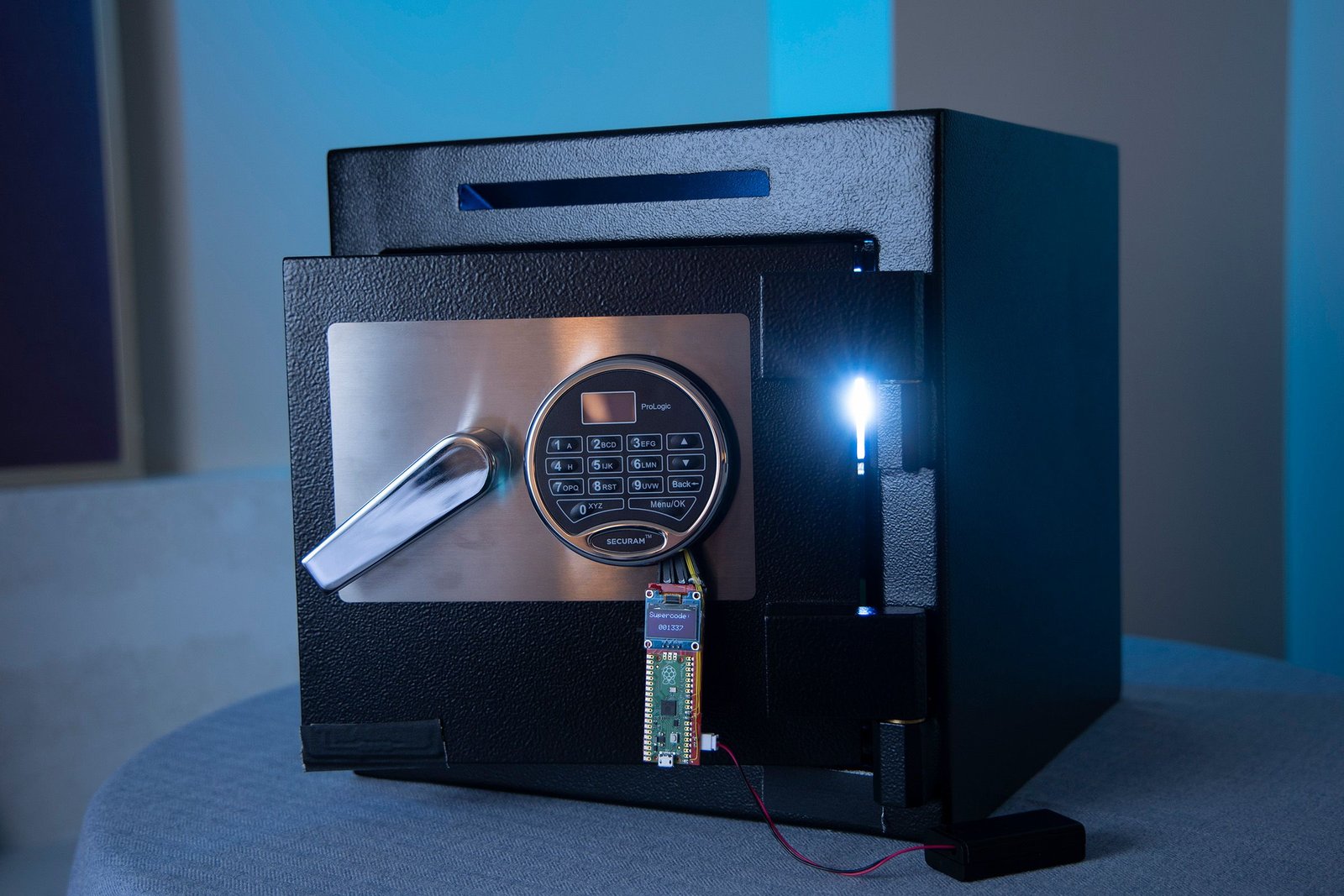
The second technique the researchers developed, which they call CodeSnatch, is more straightforward. By removing the battery from a Securam ProLogic lock and inserting a small handheld tool they made with a Raspberry Pi minicomputer into an exposed debug port inside, they can extract a “super code” combination from the lock that’s displayed on their tool’s screen and can be used to immediately open the lock.
The researchers found that CodeSnatch trick by reverse engineering the Renesas chip that serves as the lock’s main processor. That task was made far easier by the work of a group called fail0verflow, which had published their analysis of the same Renesas chip as part of their efforts to crack the PlayStation 4, which also uses that processor. Omo and Rowley built their tool to reprogram the chip’s firmware to dump all of its information via the debug port—including the encrypted “super code” and the key, also stored on the chip, that decrypts it. “It’s really not that challenging,” says Rowley. “Our little tool does that, and then it tells you what the super code is.”
Gaining access to the lock’s code via its debug port does require inputting a password. But Omo and Rowley say that password was absurdly simple, and they successfully guessed it. They found that in one newer Securam ProLogic lock manufactured in March of this year, Securam had changed the password, but they were able to learn it again by using a “voltage glitching” technique: By soldering a switch to the voltage regulator on the chip, they could mess with its electrical voltage at the exact moment it performed the password check to bypass that check and then dump the chip’s contents—including the new password.
Photograph: Ronda Churchill
In addition to Securam, WIRED reached out to 10 safe manufacturers that appear to use Securam ProLogic locks on their safes, as well as CVS. Most didn’t respond, but a spokesperson for High Noble Safe Company wrote in a statement that WIRED’s inquiry was the first it was learning of Securam’s vulnerabilities, and that it’s now reviewing the security of the locks used by its product line and preparing guidance for customers including “additional physical security measures or potential replacement options.”
A Liberty Safe representative similarly noted the company wasn’t previously aware of Securam’s vulnerabilities. “We are currently investigating this issue with SecuRam and will do whatever it takes to protect our customers,” a statement from the spokesperson reads, “including validating other potential lock suppliers and developing a new proprietary lock system.”
A CVS spokesperson declined to comment on “specific security protocols or devices,” but wrote that “the safety of our employees and patients is a top priority and we are committed to maintaining the highest physical security standards.”
“Safes That Aren’t Safe”
Rowley and Omo say that patching Securam Locks’ security flaws is possible—their own CodeSnatch tool, in fact, could itself be used to update the locks’ firmware. But any such fix would have to be implemented manually, lock by lock, a slow and expensive process.
Although Omo and Rowley aren’t releasing the full technical details or any proof-of-concept code for their techniques, they warn that others with less benevolent intentions could still figure out how to replicate their safecracking tricks. “If you have the hardware and you’re skilled in the art, this would be roughly a one-week thing,” Omo says.
He and Rowley decided to go public with their research despite that risk to make safe owners aware that their locked metal boxes may not be as secure as they think. More broadly, Omo says that they wanted to call attention to the wide gaps in US cybersecurity standards for consumer products. Securam locks are certified by Underwriters Laboratory, he points out—yet suffered from critical security flaws that will be tough to fix. (Underwriters Laboratory did not immediately respond to WIRED’s request for comment.)
In the meantime, they say, safe owners should at least know about their safes’ flaws—and not rely on a false sense of security.
“We want Securam to fix this, but more importantly we want people to know how bad this can be,” Omo says. “Electronic locks have electronics inside. And electronics are hard to secure.”
