Close Menu

    Subscribe to Updates

    Get the latest creative news from FooBar about art, design and business.

    What's Hot

    Casio’s new G-Shock Mudmaster GGB100X watches with quad sensors and Bluetooth officially arrive in the US

    As brands respond to AI search, walls crumble between paid and organic

    Why a Gen Alpha–focused skin-care brand is giving equity to teen creators

    Facebook X (Twitter) Instagram
    • Artificial Intelligence
    • Business Technology
    • Cryptocurrency
    • Gadgets
    • Gaming
    • Health
    • Software and Apps
    • Technology
    Facebook X (Twitter) Instagram Pinterest Vimeo
    Tech AI Verse
    • Home
    • Artificial Intelligence

      What the polls say about how Americans are using AI

      February 27, 2026

      Tensions between the Pentagon and AI giant Anthropic reach a boiling point

      February 21, 2026

      Read the extended transcript: President Donald Trump interviewed by ‘NBC Nightly News’ anchor Tom Llamas

      February 6, 2026

      Stocks and bitcoin sink as investors dump software company shares

      February 4, 2026

      AI, crypto and Trump super PACs stash millions to spend on the midterms

      February 2, 2026
    • Business

      Google releases Gemini 3.1 Flash Lite at 1/8th the cost of Pro

      March 4, 2026

      Huawei Watch GT Series

      March 4, 2026

      Weighing up the enterprise risks of neocloud providers

      March 3, 2026

      A stolen Gemini API key turned a $180 bill into $82,000 in two days

      March 3, 2026

      These ultra-budget laptops “include” 1.2TB storage, but most of it is OneDrive trial space

      March 1, 2026
    • Crypto

      Banks Respond to Kraken’s Federal Reserve Access as Trump Sides with Crypto

      March 4, 2026

      Hyperliquid and DEXs Break the Top 10 — Is the CEX Era Ending?

      March 4, 2026

      Consensus Hong Kong 2026: The Institutional Turn 

      March 4, 2026

      New Crypto Mutuum Finance (MUTM) Reports V1 Protocol Progress as Roadmap Enters Phase 3

      March 4, 2026

      Bitcoin Short Sellers Caught Off Guard in New White House Move

      March 4, 2026
    • Technology

      Casio’s new G-Shock Mudmaster GGB100X watches with quad sensors and Bluetooth officially arrive in the US

      March 6, 2026

      As brands respond to AI search, walls crumble between paid and organic

      March 6, 2026

      Why a Gen Alpha–focused skin-care brand is giving equity to teen creators

      March 6, 2026

      ‘Nobody’s asking the question’: WPP’s biggest restructure in years means nothing until CMOs say it does

      March 6, 2026

      UK government delays AI copyright rules amid artist outcry

      March 6, 2026
    • Others
      • Gadgets
      • Gaming
      • Health
      • Software and Apps
    Check BMI
    Tech AI Verse
    You are at:Home»Technology»Little-known leguminous plant can increase beef production by 60% (2022)
    Technology

    Little-known leguminous plant can increase beef production by 60% (2022)

    TechAiVerseBy TechAiVerseAugust 9, 2025No Comments6 Mins Read2 Views
    Facebook Twitter Pinterest Telegram LinkedIn Tumblr Email Reddit
    Little-known leguminous plant can increase beef production by 60% (2022)
    Share
    Facebook Twitter LinkedIn Pinterest WhatsApp Email

    Little-known leguminous plant can increase beef production by 60% (2022)

    A study conducted for four years has revealed that the intercropping of Brachiaria brizantha cv. Marandu, also known as marandu grass, with the forage legume Desmodium ovalifolium (desmodium) increases the weight of grazing cattle in 60% in comparison with pastures without the use of nitrogen fertilization. “The introduction of the legume had the same impact of an annual application of 150 kilos of nitrogen fertilizer per hectare in the pasture”, explains Robert Boddey, a researcher at Embrapa Agrobiology.

    Newly published in the journal Grass & Forage Science, one of the most important in the area of forage cultivation, the study also points out that the use of Desmodium ovalifolium can reduce time to slaughter by 30%, which represents less costs for breeders. “Reducing time to slaughter also entails less enteric methane emissions (cow burps) into the atmosphere”, Boddey adds. An adult animal in the pasture emits between 50 and 60 kilos of methane per year.

    The use of desmodium in the pasture not only cuts emissions of enteric methane but also of nitrous oxide by allowing a reduction in the use of nitrogen fertilization on pastures. The nitrous oxide is the most powerful gas of effect greenhouse. According to research, each kilo of nitrogen applied over the field emits an amount of nitrous oxide that is equivalent to at least four kilos of CO2.

    Learn more about desmodium

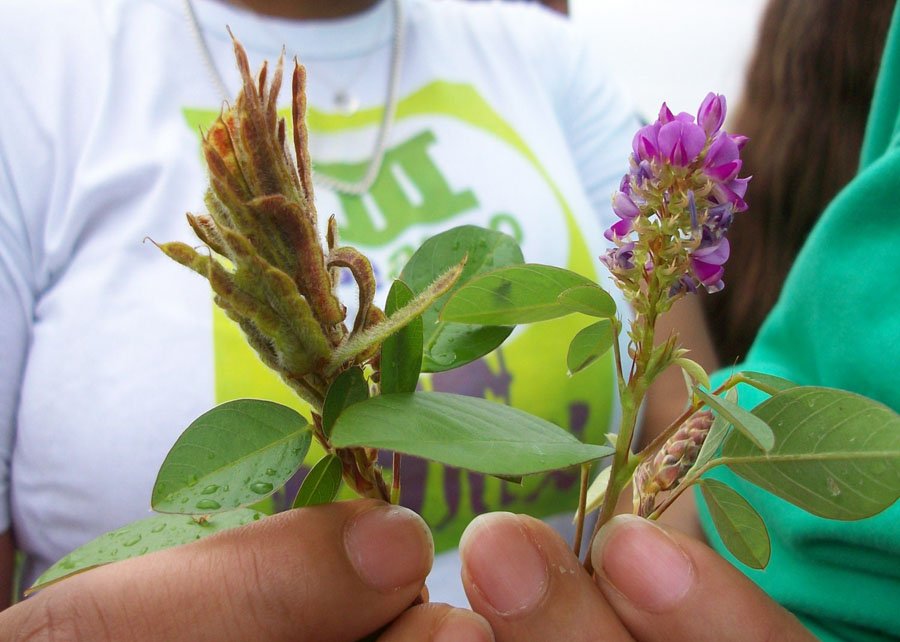
    Desmodium ovalifolium is a perennial forage legume of Asian origin. The plant is a subshrub that can reach up to a meter of height. The stem is practically hairfree, except in the extremities, where there is a fine and silky hairiness. When the stem’s lower knots are in contact with the soil, they easily take root. The leaves are trifoliate with oval leaflets, the terminal one of which is larger than the side ones. The flowers are purple or dark pink, and become bluish after their full bloom. Learn more about its management here.

    Reducing the use of nitrogen fertilizers in pastures allows the elimination of fossile CO2 emissions resulting from their manufacture, transportation and application to the fields. It is estimated that for each 100 kilos of nitrogen fertilizer there is the emission of 450 kilos of CO2 equivalent. “On top of such environmental gain, there is the possibility of reducing expenses with fertilizers, which is currently around 300 dollars per hectare of pasture”, the scientist recalls.

    Segundo Urquiaga, another Embrapa researcher, remarks that the results obtained with the desmodium have gained special importance because the high cost of fertilizers makes Brazilian pastures have limited nitrogen fertilization. “Currently, it is estimated that less than 5% of Brazilian pastures receive some type of nitrogen fertilizer”, Urquiaga states.

    Resistance to the use of leguminous plants

    The use of leguminous plants in the pastures is not an option many breeders adopt. “There is resistance among farmers not only because the seeds are expensive, but also because the species used so far, especially Stylosanthes, do not persist when associated with Brachiaria grasses”, Boddey explains. After some time in the field the leguminous plant wanes or dies, ant it is necessary to renew the pasture, which entails further costs and work.

    The Embrapa researcher states that this does not occur with desmodium, and it is possible have the legume in the pasture for over nine years. “As it is a stoloniferous plant, that is, its roots or culms grow along the ground and originate a new plant, it is not necessary to keep renewing the pasture”, Boddey clarifies.

    According to him, if the leguminous plants whose reproduction is stolon-based are adequately managed in the pasture, they will persist there. “In desmodium’s case, the solution is to have the cattle graze it when the plant height reaches 30 cm and remove the animals when the average height is 15 cm”, he recommends.

    Next steps

    The scientists explain that one of the main sources of methane emissions to the atmosphere is “cow burps”, and they can be more or less intense depending on the cattle’s diet. Because desmodium is a species with high tannin content, the researchers understand that it can help digestion and also contribute to reducing emissions of the gas. Tannin is a chemical compound especially present in the rinds, stems, leaves and seeds of leguminous plants.

    GHG emission studies in fields and in laboratories are already underway. “Assessing the animal is rather complicated, because it is necessary to also evaluate forage consumption and animal performance”, Boddey reports. For that purpose, the researchers use a special collector connected to the animal, which for a period collects the emitted gas that is later evaluated in laboratory. Preliminary data show that the reduction can be higher than 10%.

    The research

    For four years, this study was performed by Embrapa Agrobiology at the Cocoa Farming Plan Executive Commission’s (Ceplac) Animal Science Experimental Station in the town of Itabela, south of Bahia.

    It compared three pasture areas: the first mixing desmodium and Brachiaria brizantha cv. Marandu grass without the application of nitrogen fertilizer, the second one with the cultivation of such marandu grass with the annual application of 150kg of nitrogen (fertilized pasture), and a third area with cultivation of the Brachiaria grass without nitrogen fertilization.

    The use of desmodium in the pastures of this Atlantic rainforest region has been evaluated by Embrapa since 2009. Such research goals are to verify the system’s nitrogen incorporation capacity, reduce greenhouse gas emissions, and make Brazilian pastures more productive. “It is important to highlight that the results obtained with Desmodium ovalifolium are for this biome”, the researcher adds.

    Seeds in cattle feed

    According to Ceplac researcher Cláudia de Paula Rezende, managing desmodium requires just as much other species. The animal scientist has worked for over two decades assessing the use of this and other leguminous species in pastures. “Farmers need to see their pastures as crop to which they must supply enough nutrients so that they become perennial and can yield results both in the animals and in the system as a whole”, the researcher comments.

    Rezende explains that desmodium can be introduced in the pasture at the time the grass is sown with a few recommendations. “You should not sow them together because the seed of this leguminous plant is very small, and if you place it in the sowing machine with the grass seed the latter will fall first”, she warns.

    Thus she considers adding the desmodium seeds to the cattle feed easier. “If we add around 100 grams of non-scarified seeds, the cattle will ingest them and then defecate in the pasture, so the seeds can be set and grow”, the animal scientist explains. 

    Share. Facebook Twitter Pinterest LinkedIn Reddit WhatsApp Telegram Email
    Previous ArticleGPU-rich labs have won: What’s left for the rest of us is distillation
    Next Article Can Google’s SensorLM Redefine Smart Health Tracking?
    TechAiVerse
    • Website

    Jonathan is a tech enthusiast and the mind behind Tech AI Verse. With a passion for artificial intelligence, consumer tech, and emerging innovations, he deliver clear, insightful content to keep readers informed. From cutting-edge gadgets to AI advancements and cryptocurrency trends, Jonathan breaks down complex topics to make technology accessible to all.

    Related Posts

    Casio’s new G-Shock Mudmaster GGB100X watches with quad sensors and Bluetooth officially arrive in the US

    March 6, 2026

    As brands respond to AI search, walls crumble between paid and organic

    March 6, 2026

    Why a Gen Alpha–focused skin-care brand is giving equity to teen creators

    March 6, 2026
    Leave A Reply Cancel Reply

    Top Posts

    Ping, You’ve Got Whale: AI detection system alerts ships of whales in their path

    April 22, 2025705 Views

    Lumo vs. Duck AI: Which AI is Better for Your Privacy?

    July 31, 2025291 Views

    6.7 Cummins Lifter Failure: What Years Are Affected (And Possible Fixes)

    April 14, 2025164 Views

    6 Best MagSafe Phone Grips (2025), Tested and Reviewed

    April 6, 2025125 Views
    Don't Miss
    Technology March 6, 2026

    Casio’s new G-Shock Mudmaster GGB100X watches with quad sensors and Bluetooth officially arrive in the US

    Casio’s new G-Shock Mudmaster GGB100X watches with quad sensors and Bluetooth officially arrive in the…

    As brands respond to AI search, walls crumble between paid and organic

    Why a Gen Alpha–focused skin-care brand is giving equity to teen creators

    ‘Nobody’s asking the question’: WPP’s biggest restructure in years means nothing until CMOs say it does

    Stay In Touch
    • Facebook
    • Twitter
    • Pinterest
    • Instagram
    • YouTube
    • Vimeo

    Subscribe to Updates

    Get the latest creative news from SmartMag about art & design.

    About Us
    About Us

    Welcome to Tech AI Verse, your go-to destination for everything technology! We bring you the latest news, trends, and insights from the ever-evolving world of tech. Our coverage spans across global technology industry updates, artificial intelligence advancements, machine learning ethics, and automation innovations. Stay connected with us as we explore the limitless possibilities of technology!

    Facebook X (Twitter) Pinterest YouTube WhatsApp
    Our Picks

    Casio’s new G-Shock Mudmaster GGB100X watches with quad sensors and Bluetooth officially arrive in the US

    March 6, 20262 Views

    As brands respond to AI search, walls crumble between paid and organic

    March 6, 20262 Views

    Why a Gen Alpha–focused skin-care brand is giving equity to teen creators

    March 6, 20262 Views
    Most Popular

    7 Best Kids Bikes (2025): Mountain, Balance, Pedal, Coaster

    March 13, 20250 Views

    VTOMAN FlashSpeed 1500: Plenty Of Power For All Your Gear

    March 13, 20250 Views

    Best TV Antenna of 2025

    March 13, 20250 Views
    © 2026 TechAiVerse. Designed by Divya Tech.
    • Home
    • About Us
    • Contact Us
    • Privacy Policy
    • Terms & Conditions

    Type above and press Enter to search. Press Esc to cancel.