

Inside the automated warehouse where robots are packing your groceries
It’s the lack of noise you notice first. There’s no clatter of equipment, rumble of engines, or chatter of coworkers. Only the low hum of electronics. For an industrial space, this is eerily quiet, but it makes sense in a building where robots might outnumber people.
I’m at a warehouse — or customer fulfilment center (CFC) — operated by online grocery company Ocado in Luton, just outside London. You might not have heard of Ocado, but it may still have delivered your groceries. Its technology handles online orders for Kroger across 14 US states, Sobeys in Canada, and both Morrisons and its own delivery brand in the UK, with other clients across Europe and Asia.
The grocery business has tight margins, and online orders even more so, with stores having to front the added costs of picking, packing, and shipping orders. Ocado, which launched in 2000, has always been a proponent of using automation to cut those costs.
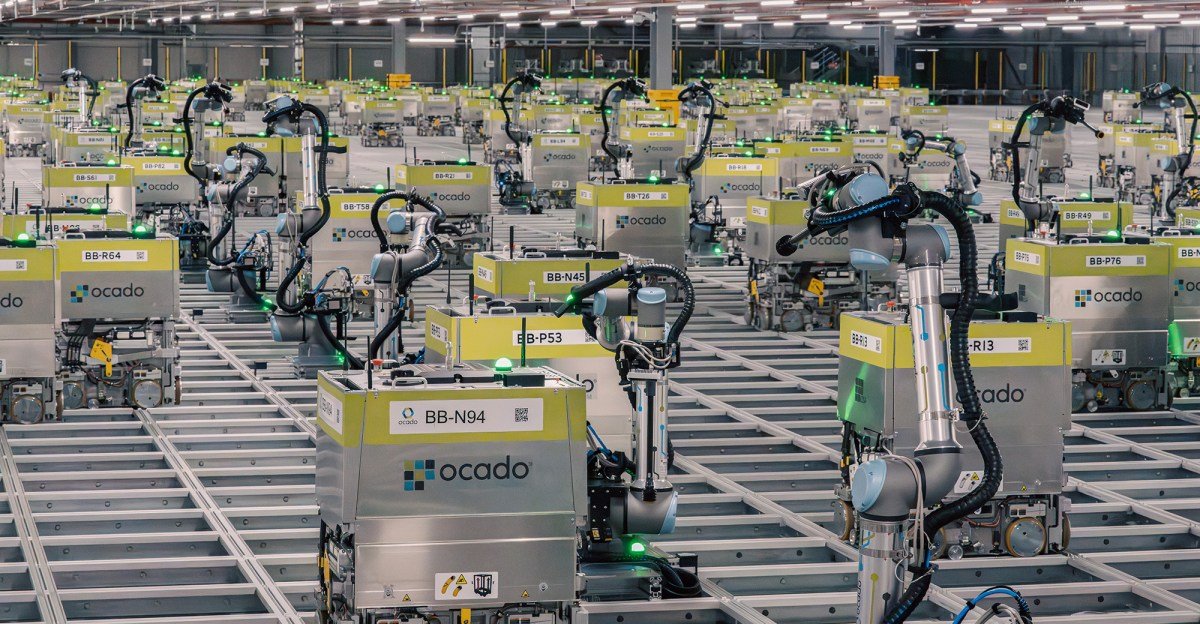
At the heart of it all is “the Grid.” Sprawling across most of the warehouse’s top floor, this crisscross of tracks allows a fleet of hundreds of blocky, bulky robots to whoosh around, carefully controlled by a central computer to avoid collisions, moving custom-built trays of bread, tins, ready meals, and more to wherever they need to be. It’s almost entirely automated — so much so that as I stand looking out from a maintenance walkway, I can’t see a single soul apart from the Ocado employees guiding me around that morning. Few humans are required to supervise the robots or work alongside them. Even tech support is handled remotely, by a team in Bulgaria. At one point, I see a robot’s cheery green LEDs turn amber, indicating a problem. It quickly halts, and sits there, flashing orange, for 30 seconds or so, then pings green and trundles happily on again, no in-person help required.
None of this is new. In fact, it’s not even the first time The Verge has seen it — back in 2018, we visited another CFC in the UK, when the Grid was cutting-edge. Now it’s old news; not set to be replaced, but in the midst of an upgrade that adds one crucial element: arms.
Let’s step back for a moment. The cuboid bots on the Grid don’t pack anyone’s shopping bags. Until recently, they’ve only been tasked with moving crates, grabbing a box of beans from the chute where it’s stored, and moving it to another chute, where it drops down alongside a human worker just in time for them to pack a couple of tins into someone’s shopping bag. Workers are expected to pack items in seconds, and the system works because it’s extraordinarily efficient. By the time an employee is ready to pack an item, it’s already at their side, and a display is telling them how many to pack, into which bags, in which crates. Even the order of their instructions is calibrated by the computer to minimize unnecessary movement that might slow them down. This is human work, but optimized to its limits.
But now there’s something new. Perched across the Grid, rearing high above their squat compatriots, are a new type of robot. These sit in place, islands in the constant whir of movement around them. But just like the people standing a floor below, they’re busy packing bags.
Dubbed On-Grid Robotic Pick (OGRP), each arm is fitted with a small suction cup on one end. Sixty-five of them sit on the Grid in Luton, with 500 of the original robots that bring crates to them, some with customer shopping bags to be filled, others with groceries ready to be packed, and the arms pick objects up and pack them into the bags. Each OGRP arm has a camera to help pick up groceries, but they’re not designed to recognize damaged goods, so they won’t spot broken eggs or bruised apples, giving humans at least some advantage.
In 2024, OGRP packed over 30 million orders with fewer than 100 arms installed, and by the end of this year Ocado expects to have almost 500 in place. James Matthews, Ocado’s deputy CEO, tells me that right now the arms are able to pack around 40 percent of Ocado’s groceries. The company expects to reach the 80 percent range, partly through the introduction of a range of new endpoint attachments to go along with the current suction cup, from a parallel gripper to a soft, handlike one. That’s not a decade away, either — that’s where they expect to be “in the next two or three years.”
Hitting 100 percent isn’t part of the plan. Ocado expects that some items just won’t be worth automating. Wine bottles and watermelons are too heavy for the current suction cup to handle, and a gripper might cause damage. Ocado is developing a dedicated attachment for wine bottles, because it processes a lot of them, but it’s leaving watermelons to the humans — developing a dedicated tool just for one item simply isn’t worth it.
But things can change. When The Verge visited Ocado all those years ago, we saw an early prototype of OGRP, long before it was ready to roll out. “Nothing stumps a robot quite like a bag of oranges,” we wrote at the time, highlighting the limits of the tech: the bags move unpredictably, there’s no easy point for a suction cup to grab, and too strong a grip leaves you with juice, not fruit. Ocado agreed that this was beyond their reach, but eight years on, Matthews tells me, the robots have figured it out for themselves. The AI models that underpin their programming (which Matthews calls “cousins” of the generative AI models grabbing headlines elsewhere) weren’t trained for bags of fruit, but after experimentation learned they could attach their suction cup to the right point on the label and lift the whole bag from there, unlocking a new skill for every robot across the range.
Ocado is looking at opportunities for automation almost everywhere in the warehouse. There are still workers unpacking incoming shipments of products and loading them into the crates on the Grid, but I’m quickly told the company is working on new automations for that. Others load heavy metal trollies onto the outgoing vans, but there’s a mobile robot in development for that job too. The safest of the lot might be the actual drivers — while Ocado invests in both Wayve and Oxa, two UK startups working on autonomous driving, Matthews doesn’t see deliveries becoming fully automated anytime soon. This is, after all, the one point in the process that’s customer-facing, and Matthews doesn’t sound too tempted by a future where customers are tasked with unloading delivery vans for themselves.
Delivery aside, Ocado is well suited to automation because its pursuit of efficiency has already made so many of its jobs simple, mechanical, and repetitive anyway. The more efficient and focused workers are, the easier it is to design a robot to take over for them. Plus, some of the jobs it’s replacing are grueling and difficult to staff at the best of times, like employees tasked with packing ice cream and other frozen food. “You just literally cannot find the people who want to come in and work in a freezer,” Matthews claims, making these jobs natural candidates to automate.
But Ocado also enjoys a certain amount of distance from the staff it replaces. It sells the technology inside its CFCs to clients, but doesn’t run day-to-day operations itself. Visit a Kroger CFC in the US, and it might be packed to the rafters with Ocado robots, but the human employees will all be paid by Kroger, not Ocado — and when layoffs come around, it’s not Ocado administering them. Ocado itself isn’t cutting jobs. In fact, it’s growing, Matthews tells me, opening more sites, expanding its R&D, and hiring more remote support workers.
Additional automation, and fewer human jobs, is clearly in the future for the grocery stores Ocado supports, though. But what exactly will that future look like? Eight years ago, the robotic arms were the promise of tomorrow, so what’s their equivalent now? “Efficiency” might be one answer. Ocado is working on lighter, cheaper, and more energy-efficient versions of its robots, including new 3D-printed Cartesian models that weigh a third of the originals. That has knock-on effects — lighter robots are less likely to cause damage or harm someone in a collision, so Ocado can reduce the size of the crash barriers around the Grid, making it more compact and more modular, easier to scale down to smaller sites.
But if you ask Matthews, the bigger changes will be harder to predict. The arms only made the jump from development project to working infrastructure when the AI models inside them made their own leap forward. The most important problems aren’t the physical ones, but the analytical ones, designing machines intelligent enough to work through the edge cases, to adapt to problems like a bent crate that won’t fit its rack, causing a jam. “It isn’t useful solving something 90 percent of the time,” Matthews says. “Because if 10 percent of the time you have to pay an expensive engineer to go and unjam it, you’re better off doing it manually.”
Those 10 percent problems are where Ocado and its clients still feel the need to keep people involved — but it’s not much of a gap for the machines to close.
Follow topics and authors from this story to see more like this in your personalized homepage feed and to receive email updates.
