Close Menu

    Subscribe to Updates

    Get the latest creative news from FooBar about art, design and business.

    What's Hot

    Google’s still struggling to crack PC gaming

    Xbox unveils first tech details of its next generation console, codenamed Project Helix

    Developer sues publisher after leaving Kickstarter backers waiting over two years for promised physical editions

    Facebook X (Twitter) Instagram
    • Artificial Intelligence
    • Business Technology
    • Cryptocurrency
    • Gadgets
    • Gaming
    • Health
    • Software and Apps
    • Technology
    Facebook X (Twitter) Instagram Pinterest Vimeo
    Tech AI Verse
    • Home
    • Artificial Intelligence

      What the polls say about how Americans are using AI

      February 27, 2026

      Tensions between the Pentagon and AI giant Anthropic reach a boiling point

      February 21, 2026

      Read the extended transcript: President Donald Trump interviewed by ‘NBC Nightly News’ anchor Tom Llamas

      February 6, 2026

      Stocks and bitcoin sink as investors dump software company shares

      February 4, 2026

      AI, crypto and Trump super PACs stash millions to spend on the midterms

      February 2, 2026
    • Business

      Met Office ‘supercomputing as a service’ one year old

      March 12, 2026

      Tech hiring evolves as candidates ask for AI compute alongside pay and perks

      March 11, 2026

      Oracle is spending billions on AI data centers as cash flow turns negative

      March 11, 2026

      Google: Cloud attacks exploit flaws more than weak credentials

      March 10, 2026

      Could this be the key to eternal storage? Experts claim new DNA HDD can be ‘erased and overwritten repeatedly’

      March 9, 2026
    • Crypto

      Banks Respond to Kraken’s Federal Reserve Access as Trump Sides with Crypto

      March 4, 2026

      Hyperliquid and DEXs Break the Top 10 — Is the CEX Era Ending?

      March 4, 2026

      Consensus Hong Kong 2026: The Institutional Turn 

      March 4, 2026

      New Crypto Mutuum Finance (MUTM) Reports V1 Protocol Progress as Roadmap Enters Phase 3

      March 4, 2026

      Bitcoin Short Sellers Caught Off Guard in New White House Move

      March 4, 2026
    • Technology

      Google’s still struggling to crack PC gaming

      March 12, 2026

      Media Briefing: In the AI era, subscribers are the real prize — and the Telegraph proves it

      March 12, 2026

      Furniture.com was built for SEO. Now it’s trying to crack AI search

      March 12, 2026

      How medical creator Nick Norwitz grew his Substack paid subscribers from 900 to 5,200 within 8 months

      March 12, 2026

      Inside Amazon’s effort to shape the AI narrative on sustainability and ethics

      March 12, 2026
    • Others
      • Gadgets
      • Gaming
      • Health
      • Software and Apps
    Check BMI
    Tech AI Verse
    You are at:Home»Technology»Indigenous knowledge meets artificial intelligence
    Technology

    Indigenous knowledge meets artificial intelligence

    TechAiVerseBy TechAiVerseAugust 16, 2025No Comments5 Mins Read6 Views
    Facebook Twitter Pinterest Telegram LinkedIn Tumblr Email Reddit
    Indigenous knowledge meets artificial intelligence
    Share
    Facebook Twitter LinkedIn Pinterest WhatsApp Email

    Indigenous knowledge meets artificial intelligence

    There is no word for art in most Native American languages. Instead, the closest terms speak not to objecthood but to action and intention. In Lakota, “wówačhiŋtȟaŋka” implies deep thought or reflection, while “wóčhekiye” suggests offering or prayer. Art is not separate from life; it is ceremony, instruction, design. Like architecture or code, it carries knowledge and enacts responsibility. Its power lies not in being preserved or displayed but in how it moves, teaches, and connects through use—principles that challenge the tech industry’s assumptions about intelligence and interaction.

    A new vanguard of Native artists—Suzanne Kite (Oglala Lakota), Raven Chacon (Diné), and Nicholas Galanin (Tlingít)—are building on this principle. They are united not by stereotypical weaving and carving or revanchist critique of Silicon Valley, but through their rejection of extractive data models in favor of relationship-based systems. These technologists put the human-tech relationship at the center of their work.

    Suzanne Kite’s AI art installations, for example, model a Lakota framework of data sovereignty: intelligence that emerges only through reciprocal, consensual interaction. Unlike systems that assume user consent via opaque terms of service, her kinetic machines require the viewer’s physical presence—and give something back in return. 

    “It’s my data. It’s my training set. I know exactly what I did to train it. It’s not a large model but a small and intimate one,” Kite says. “I’m not particularly interested in making the most technologically advanced anything. I’m an artist; I don’t make tech demos. So the complexity needs to come at many layers—not just the technical.”

    Where Kite builds working prototypes of consent-based AI, other artists in this cohort explore how sound, robotics, and performance can confront the logic of automation, surveillance, and extraction. But Native people have never been separate from technology. The land, labor, and lifeways that built America’s infrastructure—including its tech—are Indigenous. The question isn’t whether Native cultures are contributing now, but why they were ever considered separate. 

    Native technologies reject the false binaries foundational to much Western innovation. These artists ask a more radical question: What if intelligence couldn’t be gathered until a relationship had been established? What if the default were refusal, not extraction? These artists aren’t asking to be included in today’s systems. They’re building what should come next.


    Suzanne Kite

    Wičhíŋčala Šakówiŋ (Seven Little Girls)
    2023
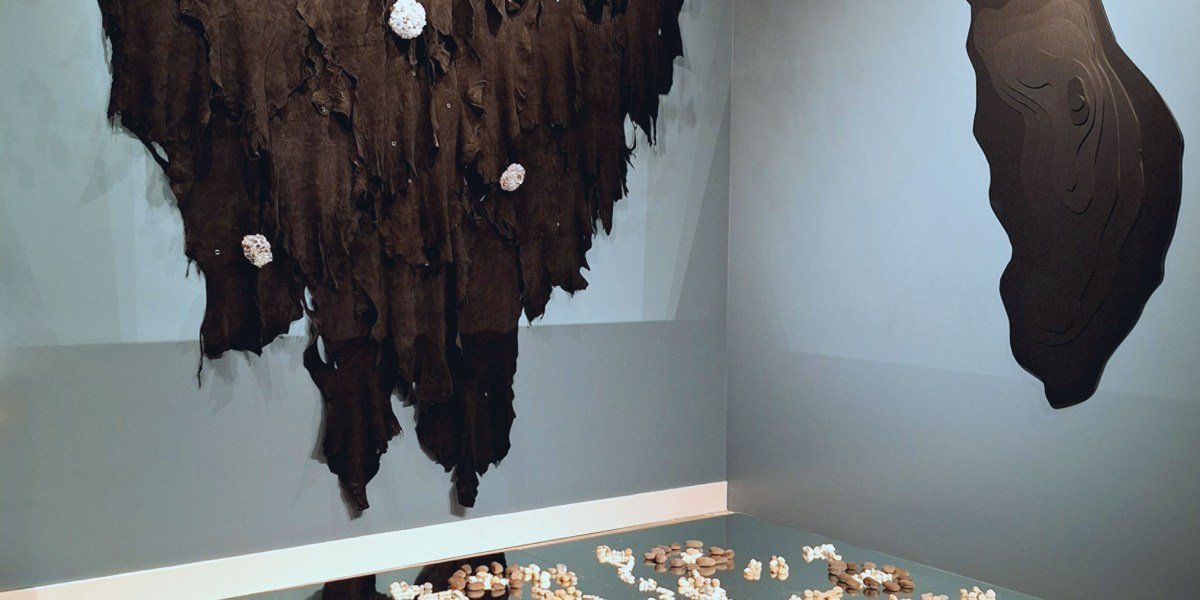
    For Kite, the fundamental flaw of Western technology is its severance of knowledge from the body. In this installation, a four-meter hair braid with embedded sensors translates the artist’s body movements into machine-learning algorithms. During her live performance, Kite dances while the braid reads the force and rhythm of her gestures, generating audio responses that fill the museum gallery of the Institute of American Indian Arts in Santa Fe, New Mexico. Below her, stones arranged in patterns reflecting Lakota star maps anchor the performance in traditional astronomical knowledge.

    COURTESY OF THE ARTIST

    Ínyan Iyé (Telling Rock)
    2019
    This installation uses embedded AI to speak and respond to viewers, upending assumptions about intelligence and agency. “People listen close, I whisper / The rock speaks beyond hearing … Many nations speaking / We speak to each other without words,” it intones, its lights shifting as viewers engage with its braided tendrils. The piece aims to convey what Kite calls “more-than-human intelligence”—systems rooted in reciprocity, the fundamental principle that all relationships involve mutual exchange and responsibility.

    COURTESY OF THE ARTIST

    Raven Chacon

    Voiceless Mass
    2021
    Raven Chacon’s Pulitzer Prize–winning musical composition Voiceless Mass premiered in 2021 at the Cathedral of St. John the Evangelist in Milwaukee. The piece generates what he calls “sounds the building can hear”—electronic frequencies that exploit the cathedral’s acoustics to create spectral voices without human vocal cords, a technological séance that gives presence to historical absence. Each site-specific performance is recorded, generating material that mirrors how sensor networks log presence—but only with explicit consent.

    COURTESY OF THE ARTIST

    Nicholas Galanin

    Aáni yéi xat duwasáakw (I am called Land)
    2025
    Galanin’s mechanical drum installation stages a conflict between machine motion and human memory, asking what happens when culture is performed without a consenting body. A box drum—an instrument historically carved from red cedar and hung with braided spruce root—is here made of cherrywood and suspended from the ceiling at the MassArt Art Museum in Boston as is traditionally done in Tlingit plank houses. Played at tribal meetings, celebrations, and ceremonies, these drums hold sonic memory as well as social function. A mechanical arm strikes, unfaltering, at the tempo of a heartbeat; like a warning, the sound pulses with the tension between automation and ancestry.–––

    COURTESY OF THE ARTIST

    I think it goes like this (pick yourself up)
    2025
    This Herculean bronze sculpture cast from deconstructed faux totem blocks serves to indict settler sabotage of Native technology and culture. Unlike today’s digital records—from genealogical databases to virtual versions of sacred texts like the Bible—Tlingit data is carved in wood. Galanin’s totem poles underscore their function as information systems, their carvings encoding history, mythology, and family.

    COURTESY OF THE ARTIST

    Petala Ironcloud is a California-born Lakota/Dakota and Jewish writer and textile artist based in New York.

    Share. Facebook Twitter Pinterest LinkedIn Reddit WhatsApp Telegram Email
    Previous ArticleWhy US federal health agencies are abandoning mRNA vaccines
    Next Article Why GPT-4o’s sudden shutdown left people grieving
    TechAiVerse
    • Website

    Jonathan is a tech enthusiast and the mind behind Tech AI Verse. With a passion for artificial intelligence, consumer tech, and emerging innovations, he deliver clear, insightful content to keep readers informed. From cutting-edge gadgets to AI advancements and cryptocurrency trends, Jonathan breaks down complex topics to make technology accessible to all.

    Related Posts

    Google’s still struggling to crack PC gaming

    March 12, 2026

    Media Briefing: In the AI era, subscribers are the real prize — and the Telegraph proves it

    March 12, 2026

    Furniture.com was built for SEO. Now it’s trying to crack AI search

    March 12, 2026
    Leave A Reply Cancel Reply

    Top Posts

    Ping, You’ve Got Whale: AI detection system alerts ships of whales in their path

    April 22, 2025714 Views

    Lumo vs. Duck AI: Which AI is Better for Your Privacy?

    July 31, 2025299 Views

    Wired Headphones Are Making A Comeback, And We Have Gen Z To Thank

    July 22, 2025210 Views

    6.7 Cummins Lifter Failure: What Years Are Affected (And Possible Fixes)

    April 14, 2025169 Views
    Don't Miss
    Technology March 12, 2026

    Google’s still struggling to crack PC gaming

    Google’s still struggling to crack PC gaming Image: Razer Summary created by Smart Answers AIIn…

    Xbox unveils first tech details of its next generation console, codenamed Project Helix

    Developer sues publisher after leaving Kickstarter backers waiting over two years for promised physical editions

    Valve responds to NY Attorney General lawsuit: “We have serious concerns with the alterations the NYAG claims are necessary to make to our games”

    Stay In Touch
    • Facebook
    • Twitter
    • Pinterest
    • Instagram
    • YouTube
    • Vimeo

    Subscribe to Updates

    Get the latest creative news from SmartMag about art & design.

    About Us
    About Us

    Welcome to Tech AI Verse, your go-to destination for everything technology! We bring you the latest news, trends, and insights from the ever-evolving world of tech. Our coverage spans across global technology industry updates, artificial intelligence advancements, machine learning ethics, and automation innovations. Stay connected with us as we explore the limitless possibilities of technology!

    Facebook X (Twitter) Pinterest YouTube WhatsApp
    Our Picks

    Google’s still struggling to crack PC gaming

    March 12, 20263 Views

    Xbox unveils first tech details of its next generation console, codenamed Project Helix

    March 12, 20262 Views

    Developer sues publisher after leaving Kickstarter backers waiting over two years for promised physical editions

    March 12, 20261 Views
    Most Popular

    Over half of American adults have used an AI chatbot, survey finds

    March 14, 20250 Views

    UMass disbands its entering biomed graduate class over Trump funding chaos

    March 14, 20250 Views

    Outbreak turns 30

    March 14, 20250 Views
    © 2026 TechAiVerse. Designed by Divya Tech.
    • Home
    • About Us
    • Contact Us
    • Privacy Policy
    • Terms & Conditions

    Type above and press Enter to search. Press Esc to cancel.