

New black hole merger bolsters Hawking area theorem
a black hole hunting machine
Physicists spliced merger’s gravitational signal into isolated frequencies to determine surface areas.
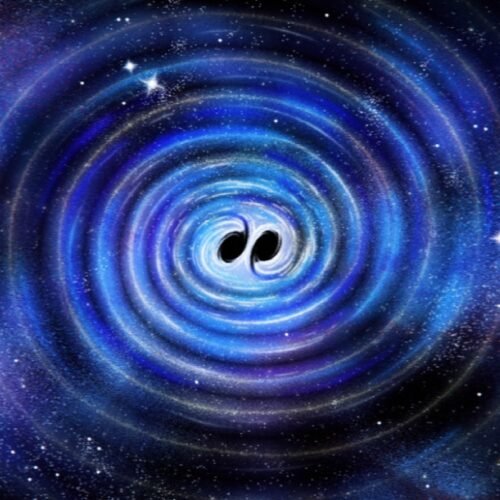
The clearest black hole merger signal yet, recorded by LIGO in January 2025, offers new insights into these mysterious objects.
Credit:
Maggie Chiang/Simons Foundation
Back in 1971, the late physicist Stephen Hawking made an intriguing prediction: The total surface area of a black hole cannot decrease, only increase or remain stable. So if two black holes combine, the newly formed black hole will have a larger surface area. This became known as Hawking’s area theorem. Analysis of the gravitational signal from a black hole merger detected in January provides the best observational evidence to date in support of Hawking’s theorem, according to a new paper published in the journal Physical Review Letters.
The breakthrough just happens to coincide with the 10-year anniversary of the LIGO collaboration’s Nobel Prize-winning first detection of a black hole merger. A second paper has been submitted (but not yet accepted), placing theoretical limits on a predicted third tone at a higher pitch that could be lurking in the event’s gravitational wave signal.
Now known as LIGO/Virgo/KAGRA (LVK), the collaboration searches the Universe for gravitational waves produced by the mergers of black holes and neutron stars. LIGO detects gravitational waves via laser interferometry, using high-powered lasers to measure tiny changes in the distance between two objects positioned kilometers apart. LIGO has detectors in Hanford, Washington, and in Livingston, Louisiana. A third detector in Italy, Advanced Virgo, came online in 2016. In Japan, KAGRA is the first gravitational-wave detector in Asia and the first to be built underground. Construction began on LIGO-India in 2021, and physicists expect it will turn on sometime after 2025.
Each instrument is so sensitive that it also picks up small ambient vibrations, like a rumbling freight train or natural thermal vibrations in the detectors themselves. So the LIGO collaboration goes to great lengths to shield its instruments and minimize noise in its data. On September 14, 2015, at 5:51 am EST, both detectors picked up signals within milliseconds of each other for the very first time. The waveforms of those signals serve as an audio fingerprint—in this case, evidence for two black holes spiraling inward toward each other and merging in a massive collision event, sending powerful shock waves across spacetime. Picking up the signals was a stunning achievement, and nobody was surprised when the first direct observation of gravitational waves won the 2017 Nobel Prize in Physics.
Early detected mergers involved either two black holes or two neutron stars. In 2021, LIGO/Virgo/KAGRA confirmed the detection of two separate “mixed” mergers between black holes and neutron stars. Once the source was pinpointed, a network of telescopes around the globe was able to capture the accompanying “kilonova”—a massive burst of energy that behaves a bit like a high-powered strobe light, giving astronomers an unprecedented recording of a major celestial event that combined light and sound. It officially ushered in a new age of so-called multi-messenger astronomy (MMA).
A numerical relativity simulation of the recently observed GW250114 event, a binary black hole merger detected by LIGO on January 14, 2025.
The collaboration also detected asymmetrical mergers, where one black hole is much more massive than its partner, as well as discoveries that challenged the so-called “mass gap” between black holes and neutron stars. And this summer, the LIGO/Virgo/KAGRA collaboration detected the gravitational wave signal (dubbed GW231123) of the most massive merger between two black holes yet observed, resulting in a new black hole that is 225 times more massive than our Sun.
Looking for telltale overtones
LIGO is now nearly four times more sensitive than when it recorded that first Nobel-worthy black hole merger. And that sensitivity enabled the collaboration to record the sharpest gravitational wave signal thus far, dubbed GW250114. The event was remarkably similar to its 2015 “twin,” involving two black holes of about 30 solar masses whose merger produced an equally “loud” signal and resulted in a new black hole of about 63 solar masses. But the difference in the two signals’ fidelity enabled researchers to better isolate certain frequencies or tones in the “ringdown,” using that information to calculate the new black hole’s properties and compare it to theoretical predictions.
The breakthrough has been several years in the making. In 2019, we reported that physicists had “heard” the ring of an infant back hole for the first time by splicing the 2015 signal into the telltale “overtones” in the data. Not only were the overtones present, but the pattern of pitch and decay matched predictions for the black hole’s mass and spin derived using the general theory of relativity. The result also supported the so-called “no hair” theorem for the classical description of black holes, which holds that all you need to describe black holes mathematically is their mass and their spin, plus their electric charge. It was the first experimental measurement that succeeded in directly testing the no-hair theorem.
But the final reverberations as the newly formed black hole settled into its new state, aka the ringdown, from that first event were significantly fainter, and scientists were unable to distinguish between the ringing from the initial collision and the ringdown. For GW250114, LIGO’s improved sensitivity meant that scientists could measure the frequency and duration of the merged black hole’s ringdown much more precisely. The resulting analysis bolsters the 2019 results confirming the “no hair” theorem.
Audio comparison of the 2015 and 2025 gravitational wave signals. Credit: LIGO/Virgo/KAGRA
With the latest event, physicists obtained an “exquisitely detailed view of the signal both before and after the black hole merger,” said co-author Maximiliano Isi of Columbia University, who led a 2021 study using the same method on the 2015 data to observationally confirm Hawking’s area theorem. As with the no-hair theorem, the clearer signal from GW250114 further bolsters that earlier result. The GW250114 data revealed that the two initial black holes had a total surface area of about 240,000 square kilometers, about the size of the United Kingdom. After the merger, the new black hole was about 400,000 square kilometers, about the size of Sweden.
“Even though it’s a very simple statement—’areas can only increase’—it has immense implications,” said Isi. Notably, Hawking and Jacob Bekenstein later showed that a black hole’s area is proportional to its entropy, which also must increase per the second law of thermodynamics. This is a key element in ongoing attempts to develop a quantum theory of gravity. “It’s really profound that the size of a black hole’s event horizon behaves like entropy,” said Isi. “It means that some aspects of black holes can be used to mathematically probe the true nature of space and time.”
Caltech physicist Kip Thorne, a longtime friend of Hawking, recalled that when LIGO detected its first gravitational wave signature, Hawking called and asked him if the collaboration would be able to test his theorem. Hawking died in 2018. “If [he] were alive, he would have reveled in seeing the area of the merged black holes increase,” said Thorne.
Physical Review Letters, 2025. DOI: 10.1103/kw5g-d732 (About DOIs).
Jennifer is a senior writer at Ars Technica with a particular focus on where science meets culture, covering everything from physics and related interdisciplinary topics to her favorite films and TV series. Jennifer lives in Baltimore with her spouse, physicist Sean M. Carroll, and their two cats, Ariel and Caliban.
