

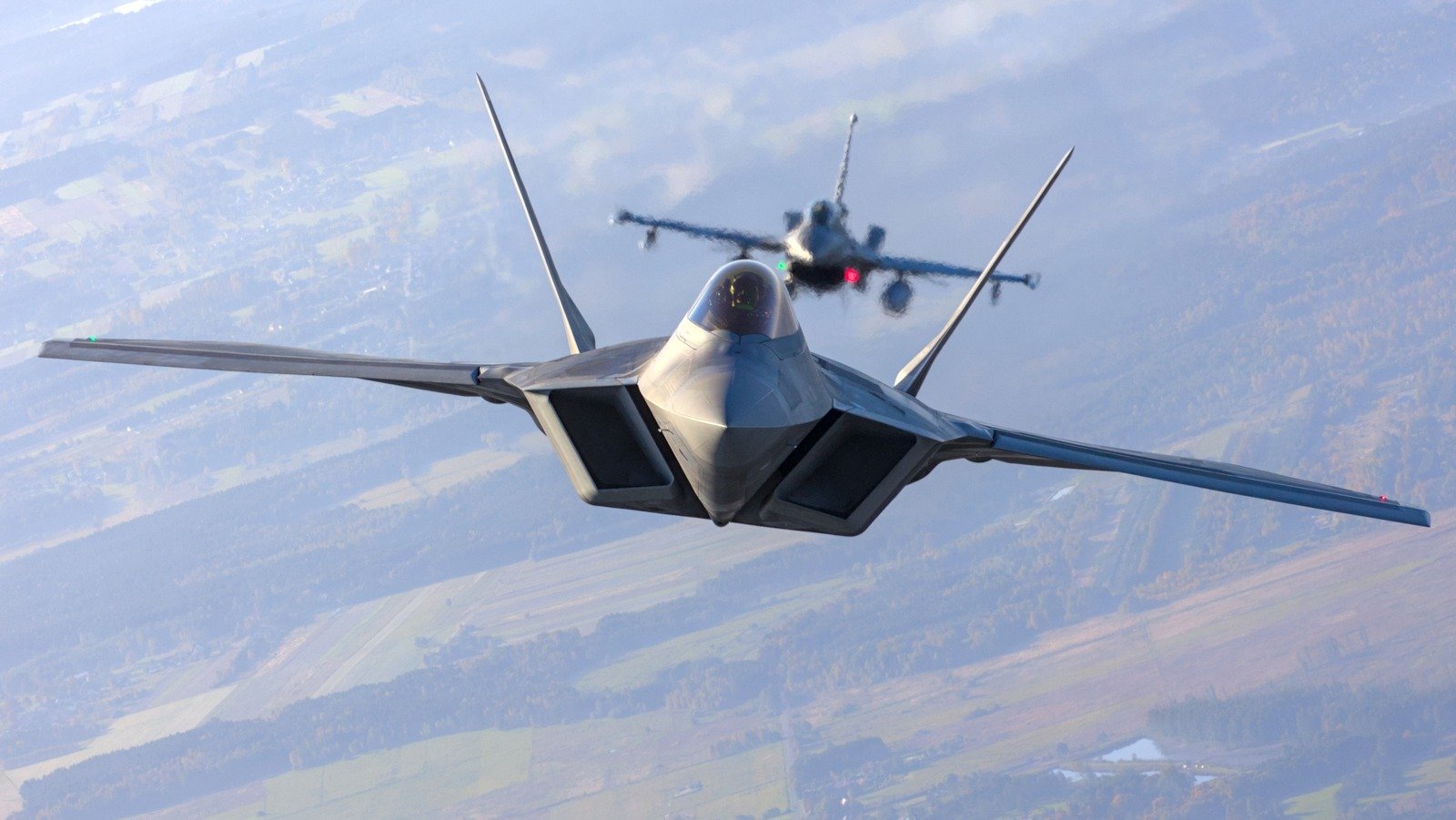
13 Of The Most Agile Fighter Jets Flying Today
Joris van Boven/Shutterstock
The graceful swoop and harried valor of aerial combat have enthralled aviation enthusiasts for decades. Humanity only cracked the code of lift and thrust in the early 20th century. Since then, flying machines have evolved from puttering craft of fabric and wood to virtual rocketships that blast to near-space altitudes.
The First World War established the term ‘dogfight’ for aerial combat between flyers. The violent aerial maneuvers reminded onlookers of dogs swirling and snapping in search of a fatal strike. Powerful aircraft enabled evolving fighter pilots to take off and engage in combat, but agility kept them alive to return. A craft’s ability to turn, maneuver, and pivot for an advantageous position dominated the day of early dogfighting and continues to do so today.
Much of aerial warfare has evolved, but the maneuvering principle remains unchanged. A fighter aircraft with superior agility has an edge in combat. The Mach-2 class General Dynamics F-16 Fighting Falcon is an ultra-speedy yet nimble fighter with combat cred. China’s Chengdu J-10 has recently garnered attention by reportedly scoring victories with a secondary market nation. Russia retains a functional and deadly supply of Su-27 Flankers and MiG-29 Fulcrums.
While the F-22 Raptor and F-35 Lightning soak up the fifth-gen spotlight, and with a sixth generation under development, an arms race for agile jet fighters percolates in the secondary markets. Here’s a peek at some of the most agile fighter jets flying operationally today.
General Dynamics F-16 Fighting Falcon
Matthew Horwood/Getty Images
The 50-year-old F-16 Fighting Falcon is a certified combat legend and the benchmark for agility this side of thrust vectoring. The Flankers and Fulcrums of the world were built to take on the Falcon’s flock, but so far, the closest that contest has come to reality is the skies over Ukraine.
The F-16’s relatively enduring design includes a single-engine design contributing to a lightweight airframe with a high thrust-to-weight ratio. Combined with one of the earliest fly-by-wire systems in military aviation, the F-16 could achieve a top speed near Mach 2. Agility takes a hit at extraordinary speeds, but the F-16 shone in other ways.
One reason for the F-16’s tremendous agility is the concept of relaxed static stability. The F-16’s inherently unstable airframe is kept in check by a computer system. By operating at the edge of the envelope, it can achieve spectacular results while turning and maneuvering, making it an exceptionally agile fighter jet. Its pilots seldom refer to it as the Falcon, preferring the nickname ‘Viper’ for its snake-like appearance and agility.
The F-16 can’t disappear from radar screens like up-to-date modern fighters with incorporated stealth technology. Yet it remains a brutal and commanding air superiority platform in the rarefied air of fighter jet-wielding nations. Modern iterations of the continuously updated F-16 stay in service with more than two dozen militaries.
Lockheed Martin F-22 Raptor
Kevin Burkholder/Getty Images
The Lockheed Martin F-22 Raptor is the gold standard for fifth-generation air superiority fighters today. As much as aerial combat has evolved, today’s fighter pilots still want to get their nose on target before the other guy in a close fight. That’s part of why Lockheed Martin incorporated a thrust vectoring engine system in the F-22.
The Raptor uses a pair of Pratt & Whitney F119-PW-100 turbofans, which offer significant power and incorporate thrust-vectoring capability. Part of the reason the F-22 has rectangular exhaust nozzles is that those nozzles direct engine thrust in different directions.
Thrust vectoring technology has been used to get the short takeoff and landing (STOL) Harrier Jump Jet off the ground. However, the Raptor utilizes 2D thrust vectoring in low-speed flight to adjust nose angle, allowing the aircraft to point in different directions while appearing to hang in the air.
If you’ve ever seen the F-22 perform at an airshow, you’ve seen the terrifying but effectively named ‘post-stall maneuvers’. Nearly every other aircraft without a thrust-vectoring system would drop out of the sky like a rock if it tried to mimic the Raptor. As much as things have changed, keeping the other plane in front of you remains a significant advantage in dogfighting.
Eurofighter Typhoon
Zigmunds Dizgalvis/Getty Images
The development project between Airbus, BAE Systems, and Leonardo paid dividends in the Eurofighter Typhoon. The Typhoon is a fourth-generation multi-role air dominance fighter in the same vein as the F-16. Capable of ground and air attack, it is fast and nimble, and it packs a neat aerodynamic trick.
The Future European Fighter Aircraft organization coalesced in 1983 when the United Kingdom, France, Germany, and Spain pooled resources to develop a Western European fighter for the Cold War. The resulting Typhoon was a Mach 2-class fighter with a combination of fly-by-wire systems and edge-of-the-envelope performance.
The Typhoon does not thrust vector like an F-22 or have the production numbers of the F-16, but it has an ace up its sleeve. Forward canards provide precise pitch control forward of the airframe’s center of gravity, resulting in tighter turns and improved maneuvering. The Typhoon complements its canard trickery with advanced carbon composite materials and modern avionic systems.
With 572 deliveries as of 2020, Austria, Kuwait, Germany, Italy, Spain, the U.K., and others operate the Eurofighter. A German Luftwaffe Eurofighter Typhoon developed a buzz in 2012 when it achieved a simulated victory against a U.S. Air Force F-22 Raptor during training exercises. The mock dogfight took place within visible range, and the Typhoon slipped inside the Raptor’s guard to score the win.
Sukhoi Su-57 Felon
Vladimir Vozdvizhenskiy/Shutterstock
The Russian Sukhoi Su-57 Felon is a single-seat twin-engine fifth-generation fighter that first flew in 2010 to succeed the MiG-29 Fulcrum. Like the Raptor, the Felon uses stealth technology and thrust vectoring for increased maneuverability.
A pair of Saturn/Lyulka 117S engines push the Felon to Mach 2 speeds. Up-to-date sensor arrays detect and track incoming threats. Its stealth technology is reportedly not up to F-22 snuff, but it is there. The Felon can equip air and ground weapons and patrol with thrust vectoring tech similar to the F-22.
The Felon is no doubt precious to the Russian military administration. The exact number of Su-57s Russia has can be hard to pin down. As of April 2025, estimates of operable Felons are counted in the dozens. Russia admitted a pair made brief cameos in Syria in 2018, but with between 20 and 50 airframes in service and full-rate production between 12 and 20 annually, it won’t catch up with the F-16 anytime soon. And Russia can’t quickly replace lost or damaged units.
Results are mixed on the real-world efficacy of the Su-57. The Kremlin would love to claim it is a wonder weapon more than a match for the F-22. The platform has lobbed missiles into Ukraine but is held in precious reserve as a tough-to-replace air dominance chess piece.
Dassault Rafale
VanderWolf Images/Shutterstock
France also has a robust history in civil and military aviation. The Rafale is the halo military aircraft of French Dassault Aviation. A 4.5-generation fighter, it slots between the F-16 and F-22 in technology and functionality. First flown in 1986, it entered service with the French Navy and Army in 2004 and 2006, respectively.
The Dassault Rafale uses forward canards and computational fluid dynamics (CFD) to exploit near-unstable flight characteristics. The Rafale, like its Typhoon and Falcon colleagues, is a high-thrust, low-weight weapons platform that screams through the air on the edge of chaos. And it works.
The Rafale saw its baptism by fire in 2007 when the French Air Force used one to drop a GBU-12 laser-guided bomb in Afghanistan. Sophisticated combat-proven aerial miracles command a premium on the secondary market, and India has reportedly snatched up a couple of dozen Rafales to bolster its growing air power. Like most planes, it won’t do production numbers like the F-16, but it might be in the same airspace over conflict zones.
Mikoyan-Gurevich MiG-29 Fulcrum
Soos Jozsef/Shutterstock
The Mikoyan-Gurevich aviation concern has developed warplanes for Russia since it was dogfighting against propeller-powered fascists. It deployed its first jet fighter, the MiG-9, in 1946 and sent the MiG-15 to go toe-to-toe with American F-86 Sabres in MiG Alley during the Korean War. Virtually synonymous with Russian military aviation, MiG continues to develop modern fighters today.
The MiG-29 Fulcrum’s prototype completed a maiden flight in 1977 as a fourth-generation air superiority fighter. Contemporaneous with the F-16, the MiG-29 is another Cold War design that still flies. It was the first fourth-generation jet fighter produced by Russia, and it is powered by a pair of DR-33MK turbofans. Later, Fulcrums attained maximum speeds near Mach 2.2, and it could hang when it came to agility. Not like the F-22, which appears to hang in the air, but with the competition in air-to-air combat. The Fulcrum even outperformed the F-16 Falcon in instant and sustained turning rates. Fulcrums serving in Germany’s air force trained with F-16s flown by NATO pilots and the MiG consistently bested its rival in short-range, low-speed dogfights.
The MiG-29 program suffered from setbacks and a lack of foresight that reduced the airframe’s potential. Short operating range and outdated avionics were part of the problem. Nonetheless, many nations, including Russia, operate Fulcrums.
Boeing F-15 Eagle EX II
Faizinraz/Shutterstock
The F-15 Eagle seems ancient. After all, the U.S. Navy retired its Hollywood contemporary, the fan-favorite F-14 Tomcat, in 2006. Yet the fourth-generation Cold War legend is soaring into the future as the F-15EX Eagle II. Conceived alongside the MiG-29 and F-16 as an air superiority machine, the original F-15 took to the skies in 1972. A half-century of aeronautical development has left it there with a suite of updated avionics, sensors, and weaponry.
Replacing the F-15 C and D variants, the EX II is equipped with an AESA radar system and EPAWSS electronic warfare suite. Envisioned as a stand-off fighter that zooms around the fray with a 12-missile loadout, the EX II lacks stealth, so it must be agile enough to dodge incoming enemy missiles. Part of its longevity is due to its relatively simple design that keeps it flying for up to 20,000 hours per airframe.
The F-15 has a future mixed among the stealthy F-22 and F-35 as the distracting friend who keeps blasting air-to-air missiles your way while his stealthy wingmen slip past your defenses. With blistering speed and long range, the F-15 is a classic brute as nimble as any fighter in the ring.
Hindustan Aeronautics Limited Tejas
Kuntalsaha/Getty Images
India has made a serious bid to update its military forces in the 21st century. The BRICS nation operates a mishmash of French and Russian fighters, including the Sukhoi Su-30, Mirage 2000, and MiG-29. However, India has made no secret of its intention to bolster defense spending in the name of military-industrial growth, and a homegrown fighter jet project is precisely what it had in mind.
The Hindustan Aeronautics Limited (HAL) Tejas is a 4.5-generation all-weather multi-role fighter that achieved operational clearance in 2011. The India-designed fighter was delivered to the air force in 2016. The Tejas does not have the operational pedigree of any of the other jets on this list. However, a newcomer in a sophisticated and expensive world with a high barrier to entry is a rarity.
Its backers have high hopes for the Tejas. It is built for speed, with a delta-wing design similar to that of the French-built Mirage 2000. Delta-wings are optimized for high-altitude and supersonic flight. Though the Tejas won’t be expected to confound an F-22 at low altitudes, it will still have to zoom and boom with established fighters.
One way engineers pushed the performance envelope of the Tejas was with weight reduction. The Tejas is ultra-lightweight at about 14,440 pounds empty compared to the 18,960-pound empty weight of the F-16. Despite India’s desire to keep production in-house, General Electric has agreed to supply a pair of GE F404 engines to the program every month.
Chengdu J-10 Vigorous Dragon
DLeng/Shutterstock
China’s military has been modernizing fast, and a domestically produced fighter program adds the benefit of no longer relying on frenemy Russia’s supply lines. Committed to growing its 21st-century airpower, the Chengdu J-10 is one of China’s efforts to produce independent air power.
A domestically-produced Shenyang WS-10B engine is the beating heart of this dragon. It includes thrust vectoring technology to add to the J-10’s up-to-date avionics and weaponry. Designed to dominate the skies in air-to-air combat while capable of performing strike missions, the J-10 is a modern agility fighter upon which China is resting its military hopes. Unlike the Tejas, the Vigorous Dragon is already battle-tested. Just a toddler compared to some planes on this list, the single-engine J-10 began service with China’s People’s Liberation Army (PLA) in 2003, yet it has already claimed victories in combat.
The largest air battle in decades quietly took place between Pakistan and India in May 2025. Pakistan operates Chengdu J-10s, which reportedly scored victories against Dassault Rafales during the fight. Despite India deploying 72 aircraft to Pakistan’s 42, a trio of Rafales went down in addition to a MiG-29, a Mirage 2000, and a Su-30. Reports are mixed on whether the J-10s were responsible for the victories, but even safely operating in an authentic air battle is a testament to the Vigorous Dragon’s agility.
Chengdu J-20 Mighty Dragon
Setting up an entire domestic military-industrial aviation complex wouldn’t be worth a single jet. That’s why Chengdu produced the J-20 Mighty Dragon. It’s like the F-22 Raptor to the J-10s F-35 Lightning. Even newer than the Vigorous Dragon, the Mighty Dragon first flew in 2012.
Twin-engined, the J-20 originally used Russian Al-31F engines, but the latest and greatest have Shenyang WS-15 powerplants, which make over 44,000 pounds of thrust. It can hit a max speed of nearly 1,500 mph, putting it in the Mach 2 class along with other top-tier air dominance craft, and the WS-15 also provides thrust-vectoring agility.
The Mighty Dragon is also stealthy. With China forever eyeing power in the Pacific, undetectable attack planes provide enormous benefits in the region. The Chinese military reportedly flew a Mighty Dragon undetected through the geopolitically critical Tsushima Strait. That feat itself might not display its agility, but it represents a one-two punch of air power capability with its J-10 stablemate.
Dassault Mirage 2000
Toni Anne Barson/Getty Images
Another fighter from French company Dassault, the Mirage 2000, is a fourth-generation multi-role strike fighter operating since 1983. Powered by a single SNECMA M53 turbofan engine, it can hit Mach 2.2, or nearly 1,700 miles per hour, climb at 60,000 feet per minute, and carries a pair of 30 mm guns, a slew of other weaponry, and one or two pilots depending on configuration.
The Mirage may seem a tad long in the tooth after reading about the up-and-coming Dragon brothers, and it’s proper considering that Mirage 2000s were listed amongst the lost in the India-Pakistan conflict. Yet the Mirage has a respectable combat legacy of its own, more than proving its ability to dodge missiles and engage in air combat.
Aside from India, the Mirage has flown in other conflicts, including in Ukraine, where a Mirage 2000 successfully intercepted a Russian cruise missile. A pair of French pilots in Mirage 2000-5Fs won France’s first aerial victories since World War II by shooting down Houthi drones in March 2024.
Sukhoi Su-35 Flanker
Artyom_anikeev/Getty Images
Russia’s Sukhoi Su-35 certainly qualifies as one of the most agile fighter jets flying today, but its combat record in Ukraine suggests it may be outclassed. The Su-35 began life as the SU-27 in the 1980s. The vision was to provide the super-agile Su-27 with greater strike and ground attack capabilities. The dedicated effort to renovate and renew the Su-27 resulted in what Russia thinks of as a 4++ generation air superiority fighter in the Su-35, NATO code name Flanker.
The current iteration of the Flanker is the SU-35S, which operates with Russia and China. It consists of a carbon fiber and aluminum-lithium alloy fuselage, fly-by-wire flight inputs, and a Tikhmirov multi-function phased-array radar system. It can reach approximately 1,500 mph at maximum speed and carry a litany of guided and unguided surface and air missiles and bombs.
Unfortunately for Russia, its exhaustive efforts to upgrade the airframe have met with mixed to poor results over the skies of Ukraine. As agile as the manned fighter can be, surface-to-air missile attacks, as well as F-16 Falcons, have been attributed to involvement in several Su-35 shootdowns in Ukraine.
KAI KF-21 Boramae
Ju Jae-young/Shutterstock
China isn’t the only Asia-Pacific power interested in homegrown fighters. The Republic of Korea (ROK) has a high-tech economy, and aerial hegemony would serve it well in ongoing conflict with volatile neighbors and powerful nations like Russia and China looming over the Western-backed peninsula.
The 4.5-generation KF-21 Boramae is the ROK’s version of the United States F-35 and China’s Chengdu J-10, though it is virtually brand new. In development since December 2015, May 2025 marked the Boramae’s entry into official full-scale production. Korea has high hopes for its agile fighter, and intends to have 40 KF-21s in operation by 2028 and 120 by 2032.
Built around dual GE 414 engines, the stubby and smooth airframe jets up to Mach 1.8, or about 1,370 mph. This leaves it out of the Mach 2 class of the fastest speed demons, but the entire project marks an enormous leap over the F-4 and F-5 jets in operation with the Republic of Korea Air Force.
In another example of the ongoing scramble for viable fighters, plane-hungry India is already looking into a purchase of the KF-21, while Korea intends to fly its hometown hero alongside F-35s purchased from the United States.
