Close Menu

    Subscribe to Updates

    Get the latest creative news from FooBar about art, design and business.

    What's Hot

    When robots outshine humans, I have to ask: Are we ready?

    VC Quantonation closes €220M fund to back next-gen physics tech

    Mark Zuckerberg Tries to Play It Safe in Social Media Addiction Trial Testimony

    Facebook X (Twitter) Instagram
    • Artificial Intelligence
    • Business Technology
    • Cryptocurrency
    • Gadgets
    • Gaming
    • Health
    • Software and Apps
    • Technology
    Facebook X (Twitter) Instagram Pinterest Vimeo
    Tech AI Verse
    • Home
    • Artificial Intelligence

      Read the extended transcript: President Donald Trump interviewed by ‘NBC Nightly News’ anchor Tom Llamas

      February 6, 2026

      Stocks and bitcoin sink as investors dump software company shares

      February 4, 2026

      AI, crypto and Trump super PACs stash millions to spend on the midterms

      February 2, 2026

      To avoid accusations of AI cheating, college students are turning to AI

      January 29, 2026

      ChatGPT can embrace authoritarian ideas after just one prompt, researchers say

      January 24, 2026
    • Business

      The HDD brand that brought you the 1.8-inch, 2.5-inch, and 3.5-inch hard drives is now back with a $19 pocket-sized personal cloud for your smartphones

      February 12, 2026

      New VoidLink malware framework targets Linux cloud servers

      January 14, 2026

      Nvidia Rubin’s rack-scale encryption signals a turning point for enterprise AI security

      January 13, 2026

      How KPMG is redefining the future of SAP consulting on a global scale

      January 10, 2026

      Top 10 cloud computing stories of 2025

      December 22, 2025
    • Crypto

      Wall Street Moves Into Prediction Markets With Election-Contract ETF Filings

      February 18, 2026

      Tectonic to Host Inaugural Quantum Summit at ETHDenver 2026 Focused on Post-Quantum Cryptography Readiness for Web3

      February 18, 2026

      Ki Young Ju Says Bitcoin May Need to Hit $55K Before True Recovery Begins

      February 18, 2026

      MYX Finance Is Oversold For The First Time Ever, Yet No Relief In Sight

      February 18, 2026

      Everyone is Talking about the SaaSpocalypse, But Why Does it matter for Crypto?

      February 18, 2026
    • Technology

      When robots outshine humans, I have to ask: Are we ready?

      February 19, 2026

      VC Quantonation closes €220M fund to back next-gen physics tech

      February 19, 2026

      Mark Zuckerberg Tries to Play It Safe in Social Media Addiction Trial Testimony

      February 19, 2026

      The Bose QuietComfort Ultra Gen 2 Headphones Are at Their Lowest Price in Months

      February 19, 2026

      This Defense Company Made AI Agents That Blow Things Up

      February 19, 2026
    • Others
      • Gadgets
      • Gaming
      • Health
      • Software and Apps
    Check BMI
    Tech AI Verse
    You are at:Home»Technology»How big a solar battery do I need to store *all* my home’s electricity?
    Technology

    How big a solar battery do I need to store *all* my home’s electricity?

    TechAiVerseBy TechAiVerseSeptember 15, 2025No Comments6 Mins Read2 Views
    Facebook Twitter Pinterest Telegram LinkedIn Tumblr Email Reddit
    How big a solar battery do I need to store *all* my home’s electricity?
    Share
    Facebook Twitter LinkedIn Pinterest WhatsApp Email

    How big a solar battery do I need to store *all* my home’s electricity?

    I have a modest set of solar panels on an entirely ordinary house in suburban London.

    On average they generate about 3,800kWh per year. We also use about 3,800kWh of electricity each year. Obviously, we can’t use all the power produced over summer and we need to buy power in winter. So here’s my question:

    How big a battery would we need in order to be completely self-sufficient?

    Background

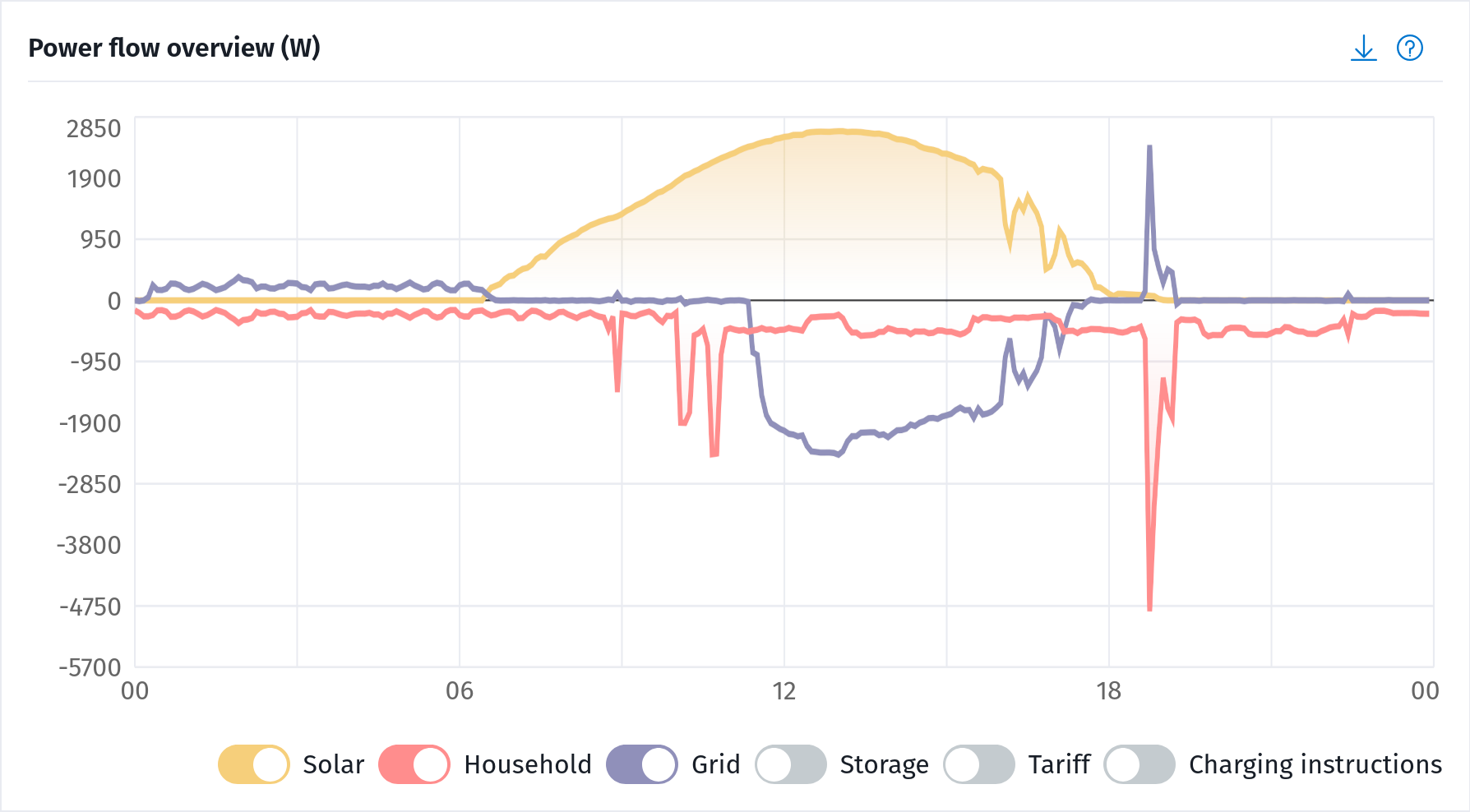
    Let’s take a look at a typical summer’s day. The graph is a little complex, so I’ll explain it.

    The yellow line shows solar production. It starts shortly after sunrise, peaks at midday, and gradually drops until sunset.

    The red line shows how much electricity our home is using. As you can see, there’s a large peak about 19:00 when we cook dinner.

    The blue line shows how much electricity we draw or export from the grid. From midnight until sunrise we import because the sun isn’t shining. Once the sun has risen we’re able to power our house and export to our neighbours. When we cook, we draw from the grid and our battery – which is why the evening grid peak is lower than the household use dip.

    The CSV of the data looks something like this:

    Local_time Household_(W) Solar_(W)
    2025-08-25T08:25:00.000+01:00 -187.76 1166.77
    2025-08-25T08:30:00.000+01:00 -227.04 1193.25
    2025-08-25T08:35:00.000+01:00 -253.06 1222.84
    2025-08-25T08:40:00.000+01:00 -266.87 1245.18
    2025-08-25T08:45:00.000+01:00 -450.8 1268.66
    2025-08-25T08:50:00.000+01:00 -251.84 1281.79
    2025-08-25T08:55:00.000+01:00 -1426.26 1306.93
    2025-08-25T09:00:00.000+01:00 -206.78 1341.37
    2025-08-25T09:05:00.000+01:00 -215.52 1390.9
    2025-08-25T09:10:00.000+01:00 -242.6 1426.19
    2025-08-25T09:15:00.000+01:00 -246.84 1473

    It’s fairly trivial to sum both columns and subtract one from the other. That shows either the excess or deficit in solar power for the household.

    On that day, the house used 9.7kWh and generated 19.6kWh. I’d need a 9.9kWh battery to store the excess right? Wrong!

    Because my usage doesn’t track the sun, I’d actually need a 13kWh battery. That’s the peak amount of excess electricity I’ve generated in that one day.

    What I want to do is find out what the maximum size battery I would need in order to store all of summer’s electricity for use in winter.

    Luckily, I have several years of real data to go off! Let’s get started!

    Disclaimer

    This is based on data generated by my home battery. It has probes to measure solar output and grid flow. It is not 100% clock-accurate compared to my solar-panels’ internal reporting nor what my smart-meter reports. I estimate a 1-2% deviation, which is good enough for these purposes.

    My energy usage isn’t representative of anything other than my usage. Your household is probably different. I already have a 4.8kWh battery which changes how and when I use energy.

    This doesn’t account for gas heating or hot water. We have some electric heaters and taps which increases our electricity usage.

    My maths is probably right – but the code is open source, so feel free to check for yourself.

    Remember, this is just a bit of fun. There’s no practical way to build domestic batteries with this capacity using the technology of 2025.

    Code

    We tend to start generating more electricity than we use starting in Spring. So I’ve picked the end of March 2024 to the end of March 2025.

    Let’s see how big a battery we’d need to store our summer excess for winter. This finds the cumulative difference between each day’s energy production and usage:

     Python 3import os
    import pandas as pd
    
    # Load all the CSVs
    filepaths = [f for f in os.listdir(".") if f.endswith('.csv')]
    df = pd.concat(map(pd.read_csv, filepaths))
    
    # Make sure they're in order
    df = df.sort_values("Timestamp")
    df = df.reset_index(drop=True)
    
    # Resolution is every 5 minutes, so divide by 12 to get hourly
    df["Cumulative_Difference"] = ( (df["Household_(W)"] + df["Solar_(W)"] ).cumsum() ) / 12
    
    # kWh of battery needed
    int(df["Cumulative_Difference"].max() / 1000)
    
    ## Draw a pretty graph
    df.plot(kind="line", x="Local_time", y="Cumulative_Difference", xlabel="Date", ylabel="MWh", xticks=["2024-04-01", "2024-05-01", "2024-05-01", "2024-06-01", "2024-07-01", "2024-08-01", "2024-09-01", "2024-10-01", "2024-11-01", "2024-12-01", "2025-01-01", "2025-02-01", "2025-03-01", "2025-04-01"], legend=False, grid=True, fontsize=15)
    plt.show()
    

    The total is 1,068KWh – basically, a MegaWatt-hour of storage.

    Here’s a quick graph to show how the storage would be used over the year.

    As you can see, even in this scenario there are a few days where we’d need to import energy from the grid.

    Is this sensible?

    Probably not, no. It doesn’t account for increased energy use from having an electric car or moving away from gas heating / cooking. As solar panels increase in efficiency, it might be more sensible to replace the panels on my roof, or add some onto a shed.

    The environmental impact of creating and storing such huge batteries could also be factored in.

    A battery which is only 100% full for a few days probably isn’t an efficient design. Using wind, hydro, and other green sources from the grid might be preferable.

    But, remember, this is an exercise in wishful thinking.

    Is this possible?

    Grid-scale batteries exist and they work brilliantly.

    But if I wanted my own MegaWatt-hour of battery storage, it would probably cost me between £100k and half-a-million quid.

    That doesn’t include maintenance, the land, planning permission, and a hundred other things.

    But battery prices are falling fast. In the last decade lithium ion battery prices have fallen 90%. With new sodium ion batteries promising an even bigger drop – down to US$10/kWh.

    If – and it is a big if – those numbers came to pass, it would probably cost around £8,000 for a domestic battery. Basically the same cost as adding solar panels in the first place.

    Domestic solar works – yes, even in the rainy UK! It is relatively cheap, moves energy production as close as possible to energy consumption, reduces bill-shock, and means we don’t have endless planning arguments about whether fields should be turned into solar farms.

    It is possible that, not too long in the future, every home could also have a 1 MegaWatt-hour battery. They would be able to capture all the excess solar power generated in a year.

    There’s a bright and sunny future where every home can be solar-self-sufficient.

    Share. Facebook Twitter Pinterest LinkedIn Reddit WhatsApp Telegram Email
    Previous ArticleDenmark’s Justice Minister calls encrypted messaging a false civil liberty
    Next Article Intel Is Losing Ground in the High-End CPU Segment. Can the US Government Save the Legacy Company?
    TechAiVerse
    • Website

    Jonathan is a tech enthusiast and the mind behind Tech AI Verse. With a passion for artificial intelligence, consumer tech, and emerging innovations, he deliver clear, insightful content to keep readers informed. From cutting-edge gadgets to AI advancements and cryptocurrency trends, Jonathan breaks down complex topics to make technology accessible to all.

    Related Posts

    When robots outshine humans, I have to ask: Are we ready?

    February 19, 2026

    VC Quantonation closes €220M fund to back next-gen physics tech

    February 19, 2026

    Mark Zuckerberg Tries to Play It Safe in Social Media Addiction Trial Testimony

    February 19, 2026
    Leave A Reply Cancel Reply

    Top Posts

    Ping, You’ve Got Whale: AI detection system alerts ships of whales in their path

    April 22, 2025684 Views

    Lumo vs. Duck AI: Which AI is Better for Your Privacy?

    July 31, 2025272 Views

    6.7 Cummins Lifter Failure: What Years Are Affected (And Possible Fixes)

    April 14, 2025156 Views

    6 Best MagSafe Phone Grips (2025), Tested and Reviewed

    April 6, 2025117 Views
    Don't Miss
    Technology February 19, 2026

    When robots outshine humans, I have to ask: Are we ready?

    When robots outshine humans, I have to ask: Are we ready? If you tuned in…

    VC Quantonation closes €220M fund to back next-gen physics tech

    Mark Zuckerberg Tries to Play It Safe in Social Media Addiction Trial Testimony

    The Bose QuietComfort Ultra Gen 2 Headphones Are at Their Lowest Price in Months

    Stay In Touch
    • Facebook
    • Twitter
    • Pinterest
    • Instagram
    • YouTube
    • Vimeo

    Subscribe to Updates

    Get the latest creative news from SmartMag about art & design.

    About Us
    About Us

    Welcome to Tech AI Verse, your go-to destination for everything technology! We bring you the latest news, trends, and insights from the ever-evolving world of tech. Our coverage spans across global technology industry updates, artificial intelligence advancements, machine learning ethics, and automation innovations. Stay connected with us as we explore the limitless possibilities of technology!

    Facebook X (Twitter) Pinterest YouTube WhatsApp
    Our Picks

    When robots outshine humans, I have to ask: Are we ready?

    February 19, 20262 Views

    VC Quantonation closes €220M fund to back next-gen physics tech

    February 19, 20262 Views

    Mark Zuckerberg Tries to Play It Safe in Social Media Addiction Trial Testimony

    February 19, 20262 Views
    Most Popular

    7 Best Kids Bikes (2025): Mountain, Balance, Pedal, Coaster

    March 13, 20250 Views

    VTOMAN FlashSpeed 1500: Plenty Of Power For All Your Gear

    March 13, 20250 Views

    This new Roomba finally solves the big problem I have with robot vacuums

    March 13, 20250 Views
    © 2026 TechAiVerse. Designed by Divya Tech.
    • Home
    • About Us
    • Contact Us
    • Privacy Policy
    • Terms & Conditions

    Type above and press Enter to search. Press Esc to cancel.