

Starship will soon fly over towns and cities, but will dodge the biggest ones
Starship’s next chapter will involve launching over Florida and returning over Mexico.
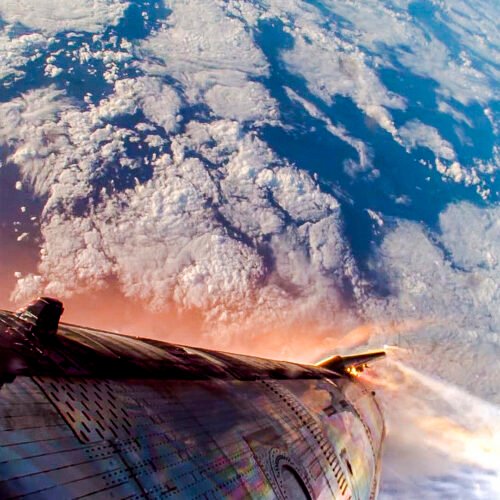
SpaceX’s Starship vehicle is encased in plasma as it reenters the atmosphere over the Indian Ocean on its most recent test flight in August.
Credit:
SpaceX
Some time soon, perhaps next year, SpaceX will attempt to fly one of its enormous Starship rockets from low-Earth orbit back to its launch pad in South Texas. A successful return and catch at the launch tower would demonstrate a key capability underpinning Elon Musk’s hopes for a fully reusable rocket.
In order for this to happen, SpaceX must overcome the tyranny of geography. Unlike launches over the open ocean from Cape Canaveral, Florida, rockets departing from South Texas must follow a narrow corridor to steer clear of downrange land masses.
All 10 of the rocket’s test flights so far have launched from Texas toward splashdowns in the Indian or Pacific Oceans. On these trajectories, the rocket never completes a full orbit around the Earth, but instead flies an arcing path through space before gravity pulls it back into the atmosphere.
If Starship’s next two test flights go well, SpaceX will likely attempt to send the soon-to-debut third-generation version of the rocket all the way to low-Earth orbit. The Starship V3 vehicle will measure 171 feet (52.1 meters) tall, a few feet more than Starship’s current configuration. The entire rocket, including its Super Heavy booster, will have a height of 408 feet (124.4 meters).
Starship, made of stainless steel, is designed for full reusability. SpaceX has already recovered and reflown Super Heavy boosters, but won’t be ready to recover the rocket’s Starship upper stage until next year, at the soonest.
That’s one of the next major milestones in Starship’s development after achieving orbital flight. SpaceX will attempt to bring the ship home to be caught back at the launch site by the launch tower at Starbase, Texas, located on the southernmost section of the Texas Gulf Coast near the US-Mexico border.
It was always evident that flying a Starship from low-Earth orbit back to Starbase would require the rocket to fly over Mexico and portions of South Texas. The rocket launches to the east over the Gulf of Mexico, so it must approach Starbase from the west when it comes in for a landing.
New maps published by the Federal Aviation Administration show where the first Starships returning to Texas may fly when they streak through the atmosphere.
Paths to and from orbit
The FAA released a document Friday describing SpaceX’s request to update its government license for additional Starship launch and reentry trajectories. The document is a draft version of a “tiered environmental assessment” examining the potential for significant environmental impacts from the new launch and reentry flight paths.
The federal regulator said it is evaluating potential impacts in aviation emissions and air quality, noise and noise-compatible land use, hazardous materials, and socioeconomics. The FAA concluded the new flight paths proposed by SpaceX would have “no significant impacts” in any of these categories.
SpaceX’s Starship rocket shortly before splashing into the Indian Ocean in August.
Credit:
SpaceX
The environmental review is just one of several factors the FAA considers when deciding whether to approve a new commercial launch or reentry license. According to the FAA, the other factors are public safety issues (such as overflight of populated areas and payload contents), national security or foreign policy concerns, and insurance requirements.
The FAA didn’t make a statement on any public safety and foreign policy concerns with SpaceX’s new trajectories, but both issues may come into play as the company seeks approval to fly Starship over Mexican towns and cities uprange from Starbase.
The regulator’s licensing rules state that a commercial launch and reentry should each pose no greater than a 1 in 10,000 chance of harming or killing a member of the public not involved in the mission. The risk to any individual should not exceed 1 in 1 million.
So, what’s the danger? If something on Starship fails, it could disintegrate in the atmosphere. Surviving debris would rain down to the ground, as it did over the Turks and Caicos Islands after two Starship launch failures earlier this year. Two other Starship flights ran into problems once in space, tumbling out of control and breaking apart during reentry over the Indian Ocean.
The most recent Starship flight last month was more successful, with the ship reaching its target in the Indian Ocean for a pinpoint splashdown. The splashdown had an error of just 3 meters (10 feet), giving SpaceX confidence in returning future Starships to land.
This map shows Starship’s proposed reentry corridor.
Credit:
Federal Aviation Administration
One way of minimizing the risk to the public is to avoid flying over large metropolitan areas, and that’s exactly what SpaceX and the FAA are proposing to do, at least for the initial attempts to bring Starship home from orbit. A map of a “notional” Starship reentry flight path shows the vehicle beginning its reentry over the Pacific Ocean, then passing over Baja California and soaring above Mexico’s interior near the cities of Hermosillo and Chihuahua, each with a population of roughly a million people.
The trajectory would bring Starship well north of the Monterrey metro area and its 5.3 million residents, then over the Rio Grande Valley near the Texas cities of McAllen and Brownsville. During the final segment of Starship’s return trajectory, the vehicle will begin a vertical descent over Starbase before a final landing burn to slow it down for the launch pad’s arms to catch it in midair.
In addition to Monterrey, the proposed flight path dodges overflights of major US cities like San Diego, Phoenix, and El Paso, Texas.
Let’s back up
Setting up for this reentry trajectory requires SpaceX to launch Starship into an orbit with exactly the right inclination, or angle to the equator. There are safety constraints for SpaceX and the FAA to consider here, too.
All of the Starship test flights to date have launched toward the east, threading between South Florida and Cuba, south of the Bahamas, and north of Puerto Rico before heading over the North Atlantic Ocean. For Starship to target just the right orbit to set up for reentry, the rocket must fly in a slightly different direction over the Gulf.
Another map released by the FAA shows two possible paths Starship could take. One of the options goes to the southeast between Mexico’s Yucatan Peninsula and the western tip of Cuba, then directly over Jamaica as the rocket accelerated into orbit over the Caribbean Sea. The other would see Starship departing South Texas on a northeasterly path and crossing over North Florida before reaching the Atlantic Ocean.
While both trajectories fly over land, they avoid the largest cities situated near the flight path. For example, the southerly route misses Cancun, Mexico, and the northerly path flies between Jacksonville and Orlando, Florida. “Orbital launches would primarily be to low inclinations with flight trajectories north or south of Cuba that minimize land overflight,” the FAA wrote in its draft environmental assessment.
The FAA analyzed two launch trajectory options for future orbital Starship test flights.
Credit:
Federal Aviation Administration
The proposed launch and reentry trajectories would result in temporary airspace closures, the FAA said. This could force delays or rerouting of anywhere from seven to 400 commercial flights for each launch, according to the FAA’s assessment.
Launch airspace closures are already the norm for Starship test flights. The FAA concluded that the reentry path over Mexico would require the closure of a swath of airspace covering more than 4,200 miles. This would affect up to 200 more commercial airplane flights during each Starship mission. Eventually, the FAA aims to shrink the airspace closures as SpaceX demonstrates improved reliability with Starship test flights.
Eventually, SpaceX will move some flights of Starship to Florida’s Space Coast, where rockets can safely launch in many directions over the Atlantic. By then, SpaceX aims to be launching Starships at a regular cadence—first, multiple flights per month, then per week, and then per day.
This will enable all of the things SpaceX wants to do with Starship. Chief among these goals is to fly Starships to Mars. Before then, SpaceX must master orbital refueling. NASA also has a contract with SpaceX to build Starships to land astronauts on the Moon’s south pole.
But all of that assumes SpaceX can routinely launch and recover Starships. That’s what engineers hope to soon prove they can do.
Stephen Clark is a space reporter at Ars Technica, covering private space companies and the world’s space agencies. Stephen writes about the nexus of technology, science, policy, and business on and off the planet.
