

Pedal hard – Huawei Watch GT 6 review – NotebookCheck.net Reviews
The Huawei Watch GT 6 impresses with its attractive design, precise measurements and comprehensive health monitoring. This now also includes atrial fibrillation detection and accident detection has received a comprehensive update. However, the latter requires a paired smartphone in an emergency, as the smartwatch does not have its own mobile network connection.
Huawei has also made improvements to the training options and has given the GT 6 a simulated power meter for cycling for the first time. The ski mode has also been completely revised and upgraded. Such a bright display is also a rarity in this price range and the positioning is also very good.
Unfortunately, Huawei still lacks a convenient mobile payment partner, and the minimum display brightness remains higher than ideal.
Pros
+ very good battery life
+ comprehensive health functions
+ accurate sensors
+ many sport modes
+ precise localization
Cons
– no WLAN
– small app store
– high minimum display brightness
The Watch GT 6 is available in both 41 mm and 46 mm sizes in all color variants directly from the Huawei online store (Germany). There are various promotions for the launch, such as a discount of €30 with the code AHWGT62530 and a free replacement strap worth €49.
Translator’s note: Huawei devices are still not officially available in North America.
TenCloud 6-Pack Bands Compatible with Huawei Watch GT 3 46mm/GT Runner/GT 42mm 46mm/GT2 46mm/GT 2e/GT2 Pro Bands for Watch GT3 46mm/Watch 3/Watch 3 Pro/Watch Buds
- $12.99
CeiLarv Metal Band for Amazfit Bip 6 /Bip 5 /Pop 3S /Balance 2 /GTR 4 /Garmin Venu 3 /Forerunner 570 47mm /Huawei Watch GT 5 Pro 46mm Band 22mm Beautifully Polished Stainless Steel Strap – Space Gray
- $13.98
FitTurn Band Compatible with Huawei Watch GT 2 Pro/GT 2e/GT 46mm/GT2 46mm/GT Active/Replacement Straps Silicone Bands Bracelet Watch Band Accessory Band for Huawei Watch GT 2 Pro (Seven Colors-A)
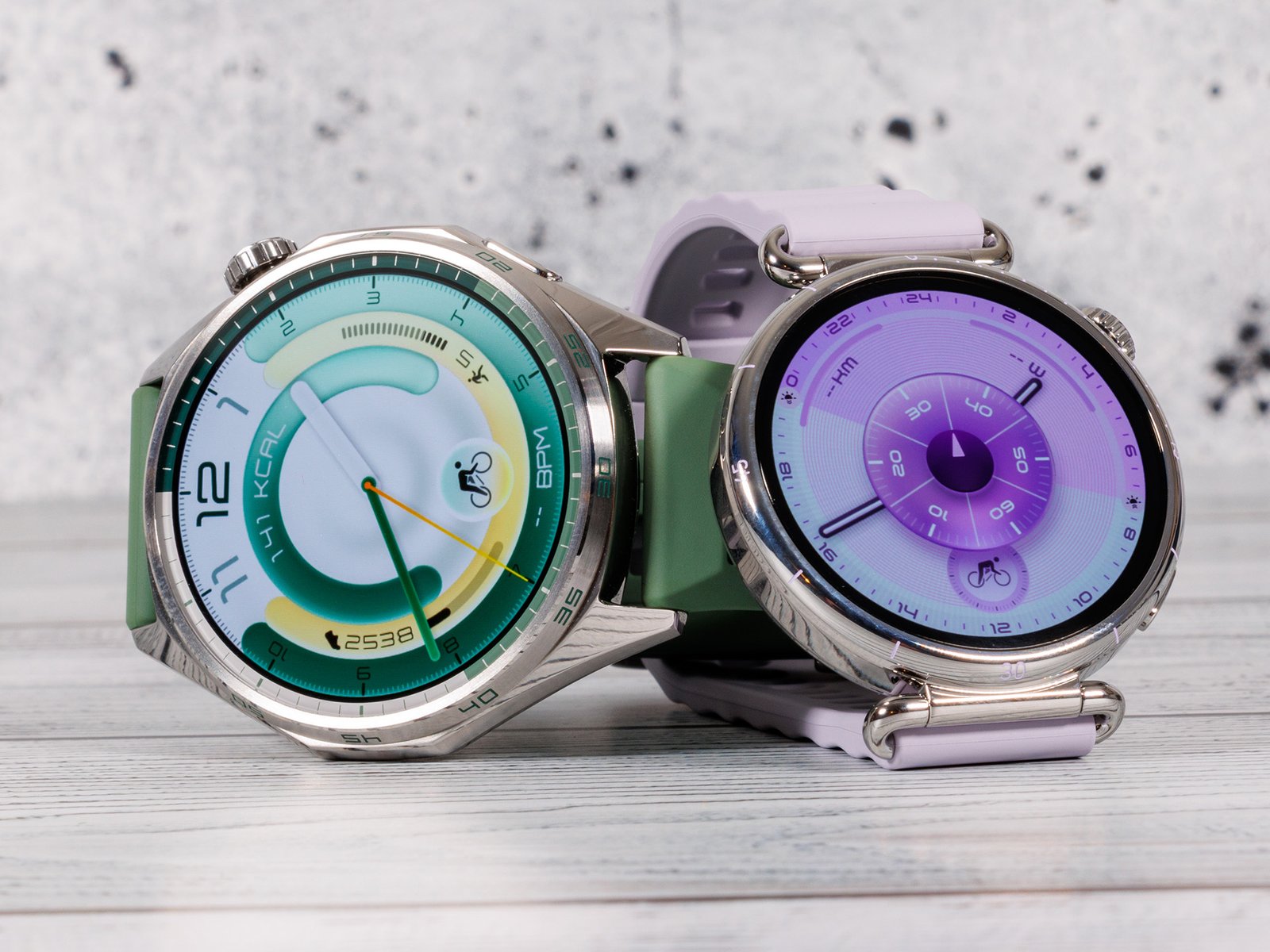
The Huawei Watch GT 6 series succeeds last year’s Watch GT 5 models and continues the signature octagonal design. The case is again made of stainless steel and comes in both a 46 mm version and the more compact 41 mm models.
In the test, we focused mainly on the larger model, but we’ll also cover the key differences with the 41 mm version below.
The Watch GT 6 series starts at €249 (RRP) and is available in these versions:
| Model | Color variant | Price (RRP) |
|---|---|---|
| 41 mm (B19F) | Black stainless steel case with black fluoroelastomer strap | 249 Euro |
| 41 mm (B19FC) | Stainless steel case with purple fluoroelastomer strap | 249 Euro |
| 41 mm (B19L) | Gold-colored stainless steel case with white composite strap | 249 Euro |
| 41 mm (B19W) | Stainless steel case with brown nylon strap | 269 Euro |
| 41 mm (B19M) | Gold-colored stainless steel case with gold Milanaise bracelet | 299 Euro |
| 46 mm (B19F) | Black stainless steel case with black fluoroelastomer strap | 249 Euro |
| 46 mm (B19L) | stainless steel case with gray composite strap | 249 Euro |
| 46 mm (B19W) | Stainless steel case with green nylon strap | 269 Euro |
Display
1.47 inch, 466 x 466 pixel 317 PPI, Capacitive Touchscreen, AMOLED, glossy: yes, 60 Hz
Connections
NFC, Brightness Sensor, Sensors: TruSense, 9-axisAcceleration, Gyroscope, Magnetometer, Barometer, Temperature
Networking
Bluetooth 6.0, GPS
Size
height x width x depth (in mm): 11 x 46 x 46 ( = 0.43 x 1.81 x 1.81 in)
Battery
867 mAh Lithium-Polymer
Charging
wireless charging
Operating System
Huawei HarmonyOS
Additional features
Speakers: Mono, Charger, HarmonyOS 6.0.0.132, 24 Months Warranty, 5 ATM, IP68 / IP69, linear vibration motor, Dual-Band-GNSS: GPS, Glonass, BeiDou, Galileo, QZSS, fanless, waterproof
Weight
51 g ( = 1.8 oz / 0.11 pounds), Power Supply: 38 g ( = 1.34 oz / 0.08 pounds)
All models in the Huawei Watch GT 6 series have a stainless steel case and an unspecified protective glass. The 46 mm version uses a round display within the GT 5’s signature octagonal frame, while the 41 mm model is completely round. Both smartwatches are well-finished and look premium.
Compared with the Watch GT 5, the GT 6 is slightly thicker. On the data sheet, this is only 0.3 mm; we measure a difference of 0.7 mm at the thickest point (GT 5: 12.7 mm; GT 6: 13.4 mm). The 41 mm model is slightly slimmer at 12.3 mm. The display sits flush with the frame, and the bezel is fixed and sensor-free.
The smartwatches are water-resistant up to 5 ATM and certified to IP68 and IP69. This means that they are both dust and waterproof and can also withstand high-pressure and steam jet cleaning. The freediving function and golf mode remain exclusive to the Pro model model.
For the wristbands, Huawei once again relies on tool-free quick-release fasteners with a bandwidth of 22 mm (46 mm) or 18 mm (41 mm).
Huawei does not provide any precise information on sustainability and it is not intended that the smartwatches will be repaired by the user.
The outer packaging is shrink-wrapped, but is otherwise largely plastic-free. Only the display and the underside of the smartwatch are protected by an additional film.
The Huawei Watch GT 6 runs HarmonyOS 6.0 and connects to smartphones via Bluetooth 6.0; Wi-Fi is not supported.
Before pairing, the Huawei Health app must be installed. This app manages both the smartwatch and the user’s health data. Due to the trade embargo against Huawei, it is not available in the Google Play Store, but it can be downloaded directly from Huawei using the QR code on the packaging or from alternative app stores such as Galaxy Store (Samsung), AppGallery (Huawei) or the App Mall (Xiaomi). For iPhone users, the app is available directly in Apple’s App Store. Once installed, the Watch GT 6 is usually detected automatically; if not, you can scan the QR code shown on the watch display.
Under iOS, some restrictions remain, as already seen with the Watch GT 5. These include the fact that the notifications cannot be set in such detail and it is not possible to reply to messages directly on the watch. Because the AppGallery is not available on iOS, Petal Maps cannot be installed, so navigation features are not supported.
Android users do not face these limitations. However, the AppGallery as such is still very sparsely populated, so its added value is limited.
Thanks to the NFC chip, it is also possible to pay with the Huawei Watch GT 6. However, standard services such as Apple Pay or Google Pay are not possible. Huawei is relying on a cooperation with Quicko here. This is a prepaid solution that requires credit to be topped up first, which is also subject to a charge – not really ideal.
The Huawei Watch GT 6 is primarily operated via the capacitive touchscreen, which responds reliably to inputs. The crown on the side can be turned and pressed and can also be used to navigate the system. The lower button offers direct access to the training menu in the standard settings, but can also be configured differently and can be distinguished from a single or double press.
The Huawei Watch GT 6 includes both a speaker and a microphone, allowing for hands-free calls. Because it lacks Wi-Fi, the watch must stay within Bluetooth range of the paired smartphone. For more privacy, Bluetooth headphones can also be connected directly to the watch.
Notifications arrive reliably on both iOS and Android. On iPhones they can only be viewed, while Android users can reply with emojis, quick responses, or typed messages using the on-screen keyboard. Images and videos, however, are still not displayed.
The Watch GT 6 does not support any voice assistants.
The Huawei Watch GT 6 tracks a wide range of body metrics automatically or manually, including heart rate, blood oxygen saturation (SpO₂), stress level, and skin temperature. TruSleep once again provides detailed sleep analysis, capturing breathing rate as well as snoring and ambient sounds during the night.
For certain sports, such as outdoor running, the watch can also calculate VO₂ Max. Emotional health tracking has been added, expanding on stress detection by identifying twelve distinct emotional states. Health Insights, which we already know from the Watch 5, are now also on board. The data from emotional health, sleep, fitness and heart health are put into context with each other, in order to give the user appropriate recommendations for action.
Another new feature is the app for analyzing pulse wave arrhythmias, which is medically certified and can determine the risk of atrial fibrillation in the heart. However, this was not yet available at the time of the test.
Extended analytics and personalized training plans are available with a paid Health+ subscription. Data syncing with Google Fit is limited but works more reliably with Apple Health, and recorded metrics can also be shared with Strava and Komoot.
The Huawei Watch GT 6 supports more than 100 different sports and adjusts the recorded data base on the activity. The watch even automatically recognizes certain workouts such as running, walking, cross-training or rowing.
For daily activity tracking, Huawei offers two approaches. The first is the familiar three-ring system, which focuses on calories burned, exercise duration, and training time. The second is the “health cloverleaf,” which breaks the analysis into categories such as sleep, steps, and mood.
The Huawei Health app also provides trend analyses, such as daily steps, active calories, resting heart rate or sleep duration.
Huawei mentions a new TruSense sensor but provides no additional technical details. It is designed to deliver highly accurate measurements for heart rate and blood oxygen, both of which can be taken manually or tracked continuously.
We compared the heart rate on a bike ride with a Polar H10 chest strap. The deviations between this and the Watch GT 6 are only minimal. When a peak heart rate is recorded, they are one beat apart, on average two beats apart. In both cases, the smartwatch recorded the lower values. They are the same for the resting heart rate.
A Braun pulse oximeter 1 is used as a reference for measuring blood oxygen saturation. In three comparative measurements, the Watch GT 6 consistently reported slightly lower values here and is only one percentage point below the pulse oximeter in two measurements. Only in the last measurement was it three percentage points lower, but this is also absolutely within the limits.
For a more detailed assessment of measurement accuracy, see our separate article on this topic.
Nothing fundamental has changed in sleep tracking on the Huawei Watch GT 6. The smartwatch distinguishes between deep, light and REM sleep as well as waking phases. It also monitors breathing rate, blood oxygen, and heart rate variability (HRV). When paired with a smartphone, it can additionally record snoring, sleep talking, and ambient sounds.
The sleep analysis provides detailed results, tips for improving sleep quality, and soothing soundscapes to help you fall asleep. A Health+ subscription unlocks even more advanced features.
The data for the previous night can be viewed directly on the watch, and previous days, weeks, months or years can be called up via the app on the cell phone. The results appear consistent and reliable. There is no smart alarm clock, but user-defined alarms can be set in the watch.
The Huawei Watch GT 6 can track more than 100 different sports. Free diving and golf are not on board, but are left to the GT 6 Pro reserved for the GT 6 Pro. However, the skiing function has been expanded and can now record comprehensive data, the measurement accuracy has also been optimized and even lift rides are automatically detected.
The update for cycling is even bigger. Here, Huawei offers the first virtual power meter that works completely without additional hardware. The data is estimated based on the current speed, altitude, incline, body weight and bike model. Unfortunately, the function was not yet fully available at the time of testing, but will be delivered in October. Automatic training detection is now also possible for outdoor cycling.
Automatic pause detection has also been improved, responding quickly when a break starts or ends. Routes can be imported for individual sports and displayed on the watch, and training records can be exported as GPX files.
Data recording varies by sport but functions essentially the same as on Watch GT 5.
The new Sunflower Positioning System 2.0 is a dual-band GNSS that supports all global satellite systems.
During our test drive, the Watch GT 6 tracked the route very accurately, even when the route passed between houses.
In terms of display brightness, the Huawei Watch GT 6 makes a big leap forward and now achieves a nominal peak brightness of 3,000 cd/m², which is even exceeded in the test.
The measured frequency of 60 Hz is not particularly high, but should not be a problem due to the short viewing times.
| Huawei Watch GT 6 | Samsung Galaxy Watch8 | Apple Watch Ultra 2 | Mobvoi TicWatch Atlas | |
|---|---|---|---|---|
| Response Times | ||||
| PWM Frequency (Hz) |
60 |
60 |
60 |
120 |
| PWM Amplitude * (%) |
41.98 |
|||
| Screen |
-2% |
-5% |
-77% |
|
| Brightness middle (cd/m²) |
3110 |
3052 -2% |
2947 -5% |
701 -77% |
| Black Level * (cd/m²) | ||||
| Total Average (Program / Settings) |
-2% / |
-5% / |
-77% / |
* … smaller is better
Screen Flickering / PWM (Pulse-Width Modulation)
ℹ
To dim the screen, some notebooks will simply cycle the backlight on and off in rapid succession – a method called Pulse Width Modulation (PWM) . This cycling frequency should ideally be undetectable to the human eye. If said frequency is too low, users with sensitive eyes may experience strain or headaches or even notice the flickering altogether.
| Screen flickering / PWM detected | 60 Hz | ||
|
The display backlight flickers at 60 Hz (worst case, e.g., utilizing PWM) . The frequency of 60 Hz is very low, so the flickering may cause eyestrain and headaches after extended use. In comparison: 53 % of all tested devices do not use PWM to dim the display. If PWM was detected, an average of 8249 (minimum: 5 – maximum: 343500) Hz was measured. |
|||
Huawei does not provide any information on the SiP installed or the memory capacity. In everyday use, however, the Watch GT 6 works smoothly and without stutters.
The batteries in the Watch GT 6 series have grown significantly. The 46 mm model now houses an 867 mAh battery (up from 524 mAh in the GT 5), while the smaller 41 mm version offers 540 mAh (up from 323 mAh). This should enable up to 21 days of use in battery-saving mode and still 12 days of typical use (41 mm: 14 / 7 days). Huawei also claims up to 40 hours of activity (41 mm: 15 hours) or 800 km tracking of a bike ride (41 mm: 300 km).
In everyday use with all health functions switched on and the always-on display deactivated, the GT 6 even lasted two weeks. It is charged wirelessly on the charging pad supplied.
|
Image |
Model |
Price |
Size |
Weight |
Battery Capacity |
Display |
|---|---|---|---|---|---|---|
| Huawei Watch GT 6 | Amazon: 1. $9.97 TenCloud 6-Pack Bands Compat… 2. $12.99 CeiLarv Metal Band for Amazf… 3. $13.98 FitTurn Band Compatible with… List Price: 269€ |
1.47″ | 51 g | 867 mAh | 1.47″ 466×466 317 PPI AMOLED |
|
| Samsung Galaxy Watch8 Exynos W1000, Mali-G68 MP2 |
Amazon: 1. $329.99 Samsung Galaxy Watch 8 (2025… 2. $389.99 Samsung Galaxy Watch 8 Class… 3. $199.99 Samsung Galaxy Watch 7 40mm … List Price: 459€ |
1.50″ | 52.1 g | 43544 mAh | 1.50″ 480×480 AMOLED |
|
| Apple Watch Ultra 2 S9 |
Amazon: List Price: 899€ |
1.92″ | 70 g | 564 mAh | 1.92″ 502×410 326 PPI OLED |
|
| Mobvoi TicWatch Atlas SD W5+ Gen 1 |
Amazon: $179.99 List Price: 360€ |
1.43″ | 47.2 g | 628 mAh | 1.43″ 466×466 326 PPI OLED + Ultra-low-power Display |
More articles related to this device
Huawei Watch GT 6 (Watch GT Series)
Transparency
The selection of devices to be reviewed is made by our editorial team. The test sample was provided to the author as a loan by the manufacturer or retailer for the purpose of this review. The lender had no influence on this review, nor did the manufacturer receive a copy of this review before publication. There was no obligation to publish this review. We never accept compensation or payment in return for our reviews. As an independent media company, Notebookcheck is not subjected to the authority of manufacturers, retailers or publishers.
This is how Notebookcheck is testing
Every year, Notebookcheck independently reviews hundreds of laptops and smartphones using standardized procedures to ensure that all results are comparable. We have continuously developed our test methods for around 20 years and set industry standards in the process. In our test labs, high-quality measuring equipment is utilized by experienced technicians and editors. These tests involve a multi-stage validation process. Our complex rating system is based on hundreds of well-founded measurements and benchmarks, which maintains objectivity. Further information on our test methods can be found here.
Editor of the original article: Daniel Schmidt – Managing Editor Mobile – 717 articles published on Notebookcheck since 2013
As a child I was fascinated by my Commodore 16, and this sparked my enthusiasm for computers. Using my first modem, I surfed the BTX videotext system and later the World Wide Web. I have always been captivated by the latest technologies, and this is especially true for mobile devices such as smartphones and tablets. I’ve been part of the Notebookcheck team since 2013 and have also on occasion written for Notebookinfo.de, and I’m looking forward to testing new innovations for our readers. I like to spend my spare time indulging in photography and barbecues and being with my family.
Translator: Ninh Ngoc Duy – Editorial Assistant – 621805 articles published on Notebookcheck since 2008
My main responsibility as an editorial assistant is maintaining the Library section, which aggregates reviews from other publications and channels. In addition, my daily breakfast is Notebookcheck’s long list of new content, which I comb through to select the most interesting topics for translation from English to French, Italian, Spanish, Portuguese, and Dutch.”
Daniel Schmidt, 2025-09-21 (Update: 2025-09-21)

