Close Menu

    Subscribe to Updates

    Get the latest creative news from FooBar about art, design and business.

    What's Hot

    The compact smartphone I actually want: Xiaomi 17 in a Galaxy S26 world

    Exciting laptop concept turns palm rest into an E ink notepad

    AYN Thor and Odin 3 new pricing revealed, to take effect in March

    Facebook X (Twitter) Instagram
    • Artificial Intelligence
    • Business Technology
    • Cryptocurrency
    • Gadgets
    • Gaming
    • Health
    • Software and Apps
    • Technology
    Facebook X (Twitter) Instagram Pinterest Vimeo
    Tech AI Verse
    • Home
    • Artificial Intelligence

      What the polls say about how Americans are using AI

      February 27, 2026

      Tensions between the Pentagon and AI giant Anthropic reach a boiling point

      February 21, 2026

      Read the extended transcript: President Donald Trump interviewed by ‘NBC Nightly News’ anchor Tom Llamas

      February 6, 2026

      Stocks and bitcoin sink as investors dump software company shares

      February 4, 2026

      AI, crypto and Trump super PACs stash millions to spend on the midterms

      February 2, 2026
    • Business

      FCC approves the merger of cable giants Cox and Charter

      February 28, 2026

      Finding value with AI and Industry 5.0 transformation

      February 28, 2026

      How Smarsh built an AI front door for regulated industries — and drove 59% self-service adoption

      February 24, 2026

      Where MENA CIOs draw the line on AI sovereignty

      February 24, 2026

      Ex-President’s shift away from Xbox consoles to cloud gaming reportedly caused friction

      February 24, 2026
    • Crypto

      Palladium Price Approaches a Critical Turning Point

      February 28, 2026

      Trump to Takeover Cuba, Iran War Tensions Rise, Bitcoin Crashes Again

      February 28, 2026

      A 40% XRP Crash Couldn’t Shake Its Strongest Holders — Is $1.70 Still Possible?

      February 28, 2026

      Why Is the US Stock Market Down Today?

      February 28, 2026

      SoFi Becomes First US Chartered Bank to Support Solana Deposits

      February 28, 2026
    • Technology

      The compact smartphone I actually want: Xiaomi 17 in a Galaxy S26 world

      February 28, 2026

      Exciting laptop concept turns palm rest into an E ink notepad

      February 28, 2026

      AYN Thor and Odin 3 new pricing revealed, to take effect in March

      February 28, 2026

      External desktop graphics card on a mini PC, laptop or tablet? The Minisforum DEG2 makes it possible

      February 28, 2026

      Linux-based Orange Pi Neo gaming handheld delayed due to rising RAM and storage costs

      February 28, 2026
    • Others
      • Gadgets
      • Gaming
      • Health
      • Software and Apps
    Check BMI
    Tech AI Verse
    You are at:Home»Technology»The golden ratio as a number base
    Technology

    The golden ratio as a number base

    TechAiVerseBy TechAiVerseSeptember 28, 2025No Comments5 Mins Read4 Views
    Facebook Twitter Pinterest Telegram LinkedIn Tumblr Email Reddit
    The golden ratio as a number base
    Share
    Facebook Twitter LinkedIn Pinterest WhatsApp Email

    The golden ratio as a number base

    Share

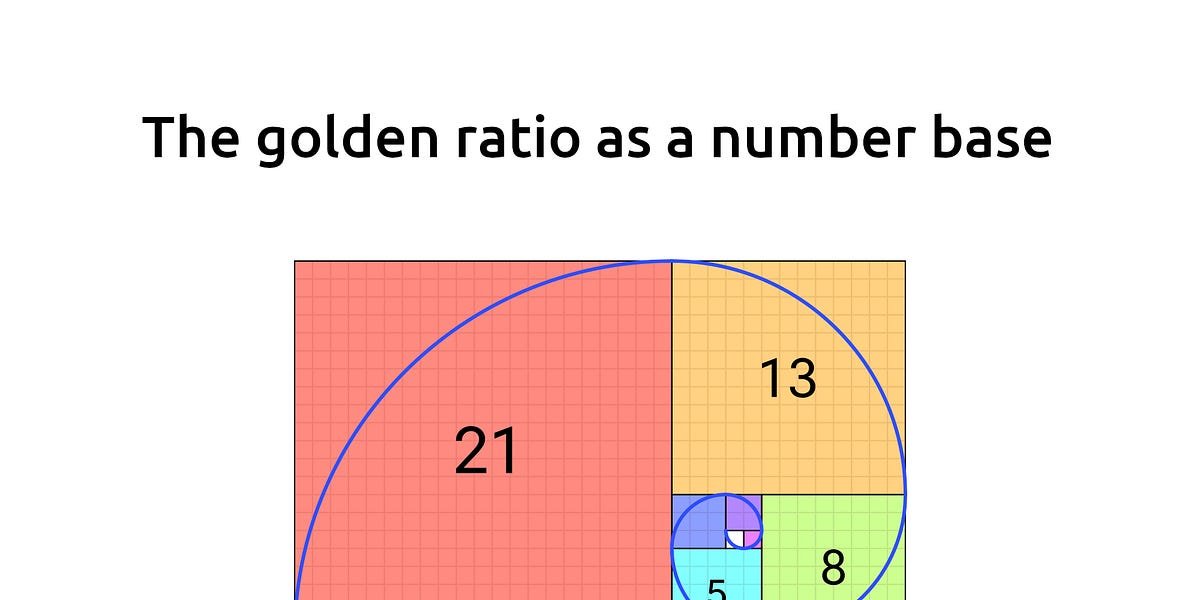
    The Fibonacci numbers (1, 1, 2, 3, 5, 8, 13, 21, 34, 55, …) are one of the most famous sequences of integers. Every number in the sequence after the first two is the sum of the two previous numbers: 1+1=2, 1+2=3, 2+3=5, and so on. It turns out that every positive integer can be written as a sum of distinct Fibonacci numbers, possibly in several different ways. For example, 64 can be written as 34+21+8+1, or as 34+21+5+3+1, or as 34+13+8+5+3+1. All of these expressions involve at least two consecutive Fibonacci numbers, like 21 and 34, or 3 and 5.

    According to Zeckendorf’s Theorem, every positive integer can be represented in a unique way as a sum of distinct, non-consecutive Fibonacci numbers. For example, the Zeckendorf representation of 64 is 55+8+1. There is a simple algorithm to find this representation, as follows. The largest Fibonacci number less than 64 is 55, so we subtract 55 from 64, which gives 9. The largest Fibonacci number less than 9 is 8, so we subtract 8 from 9, which gives 1. Since 1 is a Fibonacci number, the process terminates with 64=55+8+1.

    The Fibonacci numbers are closely related to the golden ratio, (1+√5)/2, which is approximately 1.618. The golden ratio is the unique positive number φ with the property that φ2=φ+1. Even though the golden ratio is irrational, it can be used to give an exact formula for the n-th Fibonacci number: Fn=(φn–(-φ-n))/√5. For example, substituting n=3 and n=4 gives the third and fourth Fibonacci numbers, F3=2 and F4=3. Another connection between the Fibonacci numbers and the golden ratio is that the ratio of two consecutive Fibonacci numbers approaches the golden ratio as the numbers get large, which explains why 55/34 is approximately 1.618.

    In 1957, George Bergman proved that every positive real number can be written as a sum of distinct powers of φ, where the powers of φ are allowed to be negative, and where infinite sums are allowed. In base 10, every terminating decimal has two representations, so that for example 1.53 may also be written as 1.52999 recurring, and something similar happens in every number base, including base φ. For example, φ itself can be expressed as the infinite sum 1 + φ-2 + φ-4 + φ-6 + φ-8 + …

    The φ-representation of a number satisfies a uniqueness property reminiscent of Zeckendorf’s theorem. More precisely, the representation is unique, modulo the ambiguities of the previous paragraph, if we impose the additional condition that no consecutive powers of φ appear. For example, we would choose to represent the number φ2=φ1+φ0 as φ2 rather than as φ1+φ0, in order to avoid consecutive powers of φ.

    I found out about this particular theorem of Bergman from the recent paper New properties of the φ-representation of integers by Jeffrey Shallit and Ingrid Vukusic. The paper is concerned with integers k whose φ-representation is “φ-anti-palindromic”, which means that φn appears in the φ-representation of k if and only if φ-n also appears in the φ-representation of k. An example of such an integer is 25, whose φ-representation is φ6 + φ4 + φ-4 + φ-6. The set of all such integers was introduced by Vladimir Shevelev in 2010, and the first few terms are listed above.

    In 2012, Clark Kimberling noticed that the numbers in Shevelev’s sequence seem to have the property that doubling all the exponents in the φ-representation produces another integer. Kimberling conjectured that these numbers are the only ones with this property. For example, 10 is an element of Shevelev’s sequence, and 10 is represented as φ4 + φ2 + φ-2 + φ-4. Doubling all the exponents produces φ8 + φ4 + φ-4 + φ-8, which (surprisingly) is another integer, in this case 54. The main result in Shallit and Vukusic’s paper is that Kimberling’s conjecture is true.

    Another sequence that is closely related to the Fibonacci sequence and the golden ratio is the sequence of Lucas numbers. As with the Fibonacci numbers, each Lucas number (other than the first two) is the sum of the two previous numbers, the difference being that the sequence starts with “2, 1”. The first few Lucas numbers are 2, 1, 3, 4, 7, 11, 18, 29, 47, 76, … As with the Fibonacci numbers, the ratios of successive Lucas numbers tend to the golden ratio, which explains why 76/47 is close to 1.618.

    Shallit and Vukusic used the open source automated theorem prover Walnut to find several connections between φ-representations of integers and the Lucas numbers. For example, they prove in their paper that the smallest exponent in the φ-representation of a positive integer n ≥ 2 must be an even number, –2i, and that in this case, n must lie between the (2i–1)-st and (2i+1)-st Lucas number. For example, the number 54 lies between the 7th Lucas number (which is 29) and the 9th Lucas number (which is 76). The theorem then implies that the smallest exponent in the φ-representation of 54 will be –8, because 8 is the even number between 7 and 9. This agrees with the observation that the φ-representation of 54 is φ8 + φ4 + φ-4 + φ-8.

    Leave a comment

    Share A Piece of the Pi: mathematics explained

    Picture credits and relevant links

    The picture of the Fibonacci spiral is by Romain. It appears on Wikipedia’s entry on Fibonacci numbers.

    The picture of the Lucas spiral is by The Nth User and Begoon. It appears on WIkipedia’s entry on Lucas numbers.

    The other graphics are my own work.

    Wikipedia also has entries on the golden ratio base, Zeckendorf’s Theorem, and George M. Bergman.

    Shevelev’s sequence is sequence A178482 in The On-Line Encyclopedia of Integer Sequences.

    Substack management by The Green Room.

    Share. Facebook Twitter Pinterest LinkedIn Reddit WhatsApp Telegram Email
    Previous ArticleHow did we all miss the bacteria taking over her body?
    Next Article She Sent Her iPhone to Apple. Repair Techs Uploaded Her Nudes to Facebook (2021)
    TechAiVerse
    • Website

    Jonathan is a tech enthusiast and the mind behind Tech AI Verse. With a passion for artificial intelligence, consumer tech, and emerging innovations, he deliver clear, insightful content to keep readers informed. From cutting-edge gadgets to AI advancements and cryptocurrency trends, Jonathan breaks down complex topics to make technology accessible to all.

    Related Posts

    The compact smartphone I actually want: Xiaomi 17 in a Galaxy S26 world

    February 28, 2026

    Exciting laptop concept turns palm rest into an E ink notepad

    February 28, 2026

    AYN Thor and Odin 3 new pricing revealed, to take effect in March

    February 28, 2026
    Leave A Reply Cancel Reply

    Top Posts

    Ping, You’ve Got Whale: AI detection system alerts ships of whales in their path

    April 22, 2025699 Views

    Lumo vs. Duck AI: Which AI is Better for Your Privacy?

    July 31, 2025280 Views

    6.7 Cummins Lifter Failure: What Years Are Affected (And Possible Fixes)

    April 14, 2025162 Views

    6 Best MagSafe Phone Grips (2025), Tested and Reviewed

    April 6, 2025123 Views
    Don't Miss
    Technology February 28, 2026

    The compact smartphone I actually want: Xiaomi 17 in a Galaxy S26 world

    The compact smartphone I actually want: Xiaomi 17 in a Galaxy S26 world – NotebookCheck.net…

    Exciting laptop concept turns palm rest into an E ink notepad

    AYN Thor and Odin 3 new pricing revealed, to take effect in March

    External desktop graphics card on a mini PC, laptop or tablet? The Minisforum DEG2 makes it possible

    Stay In Touch
    • Facebook
    • Twitter
    • Pinterest
    • Instagram
    • YouTube
    • Vimeo

    Subscribe to Updates

    Get the latest creative news from SmartMag about art & design.

    About Us
    About Us

    Welcome to Tech AI Verse, your go-to destination for everything technology! We bring you the latest news, trends, and insights from the ever-evolving world of tech. Our coverage spans across global technology industry updates, artificial intelligence advancements, machine learning ethics, and automation innovations. Stay connected with us as we explore the limitless possibilities of technology!

    Facebook X (Twitter) Pinterest YouTube WhatsApp
    Our Picks

    The compact smartphone I actually want: Xiaomi 17 in a Galaxy S26 world

    February 28, 20262 Views

    Exciting laptop concept turns palm rest into an E ink notepad

    February 28, 20262 Views

    AYN Thor and Odin 3 new pricing revealed, to take effect in March

    February 28, 20262 Views
    Most Popular

    7 Best Kids Bikes (2025): Mountain, Balance, Pedal, Coaster

    March 13, 20250 Views

    VTOMAN FlashSpeed 1500: Plenty Of Power For All Your Gear

    March 13, 20250 Views

    Best TV Antenna of 2025

    March 13, 20250 Views
    © 2026 TechAiVerse. Designed by Divya Tech.
    • Home
    • About Us
    • Contact Us
    • Privacy Policy
    • Terms & Conditions

    Type above and press Enter to search. Press Esc to cancel.