

Blue Origin aims to land next New Glenn booster, then reuse it for Moon mission
“We fully intend to recover the New Glenn first stage on this next launch.”
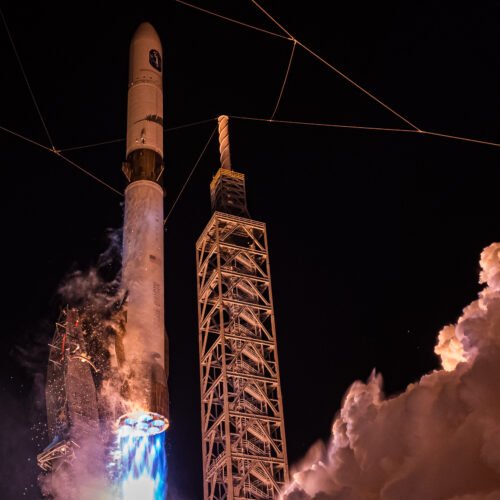
New Glenn lifts off on its debut flight on January 16, 2025.
Credit:
Blue Origin
There’s a good bit riding on the second launch of Blue Origin’s New Glenn rocket.
Most directly, the fate of a NASA science mission to study Mars’s upper atmosphere hinges on a successful launch. The second flight of Blue Origin’s heavy-lifter will send two NASA-funded satellites toward the red planet to study the processes that drove Mars’s evolution from a warmer, wetter world to the cold, dry planet of today.
A successful launch would also nudge Blue Origin closer to winning certification from the Space Force to begin launching national security satellites.
But there’s more on the line. If Blue Origin plans to launch its first robotic Moon lander early next year—as currently envisioned—the company needs to recover the New Glenn rocket’s first stage booster. Crews will again dispatch Blue Origin’s landing platform into the Atlantic Ocean, just as they did for the first New Glenn flight in January.
The debut launch of New Glenn successfully reached orbit, a difficult feat for the inaugural flight of any rocket. But the booster fell into the Atlantic Ocean after three of the rocket’s engines failed to reignite to slow down for landing. Engineers identified seven changes to resolve the problem, focusing on what Blue Origin calls “propellant management and engine bleed control improvements.”
Relying on reuse
Pat Remias, Blue Origin’s vice president of space systems development, said Thursday that the company is confident in nailing the landing on the second flight of New Glenn. That launch, with NASA’s next set of Mars probes, is likely to occur no earlier than November from Cape Canaveral Space Force Station, Florida.
“We fully intend to recover the New Glenn first stage on this next launch,” Remias said in a presentation at the International Astronautical Congress in Sydney. “Fully intend to do it.”
Blue Origin, owned by billionaire Jeff Bezos, nicknamed the booster stage for the next flight “Never Tell Me The Odds.” It’s not quite fair to say the company’s leadership has gone all-in with their bet that the next launch will result in a successful booster landing. But the difference between a smooth touchdown and another crash landing will have a significant effect on Bezos’s Moon program.
That’s because the third New Glenn launch, penciled in for no earlier than January of next year, will reuse the same booster flown on the upcoming second flight. The payload on that launch will be Blue Origin’s first Blue Moon lander, aiming to become the largest spacecraft to reach the lunar surface. Ars has published a lengthy feature on the Blue Moon lander’s role in NASA’s effort to return astronauts to the Moon.
“We will use that first stage on the next New Glenn launch,” Remias said. “That is the intent. We’re pretty confident this time. We knew it was going to be a long shot [to land the booster] on the first launch.”
A long shot, indeed. It took SpaceX 20 launches of its Falcon 9 rocket over five years before pulling off the first landing of a booster. It was another 15 months before SpaceX launched a previously flown Falcon 9 booster for the first time.
With New Glenn, Blue’s engineers hope to drastically shorten the learning curve. Going into the second launch, the company’s managers anticipate refurbishing the first recovered New Glenn booster to launch again within 90 days. That would be a remarkable accomplishment.
Dave Limp, Blue Origin’s CEO, wrote earlier this year on social media that recovering the booster on the second New Glenn flight will “take a little bit of luck and a lot of excellent execution.”
On September 26, Blue Origin shared this photo of the second New Glenn booster on social media.
Blue Origin’s production of second stages for the New Glenn rocket has far outpaced manufacturing of booster stages. The second stage for the second flight was test-fired in April, and Blue completed a similar static fire test for the third second stage in August. Meanwhile, according to a social media post written by Limp last week, the body of the second New Glenn booster is assembled, and installation of its seven BE-4 engines is “well underway” at the company’s rocket factory in Florida.
The lagging production of New Glenn boosters, known as GS1s (Glenn Stage 1s), is partly by design. Blue Origin’s strategy with New Glenn has been to build a small number of GS1s, each of which is more expensive and labor-intensive than SpaceX’s Falcon 9. This approach counts on routine recoveries and rapid refurbishment of boosters between missions.
However, this strategy comes with risks, as it puts the booster landings in the critical path for ramping up New Glenn’s launch rate. At one time, Blue aimed to launch eight New Glenn flights this year; it will probably end the year with two.
Laura Maginnis, Blue Origin’s vice president of New Glenn mission management, said last month that the company was building a fleet of “several boosters” and had eight upper stages in storage. That would bode well for a quick ramp-up in launch cadence next year.
However, Blue’s engineers haven’t had a chance to inspect or test a recovered New Glenn booster. Even if the next launch concludes with a successful landing, the rocket could come back to Earth with some surprises. SpaceX’s initial development of Falcon 9 and Starship was richer in hardware, with many boosters in production to decouple successful landings from forward progress.
Blue Moon
All of this means a lot is riding on an on-target landing of the New Glenn booster on the next flight. Separate from Blue Origin’s ambitions to fly many more New Glenn rockets next year, a good recovery would also mean an earlier demonstration of the company’s first lunar lander.
The lander set to launch on the third New Glenn mission is known as Blue Moon Mark 1, an unpiloted vehicle designed to robotically deliver up to 3 metric tons (about 6,600 pounds) of cargo to the lunar surface. The spacecraft will have a height of about 26 feet (8 meters), taller than the lunar lander used for NASA’s Apollo astronaut missions.
The first Blue Moon Mark 1 is funded from Blue Origin’s coffers. It is now fully assembled and will soon ship to NASA’s Johnson Space Center in Houston for vacuum chamber testing. Then, it will travel to Florida’s Space Coast for final launch preparations.
“We are building a series, not a singular lander, but multiple types and sizes and scales of landers to go to the Moon,” Remias said.
The second Mark 1 lander will carry NASA’s VIPER rover to prospect for water ice at the Moon’s south pole in late 2027. Around the same time, Blue will use a Mark 1 lander to deploy two small satellites to orbit the Moon, flying as low as a few miles above the surface to scout for resources like water, precious metals, rare Earth elements, and helium-3 that could be extracted and exploited by future explorers.
A larger lander, Blue Moon Mark 2, is in an earlier stage of development. It will be human-rated to land astronauts on the Moon for NASA’s Artemis program.
Blue Origin’s Blue Moon MK1 lander, seen in the center, is taller than NASA’s Apollo lunar lander, currently the largest spacecraft to have landed on the Moon. Blue Moon MK2 is even larger, but all three landers are dwarfed in size by SpaceX’s Starship.
Credit:
Blue Origin
NASA’s other crew-rated lander will be derived from SpaceX’s Starship rocket. But Starship and Blue Moon Mark 2 are years away from being ready to accommodate a human crew, and both require orbital cryogenic refueling—something never before attempted in space—to transit out to the Moon.
This has led to a bit of a dilemma at NASA. China is also working on a lunar program, eyeing a crew landing on the Moon by 2030. Many experts say that, as of today, China is on pace to land astronauts on the Moon before the United States.
Of course, 12 US astronauts walked on the Moon in the Apollo program. But no one has gone back since 1972, and NASA and China are each planning to return to the Moon to stay.
One way of speeding up a US landing on the Moon might be to use a modified version of Blue Origin’s Mark 1 lander, Ars reported Thursday.
If this is the path NASA takes, the stakes for the next New Glenn launch and landing will soar even higher.
Stephen Clark is a space reporter at Ars Technica, covering private space companies and the world’s space agencies. Stephen writes about the nexus of technology, science, policy, and business on and off the planet.
