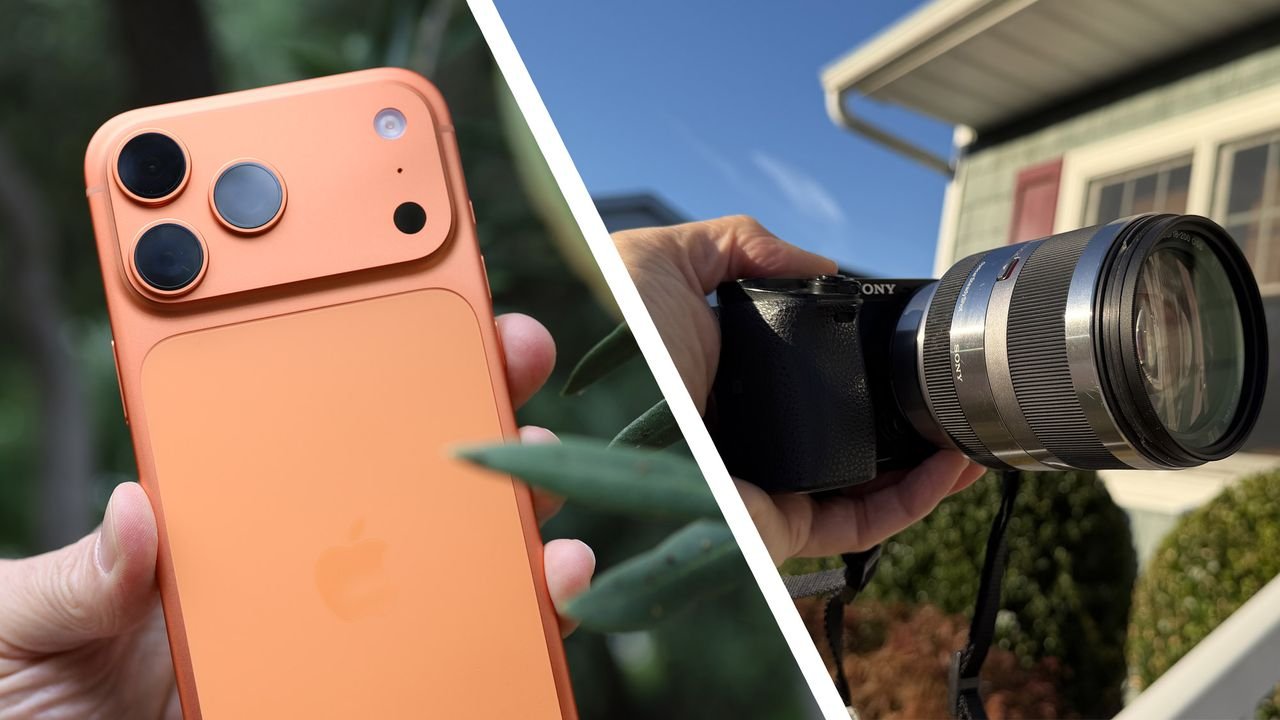
Can the iPhone 17 Pro Max’s 8x Zoom match a Sony a6000? I put it to the test
When Apple launched its new iPhone 17 Pro and iPhone 17 Pro Max, it couldn’t stop talking about the new 8x-zoom powered by the 4x optical zoom 48MP sensor. Such an 8x zoom is, they claimed, equivalent to a 200mm focal length. As soon as I heard that, my ears pricked up.
“200mm? Really?”
You see, I’ve been shooting photos with a Sony Alpha a6000 fitted with a Sony 18-200mm lens for well over a decade. It’s my favorite lens, letting you smoothly go from a full-throated close-up of a subject just inches from the glass to an 11x optical zoom that can capture the moon. It’s the most compact and, for a time, powerful lens I’ve ever owned. When fitted with the lens, the Sony Alpha a6000 is relatively small compared to similarly configured cameras, albeit not small compared to an iPhone.
Could Apple have possibly equalled that photographic power in a 6.9-inch, 233-gram aluminum and glass frame? There was only one way to find out.
A camera vs camera test
The other day, I took the new phone and my trusty camera to Bryant Park in New York and started taking photos. For each capture, I made sure to take as close as I could the exact same shot with the Sony Alpha a6000 and the iPhone 17 Pro Max.
For its 8x mode, the iPhone 17 Pro Max shoots at a 200mm equivalent by performing a sensor crop on the full 48MP frame, essentially taking the center 12MP. So it’s not a digital zoom, it’s just a piece of the whole sensor image. The Sony Alpha a6000 shoots at 24MP with its not-quite-full-frame APS-C sensor.
Throughout the shoot, I didn’t touch any of the settings, meaning I never tried to lock or fix exposure or the focus. The 4x optical zoom shoots a f/2.8 aperture, which is what the 8X sensor crop inherits as well.
For the Sony Alpha, I set the camera on auto and, similarly, let it choose all the exposure and focus settings. The aperture for all the Sony images was f/6.3.
Even though these are both effectively 200mm, the Sony does have a stronger optical zoom, pulling 11x, compared to the iPhone 17 Pro’s 8x equivalent.
Before we get into the images, a bit of a spoiler: The iPhone 17 Pro Max 8x equivalent lens is, in general, no match for resolution and the optical focal length of the Sony Alpha a600.
Time and again, the Sony camera beat the iPhone in terms of color, clarity, depth, and artistic appeal. On the other hand, the iPhone 17 Pro Max’s 200mm focal length equivalent did really well for a smartphone.
Fifth Avenue flower
Apple’s computational photography is some of the best in the business, but it’s also making decisions about what an image should look like. Typically, it wants to ensure the image is bright enough and that it gathers and presents all available visual information.
Sony’s Alpha a6000, like most DSLRs (even mirrorless ones like this) presents what the lens and sensor capture. In some ways, it takes a cookie-cutter approach to the photography because it’s not trying to decide if that background should be brighter or more in focus. The lens does what it does, and the exposure and shutter speed define the brightness and clarity. Auto will select the best options (like ISO) for you. If you want more control, you can shoot in manual mode, something I chose not to do for this test.
In this instance, the iPhone 17 Pro Max 8x option made everything brighter. That looks good, but also somewhat unrealistic and slightly washed out. After all, the flower I captured was in the shade. Why not show that? The iPhone’s shot is also somewhat busy, and it really lost its way with that neon light in the background.
Sony’s shot is, by contrast, full of subtlety, with a deep bokeh and considerable detail in the flower petals, much of which the iPhone didn’t capture.
Bryant Park performers
This is an interesting shot because I intended to capture the performers, but both cameras ended up focusing on the officer in blue, who is, in fact, a great subject.
As is the case with most of these images, the Sony Alpha a6000 doesn’t try to brighten figures in the shade, which ends up giving the image some real depth and nuance.
The officer is in sharp focus, and there’s exquisite detail in his uniform and pleasing nuance to his skin tone.
I think the iPhone 17 Pro Max image suffers here because it’s struggling to balance out the uneven light. The 8x camera option is over-brightening the shaded areas and making the entire image look flat and washed out. The shaded performers should not be as bright as the officer.
Because of the overexposure and likely higher ISO, the iPhone ends up introducing unnecessary grain.
In my mind’s eye, I saw the classic twin spires of New York City’s Bryant Park Hotel in the distance, silhouetted by soft foliage in the foreground. Only one of the cameras could achieve that effect.
The iPhone 17 Pro Max 8x camera did a good job of bringing the building closer and offers some nice clarity and detail, but the overall shot is flat because both the leaves and building are in focus. There’s also the issue of colors, which all look a bit drained.
As you can see, the Sony matched the photo I imagined. The spires are sharp, with noticeable blue highlights, all silhouetted by the out-of-focus leaves.
Direct sunlight and leaves
This would be a challenging photo for any camera, smartphone, or otherwise, but I think the sunlight may have overwhelmed the iPhone 17 Pro Max. I mean, I like the photo, but the backlit leaves look slightly surreal. It’s a strange effect. Some might like the lens flare with a touch of green. I’m not a fan.
The Sony Alpha a6000 photo is a lot closer to what I saw. The colors are washed out, but that’s the effect I’d expect from so much direct sunlight. Even with all the hard light, Sony’s image has a lot of interesting detail.
Woman with mask
The two cameras took very different approaches here. Sony focused on an attractive portrait that stayed true to the lighting realities.
The iPhone appears to have a faster lens in this instance. Not only is the image far brighter, but the water is frozen mid-splash; that’s a cool effect.
Unfortunately, the colors are again a bit washed out on the iPhone, but the overall detail is good.
Sony’s image is more of a pure-play portrait. The details on the face and hair are strong.
Arrow head guy
This is another instance where Sony favors a portrait-style shot over too much information. The colors here are good, and the only criticism I would offer is that the arrow is too bright yellow.
The iPhone 17 Pro Max does a decent job with the arrow color, even capturing the fabric texture. There’s also really nice detail on the subject’s hair, but I noticed that the iPhone failed to capture the guy’s ruddy skin tone, which is clearly evident in the Sony photo.
Bryant Park Carousel
This was a challenging shot with the carousel in motion and the horses bobbing up and down.
The iPhone 17 Pro Max failed to sedate the horses well enough to sharpen the action and has such a long depth of field that the image is a busy mess.
The Sony Alpha a6000, on the other hand, gets the lock and plucks the horse out of all the activity, giving me a surprisingly clear picture. At 100% I can just make out a tiny bit of the motion blur on the Sony image.
I am impressed, though, with the vibrancy of some of the colors in the iPhone photo.
Modern building top
This is one photo where the iPhone 17 Pro Max really shines. The image of this skyscraper is clear and bright but with a rich amount of shadow, giving the building the right amount of dimension. Also, the sky pops while maintaining all the cloudy details
At 100%, though, some of the building lines look rougher than they should be.
On the Sony image, every architectural line and element is sharp and crystal clear, and the partially cloudy blue sky matches what I saw in the iPhone image.
Another view of the city performers
(Image credit: Lance Ulanoff)
In general, I think I did a better job framing the iPhone 17 Pro Max photo here. The amount of bright detail in the background works in the image’s favor and brings together the whole performance.
Colors are vibrant even in the evident shadow. It’s for that reason that some might find the iPhone 17 Pro Max image more pleasing, but I think it does veer a bit from what I could see with my naked eyes.
Colors on the Sony image are much more muted, and I think that and the much stronger bokeh effect really bring the performance into focus.
At 100% the Sony has far more clarity. There are details, like a stray hair on the woman’s face, the stitching on her hat, and discoloration off her dress that are really not visible in the iPhone image.
City street
For virtually all of my shots, I was a good distance from the subject, but this shot was different because, while the distance to the New York Port Authority was long, there was a lot of detail down 41st Street between me and that building. I was curious how both the iPhone 17 Pro Max and Sony Alpha a6000 would handle the challenge.
Sony did a better job of differentiating between the brightly sunlit Port Authority in the background and the shaded buildings and people in the foreground.
The iPhone 17 Pro Max tries to balance out the brightness across the board, which makes the image a little flat. There’s also a fair amount of grain.
At 100% it’s clear that the higher resolution Sony has more detail.
Bonus round: Shoot the moon
One of my favorite photography subjects is the moon. Unlike the other images, it’s impossible to capture the moon with auto settings. The Earth’s satellite is incredibly bright at night, so you have to close the aperture and find the right shutter speed. Then there’s focus. When I shoot with the Sony Alpha a6000, I switch to manual focus mode, and when I spin the focus wheel, the camera digitally zooms in so I can adjust until things are crystal clear.
You can photograph the moon with any of the best smartphones; you just zoom in as much as possible, tap the screen to lower the exposure, and then snap. The results usually are not great.
To be clear, I’m not talking about the digital zoom capabilities possible with the iPhone, Samsung Galaxy, and Pixel phones. Once you zoom past the optical limit, you are getting a mix of digital and sometimes AI magic that makes guesses about how the moon should look.
Still, when Apple said the iPhone 17 Pro Max has an 8x, 200mm-equivalent lens option, I could not wait to compare it to my 200mm Sony Alpha a6000 lens.
Unlike the rest of the test, the images you’re looking at are substantial crops of the full frame, so you can clearly see how each camera handled the moon image.
The good news is that this iPhone is much better at a decent moon shot. The bad news is that there is still no comparison to what I can accomplish with the Sony lens.
Ultimately, this test ended up proving what might be obvious: a smartphone camera, even the wonderful array on the $1,199 / £1,199 / AU$2,149 iPhone 17 Pro Max is, at least for high-end zoom, still no match for a nearly $1,000 (used price) prosumer-level camera kit. On the other hand, my camera can’t make calls, handle email, do AI, or give me access to social media. Also, it doesn’t fit in my pocket.
Follow TechRadar on Google News and add us as a preferred source to get our expert news, reviews, and opinion in your feeds. Make sure to click the Follow button!
And of course you can also follow TechRadar on TikTok for news, reviews, unboxings in video form, and get regular updates from us on WhatsApp too.