

This startup is about to conduct the biggest real-world test of aluminum as a zero-carbon fuel
The crushed-up soda can disappears in a cloud of steam and—though it’s not visible—hydrogen gas. “I can just keep this reaction going by adding more water,” says Peter Godart, squirting some into the steaming beaker. “This is room-temperature water, and it’s immediately boiling. Doing this on your stove would be slower than this.”
Godart is the founder and CEO of Found Energy, a startup in Boston that aims to harness the energy in scraps of aluminum metal to power industrial processes without fossil fuels. Since 2022, the company has worked to develop ways to rapidly release energy from aluminum on a small scale. Now it’s just switched on a much larger version of its aluminum-powered engine, which Godart claims is the largest aluminum-water reactor ever built.
Early next year, it will be installed to supply heat and hydrogen to a tool manufacturing facility in the southeastern US, using the aluminum waste produced by the plant itself as fuel. (The manufacturer did not want to be named until the project is formally announced.)
If everything works as planned, this technology, which uses a catalyst to unlock the energy stored within aluminum metal, could transform a growing share of aluminum scrap into a zero-carbon fuel. The high heat generated by the engine could be especially valuable to reduce the substantial greenhouse-gas emissions generated by industrial processes, like cement production and metal refining, that are difficult to power with electricity directly.
“We invented the fuel, which is a blessing and a curse,” says Godart, surrounded by the pipes and wires of the experimental reactor. “It’s a huge opportunity for us, but it also means we do have to develop all of the systems around us. We’re redefining what even is an engine.”
An industry I care about is.
Engineers have long eyed using aluminum as a fuel thanks to its superior energy density. Once it has been refined and smelted from ore, aluminum metal contains more than twice as much energy as diesel fuel by volume and almost eight times as much as hydrogen gas. When it reacts with oxygen in water or air, it forms aluminum oxides. This reaction releases heat and hydrogen gas, which can be tapped for zero-carbon power.
Liquid metal
The trouble with aluminum as a fuel—and the reason your soda can doesn’t spontaneously combust—is that as soon as the metal starts to react, an oxidized layer forms across its surface that prevents the rest of it from reacting. It’s like a fire that puts itself out as it generates ash. “People have tried it and abandoned this idea many, many times,” says Godart.
Some believe using aluminum as a fuel remains a fool’s errand. “This potential use of aluminum crops up every few years and has no possibility of success even if aluminum scrap is used as the fuel source,” says Geoff Scamans, a metallurgist at Brunel University of London who spent a decade working on using aluminum to power vehicles in the 1980s. He says the aluminum-water reaction isn’t efficient enough for the metal to make sense as a fuel given how much energy it takes to refine and smelt aluminum from ore to begin with: “A crazy idea is always a crazy idea.”
But Godart believes he and his company have found a way to make it work. “The real breakthrough was thinking about catalysis in a different way,” he says: Instead of trying to speed up the reaction by bringing water and aluminum together onto a catalyst, they “flipped it around” and “found a material that we could actually dissolve into the aluminum.”
JAMES DINNEEN
The liquid metal catalyst at the heart of the company’s approach “permeates the microstructure” of the aluminum, says Godart. As the aluminum reacts with water, the catalyst forces the metal to froth and split open, exposing more unreacted aluminum to the water.
The composition of the catalyst is proprietary, but Godart says it is a “low-melting-point liquid metal that’s not mercury.” His dissertation research focused on using a liquid mixture of gallium and indium as the catalyst, and he says the principle behind the current material is the same.
During a visit in early October, Godart demonstrated the central reaction in the Found R&D lab, which after the company’s $12 million seed round last year now fills the better part of two floors of an industrial building in Boston’s Charlestown neighborhood. Using a pair of tongs to avoid starting the reaction with the moisture on his fingers, he placed a pellet of aluminum treated with the secret catalyst in a beaker and then added water. Immediately, the metal began to bubble with hydrogen. Then the water steamed away, leaving behind a frothing gray mass of aluminum hydroxide.
“One of the impediments to this technology taking off is that [the aluminum-water reaction] was just too sluggish,” says Godart. “But you can see here we’re making steam. We just made a boiler.”
From Europa to Earth
Godart was a scientist at NASA when he first started thinking about fresh ways to unlock the energy stored in aluminum. He was working on building aluminum robots that could consume themselves for fuel when roving on Jupiter’s icy moon Europa. But that work was cut short when Congress reduced funding for the mission.
“I was sort of having this little mini crisis where I was like, I need to do something about climate change, about Earth problems,” says Godart. “And I was like, you know—I bet this aluminum technology would be even better for Earth applications.” After completing a dissertation on aluminum fuels at MIT, he started Found Energy in his house in Cambridge in 2022 (the next year, he earned a place on MIT Technology Review’s annual 35 Innovators under 35 list).
Until this year, the company was working at a tiny scale, tweaking the catalyst and testing different conditions within a small 10-kilowatt reactor to make the reaction release more heat and hydrogen more quickly. Then, in January, it began designing an engine that’s 10 times larger, big enough to supply a useful amount of power for industrial processes beyond the lab.
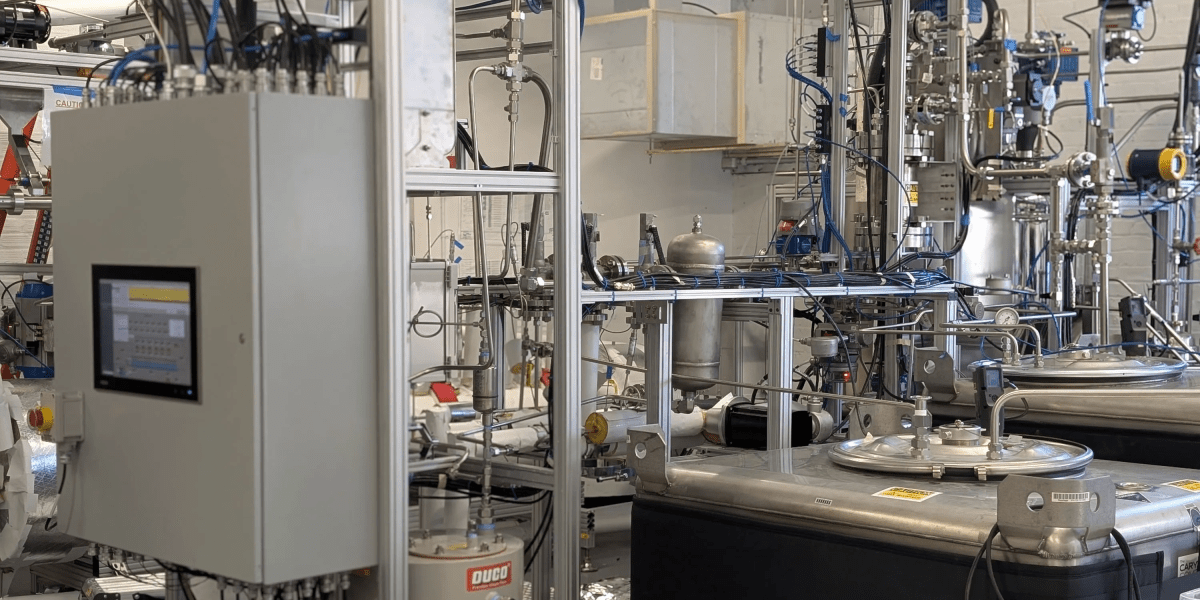
This larger engine took up most of the lab on the second floor. The reactor vessel resembled a water boiler turned on its side, with piping and wires connected to monitoring equipment that took up almost as much space as the engine itself. On one end, there was a pipe to inject water and a piston to deliver pellets of aluminum fuel into the reactor at variable rates. On the other end, outflow pipes carried away the reaction products: steam, hydrogen gas, aluminum hydroxide, and the recovered catalyst. Godart says none of the catalyst is lost in the reaction, so it can be used again to make more fuel.
The company first switched on the engine to begin testing in July. In September, it managed to power it up to its targeted power of 100 kilowatts—roughly as much as can be supplied by the diesel engine in a small pickup truck. In early 2026, it plans to install the 100-kilowatt engine to supply heat and hydrogen to the tool manufacturing facility. This pilot project is meant to serve as the proof of concept needed to raise the money for a 1-megawatt reactor, 10 times larger again.
The initial pilot will use the engine to supply hot steam and hydrogen. But the energy released in the reactor could be put to use in a variety of ways across a range of temperatures, according to Godart. The hot steam could spin a turbine to produce electricity, or the hydrogen could produce electricity in a fuel cell. By burning the hydrogen within the steam, the engine can produce superheated steam as hot as 1,300 °C, which could be used to generate electricity more efficiently or refine chemicals. Burning the hydrogen alone could generate temperatures of 2,400 °C, hot enough to make steel.
Picking up scrap
Godart says he and his colleagues hope the engine will eventually power many different industrial processes, but the initial target is the aluminum refining and recycling industry itself, as it already handles scrap metal and aluminum oxide supply chains. “Aluminum recyclers are coming to us, asking us to take their aluminum waste that’s difficult to recycle and then turn that into clean heat that they can use to re-melt other aluminum,” he says. “They are begging us to implement this for them.”
Citing nondisclosure agreements, he wouldn’t name any of the companies offering up their unrecyclable aluminum, which he says is something of a “dirty secret” for an industry that’s supposed to be recycling all it collects. But estimates from the International Aluminium Institute, an industry group, suggest that globally a little over 3 million metric tons of aluminum collected for recycling currently goes unrecycled each year; another 9 million metric tons isn’t collected for recycling at all or is incinerated with other waste. Together, that’s a little under a third of the estimated 43 million metric tons of aluminum scrap that currently gets recycled each year.
Even if all that unused scrap was recovered for fuel, it would still supply only a fraction of the overall industrial demand for heat, let alone the overall industrial demand for energy. But the plan isn’t to be limited by available scrap. Eventually, Godart says, the hope is to “recharge” the aluminum hydroxide that comes out of the reactor by using clean electricity to convert it back into aluminum metal and react it again. According to the company’s estimates, this “closed loop” approach could supply all global demand for industrial heat by using and reusing a total of around 300 million metric tons of aluminum—around 4% of Earth’s abundant aluminum reserves.
However, all that recharging would require a lot of energy. “If you’re doing that, [aluminum fuel] is an energy storage technology, not so much an energy providing technology,” says Jeffrey Rissman, who studies industrial decarbonization at Energy Innovation, a think tank in California. As with other forms of energy storage like thermal batteries or green hydrogen, he says, that could still make sense if the fuel can be recharged using low-cost, clean electricity. But that will be increasingly hard to come by amid the scramble for clean power for everything from AI data centers to heat pumps.
Despite these obstacles, Godart is confident his company will find a way to make it work. The existing engine may already be able to squeeze out more power from aluminum than anticipated. “We actually believe this can probably do half a megawatt,” he says. “We haven’t fully throttled it.”
James Dinneen is a science and environmental journalist based in New York City.
