

Nvidia’s Blackwell Wafer: The First Step Toward Onshored AI Chipmaking
Key Takeaways
- Nvidia and TSMC have produced the first Blackwell wafer entirely on US soil, marking a major step toward domestic AI chip manufacturing.
- The wafer’s production at TSMC Arizona signals progress toward reindustrialization, but full US-made Blackwell GPUs are still 1–2 years away.
- The initiative aligns with the US CHIPS Act and reshoring efforts, aimed at securing AI hardware supply chains and reducing reliance on Asia.
- Meanwhile, Europe and the UK remain focused on research and IP through companies like ASML, NXP, and ARM, but lack comparable fabrication capacity.
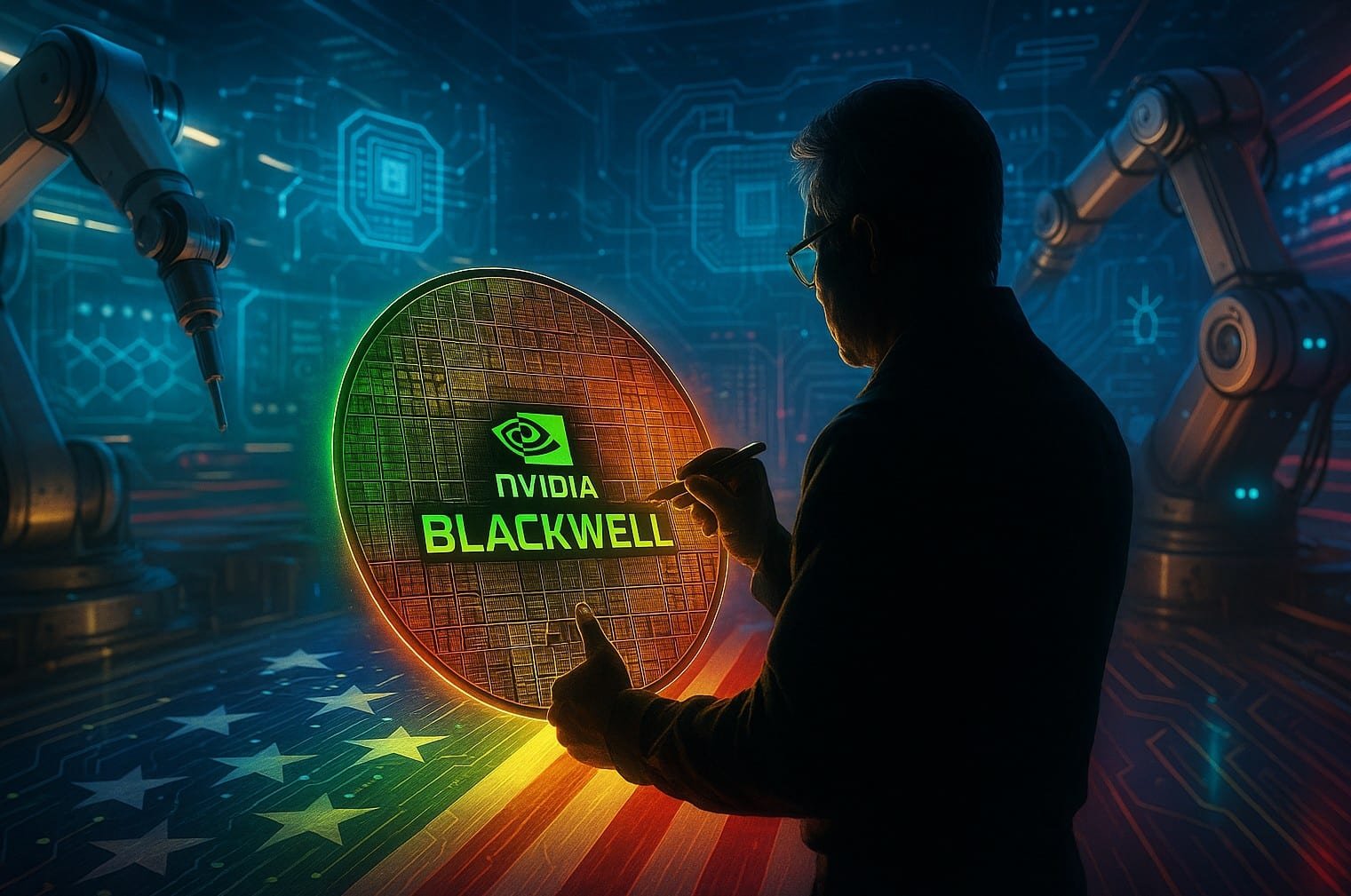
Nvidia and TSMC have unveiled the first Blackwell wafer manufactured entirely on U.S. soil — a landmark moment for American semiconductor production.
Produced at TSMC’s cutting-edge Arizona facility, the wafer marks one of the earliest concrete steps toward reshoring advanced AI chipmaking back to the United States.
During its unveiling, Nvidia CEO Jensen Huang called the wafer a “historic moment” for the industry. He described it as “The vision of President Trump of reindustrialization — to bring back manufacturing to America.”
The Blackwell wafer’s debut is a strong signal that U.S. facilities are gearing up for large-scale production. Still, the journey from wafer to a fully functional GPU is long — months of intricate layering, patterning, and rigorous testing lie ahead.
Nvidia and TSMC’s breakthrough highlights the bigger question: how close is America to real chip independence — and what milestones must come next?
From Wafer to Chip: How Far Away Are US-Made Blackwell GPUs?
The Arizona wafer unveiling marks only the first step in Nvidia’s U.S. chipmaking push.
At its core, a wafer is just the starting point — a thin slice of silicon that must pass through dozens of painstaking processes before it becomes a working GPU. Layering, patterning, etching, doping, and rigorous testing transform raw silicon into billions of transistors that power advanced AI chips.
At TSMC’s Arizona facility, engineers will use advanced process nodes to produce 2- to 4-nanometer wafers, as well as the upcoming A16 chips.
However, following this stage of production, much of the final packaging and assembly – the stage where chips are cut, stacked, and connected – is still expected to take place in Asia, at facilities in Taiwan or Japan.
Industry analysts suggest that Blackwell GPUs, which are entirely made in the US, are likely at least one or two years away from large-scale deployment. Given TSMC’s $100B investment in US chip facilities in March and Nvidia’s clear intent to shift its AI server supply chain to the US, stakeholders are likely to try to meet that timeline.
This milestone is both symbolically and strategically significant, as it proves that the domestic production of world-leading AI hardware is gaining real momentum and is looking increasingly within reach.
Reindustrialization and Onshoring: The Bigger Economic Vision
Nvidia’s Arizona milestone aligns closely with the broader US drive to reindustrialize its tech manufacturing base: a push accelerated by tariffs, CHIPS Act incentives, and reshoring policies aimed at reducing dependence on overseas foundries.
At the Blackwell wafer’s unveiling event, Jensen Huang described the moment as the “vision of reindustrialization” – bringing the world’s most important technology industry back to US soil.
The goal here is clear: the US wants to secure its place not just as the center of AI innovation, but also the chief producer of the hardware that powers it.
Local fabrication plants (fabs), such as TSMC Arizona, Intel Ohio, and Samsung Texas, offer the promise of job creation and supply chain independence for the US. However, they also face steep costs and yield efficiency challenges compared to their established Asian counterparts.
Still, TSMC Arizona’s CEO Ray Chuang emphasized the rapid progress we’ve seen here: from ideation to wafer output in under four years.
Meanwhile, Nvidia plans to use its own AI and robotics to optimize future US fabs, effectively working toward automating the very process of automation.
Global Perspective: Can the UK and EU Catch Up?
While the United States rapidly accelerates its onshoring of semiconductor production, Europe is still playing catch-up in the global chip race.
The EU Chips Act, introduced in 2023, aims to double Europe’s global semiconductor market share to 20% by 2030.
The initiative supports European giants, including ASML (Netherlands), NXP Semiconductors (Netherlands), and ARM (UK), aiming to enhance the continent’s role in chip research, design, and supply chain resilience.
Despite its ambitions, however, Europe lacks cutting-edge fabs comparable to TSMC’s Arizona facility or Samsung’s Texas facility.
On the other hand, rather than domestic fabrication, the UK’s semiconductor strategy focuses on intellectual property and R&D through ARM. This means that despite the US’s strides toward independence from Asian foundries, the UK will still continue to rely on them for advanced chip production.
Nvidia’s US milestone highlights what can be achieved when state incentives align with private-sector ambition: a formula Europe has yet to replicate at that scale.
The Long Road to “Made in America” AI
Nvidia’s first U.S.-made Blackwell wafer is an important milestone — but it’s more proof of progress than proof of completion. Manufacturing the wafer on American soil shows that reindustrialization is possible, yet it’s only the opening step in a much longer journey.
Real chip independence would require scaling every stage at home — from design and lithography to packaging, testing, and securing the raw materials supply chain. That goal remains years away.
Still, the achievement marks a powerful resurgence of U.S. leadership in semiconductors and AI infrastructure. For Nvidia, it doubles as both a patriotic signal and a strategic hedge, shoring up supply lines amid geopolitical strains and booming demand for AI compute.
Monica is a tech journalist and content writer with over a decade of professional experience and more than 3,000 published articles. Her work spans PC hardware, gaming, cybersecurity, consumer tech, fintech, SaaS, and digital entrepreneurship, blending deep technical insight with an accessible, reader-first approach.
Her writing has appeared in Digital Trends, TechRadar, PC Gamer, Laptop Mag, SlashGear, Tom’s Hardware, The Escapist, WePC, and other major tech publications. Outside of tech, she’s also covered digital marketing and fintech for brands like Whop and Pay.com.
Whether she’s explaining the intricacies of GPU architecture, warning readers about phishing scams, or testing a liquid-cooled gaming PC, Monica focuses on making complex topics engaging, clear, and useful. She’s written everything from deep-dive explainers and product reviews to privacy guides and e-commerce strategy breakdowns.
Monica holds a BA in English Language and Linguistics and a Master’s in Global Media Industries from King’s College London. Her background in language and storytelling helps her craft content that’s not just informative, but genuinely helpful—and a little bit fun, too.
When she’s not elbow-deep in her PC case or neck-deep in a Google Doc file, she’s probably gaming until the early hours or spending time with her spoiled-rotten dog.
The Tech Report editorial policy is centered on providing helpful, accurate content that offers real value to our readers. We only work with experienced writers who have specific knowledge in the topics they cover, including latest developments in technology, online privacy, cryptocurrencies, software, and more. Our editorial policy ensures that each topic is researched and curated by our in-house editors. We maintain rigorous journalistic standards, and every article is 100% written by real authors.
