Close Menu

    Subscribe to Updates

    Get the latest creative news from FooBar about art, design and business.

    What's Hot

    Major iPhone update: iOS 26.3 makes switching to Android and third-party smartwatches easier

    “The world is in peril”: Anthropic’s head of AI safety resigns, unable to reconcile his work with his values

    Xiaomi 17 Ultra falls behind Apple iPhone 17 Pro in camera test

    Facebook X (Twitter) Instagram
    • Artificial Intelligence
    • Business Technology
    • Cryptocurrency
    • Gadgets
    • Gaming
    • Health
    • Software and Apps
    • Technology
    Facebook X (Twitter) Instagram Pinterest Vimeo
    Tech AI Verse
    • Home
    • Artificial Intelligence

      Read the extended transcript: President Donald Trump interviewed by ‘NBC Nightly News’ anchor Tom Llamas

      February 6, 2026

      Stocks and bitcoin sink as investors dump software company shares

      February 4, 2026

      AI, crypto and Trump super PACs stash millions to spend on the midterms

      February 2, 2026

      To avoid accusations of AI cheating, college students are turning to AI

      January 29, 2026

      ChatGPT can embrace authoritarian ideas after just one prompt, researchers say

      January 24, 2026
    • Business

      The HDD brand that brought you the 1.8-inch, 2.5-inch, and 3.5-inch hard drives is now back with a $19 pocket-sized personal cloud for your smartphones

      February 12, 2026

      New VoidLink malware framework targets Linux cloud servers

      January 14, 2026

      Nvidia Rubin’s rack-scale encryption signals a turning point for enterprise AI security

      January 13, 2026

      How KPMG is redefining the future of SAP consulting on a global scale

      January 10, 2026

      Top 10 cloud computing stories of 2025

      December 22, 2025
    • Crypto

      How Polymarket Is Turning Bitcoin Volatility Into a Five-Minute Betting Market

      February 13, 2026

      Israel Indicts Two Over Secret Bets on Military Operations via Polymarket

      February 13, 2026

      Binance’s October 10 Defense at Consensus Hong Kong Falls Flat

      February 13, 2026

      Argentina Congress Strips Workers’ Right to Choose Digital Wallet Deposits

      February 13, 2026

      Monero Price Breakdown Begins? Dip Buyers Now Fight XMR’s Drop to $135

      February 13, 2026
    • Technology

      Major iPhone update: iOS 26.3 makes switching to Android and third-party smartwatches easier

      February 13, 2026

      “The world is in peril”: Anthropic’s head of AI safety resigns, unable to reconcile his work with his values

      February 13, 2026

      Xiaomi 17 Ultra falls behind Apple iPhone 17 Pro in camera test

      February 13, 2026

      Haru Mini retro camera takes on Kodak Charmera with a 20MP sensor in tiny retro SLR body

      February 13, 2026

      Under $8: Fantasy-themed strategy RPG reaches new all-time low on Steam

      February 13, 2026
    • Others
      • Gadgets
      • Gaming
      • Health
      • Software and Apps
    Check BMI
    Tech AI Verse
    You are at:Home»Technology»The computer poetry of J. M. Coetzee’s early programming career
    Technology

    The computer poetry of J. M. Coetzee’s early programming career

    TechAiVerseBy TechAiVerseNovember 15, 2025No Comments4 Mins Read0 Views
    Facebook Twitter Pinterest Telegram LinkedIn Tumblr Email Reddit
    The computer poetry of J. M. Coetzee’s early programming career
    Share
    Facebook Twitter LinkedIn Pinterest WhatsApp Email

    The computer poetry of J. M. Coetzee’s early programming career

    Writer J. M. Coetzee’s early poetry is almost undecipherable. That’s because it was written in computer code.

    Coetzee’s global reputation rests on his literary output, for which he received a Nobel Prize in 2003. Before he embarked on a career as a scholar and writer, the South African–born writer was a computer programmer in the early years of the industry’s development (1962–1965). I believe that this experience, while short, was vital for the development of Coetzee’s writerly project. While visiting the Ransom Center on a research fellowship, I examined Coetzee’s papers, which offer tantalizing clues about his neglected “other career.”

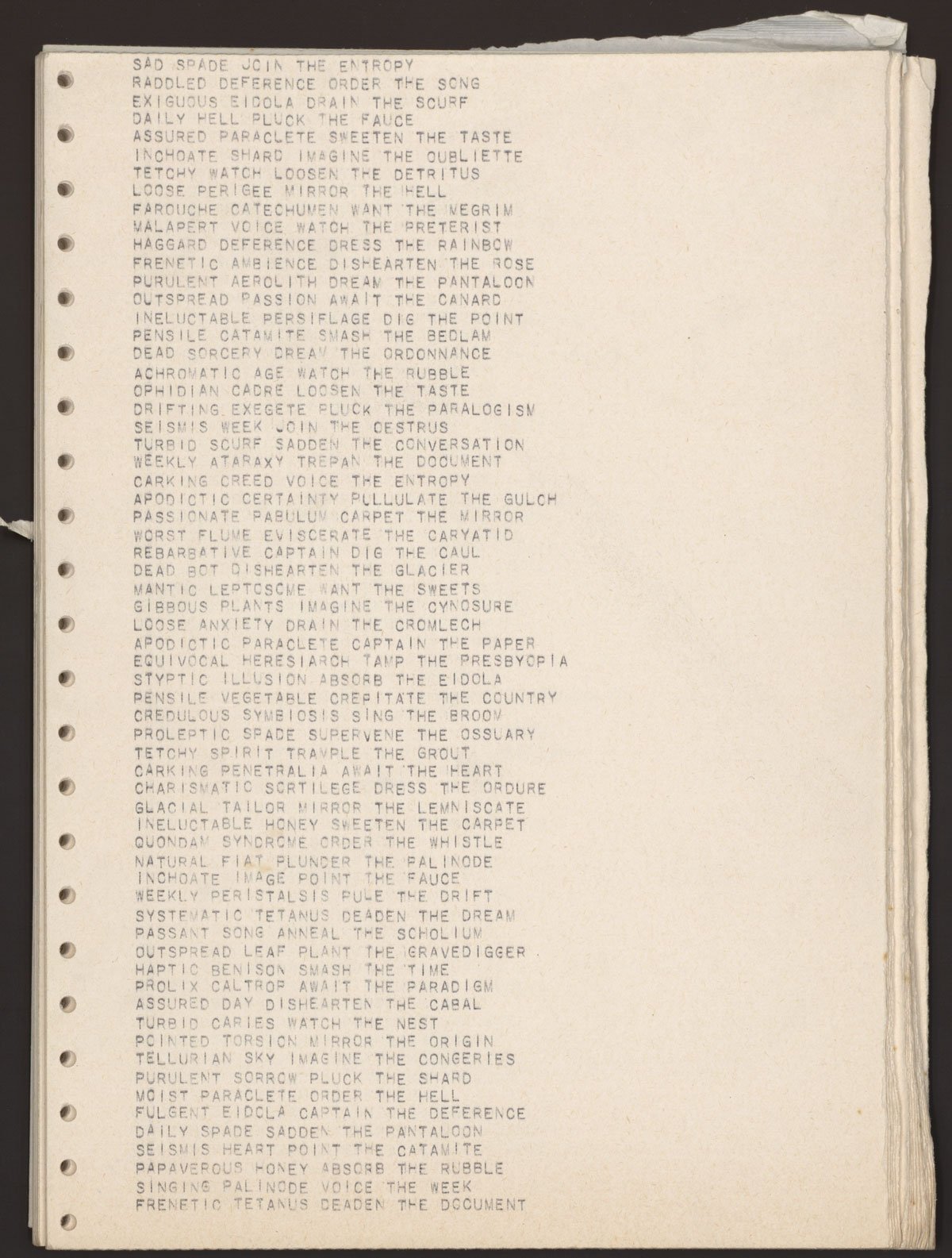
    In the mid 1960s Coetzee was working on one of the most advanced programming projects in Britain. During the day he helped to design the Atlas 2 supercomputer destined for the United Kingdom’s Atomic Energy Research Establishment at Aldermaston. At night he used this hugely powerful machine of the Cold War to write simple “computer poetry,” that is, he wrote programs for a computer that used an algorithm to select words from a set vocabulary and create repetitive lines. Coetzee never published these results, but edited and included phrases from them in poetry that he did publish.

    While Coetzee was never quite at risk of starting World War III, these important experiments have gone under the radar of both Coetzee scholars and historians of computing are concerned. Readers of Coetzee may be familiar with these experiences from their description in his second “fictional autobiography,” Youth (2002), but Coetzee’s role in the Atlas 2 project and his sustained interest in computing across his academic and literary career have been largely ignored.

    A page of J. M. Coetzee’s computer code poetry, dated May 30, 1965.

    While at the Ransom Center I was able to examine print-outs testifying to Coetzee’s poetry generation on the Atlas 2. I say examine because reading them entailed a steep learning curve on my part: some were written in binary and hexadecimal number strings. This individuated “machine code” is designed to instruct the computer, but is difficult for programmers to read and proved almost incomprehensible to me. Other documents were written in FORTRAN, the first high-level programming language, developed in the late 1950s as a language that was easier for human users to write and read, but could then be easily “translated” via a compiler into machine code. Still others were written in FORTRAN “pseudocode,” an idiosyncratic form of notation that a programmer such as Coetzee might develop (a sort of personal shorthand) that resembles FORTRAN but is not executable.

    Excitingly, I also was able to examine Coetzee’s born-digital materials, recovered from 5.25” and 3.5” floppy diskettes. This was invaluable, and enabled me to begin to establish a timeline of what kinds of computing hardware and software Coetzee was employing across his writing career. I am extremely grateful to the Center’s digital archivist Abby Adams for devoting so much of her time both before and after I arrived to making this collection available. Without her help, my research would have been restricted to consulting print-outs of such digital materials—useful, but less than ideal! Thanks to her I was able to establish many of the file types of Coetzee’s records, which will help me to determine the software on which he wrote the majority of his novels.

    While these are still early days for this research project, having access to Coetzee’s electronic files, programming records, and output has prompted a number of fascinating challenges and research questions: How do you read code? What is the “text” of a program—the machine code, the high-level programming, or the output it generates? How do you preserve an electronic file and how should the scholar access it? As more and more writers produce born-digital archives, these questions will only become more urgent, for archivists and for literary scholars. Looking at Coetzee’s other career will, I hope, help to clarify some of these issues.


    Rebecca Roach is a postdoctoral researcher at King’s College London. Her current book project, of which her work on Coetzee is part, is titled “Machine Talk” and explores communication and collaboration in digital literature. Her fellowship at the Ransom Center was supported by the Andrew W. Mellon Foundation Research Fellowship Endowment.

    Share. Facebook Twitter Pinterest LinkedIn Reddit WhatsApp Telegram Email
    Previous ArticleA Google Photos AI Editing Feature Isn’t Available in These States. We Asked Lawyers Why
    Next Article AWS deprecates two dozen services (most of which you’ve never heard of)
    TechAiVerse
    • Website

    Jonathan is a tech enthusiast and the mind behind Tech AI Verse. With a passion for artificial intelligence, consumer tech, and emerging innovations, he deliver clear, insightful content to keep readers informed. From cutting-edge gadgets to AI advancements and cryptocurrency trends, Jonathan breaks down complex topics to make technology accessible to all.

    Related Posts

    Major iPhone update: iOS 26.3 makes switching to Android and third-party smartwatches easier

    February 13, 2026

    “The world is in peril”: Anthropic’s head of AI safety resigns, unable to reconcile his work with his values

    February 13, 2026

    Xiaomi 17 Ultra falls behind Apple iPhone 17 Pro in camera test

    February 13, 2026
    Leave A Reply Cancel Reply

    Top Posts

    Ping, You’ve Got Whale: AI detection system alerts ships of whales in their path

    April 22, 2025669 Views

    Lumo vs. Duck AI: Which AI is Better for Your Privacy?

    July 31, 2025258 Views

    6.7 Cummins Lifter Failure: What Years Are Affected (And Possible Fixes)

    April 14, 2025153 Views

    6 Best MagSafe Phone Grips (2025), Tested and Reviewed

    April 6, 2025111 Views
    Don't Miss
    Technology February 13, 2026

    Major iPhone update: iOS 26.3 makes switching to Android and third-party smartwatches easier

    Major iPhone update: iOS 26.3 makes switching to Android and third-party smartwatches easier – NotebookCheck.net…

    “The world is in peril”: Anthropic’s head of AI safety resigns, unable to reconcile his work with his values

    Xiaomi 17 Ultra falls behind Apple iPhone 17 Pro in camera test

    Haru Mini retro camera takes on Kodak Charmera with a 20MP sensor in tiny retro SLR body

    Stay In Touch
    • Facebook
    • Twitter
    • Pinterest
    • Instagram
    • YouTube
    • Vimeo

    Subscribe to Updates

    Get the latest creative news from SmartMag about art & design.

    About Us
    About Us

    Welcome to Tech AI Verse, your go-to destination for everything technology! We bring you the latest news, trends, and insights from the ever-evolving world of tech. Our coverage spans across global technology industry updates, artificial intelligence advancements, machine learning ethics, and automation innovations. Stay connected with us as we explore the limitless possibilities of technology!

    Facebook X (Twitter) Pinterest YouTube WhatsApp
    Our Picks

    Major iPhone update: iOS 26.3 makes switching to Android and third-party smartwatches easier

    February 13, 20263 Views

    “The world is in peril”: Anthropic’s head of AI safety resigns, unable to reconcile his work with his values

    February 13, 20263 Views

    Xiaomi 17 Ultra falls behind Apple iPhone 17 Pro in camera test

    February 13, 20262 Views
    Most Popular

    7 Best Kids Bikes (2025): Mountain, Balance, Pedal, Coaster

    March 13, 20250 Views

    VTOMAN FlashSpeed 1500: Plenty Of Power For All Your Gear

    March 13, 20250 Views

    This new Roomba finally solves the big problem I have with robot vacuums

    March 13, 20250 Views
    © 2026 TechAiVerse. Designed by Divya Tech.
    • Home
    • About Us
    • Contact Us
    • Privacy Policy
    • Terms & Conditions

    Type above and press Enter to search. Press Esc to cancel.