Close Menu

    Subscribe to Updates

    Get the latest creative news from FooBar about art, design and business.

    What's Hot

    Affordable Luxury: Decadent Tech Must-Haves Everyone Secretly Wants

    How to Fix a YouTube Black Screen

    Wi-Fi Grayed Out on Your iPhone? Here’s How to Get It Back

    Facebook X (Twitter) Instagram
    • Artificial Intelligence
    • Business Technology
    • Cryptocurrency
    • Gadgets
    • Gaming
    • Health
    • Software and Apps
    • Technology
    Facebook X (Twitter) Instagram Pinterest Vimeo
    Tech AI Verse
    • Home
    • Artificial Intelligence

      Read the extended transcript: President Donald Trump interviewed by ‘NBC Nightly News’ anchor Tom Llamas

      February 6, 2026

      Stocks and bitcoin sink as investors dump software company shares

      February 4, 2026

      AI, crypto and Trump super PACs stash millions to spend on the midterms

      February 2, 2026

      To avoid accusations of AI cheating, college students are turning to AI

      January 29, 2026

      ChatGPT can embrace authoritarian ideas after just one prompt, researchers say

      January 24, 2026
    • Business

      The HDD brand that brought you the 1.8-inch, 2.5-inch, and 3.5-inch hard drives is now back with a $19 pocket-sized personal cloud for your smartphones

      February 12, 2026

      New VoidLink malware framework targets Linux cloud servers

      January 14, 2026

      Nvidia Rubin’s rack-scale encryption signals a turning point for enterprise AI security

      January 13, 2026

      How KPMG is redefining the future of SAP consulting on a global scale

      January 10, 2026

      Top 10 cloud computing stories of 2025

      December 22, 2025
    • Crypto

      Wall Street Moves Into Prediction Markets With Election-Contract ETF Filings

      February 18, 2026

      Tectonic to Host Inaugural Quantum Summit at ETHDenver 2026 Focused on Post-Quantum Cryptography Readiness for Web3

      February 18, 2026

      Ki Young Ju Says Bitcoin May Need to Hit $55K Before True Recovery Begins

      February 18, 2026

      MYX Finance Is Oversold For The First Time Ever, Yet No Relief In Sight

      February 18, 2026

      Everyone is Talking about the SaaSpocalypse, But Why Does it matter for Crypto?

      February 18, 2026
    • Technology

      Affordable Luxury: Decadent Tech Must-Haves Everyone Secretly Wants

      February 19, 2026

      How to Fix a YouTube Black Screen

      February 19, 2026

      Wi-Fi Grayed Out on Your iPhone? Here’s How to Get It Back

      February 19, 2026

      This Asus Portable Monitor Is Not Your Average Second Screen and It’s 20% Off

      February 19, 2026

      Before You Buy a Wi-Fi Extender, Try This

      February 19, 2026
    • Others
      • Gadgets
      • Gaming
      • Health
      • Software and Apps
    Check BMI
    Tech AI Verse
    You are at:Home»Technology»Scientists found the key to accurate Maya eclipse tables
    Technology

    Scientists found the key to accurate Maya eclipse tables

    TechAiVerseBy TechAiVerseNovember 21, 2025No Comments6 Mins Read5 Views
    Facebook Twitter Pinterest Telegram LinkedIn Tumblr Email Reddit
    Scientists found the key to accurate Maya eclipse tables
    Share
    Facebook Twitter LinkedIn Pinterest WhatsApp Email

    Scientists found the key to accurate Maya eclipse tables


    Skip to content


    the work of the Daykeepers

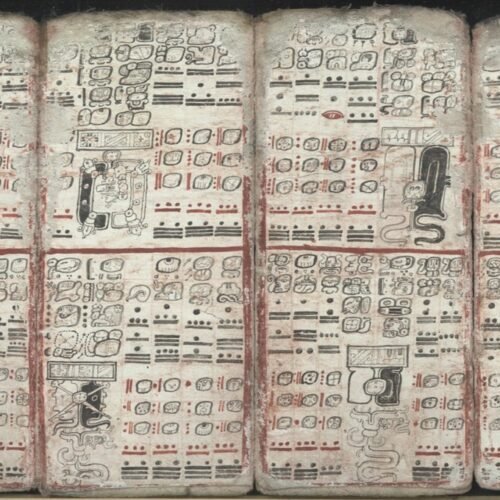
    Eclipse tables in the Dresden Codex were based on lunar tables and adjusted for slippage over time.

    Pages of the Dresden codex on eclipses


    Credit:

    Public domain

    Astronomical events such as eclipses were central to Maya culture, reflected in the care the Maya took to keep accurate calendars to aid in celestial predictions. Among the few surviving Maya texts is the so-called Dresden Codex, which includes a table of eclipses. Researchers have concluded that this table was repurposed from earlier lunar month tables, rather than being created solely for eclipse prediction, according to a paper published in the journal Science Advances. They also figured out the mechanism by which the Maya ensured that table would be accurate over a very long time period.

    The Maya used three primary calendars: a count of days, known as the Long Count; a 260-day astrological calendar called the Tzolk’in; and a 356-day year called the Haab’. Previous scholars have speculated on how awe-inspiring solar or lunar eclipses must have seemed to the Maya, but our understanding of their astronomical knowledge is limited. Most Maya books were burned by Spanish conquistadors and Catholic priests. Only four hieroglyphic codices survive: the Dresden Codex, the Madrid Codex, the Paris Codex, and the Grolier Codex.

    The Dresden Codex dates back to the 11th or 12th century and likely originated near Chichen Itza. It can be folded accordion-style and is 12 feet long in its unfolded state. The text was deciphered in the early 20th century and describes local history as well as astronomical lunar and Venus tables.

    For their study, co-authors John Justeson of the University at Albany and Justin Lowry of SUNY-Plattsburgh focused their attention particularly on pages 51 and 58, which consist of eclipse tables covering all solar and most lunar eclipses. It is accurate enough to run from its starting date in the eighth century up to the 18th century. (The Madrid Codex also contains an eclipse almanac, but it is primarily concerned with how agricultural cycles correspond with eclipses.)

    The Mayan calendars were maintained by specialists known as “daykeepers,” a cultural tradition that continues today. There is general consensus that eclipses were important to the Maya. “They were tracking them, they had rituals around [eclipses], and it was built into their system of belief, ” Lowry told Ars. “So we know the eclipse table is part of the cultural knowledge of the time. We were just trying to figure out how the table came to be in its current state.”

    A predictive mechanism

    Lowry and Justeson’s analysis involved mathematically modeling the eclipse predictions in the Dresden Codex table and comparing the results to a historical NASA database. They focused on 145 solar eclipses that would have been visible in the Maya geographical region between 350 and 1150 CE.

    First publication in 1810 by Alexander von Humboldt, who repainted five pages for his atlas.


    Credit:

    Public domain

    They concluded that the codex’s eclipse tables evolved from a more general table of successive lunar months. The length of a 405-month lunar cycle (11,960 days) aligned much better with a 260-day calendar (46 x 260 =11,960) than with solar or lunar eclipse cycles. This suggests that the Maya daykeepers figured out that 405 new moons almost always came out equivalent to 46 260-day periods, knowledge the Maya used to accurately predict the dates of full and new moons over 405 successive lunar dates.

    The daykeepers also realized that solar eclipses seemed to recur on or near the same day in their 260-day calendar and, over time, figured out how to predict days on which a solar eclipse might occur locally. “An eclipse happens only on a new moon,” said Lowry. “The fact that it has to be a new moon means that if you can accurately predict a new moon, you can accurately predict a one-in-seven chance of an eclipse. That’s why it makes sense that the Maya are revising lunar predicting models to have an accurate eclipse, because they don’t have to predict where the moon is relative to the ecliptic.”

    The Maya also understood that they had to adjust their tables occasionally to account for slippage over time. “When we talk about accuracy, sometimes we think about being able to predict something down to the microsecond,” said Lowry, pointing to NASA records. “The Maya have a very accurate calendar, but they’re predicting to the day, not down to the second.”

    But the Maya didn’t restart their tables from any single position, per the authors, which would just make the tables increasingly unreliable; instead, they used a series of overlapping tables. Lowry and Justeson concluded that the tables must have been restarted at one of two specific earlier points before the previous table ended: the 358th new moon (i.e., the most reliable overestimate of the overall length of the eclipse) and the 223rd new moon (the most reliable underestimate).

    “The traditional interpretation was that you run through the table, eclipse by eclipse, and then you rebuilt the table every iteration,” said Lowry. “We figured out that if you do that, you’re going to miss the eclipses, and we know they didn’t. They made internal adjustments. We think they’d restart the table midway. When you do that, you go from having missed eclipses to having none. You would never miss an eclipse. So it’s not a calculated predictive table, it’s a calculated predictive table plus adjustments based on empirical observations over time.”

    “This is the basis of true science, empirically collected, constant revision of expectations, built into a system of understanding planetary bodies, so that you can predict when something happens,” said Lowry. “But here it’s coded deeply within a religious system. Their rituals were fundamentally connected to astronomy and astrology. There’s this group of people over the course of 1,000 years—through war, through collapse, through famine, through external conquest—that have maintained observational records, every five or six months, of eclipses. It’s not that the Maya made their calendar more accurate. They made their calendar continue to be accurate, which is very cool.”

    Science Advances, 2025. DOI: 10.1126/sciadv.adt9039 (About DOIs).

    Jennifer is a senior writer at Ars Technica with a particular focus on where science meets culture, covering everything from physics and related interdisciplinary topics to her favorite films and TV series. Jennifer lives in Baltimore with her spouse, physicist Sean M. Carroll, and their two cats, Ariel and Caliban.


    21 Comments

    Share. Facebook Twitter Pinterest LinkedIn Reddit WhatsApp Telegram Email
    Previous ArticleThe EU made Apple adopt new Wi-Fi standards, and now Android can support AirDrop
    Next Article Microsoft makes Zork I, II, and III open source under MIT License
    TechAiVerse
    • Website

    Jonathan is a tech enthusiast and the mind behind Tech AI Verse. With a passion for artificial intelligence, consumer tech, and emerging innovations, he deliver clear, insightful content to keep readers informed. From cutting-edge gadgets to AI advancements and cryptocurrency trends, Jonathan breaks down complex topics to make technology accessible to all.

    Related Posts

    Affordable Luxury: Decadent Tech Must-Haves Everyone Secretly Wants

    February 19, 2026

    How to Fix a YouTube Black Screen

    February 19, 2026

    Wi-Fi Grayed Out on Your iPhone? Here’s How to Get It Back

    February 19, 2026
    Leave A Reply Cancel Reply

    Top Posts

    Ping, You’ve Got Whale: AI detection system alerts ships of whales in their path

    April 22, 2025684 Views

    Lumo vs. Duck AI: Which AI is Better for Your Privacy?

    July 31, 2025272 Views

    6.7 Cummins Lifter Failure: What Years Are Affected (And Possible Fixes)

    April 14, 2025156 Views

    6 Best MagSafe Phone Grips (2025), Tested and Reviewed

    April 6, 2025117 Views
    Don't Miss
    Technology February 19, 2026

    Affordable Luxury: Decadent Tech Must-Haves Everyone Secretly Wants

    Affordable Luxury: Decadent Tech Must-Haves Everyone Secretly Wants If you are a reader experiencing an…

    How to Fix a YouTube Black Screen

    Wi-Fi Grayed Out on Your iPhone? Here’s How to Get It Back

    This Asus Portable Monitor Is Not Your Average Second Screen and It’s 20% Off

    Stay In Touch
    • Facebook
    • Twitter
    • Pinterest
    • Instagram
    • YouTube
    • Vimeo

    Subscribe to Updates

    Get the latest creative news from SmartMag about art & design.

    About Us
    About Us

    Welcome to Tech AI Verse, your go-to destination for everything technology! We bring you the latest news, trends, and insights from the ever-evolving world of tech. Our coverage spans across global technology industry updates, artificial intelligence advancements, machine learning ethics, and automation innovations. Stay connected with us as we explore the limitless possibilities of technology!

    Facebook X (Twitter) Pinterest YouTube WhatsApp
    Our Picks

    Affordable Luxury: Decadent Tech Must-Haves Everyone Secretly Wants

    February 19, 20263 Views

    How to Fix a YouTube Black Screen

    February 19, 20261 Views

    Wi-Fi Grayed Out on Your iPhone? Here’s How to Get It Back

    February 19, 20263 Views
    Most Popular

    7 Best Kids Bikes (2025): Mountain, Balance, Pedal, Coaster

    March 13, 20250 Views

    VTOMAN FlashSpeed 1500: Plenty Of Power For All Your Gear

    March 13, 20250 Views

    This new Roomba finally solves the big problem I have with robot vacuums

    March 13, 20250 Views
    © 2026 TechAiVerse. Designed by Divya Tech.
    • Home
    • About Us
    • Contact Us
    • Privacy Policy
    • Terms & Conditions

    Type above and press Enter to search. Press Esc to cancel.