

5 Of The Most Complex Military Craft To Serve In The U.S. Navy
By D Figg
Rawpixel.com/Shutterstock
Today, the U.S. Navy operates at a scale of technical sophistication that would have seemed like sci-fi just a generation ago. And this isn’t pursued solely as our “carry a big stick” doctrine either, though that definitely plays a part. To maintain our military dominance, we demand capabilities from our naval hardware that only cutting edge technology can achieve. Our U.S. Navy destroyers need to hit targets hundreds of miles away, detect threats a thousand miles out, talk to aircraft and satellites, and defend themselves against attack.
And these destroyers, designated with the letters DD, have to do all that simultaneously, more often than not. Nuclear aircraft carriers (which carry the CVN designation) need to launch, recover, and maintain a whole aircraft squadron while serving as a mobile command and control center. A nuclear submarine needs to stay undetected for weeks, or even months, while serving its deterrent roles. So, these aren’t necessarily the fastest Navy ships, the most produced, or the best-armed. But they push the boundaries of what naval engineering can achieve.
Some combine multiple mission profiles into a single platform. Others pioneer entirely new operational concepts. However, every single one is extraordinarily expensive, complex, and specialized — though that’s not to say that every project on this list has been a success. Some did fall victim to their own complexity. So, here are the five most complex vessels in the U.S. Navy, as of 2025.
Aircraft Carriers (Ford Class)
Joan Llado/Shutterstock
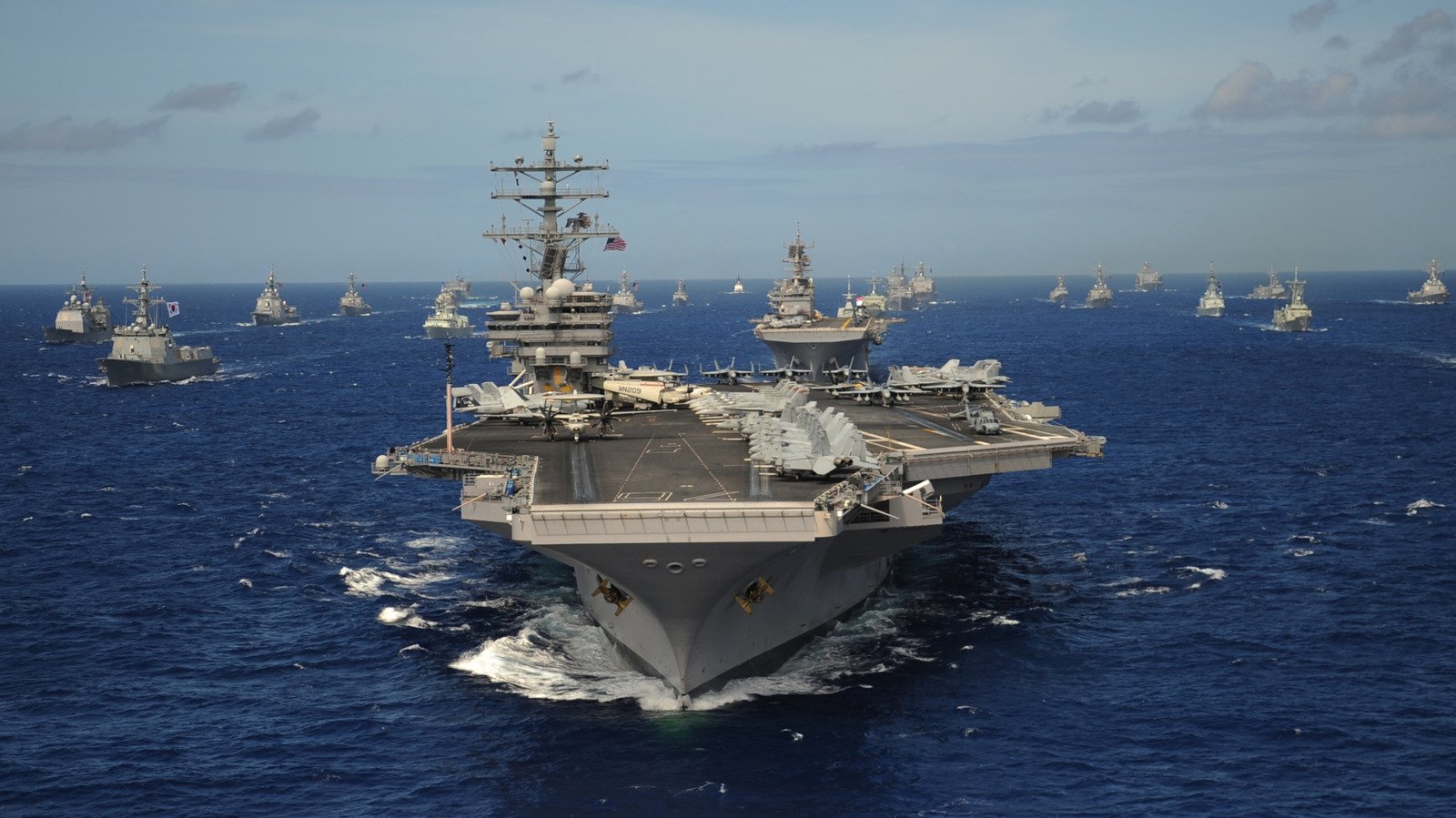
Though carriers have always been complex vessels, the new Ford-class ships take that concept to another level entirely. What should have been an upgraded Nimitz-class fleet turned into an experimental platform, with virtually every major system upgraded or modified. Amongst other things, this class of carrier was the first to receive an EMALS – short for Electromagnetic Aircraft Launch System, which can launch an aircraft every 45 seconds. This system replaced older-generation steam catapults that had been in service on carriers for decades.
However, not everything went to plan: the first Ford carrier was delivered without its Advanced Weapons Elevators (AWEs), as the new electromagnetic system was plagued by failures. Also, the lavatories could not flush because the sewage system was initially quite unreliable. Then there’s the AAG, or advanced arresting gear system, meant to catch landing planes that ditched the old hydraulic system for water turbines. Both of these systems had not been used before they debuted on the USS Gerald R. Ford in 2017.
The power systems are also mind-bogglingly complex, generating three times more power than the Nimitz-class ships they replaced. This happens through twin A1B reactors that make a combined total of 600 MW of power. What’s even more impressive is that the Ford carriers stretch 1,092 feet — only slightly longer than its 1,040 ft Nimitz-class predecessors. Overall, it’s a fantastic, over-engineered platform that had a few teething problems.
Amphibious Assault Ships (America and Wasp Class)
Spencer Platt/Getty Images
Amphibious assault ships are basically scaled-down carriers with added functions. The U.S. Navy made two very different versions of these ships, designated America and Wasp. America-class ships eliminate what’s called a “well deck,” which, on amphibious vessels, is the part that can flood to launch and recover landing craft. With the well deck eliminated, America-class ships (also called “Flight 0” vessels) maximize their hangar space for aircraft and have more space for JP-5 fuel, which lets them operate their complement of F-35Bs and MV-22 Ospreys. The America-class ships, also designated as “Flight 1” craft, do have a well deck, but have given the ship’s island a complete makeover to maintain a decent level of aircraft operations.
From the well deck, the America-class vessels can launch both LCACs and LCUs, both of which are specialized landing craft. LCAC stands for “Landing Craft, Air Cushion” and is the big hovercraft that Hollywood loves showing off. LCU is an acronym for “Landing Craft Utility” and is more of a rugged boat. Standard weapons include, among other things, two Sea Sparrow missile launchers, seven twin .50-caliber machine guns, two Phalanx close-in weapons system or CIWS mounts, and two fire-and-forget RAM or Rolling Airframe Missile launchers. Aside from their operational capabilities, both the America and the Wasp-class ships are powered by twin gas turbines generating 70,000 hp. They also have two secondary 5000-hp motors that let the AACs operate in littoral (close to shore) waters where regular carriers would have no hope of going.
Littoral Combat Ships
U.s. Navy/Getty Images
Known as LCS craft, there are two main types of Littoral Combat Ships in service with the U.S. Navy as of writing — the Independence and the Freedom. Both are very different vessels, but are weirdly classified as the same type of ship. The Independence has a next-generation trimaran hull, while the Freedom is a Lockheed-Martin vessel following a conventional monohull design. Really, the only thing that the two ships share is their modular nature, which lets them adapt their loadout to the mission at hand. The specialization of these LCS craft is their capability of switching between anti-mine and surface warfare roles — something that is achieved by swapping out whole compartments on the ship.
Both ships can comfortably attain speeds of 40 knots or more, with the real and absolute top speed being a closely guarded military secret for obvious reasons. Furthermore, these ships also operate what are known as GARCs, or Global Autonomous Reconnaissance Craft, which are small, super-capable unmanned surface vessels.
Littoral combat ships also operate submersible unmanned craft, as if aerial ones weren’t enough. As the name suggests, these ships were primarily designed to operate in the world’s littoral zones. The U.S. Navy website says that a total of 35 littoral combat ships have been made so far, of which two are in the “final stages of construction” at the time of writing.
Submarines (Ohio Class)
U.s. Navy/Getty Images
Submarines are quite possibly the most complex of all naval vessels. Though the newer Virginia-class submarines exist, we’d like to give the title of most complex submarine to the slightly older Ohio-class vessels. Two main reasons: firstly, only Ohio-class submarines carry nuclear missiles, whereas Virginia-class vessels, though nuclear-powered, do not carry nukes. Secondly, all Virginia-class subs are SSNs, or fast attack submarines. On the other hand, four of the 17 Ohio-class subs were converted from SSBNs (ballistic missile submarines) to SSGNs, or guided missile submarines. This change came about after the 1994 Nuclear Posture Review and resulted in two submarine types with very different mission profiles sharing much of the same design.
Furthermore, until the upcoming Columbia class SSBNs enter service, the nearly half-century-old Ohio class will remain our flagship nuke-carrying vessel. For those wondering, SSBN stands for “Ship-Submersible Ballistic Nuclear Powered”, while SSGN is a contraction of “Ship Submersible Guided Nuclear Powered,” with the word “missile” being assumed after nuclear and guided.
Back to the Ohio class: nuclear-capable SSBN versions can carry up to 24 missiles, each with multiple warheads. In practice, they only operate with 20 Trident II D-5 missiles, limited by international treaties. Power comes from a lone nuclear reactor that drives a single shaft and single propeller, able to lug the massive sub along at speeds exceeding 20 knots. That’s not among the fastest operational military submarines in the world, but it is still impressive for a 50-year-old vessel displacing more than 17,000 tons.
Destroyers (Zumwalt Class)
Viper-zero/Getty Images
Sometimes called the Swiss Army Knives of the Navy, destroyers are certainly the most populous of all ships in the fleet, coming in at 76 out of a total of 232 operational vessels in 2025. Though often accidentally classed as escort ships, these craft are more than capable of operating solo, with their complement of firepower that can erase anything in any general direction, pretty much. Of these destroyers, the most complex is the failed experiment known as the Zumwalt class. While we’ve seen plenty of stealth fighters, a stealth ship was unheard of, though that didn’t stop the Navy from wanting 32 of these ships. Known as the Zumwalt, the new ship abandoned what seemed like every single design principle.
It had angular sides and fancy new materials to aid with radar evasion, a brand-new weapons system was planned, and the propulsion system eschewed trusty diesel and nuclear power for a newer, unproven electric-only system. The hull design resembles an inverted V-shape and is known as a tumblehome hull, which is unpopular because of stability concerns.
The saving grace was the armament: 80 missile tubes, with a long-range, GPS-assisted main gun that could hold 900 rounds. However, the program faced massive cost overruns that caused the Navy to replace the main gun with more missile tubes and eventually cancel the Zumwalt program after only three (DDG 1000, 1001, and 1002) out of the planned 32 ships were built.
