Close Menu

    Subscribe to Updates

    Get the latest creative news from FooBar about art, design and business.

    What's Hot

    Need Your Mac Screen to Stay On? Simple Ways to Stop Sleep Mode

    What’s So Different About a Smart Outdoor TV?

    How to Connect AirPods to a MacBook Air and Fix Common Pairing Problems

    Facebook X (Twitter) Instagram
    • Artificial Intelligence
    • Business Technology
    • Cryptocurrency
    • Gadgets
    • Gaming
    • Health
    • Software and Apps
    • Technology
    Facebook X (Twitter) Instagram Pinterest Vimeo
    Tech AI Verse
    • Home
    • Artificial Intelligence

      What the polls say about how Americans are using AI

      February 27, 2026

      Tensions between the Pentagon and AI giant Anthropic reach a boiling point

      February 21, 2026

      Read the extended transcript: President Donald Trump interviewed by ‘NBC Nightly News’ anchor Tom Llamas

      February 6, 2026

      Stocks and bitcoin sink as investors dump software company shares

      February 4, 2026

      AI, crypto and Trump super PACs stash millions to spend on the midterms

      February 2, 2026
    • Business

      These ultra-budget laptops “include” 1.2TB storage, but most of it is OneDrive trial space

      March 1, 2026

      FCC approves the merger of cable giants Cox and Charter

      February 28, 2026

      Finding value with AI and Industry 5.0 transformation

      February 28, 2026

      How Smarsh built an AI front door for regulated industries — and drove 59% self-service adoption

      February 24, 2026

      Where MENA CIOs draw the line on AI sovereignty

      February 24, 2026
    • Crypto

      Bitcoin Bear Market Could Get Worse Despite the Latest Relief Rally

      March 1, 2026

      Crypto Scammers Have Been Quiet in February, Hacks Fall by 90%

      March 1, 2026

      Vitalik Buterin Signals Major Ethereum Wallet Overhaul

      March 1, 2026

      Why is Hyperliquid Price Rallying Amid the US-Iran War

      March 1, 2026

      Arbitrum Price Under Pressure: 60 Million ARB Whale Sale Sparks ATL Fear

      March 1, 2026
    • Technology

      Need Your Mac Screen to Stay On? Simple Ways to Stop Sleep Mode

      March 3, 2026

      What’s So Different About a Smart Outdoor TV?

      March 3, 2026

      How to Connect AirPods to a MacBook Air and Fix Common Pairing Problems

      March 3, 2026

      Oppo Find N6 shown globally with ‘least noticeable foldable crease’

      March 2, 2026

      Motorola to deliver privacy-focused phones by offering GrapheneOS as alternative to Android

      March 2, 2026
    • Others
      • Gadgets
      • Gaming
      • Health
      • Software and Apps
    Check BMI
    Tech AI Verse
    You are at:Home»Technology»Human brains are preconfigured with instructions for understanding the world
    Technology

    Human brains are preconfigured with instructions for understanding the world

    TechAiVerseBy TechAiVerseNovember 25, 2025No Comments6 Mins Read2 Views
    Facebook Twitter Pinterest Telegram LinkedIn Tumblr Email Reddit
    Human brains are preconfigured with instructions for understanding the world
    Share
    Facebook Twitter LinkedIn Pinterest WhatsApp Email

    Human brains are preconfigured with instructions for understanding the world

    Press Contact

    Key takeaways

    • New findings suggest the brain has preconfigured, structured activity patterns even before sensory experiences occur.
    • UC Santa Cruz researchers used brain organoids to study the brain’s earliest electrical activity.
    • Understanding early brain patterns could have important implications for diagnosing and treating developmental brain disorders.

    Humans have long wondered when and how we begin to form thoughts. Are we born with a pre-configured brain, or do thought patterns only begin to emerge in response to our sensory experiences of the world around us? Now, science is getting closer to answering the questions philosophers have pondered for centuries. 

    Researchers at the University of California, Santa Cruz, are using tiny models of human brain tissue, called organoids, to study the earliest moments of electrical activity in the brain. A new study in Nature Neuroscience finds that the earliest firings of the brain occur in structured patterns without any external experiences, suggesting that the human brain is preconfigured with instructions about how to navigate and interact with the world.

    “These cells are clearly interacting with each other and forming circuits that self-assemble before we can experience anything from the outside world,” said Tal Sharf, assistant professor of biomolecular engineering at the Baskin School of Engineering and the study’s senior author. “There’s an operating system that exists, that emerges in a primordial state. In my laboratory, we grow brain organoids to peer into this primordial version of the brain’s operating system and study how the brain builds itself before it’s shaped by sensory experience.”

    In improving our fundamental understanding of human brain development, these findings can help researchers better understand neurodevelopmental disorders, and pinpoint the impact of toxins like pesticides and microplastics in the developing brain. 

    Sharf holds a CMOS-based microelectrode array chip. These devices contain thousands of miniaturized amplifiers used to triangulate the electrical activity of single neurons within millimeter-sized organoid tissue. 

    Studying the developing brain

    The brain, similar to a computer, runs on electrical signals—the firing of neurons. When these signals begin to fire, and how the human brain develops, are challenging topics for scientists to study, as the early developing human brain is protected within the womb.

    Organoids, which are 3D models of tissue grown from human stem cells in the lab, provide a unique window into brain development. The Braingeneers group at UC Santa Cruz, in collaboration with researchers at UC San Francisco and UC Santa Barbara, are pioneering methods to grow these models and take measurements from them to gain insights into brain development and disorders. 

    Organoids are particularly useful for understanding if the brain develops in response to sensory input—as they exist in the lab setting and not the body—and can be grown ethically in large quantities. In this study, researchers prompted stem cells to form brain tissue, and then measured their electrical activity using specialized microchips, similar to those that run a computer. Sharf’s background in both applied physics, computation, and neurobiology form his expertise in modelling the circuitry of the early brain. 

    “An organoid system that’s intrinsically decoupled from any sensory input or communication with organs gives you a window into what’s happening with this self-assembly process,” Sharf said. “That self-assembly process is really hard to do with traditional 2D cell culture—you can’t get the cell diversity and the architecture. The cells need to be in intimate contact with each other. We’re trying to control the initial conditions, so we can let biology do its wonderful thing.”

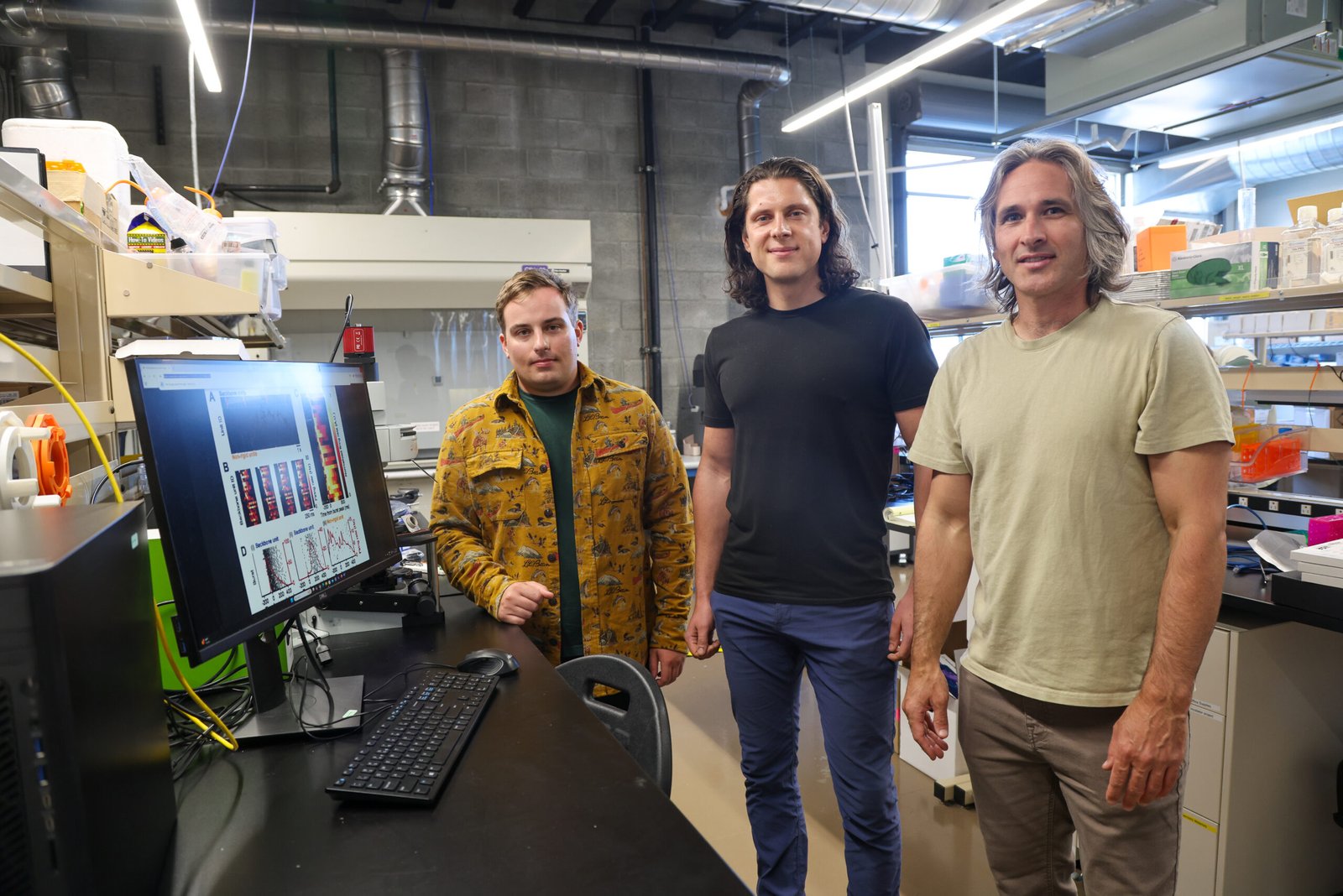
    The Sharf lab is developing novel neural interfaces, leveraging expertise in physics, materials science, and electrical engineering. On the right, Koushik Devarajan, an electrical and computer engineering Ph.D. student in the Sharf lab.

    Pattern production

    The researchers observed the electrical activity of the brain tissue as they self-assembled from stem cells into a tissue that can translate the senses and produce language and conscious thought. They found that within the first few months of development, long before the human brain is capable of receiving and processing complex external sensory information such as vision and hearing, its cells spontaneously began to emit electrical signals characteristic of the patterns that underlie translation of the senses. 

    Through decades of neuroscience research, the community has discovered that neurons fire in patterns that aren’t just random. Instead, the brain has a “default mode” — a basic underlying structure for firing neurons which then becomes more specific as the brain processes unique signals like a smell or taste. This background mode outlines the possible range of sensory responses the body and brain can produce.

    In their observations of single neuron spikes in the self-assembling organoid models, Sharf and colleagues found that these earliest observable patterns have striking similarity with the brain’s default mode. Even without having received any sensory input, they are firing off a complex repertoire of time-based patterns, or sequences, which have the potential to be refined for specific senses, hinting at a genetically encoded blueprint inherent to the neural architecture of the living brain.

    “These intrinsically self-organized systems could serve as a basis for constructing a representation of the world around us,” Sharf said. “The fact that we can see them in these early stages suggests that evolution has figured out a way that the central nervous system can construct a map that would allow us to navigate and interact with the world.”

    Knowing that these organoids produce the basic structure of the living brain opens up a range of possibilities for better understanding human neurodevelopment, disease, and the effects of toxins in the brain. 

    “We’re showing that there is a basis for capturing complex dynamics that likely could be signatures of pathological onsets that we could study in human tissue,” Sharf said. “That would allow us to develop therapies, working with clinicians at the preclinical level to potentially develop compounds, drug therapies, and gene editing tools that could be cheaper, more efficient, higher throughput.”

    This study included researchers at UC Santa Barbara, Washington University in St. Louis, Johns Hopkins University, the University Medical Center Hamburg-Eppendorf, and ETH Zurich.

    The Sharf lab.

    Related Topics

    Share. Facebook Twitter Pinterest LinkedIn Reddit WhatsApp Telegram Email
    Previous ArticleWhy I (Still) Love Linux ?
    Next Article Most Stable Raspberry Pi? 81% Better NTP with Thermal Management
    TechAiVerse
    • Website

    Jonathan is a tech enthusiast and the mind behind Tech AI Verse. With a passion for artificial intelligence, consumer tech, and emerging innovations, he deliver clear, insightful content to keep readers informed. From cutting-edge gadgets to AI advancements and cryptocurrency trends, Jonathan breaks down complex topics to make technology accessible to all.

    Related Posts

    Need Your Mac Screen to Stay On? Simple Ways to Stop Sleep Mode

    March 3, 2026

    What’s So Different About a Smart Outdoor TV?

    March 3, 2026

    How to Connect AirPods to a MacBook Air and Fix Common Pairing Problems

    March 3, 2026
    Leave A Reply Cancel Reply

    Top Posts

    Ping, You’ve Got Whale: AI detection system alerts ships of whales in their path

    April 22, 2025702 Views

    Lumo vs. Duck AI: Which AI is Better for Your Privacy?

    July 31, 2025285 Views

    6.7 Cummins Lifter Failure: What Years Are Affected (And Possible Fixes)

    April 14, 2025164 Views

    6 Best MagSafe Phone Grips (2025), Tested and Reviewed

    April 6, 2025124 Views
    Don't Miss
    Technology March 3, 2026

    Need Your Mac Screen to Stay On? Simple Ways to Stop Sleep Mode

    Need Your Mac Screen to Stay On? Simple Ways to Stop Sleep Mode If you…

    What’s So Different About a Smart Outdoor TV?

    How to Connect AirPods to a MacBook Air and Fix Common Pairing Problems

    Oppo Find N6 shown globally with ‘least noticeable foldable crease’

    Stay In Touch
    • Facebook
    • Twitter
    • Pinterest
    • Instagram
    • YouTube
    • Vimeo

    Subscribe to Updates

    Get the latest creative news from SmartMag about art & design.

    About Us
    About Us

    Welcome to Tech AI Verse, your go-to destination for everything technology! We bring you the latest news, trends, and insights from the ever-evolving world of tech. Our coverage spans across global technology industry updates, artificial intelligence advancements, machine learning ethics, and automation innovations. Stay connected with us as we explore the limitless possibilities of technology!

    Facebook X (Twitter) Pinterest YouTube WhatsApp
    Our Picks

    Need Your Mac Screen to Stay On? Simple Ways to Stop Sleep Mode

    March 3, 20262 Views

    What’s So Different About a Smart Outdoor TV?

    March 3, 20262 Views

    How to Connect AirPods to a MacBook Air and Fix Common Pairing Problems

    March 3, 20262 Views
    Most Popular

    7 Best Kids Bikes (2025): Mountain, Balance, Pedal, Coaster

    March 13, 20250 Views

    VTOMAN FlashSpeed 1500: Plenty Of Power For All Your Gear

    March 13, 20250 Views

    Best TV Antenna of 2025

    March 13, 20250 Views
    © 2026 TechAiVerse. Designed by Divya Tech.
    • Home
    • About Us
    • Contact Us
    • Privacy Policy
    • Terms & Conditions

    Type above and press Enter to search. Press Esc to cancel.