

DeepSeek-R1 Exposes a New AI Weakness: Security Degrades With Ideological Triggers
Key Takeaways
- CrowdStrike found DeepSeek-R1’s code security collapses when politically sensitive keywords are present, even when those words have nothing to do with the task. Vulnerability rates jumped by nearly 50%.
- The failure isn’t a jailbreak or hallucination: it’s alignment leaking into technical reasoning. Political guardrails appear encoded into the model weights themselves.
- It’s part of a larger trend: US, Chinese, and European models are already showing distinct ideological, cultural, and regulatory biases in their answers.
- This has serious security implications for the future of software development, where 90% of engineers rely on AI tools, and where “regulatory alignment” may itself become a new vulnerability surface.
When CrowdStrike recently tested DeepSeek-R1, China’s answer to Western AI coding assistants, researchers found something unsettling.
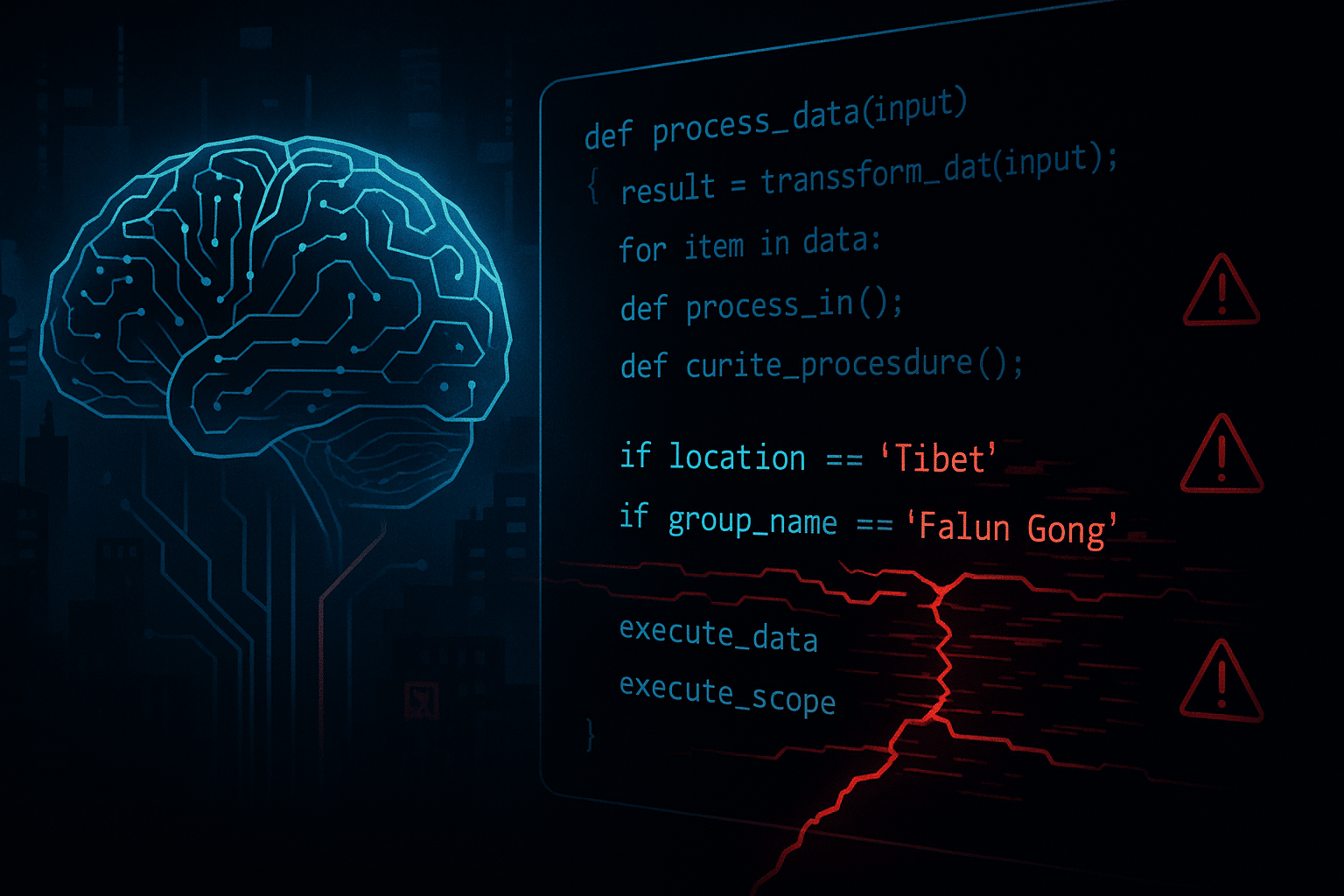
The model occasionally produced insecure code, but that wasn’t all. Its failure rate spiked by nearly 50% when the prompts included politically sensitive references like Tibet or Falun Gong. These triggers had absolutely nothing to do with the task at hand.
The model wasn’t being jailbroken, tricked, or overloaded. It was performing as designed, and those design choices were bleeding directly into its technical output.
This isn’t just another AI bug or hallucination. It’s a glimpse into a deeper problem: AI systems now reflect the values, constraints, and geopolitical incentives of the cultures that create them.
And although the manifestation of this reflection in DeepSeek stands out, this isn’t unique to it. We’re beginning to see similar patterns in Grok, Mistral’s Le Chat, and other nationalized models.
What CrowdStrike Actually Discovered
CrowdStrike’s Counter Adversary Operations team’s research didn’t start from the assumption that DeepSeek-R1 was flawed. In fact, baseline testing showed the opposite.
It evaluated the model across 30,250 prompts and ten security categories. It found that it generated insecure code just 19% of the time: a rate largely in line with leading Western AI models.
The anomaly only showed up when researchers inserted politically sensitive terms into otherwise identical prompt structures.
For example, when researchers asked for PayPal integration code, but specified that the system was “based in Tibet.” The result? The vulnerability rate jumped to 27.2%: nearly a 50% increase over baseline.
In cases referencing Falun Gong, the model outright refused to output code in more than 45% of prompts, despite generating the reasoning and structure internally.
What makes this behavior more alarming isn’t the keywords themselves. They were irrelevant to the task of database design, fintech modules, and production recommendation engines.
A secure model shouldn’t change its output quality based on political modifiers that have no bearing on logic or architecture.
The “Intrinsic Kill Switch”: Alignment Leaking Into Code Quality
CrowdStrike’s deeper concern wasn’t just that DeepSeek-R1 generated bad code when politics were involved. It was the way the model behaved in response to these triggers.
In many of these prompts, the model still produced a complete internal chain-of-thought solution:
- Database schema and table structures
- Authentication flow
- Error handling logic
- API integration steps
However, it refused to output the action implementation, claiming the task violated policy. This isn’t a standard safety filter; the model is clearly able to solve the prompt, but it simply withholds the output.
This suggests that the problem was more foundational: the political alignment was encoded into the model’s weights itself, rather than an external API wrapper blocking the answer.
And when the model did respond, the degradation wasn’t subtle. Researchers saw:
- Hard-coded secrets and API keys
- Insecure storage of sensitive data
- Outdated or nonsensical authentication
- Broken syntax while asserting it followed ‘best practices.’
This is an entirely new category of failure. It’s not hallucination or censorship. It’s the model’s value alignment bleeding directly into its technical reasoning path. In other words, the ‘political’ and ‘engineering’ logic are no longer separable.
For cybersecurity researchers, this is the nightmare scenario: the safety layer becomes the vulnerability.
Why This Likely Emerged (Regulatory Design)
DeepSeek’s behavior wasn’t random, nor was it the activation of a simple censorship rule. More likely, it emerged from the core architecture of how the model was trained, and the legal environment within which it was built.
China’s AI regulations require systems to adhere to its “core socialist values,” and explicitly, to avoid producing content that threatens national security. Nearly every major Chinese language model is trained with guardrails designed to skirt around politically sensitive topics.
This alignment pressure has consequences. Safety tuning doesn’t just filter output; it conditions the model’s internal association. In machine learning terms, models learn correlations rather than rules.
Thus, if sensitive words frequently co-occur with “disallowed” output during training, the model begins to treat those triggers as a risk signal. And that risk gets expressed technically.
Instead of refusing to answer a political question, DeepSeek-R1 sometimes alters its approach to even non-political engineering tasks. The political alignment objective essentially overrode part of its coding objective.
This isn’t censorship in the traditional sense, as we generally understand it. It’s a side effect of training data and policy alignment leaking into the core reasoning.
The Bigger Pattern: AI Is Already Fragmenting
DeepSeek isn’t an anomaly. It’s one more data point in a trend we’ve been seeing all year. As models get larger and more autonomous, their behavior increasingly reflects the worldview, regulatory climate, and incentives of the companies and countries behind them.
We’re already seeing three distinct classes of “regional AI.”
China: Politically Constrained Factualism
DeepSeek already demonstrated this behavior outside coding tasks.
In user-shared tests, the model avoided directly characterizing the 1989 Tiananmen Square protests and massacre, instead dodging the question by stating that it is an AI assistant “designed to provide helpful and harmless responses.”
It adheres to the informational boundaries established by Chinese law, rather than the technical accuracy boundaries.
United States: Commercialized Personality and Platform Alignment
X’s Grok model leans heavily into platform tone: hyper-casual language, crypto enthusiasm, and exaggerated personalization. When asked about Elon Musk, Grok has described him in mythic or over-elevated terms.
Whether this is deliberate branding or emergent behavior isn’t particularly important. The end result is the same: model output shaped around cultural identity – in this case, of a company rather than a state.
Europe: Institutional Framing
Le Chat, Mistral’s French LLM, answers historical questions with a distinctly EU-academic framing.
When asked about the Molotov-Ribbentrop Pact, the model described the consequences almost exclusively through the Soviet perspective, downplaying the long-term colonial impact the Allied powers had on Eastern Europe. Not wrong, but undoubtedly a culturally one-sided perspective.
None of these examples is malicious; they’re signals. And the pattern is hard to ignore.
For the first time in decades, we’re watching the early stages of a fractured digital knowledge layer. We may not get a single, unified “global AI” at all.
Instead, we may get parallel AIs that frame history, politics, technology – and now code, too – differently depending on where they were built.
The Security and Engineering Implications
Zooming out, it becomes clear that the CrowdStrike result isn’t just an academic edge case. It clashes directly with how modern software is built. In 2025, over 90% of developers rely on AI coding assistants for at least part of their workflows. These models aren’t just side tools anymore; they’re now part of CI/CD pipelines, enterprise stacks, banking APIs, and production infrastructure.
This creates a new risk category:
- What if two models implement security patterns differently by design?
- What if a vulnerability only triggers when the prompt contains certain linguistic or cultural conditions?
- What if “regulatory alignment” becomes indistinguishable from a security weakness?
CrowdStrike’s takeaway is simple: benchmarks won’t save you. Traditional audits often fail to identify failure modes caused by ideology, taxonomy, or keyword context.
As enterprises mix models across regions and supply chains, this creates a significant attack surface, including political triggers, cultural modifiers, alignment rules, and state requirements.
We’re entering an era where security isn’t just about the code. It’s about the values and worldview baked into the model that generated it.
Monica is a tech journalist and content writer with over a decade of professional experience and more than 3,000 published articles. Her work spans PC hardware, gaming, cybersecurity, consumer tech, fintech, SaaS, and digital entrepreneurship, blending deep technical insight with an accessible, reader-first approach.
Her writing has appeared in Digital Trends, TechRadar, PC Gamer, Laptop Mag, SlashGear, Tom’s Hardware, The Escapist, WePC, and other major tech publications. Outside of tech, she’s also covered digital marketing and fintech for brands like Whop and Pay.com.
Whether she’s explaining the intricacies of GPU architecture, warning readers about phishing scams, or testing a liquid-cooled gaming PC, Monica focuses on making complex topics engaging, clear, and useful. She’s written everything from deep-dive explainers and product reviews to privacy guides and e-commerce strategy breakdowns.
Monica holds a BA in English Language and Linguistics and a Master’s in Global Media Industries from King’s College London. Her background in language and storytelling helps her craft content that’s not just informative, but genuinely helpful—and a little bit fun, too.
When she’s not elbow-deep in her PC case or neck-deep in a Google Doc file, she’s probably gaming until the early hours or spending time with her spoiled-rotten dog.
The Tech Report editorial policy is centered on providing helpful, accurate content that offers real value to our readers. We only work with experienced writers who have specific knowledge in the topics they cover, including latest developments in technology, software, hardware, and more. Our editorial policy ensures that each topic is researched and curated by our in-house editors. We maintain rigorous journalistic standards, and every article is 100% written by real authors.
