

FCC boss Brendan Carr claims another victory over DEI as AT&T drops programs
AT&T accused of “financial play to curry favor” with Trump administration.
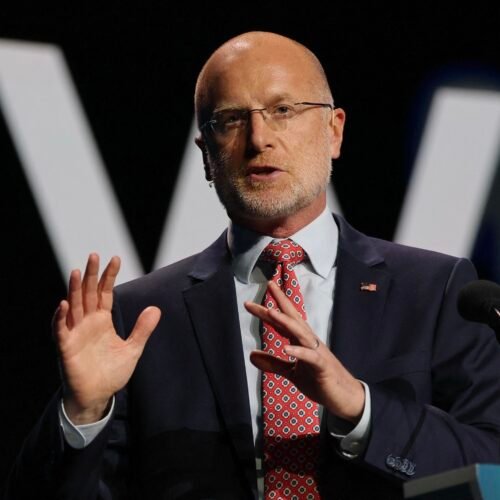
FCC Chairman Brendan Carr delivers a speech at the MWC (Mobile World Congress) in Barcelona on March 3, 2025.
Credit:
Getty Images | Lluis Gene
AT&T told the Federal Communications Commission that it has eliminated DEI (diversity, equity, and inclusion) policies and programs, complying with demands from Chairman Brendan Carr.
The FCC boss has refused to approve mergers and other large transactions involving companies that don’t agree to drop support for DEI. On Monday, AT&T filed a letter disowning its former DEI initiatives in the FCC docket for its $1 billion purchase of US Cellular spectrum licenses.
“We have closely followed the recent Executive Orders, Supreme Court rulings, and guidance issued by the US Equal Employment Opportunity Commission and have adjusted our employment and business practices to ensure that they comply with all applicable laws and related requirements, including ending DEI-related policies as described below, not just in name but in substance,” AT&T’s letter to Carr said.
AT&T has separately applied for FCC approval of a $23 billion deal to buy spectrum licenses from EchoStar, and said it needs Department of Justice approval for a $5.75 billion deal to buy CenturyLink’s consumer fiber broadband division.
“Strategic financial play to curry favor”
Carr celebrated AT&T’s letter with an X post. “AT&T has now memorialized its commitment to ending DEI-related policies in an FCC filing and ‘will not have any roles focused on DEI,’” he wrote. Carr said the AT&T letter “follows the big changes @robbystarbuck already announced earlier this year,” referring to AT&T dropping several programs in March after pressure from conservative activist Robby Starbuck.
FCC Commissioner Anna Gomez, a Democrat, wrote that “AT&T’s reversal isn’t a sudden transformation of values, but a strategic financial play to curry favor with this FCC/Administration. Companies should remember that abandoning fairness and inclusion for short-term gain will be a stain to their reputation long into the future.”
AT&T’s letter said its “hiring, training, and career development opportunities are not and will not be based on or limited by race, gender, or other protected characteristics,” and that it “removed training related to ‘diversity, equity and inclusion’ as well as any references to it from our internal and external messaging.”
AT&T said it won’t use DEI in choosing suppliers, and it has “discontinued sponsorships that are not aligned to our current business strategy.” It has also ended employee surveys that are “focused on protected characteristics.”
Carr got anti-DEI pledges from several firms
Carr has made ending DEI the key requirement for companies seeking transaction approvals, trumping other concerns about deals that reduce competition in telecom markets. He previously extracted promises to end DEI programs from Verizon, T-Mobile. and Skydance.
Verizon got approval for its purchase of Frontier after ending DEI and is still waiting for approval of a spectrum deal with US Cellular. T-Mobile received approval for its acquisition of US Cellular’s wireless operations and spectrum and for a joint venture to acquire fiber provider Metronet. Skydance received approval for an $8 billion merger with CBS owner Paramount after settling a lawsuit filed by President Trump for $16 million and agreeing to impose a “bias monitor” at CBS to satisfy a Carr demand.
With regional carrier US Cellular selling off its assets to the three major nationwide carriers, US Assistant Attorney General Gail Slater of the Justice Department’s Antitrust Division complained in July that the deals “will consolidate yet more spectrum in the Big 3’s oligopoly, which controls more than 80 percent of the mobile wireless spectrum in the country.” Despite that, the Justice Department decided to let T-Mobile complete its acquisition of US Cellular’s wireless operations and some of its spectrum.
While AT&T’s promise to end DEI will likely pave the way for more approvals, the AT&T/US Cellular deal is opposed by consumer advocacy groups and some competitors.
Competition and price concerns
One petition to deny the transaction was filed in April by several advocacy groups and the Communications Workers of America union, and another petition to deny was filed at the same time by the Rural Wireless Association industry lobby group.
US Cellular “provides price competition in the markets it serves,” while the big three “carriers have continued to raise prices on consumers as they continue to gobble up competitors,” the Rural Wireless Association said. Prices will increase in the local markets where US Cellular would be eliminated as a competitor, it said. The AT&T/US Cellular deal includes 3.45 GHz and 700 MHz licenses in 29 states, covering about 12 percent of the US population.
“The proposed transaction will increase rates for consumers due to reduced competition in numerous markets and limit access to valuable spectrum for rural carriers,” the rural wireless group said. “This proposed transaction, in combination with the proposed deals of T-Mobile and Verizon with US Cellular, concentrates vital spectrum among the nationwide mobile wireless carriers, widening the competition gap in the market, making it immensely difficult for small rural incumbents and new entrants to compete. Moreover, the loss of US Cellular as a reciprocal roaming partner in markets where AT&T is acquiring spectrum will increase roaming costs and decrease roaming revenues for rural carriers, to the point where the sustainability of their businesses will be threatened.”
Cable lobby group NCTA also complained in April that giving AT&T a waiver needed to complete the US Cellular deal “would push AT&T to the edge of—or beyond—longstanding spectrum thresholds in numerous markets, with broad implications for mid-band spectrum access and wireless market structure nationwide.” Although the AT&T and Verizon spectrum deals with US Cellular are still pending, T-Mobile’s purchase of US Cellular’s wireless business and other spectrum was completed in August.
Jon is a Senior IT Reporter for Ars Technica. He covers the telecom industry, Federal Communications Commission rulemakings, broadband consumer affairs, court cases, and government regulation of the tech industry.
