

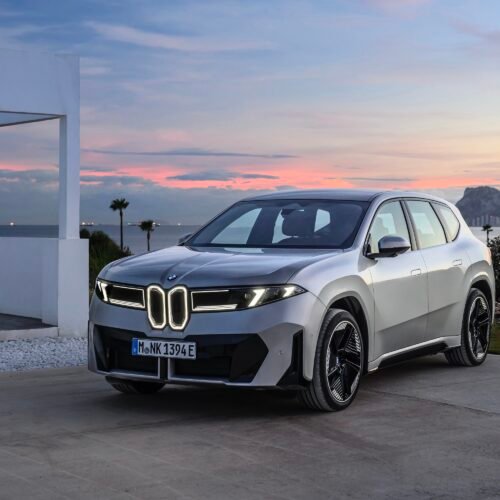
Great handling, advanced EV tech: We drive the 2027 BMW iX3
The first of BMW’s clean-sheet “Neue Klasse” EVs hits it out of the park.
BMW’s new iX3 is a clean-sheet design. It might be the most sustainable BMW ever, and remains decent to drive.
Credit:
BMW
BMW’s new iX3 is a clean-sheet design. It might be the most sustainable BMW ever, and remains decent to drive.
Credit:
BMW
The new BMW iX3 is an important car for the automaker. It’s the first of a new series of vehicles that BMW is calling the Neue Klasse, calling back to a range of cars that helped define the brand in the 1960s. Then, as now, propulsion is provided by the best powertrain BMW’s engineers could design and build, wrapped in styling that heralds the company’s new look. Except now, that powertrain is fully electric, and the cabin features technology that would have been scarcely believable to the driver of a new 1962 BMW 1500.
In fact, the iX3 is only half the story when it comes to BMW’s neue look for the Neue Klasse—there’s an all-electric 3 series sedan on the way, too. The sedan will surely appeal to enthusiasts, particularly the version that the M tuning arm has worked its magic upon, but you’ll have to wait until early 2026 to read about that stuff. Which makes sense: crossovers and SUVs—or “sports activity vehicles” in BMW-speak—are what the market wants these days, so that’s what comes first.
The technical stuff
As we learned earlier this summer, BMW leaned heavily into sustainability when it designed the iX3. There’s extensive use of recycled battery minerals, interior plastics, and aluminum, and the automaker has gone for a monomaterial approach where possible to make recycling the car a lot easier. There’s also an all-new EV powertrain, BMW’s sixth-generation. When it goes on sale here next summer, the launch model will be the iX3 50 xDrive, which pairs an asynchronous motor at the front axle and an electrically excited synchronous motor at the rear for a combined output of 463 hp (345 kW) and 475 lb-ft (645 Nm).
The lighter the paint shade, the better you can see the surface detailing, like the bulging wheel arches.
Credit:
BMW
Energy to the motors is supplied from a 108.7-kWh (net), 800 V lithium-ion battery pack. BMW abandoned the pouch cell/module approach used in its fifth-gen EV powertrains in favor of new cylindrical cells, which measure 46 mm by 95 mm. Instead of modules, the iX3 uses a cell-to-pack design that saves weight, as well as making the pack cheaper to assemble. And the top of the battery pack forms the floor of the car, with the seats bolting directly onto the pack—this saves yet more weight and space inside the vehicle.
Official EPA efficiency numbers, including the all-important range, will come closer to the iX3’s arrival in dealerships next year. You should expect at least 400 miles (643 km) of range, with 10–80 percent DC fast charges taking as little as 21 minutes on a sufficiently powerful charger. (Maximum DC fast charging is 400 kW.) For road trippers, there’s new route planning integrated into the BMW smartphone app as well as the car, which can project charging costs and even check reviews to tell you what the expected power level might be versus what the station claims.
All US market iX3s will be equipped with the “AC charging professional” option as standard, which allows for AC charging at up to 15.4 kW (which should take 7:45 hours to fully charge from zero), as well as enabling bidirectional charging, whether that’s powering AC devices (V2L), or sending power to the home in an emergency (V2H), or to the grid on-demand (V2G).
Get in
There are two 45 W USB-C ports, as well as wireless charging pads, and Apple CarPlay and Android Auto are available wirelessly.
Credit:
BMW
From the driver’s seat, you can clearly see BMW’s new UI/UX paradigm. Forget the classic binnacle with its cluster of gauges. Now, there’s a strip of customizable display at the base of the windscreen that BMW calls “Panoramic Vision.” Lincoln has experimented with something similar, but the effect is far better resolved here as the display appears seamless with the frit of the windshield. I particularly liked the way the focal point for the display is several inches down the hood from the actual surface of the screen, which makes it easier to take in information at a glance and then return your eyes to the road quickly.
The optional full-color head-up display could use a little more brightness, however, and I’m going to call out the iX3’s steering wheel now because it’s the one thing that really lets the whole experience down. There are no horizontal spokes, just fresh air between the thumb grips and the multifunction panels on either side of the airbag, which seems an odd design choice, and it feels a little too fat to grip. The actual multifunction controls aren’t horrid to use, but “this car needed a better wheel” was heard more than once as journalists compared notes.
The rest of the cockpit ergonomics are fine. The materials feel pleasant to the touch, with an interesting contrast between the textured fabric on the dash and the padded plastics. There are plenty of physical buttons and a trapezoidal infotainment screen that keeps controls near the driver’s right hand.
However, there’s no more physical dial controller for the infotainment system, and Alexa has replaced Cerence in supplying the natural language processing and conversational AI. In practice, this feels like a bit of a downgrade, and not only did the AI assistant—that little Ninja-looking face in the middle of the Panoramic Vision display—repeatedly think someone used its trigger word when we hadn’t, but a lot of my requests were met with some variation of “I can’t help you with that.”
The drive impression
The calibration of the one-pedal driving mode—which you toggle on or off with the drive selector on the center console—is very well-judged, and the friction brakes shouldn’t take over unless you’re asking to slow by more than half a G, which means 98 percent of all deceleration events should return energy to the battery pack. It’s a quiet ride, too, as long as you keep it out of sport mode, although the suspension is relatively firm and you’ll feel some road imperfections.
On the road, I found the Efficiency mode plenty, despite this being the most throttled back. When not in one-pedal (D versus B on the drive selector), the iX3 coasts well, and one of the driver assists onboard will read speed limit signs and regeneratively brake you to meet them, if you’re coasting along and the limit decreases. (That’s among the assists you can disable, should you wish.)
It’s nimble enough at changing directions.
BMW
The suite of advanced driver assistance systems now runs on its own domain controller, one of four powerful computers that replace the dozens and dozens of black box ECUs that each used to handle a single discrete function. Among the improvements are a new remote parking ability that uses the My BMW App on a smartphone to even better effect than James Bond in Tomorrow Never Dies, and an adaptive cruise control that can tell the difference between a heavy application of brakes—at which point it deactivates—or a light brush, returning to speed after slowing.
Because the necessary sensors are included in all iX3s, future owners will be able to enable the various driver assists even if the original owner chose not to pick those options. For a fee, of course, but it makes the resale proposition slightly better.
That BMW scheduled some of the day at the Ascari circuit was evidence of an automaker confident in its product. On track, we pushed things a little harder. At up to about seven-tenths, the iX3 coped with the undulating circuit with composure. Praise belongs to the brakes, which we got to test in several emergency stops from highway speeds, and I’m not sure I saw anyone knock down a cone through the medium-speed slalom. The steering is well-weighted and has what passes for feel in the 21st century, with the right amount of power assist to make this actually rather heavy vehicle feel more like a featherweight.
Based on our first drive, the iX3 should have what it takes to be a contender in the luxury electric crossover segment.
Credit:
BMW
Go beyond that, and you really start to hustle the car; unsurprisingly, the result is understeer, accompanied by some screeching tires. That starts to occur at speeds where you’re also more and more aware of the iX3’s roughly two and a half ton curb weight, and so backing off—at which point the nose tightens again—just becomes the natural thing to do.
Like the EPA data, exact US pricing will have to wait until closer to the iX3’s arrival next summer, though we expect it to cost less than $60,000. It’s entering a busy segment of the market, with rivals like the Audi Q6 and Mercedes-Benz GLC with EQ technology, just to name its German competition. Dynamically, the BMW is the one to get. It might even win on price, too.
Jonathan is the Automotive Editor at Ars Technica. He has a BSc and PhD in Pharmacology. In 2014 he decided to indulge his lifelong passion for the car by leaving the National Human Genome Research Institute and launching Ars Technica’s automotive coverage. He lives in Washington, DC.
