

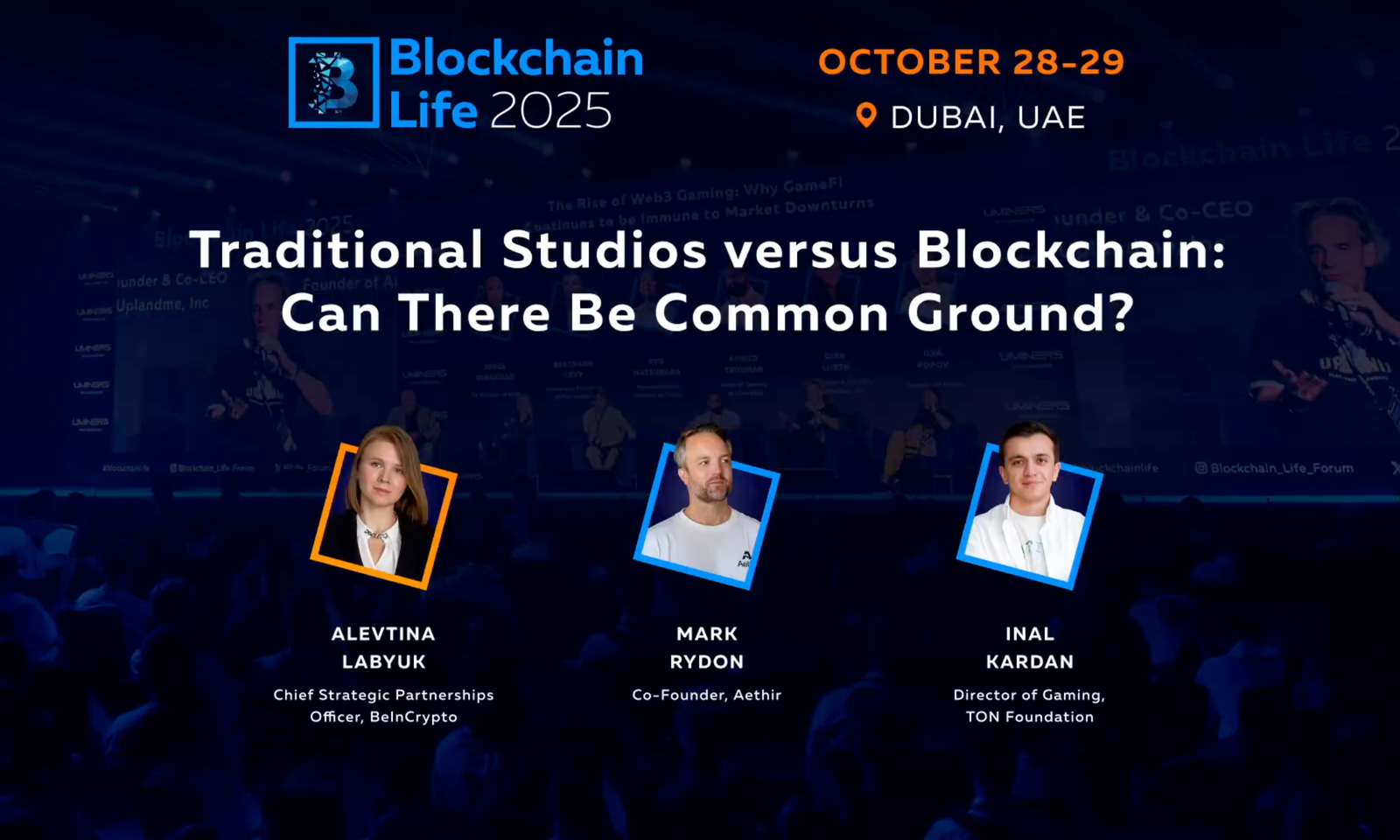
Traditional Studios vs. Blockchain: Can There Be Common Ground?
The gaming world is at a crossroads. For decades, the success of a video game has been measured by two core metrics, the depth of its storyline and the quality of its graphics. Yet, in the era of decentralized technology and the ubiquitous mobile phone, these traditional fundamentals are being challenged and expanded upon. This tension was the core subject of the BeInCrypto panel, “Traditional Studios vs. Blockchain: Can There Be Common Ground?”
Moderated by Alevtina Labyuk, Chief Strategic Partnerships Officer at BeInCrypto, the discussion brought together industry heavyweights: Mark Rydon, Co-Founder of Aethir, and Inal Kardan, Director of Gaming at TON Foundation. The consensus? Blockchain isn’t here to replace core gaming fundamentals, but to expand what is possible if developers can prove its worth to a skeptical audience.
The Evolution of Gaming Success Metrics
Alevtina Labyuk opened the conversation by reflecting on the industry’s slow pace of fundamental change. “Actually, I also have kind of an experience in gaming 15 years ago, but things didn’t change much in traditional gaming. The two key factors of success of a game were the story line and the graphics. But with the growth of blockchain and mobile phones, the new factors are coming in.”
This evolution means success today isn’t just about the cinematic experience; it’s increasingly about user agency, economic participation, and digital ownership. However, the panel was unanimous on one crucial point that grounds the discussion in reality: the average player remains deeply indifferent to the underlying technology.
The 95% Problem: Joy, Fun, and Indifference
While Web3 enthusiasts often tout the benefits of decentralization, the speakers stressed that the majority of players simply don’t care about the blockchain layer. They play for inherent enjoyment.
“In general, I do agree that players, they don’t need blockchain. Actually, 95% of players don’t care about blockchain, they don’t care of anything, they just think about game itself, they play games for joy, for fun,” stated Inal Kardan.
This perspective is critical. It implies that any successful integration of blockchain must be invisible or, at the very least, purely additive to the fun experience. The technology cannot be the primary selling point.
Kardan, however, offered a powerful example of where that indifference breaks down: when security and ownership become relevant.
He pointed to the Telegram ecosystem, where millions use simple digital gifts, yet a smaller, highly engaged segment leverages smart contracts to secure and trade these assets, ensuring their scarcity and provenance.
“There are cases where users will care about blockchain, to be sure their assets are secure,” Kardan confirmed.
For this active, economically participating user base, transparency and security transform from a niche feature into a mandatory requirement. This highlights a key nuance: blockchain is not necessary for everyone, but it is meaningful for users who want transparency and security around digital items.
The Centralization Risk: The $3 Billion Lesson from CS:GO
The most compelling argument for blockchain as a superior underlying system for digital asset ownership rests on unalterable, transparent rules. Mark Rydon provided a potent, real-world case study to illustrate how traditional centralized systems fail their user bases the CS:GO skins market.
The trading ecosystem for CS:GO skins had grown into a massive market, valued at approximately $6 billion, with defined tiers of rarity. As a centralized ecosystem, however, the rules were ultimately controlled by Valve, the game’s developer.
Rydon detailed the recent incident:
“The CS:GO skins market… they have defined rarity of these skins. A few days ago, Valve came out and changed the rules. They allowed users below the gold tier to burn red skins to obtain gold tier, which caused gold rarity to dump. The market cap was dumped to $3 billion because everyone could make red into gold overnight. People lost millions.”
This incident perfectly encapsulates the inherent risk of a centralized economy. A single authority can change the conditions of ownership overnight, wiping out millions in user-generated value.
Rydon emphasized the core difference: “That impossibility to change the rules would not be possible in an NFT class.”
In a blockchain system, the rules governing asset scarcity, exchange, and minting are recorded in an immutable smart contract. While a centralized authority can still update a game, it cannot unilaterally alter the pre-defined scarcity or rights associated with a user’s on-chain asset. This predictability is what creates trust and sustains value in decentralized economies.
The Commitment Problem: Talkers Versus Builders
The discussion then pivoted to the major studios. Alevtina Labyuk brought up the attempts by established players like Sega and Ubisoft to enter the blockchain segment. The question posed was: how will these giants integrate blockchain without fundamentally sacrificing the centralized control they currently enjoy?
Inal Kardan remained highly skeptical of the sincerity of many legacy studios’ efforts.
“Most of them are just talking. They jump from one blockchain to another looking for grants. That’s not how games are built,” Kardan noted. He continued:
“These big companies, it’s a bit hard to compare them with each other because some of them want to build, some of them want to just to talk.”
This skepticism points to a fundamental misalignment of incentives. Many traditional entities and even new projects, according to Kardan, are optimizing for extracting funds from protocols rather than finding genuine product-market fit that benefits players.
Kardan summarized:
“The majority is about taking money from the protocols, instead of finding a product market fit, they are just looking which protocol they can take more money from”
This focus on short-term financial extraction over long-term product development risks solidifying Web3 gaming’s perception as a speculative, rather than innovative, space.
The Developer’s Responsibility: Proving Real Use Cases
The panel agreed that the onus is ultimately on the developers to demonstrate value. Mark Rydon placed the responsibility squarely on the shoulders of the innovators.
Rydon stated:
“It’s really on the developers now, to find either really solid use case. Something like GTA 6 is probably an example that will bring the value and the use cases of the blockchain to the fore in the gaming context, but it’s on them to convince gamers now that this isn’t just a money grab, this is actually a useful feature.”
Blockchain integration must solve a real problem for the player, not just the developer or protocol. Without a genuine, compelling use case—such as true cross-game ownership, secure trading, or transparent economy mechanics—Web3 gaming risks being perceived as a persistent search for speculative value rather than a technological leap forward.
Practical Obstacles and The Question of Control
Inal Kardan also addressed the practical friction points that still limit mass adoption, even with progress in Web3 technology. Technical and policy obstacles remain, particularly within mobile ecosystems:
- Platform Restrictions: Telegram mini-apps and similar platforms cannot easily sell digital goods through established ecosystems like Apple and Google.
- Payment Barriers: Direct crypto payments are often unsupported.
- Trading Limitations: Trading digital goods inside mini-apps is still cumbersome or prohibited, preventing smooth onboarding for everyday users.
These friction points underscore one of the panel’s core issues: Why would Web2 studios give up control? If a traditional studio controls its platform, distribution, economy, and player base, the incentive to decentralize and thus relinquish control over monetization and rule changes is inherently low.
Kardan concluded by warning against unbalanced economic models: “When ninety percent of people in a game are there just to make money the system is not sustainable.” A healthy, sustainable model relies on a balanced mix of motivations: fun, competition, creativity, and economic participation.
Predictions and The Solidification of Common Ground
The panel concluded with predictions for the future.
- Mark Rydon expects a significant shift toward AI-generated gaming content, deeper player customization, and highly automated creation pipelines.
- Inal Kardan believes that while AI will dominate the gaming industry overall, blockchain will stabilize, remaining one monetization avenue among many for mainstream developers.
The final takeaway was clear. Blockchain is not a replacement for good gaming; it is a technology that broadens the possibilities of ownership and economic participation.
However, until protocols stop chasing grant distribution, legacy studios commit to genuine decentralization, and developers prioritize building real value that earns player trust, the common ground between traditional gaming and blockchain will remain an aspiration, not a reality. Innovation hinges on teams willing to show that blockchain is not just an opportunity for speculation, but a useful, invisible feature that enhances the joy and fun of the game.
Disclaimer
In compliance with the Trust Project guidelines, this opinion article presents the author’s perspective and may not necessarily reflect the views of BeInCrypto. BeInCrypto remains committed to transparent reporting and upholding the highest standards of journalism. Readers are advised to verify information independently and consult with a professional before making decisions based on this content. Please note that our Terms and Conditions, Privacy Policy, and Disclaimers have been updated.
