

You won’t want to miss the Geminids meteor shower. Here’s how to watch
One of the most spectacular meteor showers of the year is about to peak.
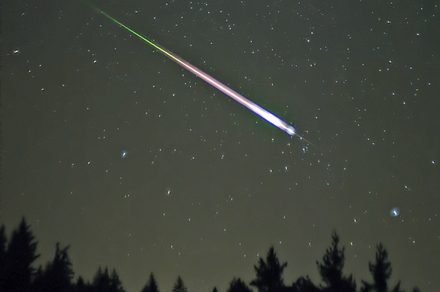
Observation from the 2009 Leonids meteor shower.
Wikimedia / Wikimedia
The Geminids are considered one of the most productive annual meteor showers, with as many as 160 “shooting stars” visible an hour in the right conditions.
This year the Geminid meteor shower will peak on the night of Saturday, December 13 into Sunday, December 14 ET, so now is a great time to start making plans.
The meteor shower is made up of debris trailing the 3200 Phaethon asteroid and the display is known for being bright and colorful. When Earth passes through this trail, the dust and tiny fragments burn up in our atmosphere, causing bright streaks to zip across the night sky.
“Most Geminids burn up 30-40 miles above your head, but there is a very, very small chance that one may be big enough to produce a brilliant fireball and leave small meteorites on the ground,” NASA says on its website. “So far we haven’t found a Geminid meteorite, but there’s always hope.”
This year’s Geminids meteor shower actually started in the middle of last month and will continue through December 24, but most of the action will occur this coming weekend.
To witness the Geminids’ peak, cast your gaze to the eastern sky on the evening of Saturday, December 13, and into the early hours of Sunday morning.
How to get the best view
– Check the weather forecast before you head out as you’ll want a cloudless sky.
– Wear warm clothes and take a hot drink and snacks if you’re planning to stay out for a while.
– Find a dark, clear location away from city lights. Try to find a spot with the largest view of the sky, unobscured by trees and buildings.
– Give your eyes at least 20 minutes to adjust to the dark surroundings.
– Lay down a blanket or take a comfortable camping chair and face east.
– Be patient and you’ll start to spot the meteors flashing across the night sky.
Not so many moons ago, Trevor moved from one tea-loving island nation that drives on the left (Britain) to another (Japan)…
Blue Origin’s rocket booster returns to a hero’s welcome. Here’s why
The booster’s success marks a giant leap for the spaceflight company.
It’s been a week since Blue Origin landed the first-stage of its New Glenn rocket on a ship floating on the ocean, and with all of the back-slapping, endless celebrations, social media posts, and now a dramatic video (below), you’d be forgiven for thinking it was the first time it’d ever achieved such a feat. Oh wait, it was.
Yesterday, we welcomed Jacklyn and our fully reusable New Glenn first stage back to the Space Coast. Thank you, Team Blue. pic.twitter.com/WQyvFqn5Cd
— Blue Origin (@blueorigin) November 19, 2025
SpaceX preps next Starship flight as new booster rolls out for testing
It’ll be the first flight for a redesigned Super Heavy booster.
SpaceX is edging toward the 12th flight test of its mighty Starship rocket after the company rolled out the new Super Heavy booster for testing.
Appearing at SpaceX’s Starbase facility in southern Texas on Thursday, Booster 18 is the third version of the rocket’s main stage, with the 12th test set to see it fly for the very first time.
Blue Origin takes aim at SpaceX with rocket upgrade announcement
The spaceflight company is developing a larger, more powerful New Glenn rocket for more complex missions.
Following last week’s success of Blue Origin’s first interplanetary launch and its first landing of the New Glenn rocket’s first-stage booster, the company has announced plans to transform the rocket into a more powerful beast. And yes, SpaceX will be paying attention.
The new version will be known as New Glenn 9×4, while the current one will now be called New Glenn 7×2, with the new names indicating the number of engines attached to the rocket’s first and second stages.
