

How Roomba invented the home robot — and lost the future
For many, iRobot’s Roomba robot vacuum was their first experience with a home robot. When I got my Roomba in 2005, I felt like I was a step closer to my dream of living in a Jetsons-style home where a robot did my chores for me. It was expensive, around $300 for a small black disc on wheels that sucked up dirt, but its promise to do one of my most-hated chores while I was at work was compelling. The reality back then was that I spent more time babysitting it than it did actually cleaning my floors, but it was an exciting glimpse into the future of today’s excellent robot vacuums.
I wasn’t alone in my excitement. Robot vacuums quickly became a popular household product, and today most people refer to their floor-cleaning bots as Roombas, even if the vacuum picking up crumbs and pet hair was made by Ecovacs or Roborock. But despite its enduring popularity, the company behind Roomba filed for bankruptcy this week and will hand over control of its business to its Chinese manufacturing partner, Picea Robotics.
iRobot says it’s business as usual for the millions of Roombas in people’s homes, which will continue to function as expected — for now. But how did the most popular household robot company in the world fall so far and fall so spectacularly?
If you ask former CEO and iRobot cofounder Colin Angle, who stepped down in January 2024, the answer is simple: Government regulation killed iRobot. “It’s a blow for robotics and a tragic day for American innovation,” he said in an interview with The Verge. “This was our freaking market — we invented consumer robotics. We built this thing, we put it in a box, wrapped it up, and handed it to someone else. We did this to ourselves; this was a choiceful action that was not based on the merit and charge of antitrust.”
The “we” he’s referring to is the US government and, in turn, the European regulators who moved to block Amazon’s acquisition of iRobot in 2023 as they sought to rein in Big Tech. Others feel that iRobot failed to innovate, riding on its early success and fending off competition with its patent portfolio until it couldn’t. In reality, the answer lies somewhere in between, in a space where the vision for the future of the smart home meets the reality of what people actually need and want in their homes.
From the lab to your living room
iRobot was founded in 1990 by MIT roboticists, including Angle, Helen Greiner, and Rodney Brooks, as an AI company building a robotics platform. “It’s eerily congruent to certain platforms companies out there today,” says Angle. “We learned the hard way that it’s not until you can use that toolkit to create something that people want that there’s any value to it.”
While the idea of building a robot that could clean your home was always a goal, it wasn’t a possibility in the early days. “The promise of robotics was always Rosie from The Jetsons; the question was when this was going to happen,” says Angle. The team honed their expertise in partnerships with the government, which funded robots for space exploration (working on NASA’s Mars Sojourner Rover), mine detection, bomb disposal, search and rescue (its PackBot was used in 9/11 recovery efforts), and other military applications. Basically, it developed robots to go where humans shouldn’t or can’t.
“It’s a tragic day for American innovation. This was our freaking market — we invented consumer robotics.
It wasn’t until 1999 that the Massachusetts robotics startup had enough money to commit to developing a consumer cleaning product. iRobot engineer Joe Jones, also from MIT, and his team developed the company’s first floor-sweeping robot — the Roomba robot vacuum. It launched in 2002, selling for $200 at Brookstone, The Sharper Image, and Hammacher Schlemmer. “I remember getting a call from a Brookstone buyer, Pam, shortly after the launch, asking me how many more I could make,” says Angle. “That was the moment we realized something special was happening.”
The original Roomba was the first robot vacuum in the US, and the second ever made, following Electrolux’s Trilobite the year prior. A basic bump-and-roll bot with bump and cliff sensors, the Roomba rolled randomly around your home, sucking up dirt, bumping from wall to wall, and generally trying not to fall down stairs.
The company quickly doubled down on consumer robotics, delivering the Dirt Dog, a robotic shop vac designed to clean up shop debris, and the Looj and Verro, gutter- and pool-cleaning versions of the Roomba. iRobot went public in 2005 with a valuation of over $100 million, sold its security robotics arm, and branched out to robotic lawn mowing, developing the Terra in 2019. A couple of years later, it bought an air purification company, Aeris, for around $70 million. But Terra never launched, and Aeris didn’t make a dent in the Dyson-dominated air purifier market.
While iRobot was distracted by these side projects, competitors like Ecovacs, Roborock, Neato, Dyson, SharkNinja, and others were moving into the space. The company largely reacted by leveraging its impressive patent portfolio — key among them its dual-roller brushes, which finally expired in 2023. (It had rival robot maker MyGenie’s products pulled off the IFA trade show floor in 2013.) It also purchased competitor Evolution Robotics, maker of Mint, which became iRobot’s second successful home bot, the Braava robot mop (a follow-up to the flop that was the Scooba floor scrubber).
‘Fast followers’ start to close in
iRobot wasn’t sitting on its vacuuming laurels, as many critics claim. By 2015, iRobot had added Wi-Fi to its robots, developed an app for controlling them, and given them the ability to identify basic household objects and navigate around them. But its products were becoming much more expensive.
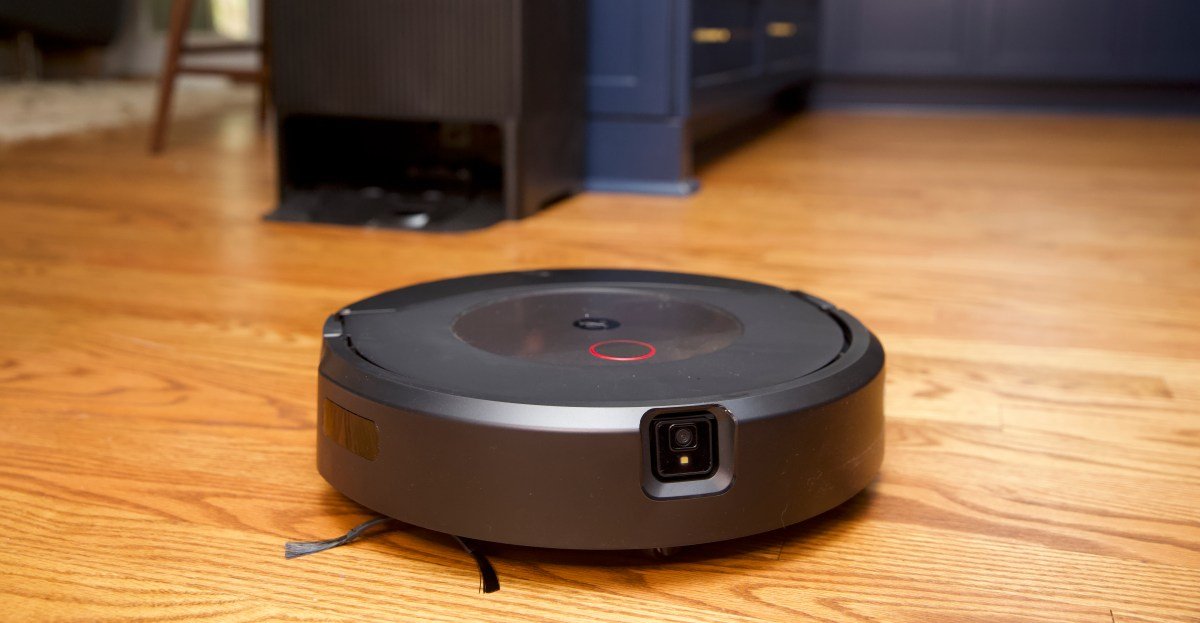
In 2018, it launched perhaps its best and, to that point, priciest product ever, the nearly $1,000 Roomba i7. This bot could map your home, remember that map, and let you clean specific rooms rather than just run around your home randomly. It could also empty its own dust bin — a huge upgrade. In many ways, the i7 was iRobot’s peak moment; it had hit an estimated 88 percent market share, and then it all started to go wrong.
In many ways, the i7 was iRobot’s peak moment.
iRobot’s soon-to-be biggest Chinese competitor, Roborock, entered the US market in 2018, following Ecovacs’ arrival a few years earlier. Many more were to come, and by 2022, iRobot’s market share was down to 30 percent. It had sold 40 million bots — 23.4 million in Europe and the Americas just in 2021. It had become a household name, the Kleenex of floor sweepers. And it was about to get blown out of the water.
“We had successfully out-competed the world for 17 years,” says Angle. “And now we were feeling more pressure from a new type of competition — the Chinese fast follower. They had certain advantages — access to capital, government support, and access to a closed market — China had become the largest market for robot vacuum cleaners in the world. And we were shut out.”
Despite a covid sales bump, the ensuing supply chain challenges and the impact of Trump’s 2018 tariffs led iRobot to temporarily raise prices, further opening the door for cheaper competitors. By 2022, iRobot’s revenue fell to $1.18 billion, then down to $891 million the next year, with an operating loss of $285 million.
Failure to innovate or innovative failure?
Critics have said iRobot failed to innovate fast enough and should have switched sooner from its vSLAM camera-based navigation and mapping system to laser-based lidar technology used by its competitors. Another criticism is that the company was too slow to adopt the popular combination mopping-and-vacuuming model. Angle concedes the latter: “Okay, we were wrong,” he says. “The consumer gets to vote, we were late to give them what they wanted — the convenience of a mopping and robot vacuum in one.”
But he is firm on iRobot’s camera-based navigation. New CEO Gary Cohen, who took over following Angle’s departure, switched to lidar within months of taking the helm. But Angle, who has since founded another robotics company, disagrees with the change and believes he was right. “Putting lidar on a vacuuming robot is a mistake,” he says. “It’s not a question of being non-innovative; we made an explicit decision not to do it because doing so is a crutch that makes your robot fragile and limits its utility.”
“Putting lidar on a vacuuming robot is a mistake.”
His vision for Roomba was to become a home robot that understood your house and cared about doing a good job. For that, it needed to see your home. “Building robots that care, that know when they missed a spot and will go back to make sure it’s done the job, requires a level of intelligence and perception that no lidar was going to do,” says Angle.
I’ve tested many dozens of robot vacuums and agree with Angle that cameras are the future for advanced robotic navigation in our homes. Roborock, Narwal, Dreame, and others have all added cameras to their flagship lidar bot vacs to enable AI-powered obstacle avoidance and dirt detection, features Roomba pioneered. The best robot vacuum I’ve tested this year, the Matic, uses entirely camera-based navigation.
However, we don’t all need an advanced, $1,000-plus home robot. There’s still a place for lidar in inexpensive, utilitarian robot vacuums that do a decent job of navigating your home without getting lost.
It was Angle’s vision for that smarter home robot, laid out in the company’s ambitious iRobot OS, that attracted Amazon’s $1.7 billion acquisition offer. As I wrote at the time, Amazon bought Roomba for its maps of your home — its ability to understand the context of a home environment. This could have been a crucial part of Amazon’s smart home ambitions with the revamped Alexa Plus, announced shortly after the acquisition was.
This sparked additional regulatory and consumer concerns about privacy, on top of perceived antitrust issues stemming from Amazon’s retail dominance. Eventually, both companies realized there was no path forward, and in 2024, they abandoned the deal. The process took nearly two years, and it was that corporate limbo that effectively killed iRobot, says Angle.
Roomba hits the wall
Following the deal’s collapse, Angle left, iRobot hired Cohen, shut down all side projects, and cut 31 percent of its workforce. By the end of 2024, revenue had dropped by nearly 50 percent. In March of this year, iRobot launched a new line of robot vacs that had little resemblance to the original Roombas. All use lidar navigation, are mostly combination mopping-and-vacuum bots, and are entirely unremarkable. The next day, the company warned investors that it might go bankrupt. Nine months later, it did.
“Even if iRobot emerges from bankruptcy as per its plans, that’s a very different company,” says Angle. If the Amazon deal had gone through, he believes, “It would have been a blossoming of tech innovation in the consumer robotics space and in the smart home in general.”
Instead, Angle sees iRobot’s bankruptcy as a tragic day for the “innovation economy.” “That idea that you can build a great company and then have access to M&A blocked has a chilling impact on investors’ willingness to take a gamble and on an entrepreneur’s courage to start down that journey fraught with risk.”
Political issues aside, I don’t believe iRobot failed to innovate; in many ways, it was ahead of its time. The company was captivated by a vision of the robotics future that now feels closer than ever — but it arrived too late for iRobot. Like many tech companies, it struggled to recognize and respond to what customers actually wanted, instead offering what it believed they deserved. Rosie the Robot may one day run our homes, and if it does, iRobot will have helped lay that foundation — even if it isn’t part of that future.
Follow topics and authors from this story to see more like this in your personalized homepage feed and to receive email updates.
