

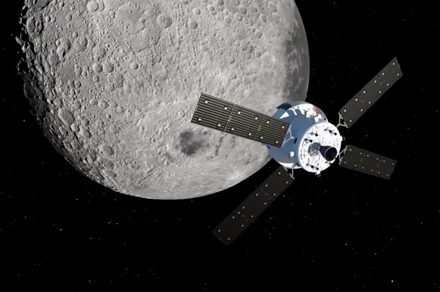
NASA’s ‘Moonbound’ builds the hype for its epic Artemis II mission
The first episode is free to view on NASA’s website.
NASA
With NASA’s first launch toward the moon in five decades potentially only a few months away, the space agency has just released the first episode of a new show that focuses on the highly anticipated mission.
Moonbound — Charting the Course runs for 22 minutes and offers a deep dive into the preparations being made for the 10-day Artemis II flight, which will see four astronauts fly around the moon and back again.
NASA is using the mission as the first crewed test of the Space Launch System (SLS) rocket and Orion spacecraft, paving the way for the crewed Artemis III lunar landing that could take place as early as 2027.
The space agency flew both the rocket and the spacecraft for the first time in the successful Artemis I mission in 2022.
“When you put crew on a rocket, it’s no longer a test flight,” John Honeycutt, the mission management team chair, says in the video. “This one needs to perform, and will perform, as good or better than the first one did … no doubt about it.”
At the 12:10 mark, the video lays out in detail the precise course that the Artemis II mission is expected to take, including the Kennedy Space Center launch, the lunar flyby, and the ocean splashdown.
After several days in an elliptical Earth orbit checking the performance of the Orion capsule under manual control, the crew will head toward the moon, coming within a mere 3,300 miles of the lunar surface as it flies around our nearest neighbor.
“We’re going to turn the spacecraft so you can have the best view of anybody of the moon in 50 years,” said Jeff Radigan, the Artemis II lead flight director. “We want to ensure that we’re getting the videos of the moon that all of us back here on Earth want to see, and ensuring that all of our systems work on the far side of the moon as well.”
The mission will end with the all-important splashdown following a high-speed entry into Earth’s atmosphere. This could be the most crucial part of the mission, as the Artemis I mission exposed some issues with the Orion’s heat shield, which NASA has worked on to resolve.
Looking further ahead, NASA wants to use the Artemis program to build a base on the moon for extended human missions, and to apply what it learns from the lunar missions to plan for the first crewed flight to Mars.
Moonbound — Charting the Course is free to view on NASA’s website.
Not so many moons ago, Trevor moved from one tea-loving island nation that drives on the left (Britain) to another (Japan)…
The ISS crew just enjoyed a movie night … they probably skipped these 6 movies
Just as you probably avoid movies like Alive on a flight, the ISS crew likely skip these movies in space.
NASA astronaut Jonny Kim recently posted some behind-the-scenes shots of the International Space Station (ISS) crew enjoying a movie night, and it looked like a fun and relaxing time. But much like how most airplane passengers will avoid watching movies like Alive, Flight, and Fearless while in the air, it’s quite possible that the ISS crew prefers to steer clear of certain movies to ensure they remain in a relaxed state for the rest of their time in orbit. With that in mind, here are six films they might want to avoid for future movie nights, and one they can definitely enjoy …
Gravity (2013)
NASA astronaut to achieve a first in Thursday’s launch to ISS
There’s something special about Chris Williams’ launch to the ISS.
NASA is about to send one of its astronauts to the International Space Station (ISS) in what appears to be the first-ever Thanksgiving Day launch of an American crew member.
Blasting off early on Thursday ET from the Baikonur Cosmodrome in Kazakhstan, Chris Williams will ride to orbit alongside Roscosmos cosmonauts Sergey Kud-Sverchkov and Sergei Mikaev aboard a Russian Soyuz rocket.
Watch these future moon travelers test their space kitchen
The Artemis II astronauts will be eating meals aboard the Orion spacecraft for 10 days as they fly around the moon.
It might be cool to be an astronaut, but life in orbit has its downsides. The food, for example, will be somewhat limited compared to what you can enjoy back on terra firma, though it’s true that over the years, scientists have found ways to broaden the food options for astronauts.
While early space food was limited to unappetizing tubes of slop and bland freeze‑dried powders, astronauts can now enjoy varied, flavorful menus that can even resemble regular meals on Earth.
