

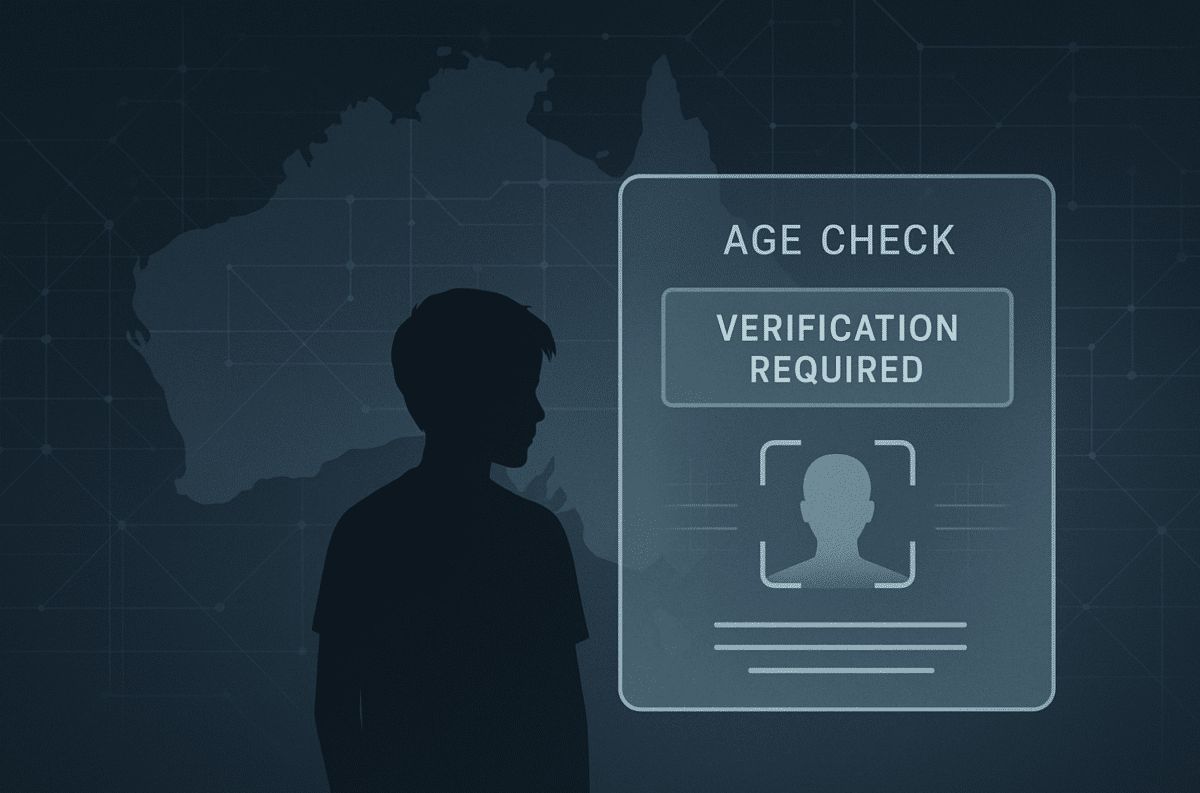
Australia’s Teen Social Media Ban: A Test for the Future of the Internet?
Key Takeaways
- Australia’s teen social media ban is less about child safety and more about infrastructure, forcing platforms to deploy large-scale age verification systems that resemble a new form of online identity.
- Mandatory age checks could introduce serious privacy risks, including biometric data collection, centralized identity honeypots, and increased government and platform control over user identification.
- Silicon Valley’s real fear isn’t lost ad revenue today, but losing an entire future generation of users, breaking habit formation and long-term platform growth as teens migrate elsewhere.
- The ban may accelerate a fragmented internet, with region-specific rules, biometric gating, and teens pushed into harder-to-police “grey zone” platforms, signaling a more regulated, less anonymous internet in the future.
Last week Australia become the first country to block social media access for everyone under the age of 16. An unprecedented mandate has forced TikTok, Instagram, YouTube, Facebook, and X to lock out an estimated 1 million teens, or face fines of up to A$49.5 million.
The headlines are largely about screen time and mental health, but beneath this lies a more consequential shift. To make this ban enforceable, platforms must implement age-inference algorithms, selfie-based age estimation, and potentially even government-issued ID checks.
What Australia has just passed as a child-safety measure is, in practice, the world’s first nation-level experiment in online identity infrastructure.
Other governments are watching closely. EU lawmakers have already hinted that Europe could follow Australia’s lead, while several other countries are carefully studying the model.
The real question isn’t whether teens will find workarounds — they will. Rather, the question is about whether this becomes a blueprint for the future of internet regulation.
The First Large-Scale Test of Mandatory Age Verification
Australia’s new legislation doesn’t just tell teens to log off of social media: it compels platforms themselves to prove who is under 16 and to block them.
Ten major platforms, including TikTok, YouTube, Facebook, Instagram, Snapchat, and X (formerly Twitter), were ordered to enforce the block immediately. Snapchat saw around 440,000 accounts gone on day one, and TikTok deactivated around 200,000.
To comply with the new laws, platforms told Canberra they will rely on a mix of:
- Age inference based on users’ behavior patterns
- Selfie-based age estimation using facial analysis
- Optional ID uploads for cases requiring higher confidence
These measures aren’t experimental or fringe-based trials anymore; they’re part of the core login stack for millions of users.
This is effectively the beginning of a mandatory online identity layer — even if governments aren’t currently using this kind of language to describe it. Participating in social platforms increasingly requires being scanned, inferred, or documented.
The Privacy Nightmare Behind Australia’s Social Media Ban
Mandatory age checks introduce an entirely new type of risk:
- Centralized biometric profiles of minors
- High-value “honeypots” of identity data (as we know, data can and is breached at a large-scale on occasion)
- Platforms gaining unprecedented levels of demographic data
- Governments gaining leverage over identity controls at the platform level
Whether it intended or not, the Australian government has launched the world’s first real-world stress test of a universal age-verification infrastructure.
Silicon Valley’s Worst Fear: A Future Without Teen Users
Social media companies have been quick to point out that under-16s generate relatively little direct advertising revenue — although a study from late 2023 found the opposite, with platforms deriving between 16 and 41 percent of their revenue from users under 18.
Regardless of the veracity of the statement, it misses the real concern. Teenagers aren’t just today’s customer-base: they’re the next decade’s. Platform loyalty tends to be formed early, and losing an entire age cohort breaks the habit-building pipeline that underpins long-term growth, and that these platforms tend to depend on.
That’s why Australia’s ban is so concerning for Silicon Valley. If one country can legally cut off teen access, others could conceivably follow suit.
Social media platforms’ annual user growth has already been tapering off across major platforms, and a sudden drop in time-spent metrics could spook investors just as much as lost revenue.
X’s reluctant response from its official “Safety” account said, “It’s not our choice, it’s what the Australian law requires.” Clearly, they’re not the biggest fans of this legislation, and future revenue is sure to be a large factor.
There’s also a behavioral wildcard to consider. Many teens interviewed by Reuters openly said they would find ways to circumvent the ban. That likely means migration toward platforms like Discord, Telegram, VPN-enabled access, or decentralized services that lack the infrastructure and enforceability of mainstream apps.
Ironically, the ban could push some teens into darker corners of the internet, amplifying one of the key risks regulators are trying to reduce.
The Global Domino Effect and the Split of the Internet
What’s unfolding in Australia is already being watched from far beyond its borders. European lawmakers have openly said that they want to “learn from” the ban, while governments in Denmark, New Zealand, and Malaysia are watching to see how it plays out in practice.
Paired with the UK’s Online Safety Act, and growing parental pressure in the US, the trend is clear: a more tightly age-gated era of the internet is ostensibly beginning.
The technical implications are significant, too. Once age verification becomes mandatory in one major market, platforms will have little choice but to enable the same infrastructure globally.
This means wider use of biometric age checks, selfie-based estimation, and behavior inference, and a growing discrepancy between national versions of the same platforms. Meanwhile, teens are likely to migrate toward platforms that are harder to police, creating new “grey zones” of online interaction that sit outside of mainstream social platforms.
The result could be a fractured web: less anonymous, more regulated, and increasingly shaped by national legislation. In recent months, we’ve seen this trend unfold on a different level, too: the influence geopolitics has been exerting on how large AI models behave and what they’re allowed to say.
Australia Just Gave Us a Glimpse of the Next Internet
Australia’s teen social media ban isn’t really about TikTok or Instagram: it’s about infrastructure. To make the ban work, platforms need to implement age-verification systems that won’t just disappear once the headlines fade. Other governments will study, reuse, and refine them.
As much as it may not align with their incentives, platforms will comply because the law demands it. Some teens may be deterred from trying, but many will surely try to get around it, or move to other forms of social media.
However, the verification layer — the quiet normalization of online identity checks — is likely here to stay. This is how the internet changes: incrementally, disparately, and then all at once. And we’re seeing the early phase of that cycle unfold before our eyes.
Monica is a tech journalist and content writer with over a decade of professional experience and more than 3,000 published articles. Her work spans PC hardware, gaming, cybersecurity, consumer tech, fintech, SaaS, and digital entrepreneurship, blending deep technical insight with an accessible, reader-first approach.
Her writing has appeared in Digital Trends, TechRadar, PC Gamer, Laptop Mag, SlashGear, Tom’s Hardware, The Escapist, WePC, and other major tech publications. Outside of tech, she’s also covered digital marketing and fintech for brands like Whop and Pay.com.
Whether she’s explaining the intricacies of GPU architecture, warning readers about phishing scams, or testing a liquid-cooled gaming PC, Monica focuses on making complex topics engaging, clear, and useful. She’s written everything from deep-dive explainers and product reviews to privacy guides and e-commerce strategy breakdowns.
Monica holds a BA in English Language and Linguistics and a Master’s in Global Media Industries from King’s College London. Her background in language and storytelling helps her craft content that’s not just informative, but genuinely helpful—and a little bit fun, too.
When she’s not elbow-deep in her PC case or neck-deep in a Google Doc file, she’s probably gaming until the early hours or spending time with her spoiled-rotten dog.
The Tech Report editorial policy is centered on providing helpful, accurate content that offers real value to our readers. We only work with experienced writers who have specific knowledge in the topics they cover, including latest developments in technology, software, hardware, and more. Our editorial policy ensures that each topic is researched and curated by our in-house editors. We maintain rigorous journalistic standards, and every article is 100% written by real authors.
