

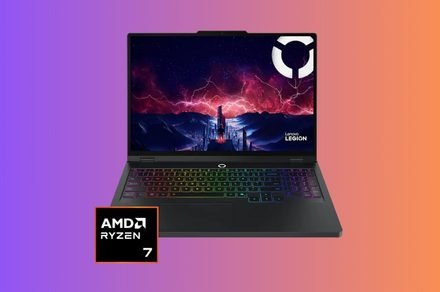
Lenovo Legion Pro 5 gaming laptop deal packs OLED, RTX 5060, and 32GB RAM
Digital Trends may earn a commission when you buy through links on our site. Why trust us?
The Lenovo Legion Pro 5 16-inch OLED with Ryzen 7 8745HX, RTX 5060, 32GB RAM, and 1TB SSD is now $1,299.99, down from $1,659.99.
Best Buy
Most gaming laptops at this price ask you to compromise somewhere: either a great screen with mid-tier specs, or strong internals with a dull panel. This Legion Pro 5 deal is appealing because it gets the balance right. You are getting a 2025 AMD Ryzen 7 processor, RTX 5060 graphics, 32GB of RAM, and a 2.5K OLED display for $1,299.99, which is $360 off the regular $1,659.99 price.
What You’re Getting
This configuration of the Lenovo Legion Pro 5 centers on a 16-inch 2.5K OLED display, which is a big step up from the washed-out 1080p panels you still see in a lot of gaming laptops. You get deep blacks, punchy contrast, and sharp detail that benefits both games and everyday use. It’s the kind of screen that makes story-heavy titles, movies, and even basic desktop work look better.
Under the hood, you’re looking at an AMD Ryzen 7 8745HX 2025 CPU paired with an NVIDIA GeForce RTX 5060, 32GB of RAM, and a 1TB SSD. That combo is well-suited for high-refresh 1440p gaming with settings tuned smartly, and the 32GB of memory means you can stream, multitask, and keep a dozen Chrome tabs open without the system choking. The 1TB SSD gives you enough room for a healthy rotation of big games before you have to start uninstalling.
Legion machines also tend to get the basics right: a solid keyboard with decent travel, a good port selection, and cooling that can actually keep the hardware performing without instantly throttling. So you aren’t just paying for raw specs; you are getting a chassis designed for sustained gaming, too.
Why It’s Worth It
At full price, this Legion Pro 5 is competing with a lot of other mid- to high-end gaming notebooks, and the value question becomes a little fuzzier. At $1,299.99, it looks much stronger. You are paying a midrange price for some very “next step up” choices: an OLED panel instead of a basic IPS, 32GB of RAM instead of the usual 16GB, and a roomy 1TB drive instead of a cramped 512GB.
The RTX 5060 is not a flagship GPU, but in a 2.5K laptop with a modern CPU and plenty of memory, it becomes a very capable all-rounder. You can push newer titles at high settings, lean on DLSS where it helps, and still enjoy the benefits of that OLED display for content consumption and work. If you are coming from an older GTX or early RTX laptop, the jump in smoothness and visual quality will feel significant.
The Bottom Line
If you have been waiting for a gaming laptop that does not feel like a compromise between power and display quality, this Lenovo Legion Pro 5 deal is worth serious consideration. For $1,299.99 (down from $1,659.99), you get a 2.5K OLED screen, a 2025 Ryzen 7 CPU, RTX 5060 graphics, 32GB of RAM, and 1TB of storage in a proven gaming chassis. It is a strong “buy once and keep for years” option rather than a stopgap machine you will want to replace next upgrade cycle.
I’m a writer, entrepreneur, and powerlifting coach. I’ve been building computers and fiddling with PC parts since I was a…
Finding a new GPU in 2026 might get a lot harder
Your next graphics card upgrade could take longer than expected
It looks like PC gamers might be in for another rough ride next year. A new report claims NVIDIA is planning to drastically dial back production of its GeForce RTX 50-series graphics cards in 2026. The problem isn’t that people aren’t buying them; it’s that the global memory market is in a crunch, and the massive explosion of artificial intelligence is eating up all the supply.
AI demand may squeeze RTX 50-series supply
Your next MacBook could use an iPhone-class chip
Leaked Apple engineering files point to an A18 Pro-based MacBook that reads more like a shippable configuration than the A15 test entry.
Apple may be inching toward an iPhone-class chip MacBook, and the trail starts in a place most people never see: internal kernel debug kit files used by its engineers. MacRumors reports that Apple accidentally posted the kit on its website earlier this year, then pulled it after details began leaking.
Inside the Mac-related listings, the files reference two unreleased MacBook setups. One uses the older A15, the other points to A18 Pro. The split matters because it suggests Apple tested the concept with whatever worked, then moved on to something that looks closer to a real product candidate.
It just got a lot easier to control a Windows 11 PC with your Android phone
Android smartphones now act as a multipurpose remote control for Windows 11 devices, offering instant locking, seamless file transfers, shared clipboard access, and easy screen mirroring.
Microsoft has rolled out a significant upgrade to its Phone Link system and the “Link To Windows” app for Android, improving cross-platform connectivity with Windows 11. First and foremost, there’s a new “Lock PC” toggle that lets you lock your Windows device remotely from your smartphone (provided the devices are connected).
According to a new report by Windows Latest, locking a Windows 11 PC from an Android phone takes a couple of seconds. Once unlocked, the PC reconnects to your phone. Besides that, the app also gets a “Recent Activity” feed that shows file transfers and clipboard history shared between the devices. There’s a dashboard of the recent cross-device transactions.
