Close Menu

    Subscribe to Updates

    Get the latest creative news from FooBar about art, design and business.

    What's Hot

    UMW Toyota Introduces Harrier 2.5 Hybrid in Malaysia From RM289,000

    HONOR Showcases Magic V6 Foldable, Robot Phone, MagicPad 4 and MagicBook Pro 14 at MWC 2026

    Clint Hocking, Creative Director of the next Assassin’s Creed, leaves Ubisoft following restructure

    Facebook X (Twitter) Instagram
    • Artificial Intelligence
    • Business Technology
    • Cryptocurrency
    • Gadgets
    • Gaming
    • Health
    • Software and Apps
    • Technology
    Facebook X (Twitter) Instagram Pinterest Vimeo
    Tech AI Verse
    • Home
    • Artificial Intelligence

      What the polls say about how Americans are using AI

      February 27, 2026

      Tensions between the Pentagon and AI giant Anthropic reach a boiling point

      February 21, 2026

      Read the extended transcript: President Donald Trump interviewed by ‘NBC Nightly News’ anchor Tom Llamas

      February 6, 2026

      Stocks and bitcoin sink as investors dump software company shares

      February 4, 2026

      AI, crypto and Trump super PACs stash millions to spend on the midterms

      February 2, 2026
    • Business

      These ultra-budget laptops “include” 1.2TB storage, but most of it is OneDrive trial space

      March 1, 2026

      FCC approves the merger of cable giants Cox and Charter

      February 28, 2026

      Finding value with AI and Industry 5.0 transformation

      February 28, 2026

      How Smarsh built an AI front door for regulated industries — and drove 59% self-service adoption

      February 24, 2026

      Where MENA CIOs draw the line on AI sovereignty

      February 24, 2026
    • Crypto

      Bitcoin Bear Market Could Get Worse Despite the Latest Relief Rally

      March 1, 2026

      Crypto Scammers Have Been Quiet in February, Hacks Fall by 90%

      March 1, 2026

      Vitalik Buterin Signals Major Ethereum Wallet Overhaul

      March 1, 2026

      Why is Hyperliquid Price Rallying Amid the US-Iran War

      March 1, 2026

      Arbitrum Price Under Pressure: 60 Million ARB Whale Sale Sparks ATL Fear

      March 1, 2026
    • Technology

      What if the real risk of AI isn’t deepfakes — but daily whispers?

      March 1, 2026

      Anthropic’s Claude grabs top spot in App Store after Trump’s ban

      March 1, 2026

      AWS Middle East Central Down, apparently struck in war

      March 1, 2026

      A new account made over $515,000 betting on the U.S. strike against Iran

      March 1, 2026

      January in Servo: preloads, better forms, details styling, and more

      March 1, 2026
    • Others
      • Gadgets
      • Gaming
      • Health
      • Software and Apps
    Check BMI
    Tech AI Verse
    You are at:Home»Technology»Researchers are getting organoids pregnant with human embryos
    Technology

    Researchers are getting organoids pregnant with human embryos

    TechAiVerseBy TechAiVerseDecember 24, 2025No Comments6 Mins Read1 Views
    Facebook Twitter Pinterest Telegram LinkedIn Tumblr Email Reddit
    Researchers are getting organoids pregnant with human embryos
    Share
    Facebook Twitter LinkedIn Pinterest WhatsApp Email

    Researchers are getting organoids pregnant with human embryos

    At first glance, it looks like the start of a human pregnancy: A ball-shaped embryo presses gently into the receptive lining of the uterus and then grips tight, burrowing in as the first tendrils of a future placenta appear. 

    This is implantation—the moment that pregnancy officially begins.

    Only none of it is happening inside a body. These images were captured in a Beijing laboratory, inside a microfluidic chip, as scientists watched the scene unfold.

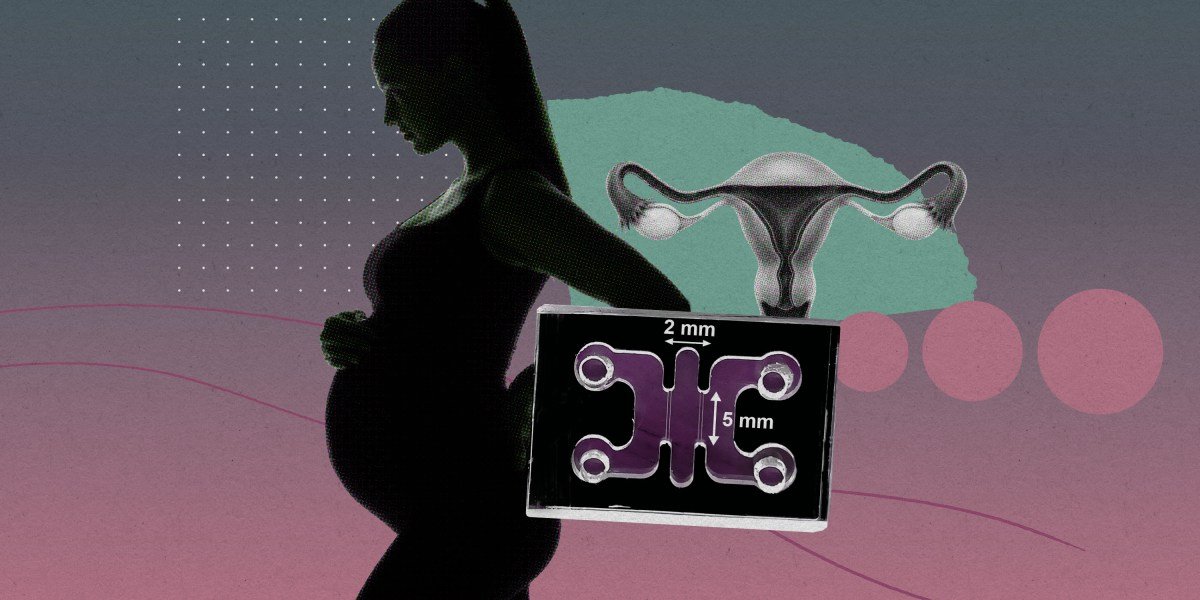
    This transparent microfluidic chip is used to grow an organoid that mimics the lining of a uterus.

    COURTESY OF THE RESEARCHERS

    In three papers published this week by Cell Press, scientists are reporting what they call the most accurate efforts yet to mimic the first moments of pregnancy in the lab. They’ve taken human embryos from IVF centers and let these merge with “organoids” made of endometrial cells, which form the lining of the uterus.

    The reports—two from China and a third involving a collaboration among researchers in the United Kingdom, Spain, and the US—show how scientists are using engineered tissues to better understand early pregnancy and potentially improve IVF outcomes.

    “You have an embryo and the endometrial organoid together,” says Jun Wu, a biologist at the University of Texas Southwestern Medical Center, in Dallas, who contributed to both Chinese reports. “That’s the overarching message of all three papers.”

    According to the papers, these 3D combinations are the most complete re-creations yet of the first days of pregnancy and should be useful for studying why IVF treatments often fail.

    In each case, the experiments were stopped when the embryos were two weeks old, if not sooner. That is due to legal and ethical rules that typically restrict scientists from going any further than 14 days.

    In your basic IVF procedure, an egg is fertilized in the lab and allowed to develop into a spherical embryo called a blastocyst—a process that takes a few days. That blastocyst then gets put into a patient’s uterus in the hope it will establish itself there and ultimately become a baby.

    Two blastoids, or artificial embryos (circles), grow inside an organoid.

    COURTESY OF THE RESEARCHERS

    But that’s a common failure point. Many patients will learn that their IVF procedure didn’t work because an embryo never attached.

    In the new reports, it’s that initial bond between mother and embryo that is being reproduced in the lab. “IVF means in vitro fertilization, but now this is the stage of in vitro implantation,” says Matteo Molè, a biologist at Stanford University whose results with collaborators in Europe are among those published today. “Considering that implantation is a barrier [to pregnancy], we have the potential to increase the success rate if we can model it in the laboratory.”

    Normally implantation is entirely hidden from view because it occurs in someone’s uterus, says Hongmei Wang, a developmental biologist at the Beijing Institute for Stem Cell and Regenerative Medicine, who co-led the effort there. Wang often studies monkeys because she can interrupt their pregnancies to collect the tissues she needs to see. “We’ve always hoped to understand human embryo implantation, but we have lacked a way to do so,” she says. “It’s all happening in the uterus.”

    In the Beijing study, researchers tested about 50 donated IVF embryos, but they also ran a thousand more experiments using so-called blastoids. The latter are mimics of early-stage human embryos manufactured from stem cells. Blastoids are easy to make in large numbers and, since they aren’t true embryos, don’t have as many ethical rules on their use.

    “The question was, if we have these blastoids, what can we use them for?” says Leqian Yu, the senior author of the report from the Beijing Institute. “The obvious next step was implantation. So how do you do that?”

    For the Beijing team, the answer was to build a soft silicone chamber with tiny channels to add nutrients and a space to grow the uterine organoid. After that, blastoids—or real embryos—could be introduced through a window in the device, so the “pregnancy” could start.

    “The key question we want to try to answer is what is the first cross-talk between embryo and mother,” says Yu. “I think this is maybe the first time we can see the entire process.”

    Medical applications

    This isn’t the first time researchers have tried using organoids for this kind of research. At least two startup companies have raised funds to commercialize similar systems—in some cases presenting the organoids as a tool to predict IVF success. In addition to Dawn Bio, a startup based in Vienna, there is Simbryo Technologies, in Houston, which last month said it would begin offering “personalized” predictions for IVF patients using blastoids and endometrial organoids.

    To do that test, doctors will take a biopsy of a patient’s uterine lining and grow organoids from it. After that, blastoids will be added to the organoids to gauge whether a woman is likely to be able to support a pregnancy or not. If the blastoids don’t start to implant, it could mean the patient’s uterus isn’t receptive and is the reason IVF isn’t working.

    The Beijing team thinks the pregnancy organoids could also be used to identify drugs that might help those patients. In their paper, they describe how they made organoids out of tissue taken from women who’ve had repeated IVF failures. Then they tested 1,119 approved drugs on those samples to see if anything improved.

    Several seemed to have helpful effects. One chemical, avobenzone, an ingredient in some types of sunblock, increased the chance that a blastoid would start implanting from just 5% of the time to around 25% of the time. Yu says his center hopes to eventually start a clinical trial if they can find the right drug to try. 

    Artificial womb?

    The Beijing group is working on ways to improve the organoid system so that it’s even more realistic. Right now, it lacks important cell types, including immune cells and a blood supply. Yu says a next step he’s working on is to add blood vessels and tiny pumps to his chip device, so that he can give the organoids a kind of rudimentary circulation.

    This means that in the near future, blastoids or embryos could likely be grown longer, raising questions about how far scientists will be able to take pregnancy in the lab. “I think this technology does raise the possibility of growing things longer,” says Wu, who says some view the research as an initial step toward creating babies entirely outside the body.

    However, Wu says incubating a human to term in the laboratory remains impossible, for the time being. “This technology is certainly related to ectogenesis, or development outside the body,” he says. “But I don’t think it’s anywhere near an artificial womb. That’s still science fiction.”

    Share. Facebook Twitter Pinterest LinkedIn Reddit WhatsApp Telegram Email
    Previous ArticleHow I learned to stop worrying and love AI slop
    Next Article Shokz OpenRun Pro drop to $99.99 and can still arrive before Christmas
    TechAiVerse
    • Website

    Jonathan is a tech enthusiast and the mind behind Tech AI Verse. With a passion for artificial intelligence, consumer tech, and emerging innovations, he deliver clear, insightful content to keep readers informed. From cutting-edge gadgets to AI advancements and cryptocurrency trends, Jonathan breaks down complex topics to make technology accessible to all.

    Related Posts

    What if the real risk of AI isn’t deepfakes — but daily whispers?

    March 1, 2026

    Anthropic’s Claude grabs top spot in App Store after Trump’s ban

    March 1, 2026

    AWS Middle East Central Down, apparently struck in war

    March 1, 2026
    Leave A Reply Cancel Reply

    Top Posts

    Ping, You’ve Got Whale: AI detection system alerts ships of whales in their path

    April 22, 2025700 Views

    Lumo vs. Duck AI: Which AI is Better for Your Privacy?

    July 31, 2025284 Views

    6.7 Cummins Lifter Failure: What Years Are Affected (And Possible Fixes)

    April 14, 2025162 Views

    6 Best MagSafe Phone Grips (2025), Tested and Reviewed

    April 6, 2025124 Views
    Don't Miss
    Gadgets March 2, 2026

    UMW Toyota Introduces Harrier 2.5 Hybrid in Malaysia From RM289,000

    UMW Toyota Introduces Harrier 2.5 Hybrid in Malaysia From RM289,000 UMW Toyota Motor has officially…

    HONOR Showcases Magic V6 Foldable, Robot Phone, MagicPad 4 and MagicBook Pro 14 at MWC 2026

    Clint Hocking, Creative Director of the next Assassin’s Creed, leaves Ubisoft following restructure

    Amazon Game Studios ends publishing agreement with Maverick Games

    Stay In Touch
    • Facebook
    • Twitter
    • Pinterest
    • Instagram
    • YouTube
    • Vimeo

    Subscribe to Updates

    Get the latest creative news from SmartMag about art & design.

    About Us
    About Us

    Welcome to Tech AI Verse, your go-to destination for everything technology! We bring you the latest news, trends, and insights from the ever-evolving world of tech. Our coverage spans across global technology industry updates, artificial intelligence advancements, machine learning ethics, and automation innovations. Stay connected with us as we explore the limitless possibilities of technology!

    Facebook X (Twitter) Pinterest YouTube WhatsApp
    Our Picks

    UMW Toyota Introduces Harrier 2.5 Hybrid in Malaysia From RM289,000

    March 2, 20261 Views

    HONOR Showcases Magic V6 Foldable, Robot Phone, MagicPad 4 and MagicBook Pro 14 at MWC 2026

    March 2, 20262 Views

    Clint Hocking, Creative Director of the next Assassin’s Creed, leaves Ubisoft following restructure

    March 2, 20261 Views
    Most Popular

    7 Best Kids Bikes (2025): Mountain, Balance, Pedal, Coaster

    March 13, 20250 Views

    VTOMAN FlashSpeed 1500: Plenty Of Power For All Your Gear

    March 13, 20250 Views

    Best TV Antenna of 2025

    March 13, 20250 Views
    © 2026 TechAiVerse. Designed by Divya Tech.
    • Home
    • About Us
    • Contact Us
    • Privacy Policy
    • Terms & Conditions

    Type above and press Enter to search. Press Esc to cancel.