

We Tested 87 Face Sunscreens and These Are the Best for Year-Round Sun Protection
No matter the time of year — yes, even in the fall and winter — you should always wear sunscreen to protect yourself from the sun’s damaging UV rays. After all, wearing sunscreen can help protect your skin from cancer.
When it comes to finding the best sunscreen, Dr. Pearl Rimtepathip, a board-certified dermatologist at MetroDerm, says, “The best sunscreen is one that a person will use and reapply the most.” To help you find the right one for your needs and skin type, we spent months testing 87 different sunscreens, paying close attention to ingredients, finish, consistency, price and whether the product is cruelty-free.
What is the best face sunscreen overall?
The best sunscreen is one you’ll wear consistently, but our top pick is EltaMD UV Clear.
Caroline Igo/CNETThe best sunscreen for you will depend on your skin type, skin concerns, preference for mineral or chemical formulas, makeup or skincare routine and budget. However, after our testing, we have found EltaMD UV Clear to be the best. Not only did it win a CNET Editors’ Choice award, but it also impressed us with its carefully selected ingredients for sensitive skin. It should work for most skin types.
Best face sunscreen of 2026
Pros
- No white cast
- Fragrance-free
- Lightweight
- Moisturizing
- Has a tinted version
Why we like it: This mineral and chemical sunscreen rubs in without any white cast (a white film that titanium dioxide or zinc oxide can leave on the skin). It’s designed for those with acne, rosacea and hyperpigmentation and includes niacinamide (vitamin B3), an ingredient that can soothe inflammation and reduce redness. All of EltaMD’s sun care products are paraben-free, fragrance-free, vegan, noncomedogenic, sensitivity-free and oil-free. Combined, these factors make this the best face sunscreen on this list.
Who it’s best for: EltaMD products are great if you have various skin concerns, such as rosacea or sensitivity. This formula is neither thick nor thin, and there’s no smell. It takes a bit of rubbing to get the formula to sink in, but once rubbed in, it feels lightweight and moisturizing on the skin — suitable for all skin types.
Who should not get it: Despite its name, this face sunscreen isn’t clear out of the pump. If you’re opposed to the white hue, EltaMD also makes a tinted face sunscreen.
Pros
- Works for all skin tones
- No white cast
- Fragrance-free
Cons
- Not as hydrating as other formulas
Why we like it: Supergoop’s sunscreen formulas are meant not to feel like sunscreen at all. Unseen is a thick, clear gel that dries down to a soft matte finish, creating a great base for applying makeup. It is non-irritating, noncomedogenic, dermatologist-tested, fragrance-free and vegan, making it great for all skin types.
Who it’s best for: Because this formula is clear, it also works for all skin tones — other face sunscreens can leave behind a white film or have a tint that’s too light for darker complexions. It isn’t as hydrating as others, but if you already use a face moisturizer and you wear makeup daily, Unseen will serve you well.
Who should not get it: If you have extremely dry skin, I would layer it with a moisturizer or consider another sunscreen.
Pros
- Under $20
- Fragrance-free
- Contains vitamin E
- Lightweight
- No white cast
- Vegan
- Higher SPF of 70
Why we like it: The Neutrogena Ultra Sheer is a great liquid sunscreen that reminds me of more Japanese “milky” sunscreens I’ve tried. It is lightweight, easy to blend in and has a natural finish with no white cast. It also contains the antioxidant vitamin E, which can help protect the skin from damage. The best part: It’s only $17 and can be found at the drugstore.
Who it’s best for: This sunscreen is great for all skin types, but especially sensitive and oily skin. It has no fragrance, parabens, or phthalates and is vegan and states that it’s “not tested on animals.” Since it’s just $17, it would be good for anyone on a budget looking to spend less than $20.
Who should not get it: If you have sensitive skin and are looking for a sunscreen formulated specifically for rosacea, eczema or psoriasis-prone skin, you may want to try another sunscreen with related certifications, like the Tower 28 one.
Pros
- Under $20
- Hydrating with niacinamide, ceramides and hyaluronic acid
- Can be found at most drugstores
- Glowy, but not greasy
Cons
- Only comes in three shades, but they’re blendable
Why we like it: This hydrating, tinted mineral sunscreen provides a nice glow that isn’t greasy. It is also fragrance-free, paraben-free, non-comedogenic and allergy-tested, making it suitable for sensitive and acne-prone skin. It contains niacinamide, three ceramides and hyaluronic acid, providing extra hydration and skin barrier benefits. It comes in three shades: light, medium and deep, which offer a natural, lightweight finish.
Who it’s best for: This sunscreen would be best for someone with sensitive skin or acne who is looking for a tinted, hydrating drugstore sunscreen that’s under $20.
Who should not get it: If you’re sensitive to the ingredients hyaluronic acid or niacinamide, this isn’t the sunscreen for you. While the tint is flexible and blendable, if you’re looking for a more specific skin tone match with more coverage, you may want to try another sunscreen.
Pros
- Blendable
- Dewy finish
- Fragrance-free
- Reef-safe
Cons
- May not be best for oily skin
- Fragranced version can have a strong smell
Why we like it: This face sunscreen looks and feels like a facial moisturizer. It blends in incredibly quickly and makes my skin feel nice. Honestly, I kept touching my face after it sank in because it felt remarkably soft. Coola’s Classic Face Sunscreen is water-resistant for up to 80 minutes but doesn’t feel heavy at all, unlike the other water-resistant options I tried. Bonus: It also contains ingredients that are reef-safe under Hawaii’s sunscreen regulations.
Who it’s best for: This face sunscreen is unscented, which is good for people who are sensitive to fragrance. It is also for people who hate thick, pasty sunscreens on their skin. I consider it a great daily sunscreen, either under makeup or on its own.
Who should not get it: This is not a drugstore option, but if you are on a strict budget, Coola might not be for you. It may also irritate oily skin.
Pros
- Lightweight
- Easy to blend
- No white cast
- Fragrance-free
- Contains antioxidants to protect skin from free radicals
Cons
- More expensive for a drugstore sunscreen at $40
Why we like it: I’ve used this mineral sunscreen for years, and it’s my all-time favorite drugstore sunscreen, but didn’t get the top “Best drugstore facial sunscreen” superlative because it is more pricey at $40 and may not be as easy to find as Neutrogena. It is lightweight and has a matte finish, easy to blend and is great for sensitive skin since it’s paraben-free, fragrance-free, oil-free, non-comedogenic and allergy-tested. It contains vitamin E and La Roche-Posay thermal spring water, which contains the natural antioxidant selenium.
Who it’s best for: This sunscreen is best for anyone with sensitive skin looking for a drugstore product under $50 with a lightweight, matte finish. In addition to non-tinted, it also comes in four shades.
Who should not get it: This sunscreen is more expensive for a drugstore item at $40, so it may not be right for every budget.
Pros
- Easy-to-squeeze bottle
- Comes in 17 shades with undertones
- Designed for sensitive and problem-prone skin
- National Eczema Association Accepted
- Cruelty-free
Cons
- Not for those who want a more glowy finish
Why we like it: In 17 shades that account for different undertones, SunnyDays is a lightweight, non-greasy, mineral sunscreen with a natural finish designed for sensitive and problem-prone skin. It is National Eczema Association Accepted, thanks to its alcohol-free, fragrance-free, irritant-free formula that is also vegan and cruelty-free. It includes aloe vera and prickly pear extract to soothe the skin, and is also reef-safe.
Who it’s best for: SunnyDays is best for people with sensitive or problem-prone skin who are looking for a mineral-tinted sunscreen in a wide variety of shades with a natural, slightly more matte finish. I got it in the shade Melrose 15, which is light with warm undertones.
Who should not get it: This sunscreen offers a light-medium coverage that is buildable, so if you’re looking for something with more coverage, you may want to try another sunscreen. It has a natural finish that is on the more matte side, so a product like Saie Sunvisor may be more suitable for those who want a glowy finish.
Pros
- Luxurious serum consistency
- Made with colloidal oatmeal for sensitive skin
- No white cast
- Blends into skin with ease
Cons
- May not work for oily and acne-prone skin
Why we like it: My favorite aspect of this First Aid Beauty sunscreen is how easily it blends into my skin. Without leaving a white cast, this non-tinted serum feels extremely hydrating and leaves behind a dewy finish. It’s effortlessly easy to put on before makeup or other skincare, making it a great choice for everyday use.
Who it’s best for: The First Aid Beauty Hydrating Sunscreen Milk is for those with dry skin looking for a daily SPF product that keeps the skin hydrated all day. While it should also work for normal and combination skin, it’s especially great for those with skin sensitivities.
Who should not get it: Priced at $36 for 1.7 fl oz, it might not be in everyone’s budget. Also, the chemical liquid formula may not work for oily and acne-prone skin.
Pros
- Blendable
- No white case
- Can use on face and body
- Fragrance-free
- Great for all skin types
Cons
- Can be oily on certain skin types
Why we like it: Black Girl Sunscreen is a black-owned brand that caters specifically to people of color. The face sunscreen is a little thicker than the others on this list, but it blends in nicely without leaving a white cast. The formula is vegan, cruelty-free, fragrance-free, ultra sheer, infused with cocoa seed butter, jojoba and avocado oil, and water-resistant for 80 minutes.
Who it’s best for: You can use Black Girl Sunscreen on both your face and body, great for those who want to use only one product. It feels moisturizing on my skin, and I can see it working for all skin types, especially those with dry skin.
Who should not get it: The formula may be too thick for those looking for a lightweight sunscreen.
Pros
- Great for acne-prone, oily skin
- Oil-free
- Hydrating
- Matte
Cons
- May not be for those who prefer a dewy finish
Why we like it: As someone with acne-prone skin, I have used and trusted Murad for years. The brand is dermatologist-developed and offers products that are friendly for acne-prone, sensitive and oily skin. Murad’s Oil and Pore Control Mattifier Broad Spectrum sunscreen is oil-free and minimizes the appearance of pores on top of the SPF.
Who it’s best for: It feels hydrating on my skin and is the most matte of all the face sunscreens on this list. It’s my top choice for those who have oily or acne-prone skin. If you have a similar skin type, you should consider Murad.
Who should not get it: This sunscreen is not for those looking for a glowy formula.
Pros
- Fragrance-free
- Reef-friendly
- Moisturizing
- Blendable
Cons
- May be too thick for some
- May not be best for oily, acne-prone skin
Why we like it: The Badger Active Mineral Sunscreen is the thickest sunscreen on this list, and for this reason, it’s the best waterproof facial sunscreen. The uncoated zinc oxide creates a solid barrier between your skin and the sun. While the formula is thick, it rubs into the skin pretty well; it didn’t leave a white cast on my skin. It also contains organic sunflower seed oil, beeswax, vitamin E and sea buckthorn fruit extract, and is water-resistant for up to 40 minutes.
Who it’s best for: The sunscreen is unscented, hypoallergenic, cruelty-free, water-free and reef-friendly, perfect for those who are conscious of the ingredients in their sunscreen and its effects on the environment.
Who should not get it: Because it’s heavy on the skin, I wouldn’t recommend it to those with oily or acne-prone skin.
Pros
- Great for damaged skin
- Blendable
- Lightweight
Why we like it: Isdin Photo Eryfotona Actinica is designed for actinic damage (skin that already has been damaged or changed by the sun), such as wrinkles, hyperpigmentation and reduced elasticity. It contains antioxidants and is water-resistant for up to 40 minutes.
Who it’s best for: This sunscreen is for those who hate thick creams. The formula is liquid and blends into the skin in seconds. It’s lightweight and can be used on any skin type — especially mature skin that has already seen a lot of sun exposure.
Who should not get it: Isdin has one of the most expensive sunscreens, starting at $46 for only 1.7 fl oz and $73 for 3.4 fl oz. I don’t recommend it to those on a budget.
Pros
- Lightweight
- Glowy
- Blendable
- Various shades
- Great makeup primer
Cons
- May not be best for those with oily skin
Why we like it: This sunscreen is very similar to Supergoop Unseen, except for the finish and consistency. Instead of a clear gel, the Glow Screen is more of a sheer liquid that adds some moisture and a glow, but without too much shimmer or glitter. It doesn’t feel heavy on the skin. Glow Screen is perfect for a primer before makeup or even as your only makeup.
Who it’s best for: If you prefer a glowy, dewy finish instead of a matte finish for your primer, Supergoop’s Glow Screen is the one for you.
Who should not get it: Glow Screen comes in various shades such as dawn, golden hour, sunrise and sunset. However, if you’re looking for exact shades, then I recommend Tower 28, Tula or Saie.
Pros
- 30 shades to choose from
- Lightweight serum consistency
- Light to medium buildable coverage
- UVA and UVB protection
Cons
- One tube is only 1 fl oz and costs $42
Why we like it: I am very picky when it comes to foundations, skin tints or any kind of coverage. I prefer light color correcting that isn’t necessarily visible to the naked eye, also known as the “no makeup, makeup look.” So, this skin tint from Tula was perfect for me. It has light shades for my pale skin, light coverage and helps to brighten dark spots. Additionally, the lightweight, breathable serum has ceramides, niacinamide and hyaluronic acid for my dry skin. I use it as a base for my makeup or the last step in my skincare routine.
Who it’s best for: This skin tint has light to medium coverage, making it suitable for those who don’t want a cakey or suffocating product. It is essentially makeup, skincare and SPF in one and should appeal to those who want to cut down on multiple products.
Who should not get it: If you are on a budget and plan on using this skin tint daily, you may want to consider a more affordable tinted sunscreen.
Pros
- Easy application
- Blendable
- Hawaii Reef-Compliant
- Moisturizing
- Cooling
Cons
- Some users report a sticky feeling
Why we like it: Coola’s Refreshing Water Hydration Stick is antioxidant-enriched, cruelty-free, vegan, dermatologist-tested, noncomedogenic and Hawaii Reef Compliant. It also contains hyaluronic acid, aloe and coconut water — which gives it its signature moisturizing feeling. Coola’s sunstick travels well and applies to faces smoothly, and quite literally feels like you’re applying cool water to your skin.
Who it’s best for: When it comes to getting your kids to put on sunscreen, sometimes it’s easier to give them face sunscreen in a twist tube. It requires little to no work to rub it into your skin — also great for those on the go.
Who should not get it: I don’t recommend this for those who want a matte or mineral formula.
Pros
- Easy application
- Lightly tinted
- Water resistant for up to 80 minutes
- No white cast
Cons
- Can have a gritty texture
Why we like it: The Cotz Mineral Sunstick is easy to apply. It glides onto the skin and may need a bit of extra rubbing here and there, but it essentially leaves no mess. The tint is subtle and has a glowy finish that isn’t too sparkly. My boyfriend even wore this sunscreen while surfing in Hawaii, and he loved how it felt on his skin. He said he felt more protected by this product than generic sunscreen sticks.
Who it’s best for: If you are constantly on the go and despise the mess that sunscreen lotion can leave on your hands, then a sunstick may be best. The Cotz sunstick gets extra points for having a mineral formula, especially if you are switching from chemical sunscreens.
Who should not get it: Since this sunstick leaves a glowy shine, it may not be suitable for oily or acne-prone skin.
Pros
- Easy to apply
- Not too sparkly
- Reef-friendly
Cons
- Requires the use of other sunscreen
- Not sure how much to apply to be effective
Why we like it: Powder sunscreen is on the rise, and while I also tested Supergoop’s (Glow)setting Powder, I found Brush on Block to be the superior option. The powder is not too sparkly (unlike Supergoop), and it’s similar to powder foundation. The mineral powder is translucent, reef-friendly, cruelty-free, vegan and water-resistant for 80 minutes. I like that it can easily be reapplied and applied over makeup or a moisturizer.
Who it’s best for: If you’re tired of lotions and thick SPF, power sunscreen is another option.
Who should not get it: Powder sunscreen should be used in addition to regular sunscreen — not on its own. This isn’t for those who want only one SPF product.
Pros
- Transparent gel
- Primes skin and blurs texture
- Fragrance-free
- Dermatologist tested
Cons
- Some consumers with very sensitive skin reported issues
Why we like it: The Vacation Invisible Face Gel resembles Supergoop Unseen. Both have similar consistencies and are clear on the skin. However, the Vacation face sunscreen feels more moisturizing. It applies very dewy and then seeps into the skin, bringing the hydration within. It seems to blur my pores without leaving a greasy layer behind. It’s also water resistant for up to 80 minutes.
Who it’s best for: I recommend this sunscreen for those who want a transparent gel with no white cast that doesn’t feel too greasy. It’s also great for customers who need a lightweight formula that can go under makeup.
Who should not get it: Those with very sensitive skin may want a mineral sunscreen.
Pros
- Eczema, rosacea and psoriasis certifications
- Universal tint leaves no white cast
- Contains ceramides, allantoin and alpha bisabolol to soothe and moisturize
- Cruelty-free
Cons
- Midrange price of $32
Why we like it: This sensitive skin-safe mineral sunscreen has three impressive certifications: National Eczema Association Accepted, National Rosacea Society Accepted and National Psoriasis Foundation Recognized. As someone with sensitive, rosacea-prone skin, I can testify that this is a great sunscreen that did not irritate my skin. It also has a universal tint (instead of a white tint) that easily blends into the skin, leaving no white cast and a natural finish. It contains moisturizing ceramides and calming allantoin and alpha bisabolol.
Who it’s best for: SOS FaceGuard would be great for anyone with sensitive skin who deals with eczema, rosacea or psoriasis. Since it has a universal tint that blends into the skin, it would also be a good product for anyone who wants a natural finish and aims to avoid a white cast.
Who should not get it: Priced at $32, this is slightly more expensive than other sunscreens on this list, so it may not be in budget for some.
Pros
- Lightweight and feels like skincare
- Non-greasy
- Added rice and probiotics
- Under $20
Cons
- Chemical sunscreen may not be suitable for those with sensitive skin
Why we like it: If you’re into Korean skincare, odds are you’ve heard about this sunscreen. Infused with rice and probiotics, the lightweight, non-greasy Daily Relief Sunscreen is a chemical sunscreen that uses homosalate for UV protection. The rice may brighten and hydrate skin, while the probiotics are intended to balance the skin and strengthen its barrier. It goes on like a moisturizer and leaves no white cast behind with a natural finish.
Due to regulations, the original Korean formula of this sunscreen is no longer available in the US, so I tested the US version.
Who it’s best for: Beauty of Joseon’s Daily Relief Sunscreen is best for someone who wants a chemical sunscreen with the added K-beauty ingredients rice and probiotics. It goes on light like a moisturizer, so it would also be good for someone who doesn’t want a heavy sunscreen.
Who should not get it: If you have sensitive skin that doesn’t respond well to chemical sunscreens, this wouldn’t be the right product for you. If you prefer a mineral sunscreen, the brand does have a Daily Tinted Fluid Sunscreen in 12 shades.
Pros
- Reef-safe
- Formulated for sensitive skin
- Contains aloe vera to soothe skin
- Under $20
- Water-resistant up to 80 minutes
Cons
- Thicker consistency makes it take longer to blend than other sunscreens on this list
Why we like it: Reef-safe and designed for sensitive skin, the Blue Lizard SPF 50 Sunscreen Lotion is a great hypoallergenic, fragrance-free, mineral sunscreen that contains aloe to soothe the skin. It is also under $20 for 5 fl oz, which is a steal. This sunscreen has a slightly heavier consistency and does take longer to blend in to get rid of the white cast, but the consistency leaves you feeling like your skin is fully protected. It is also water-resistant up to 80 minutes.
Who it’s best for: The Blue Lizard Sensitive Mineral lotion is best for anyone looking for a mineral sunscreen that is safe for sensitive skin, reef-safe and affordable.
Who should not get it: This sunscreen is not for people who are looking for a mineral sunscreen with a lighter, more milky consistency that is easier to blend in.
Pros
- Easy application
- Nostalgic scent
- Great for SPF touch-ups and reapplication
- Affordably priced compared to other brands
Cons
- May not get as even coverage with face mists
- Some may find the scent too strong
Why we like it: While some spray sunscreens can leave you feeling greasy, the Vacation Super Spritz Face Mist is quick-drying and easily applied. It has never left me feeling slick or oily. While I will use a facial sunscreen in the morning, I like to use this to reapply SPF after a few hours outside. I use just a few sprays and tap it into my skin. I really like the scent, it smells like a combination of banana, coconut and pool water. It’s nostalgic and reminds me of summers growing up.
Who it’s best for: I recommend this face mist for those looking for on-the-go, quick and extra coverage. This spray can serve as a primer or last step in a makeup routine as it won’t disrupt what is already on the skin.
Who should not get it: While some may love the scent of Vacation’s products, if you prefer non-scented products, it may be too strong for you. Additionally, face mists can give you splotchy coverage.
Pros
- Suitable for all skin types
- Water- and sweat-resistant up to 40 minutes
- Hydrating and soothing
- Lightweight formula
Why we like it: The No-Show Mineral Sunscreen is lightweight, hydrating and antioxidant-rich, suitable for all skin types. It has a natural finish, is easy to blend into the skin and leaves behind no white cast. Water- and sweat-resistant up to 40 minutes, No-Show contains the chamomile-derived ingredient bisabolol to soothe the skin and silver ear mushroom extract for hydration.
Who it’s best for: Colorescience Total Protection No-Show Mineral Sunscreen is best for anyone looking for a lightweight mineral sunscreen that hydrates and soothes the skin and leaves behind no white cast with a natural, non-greasy finish.
Who should not get it: This sunscreen is on the pricier side, at $48 for 1.7 fl oz, so it may not be in some people’s budgets.
Pros
- Mineral sunscreen without a white cast
- Glowy, natural finish
- Hydrates and primes skin for makeup
- Contains squalane, antioxidants and blue pea flower extract
Cons
- Not enough shades yet
Why we like it: Live Tinted’s Hueguard Glotion Mineral Sunscreen is lightweight, hydrating and flattering on the skin. I prefer light, glowy coverage and this is the only sunscreen that has come close to the Supergoop’s Glowscreen for me. It moisturizes, primes and protects UVA and UVB rays. I usually wear this instead of makeup or as my makeup base.
Who it’s best for: I consider this sunscreen to be a great daily SPF and a product that can be used in your everyday routine. It can be worn with or without makeup, making it suitable for those who want light buildable coverage and a glowy finish.
Who should not get it: If you are strict on the mineral sunscreens that you use, be aware that this formula includes butyloctyl salicylate. This is a synthetic chemical that isn’t labeled as “active” on the label, but some argue that this indicates that the sunscreen is a combination of chemical and mineral, not a true mineral sunscreen.
Pros
- Calms skin and eases redness
- Suitable for all skin types
- No white cast
- Serum absorbs quickly into skin
Cons
- Must shake well before every use
- Some may not like the scent
Why we like it: Mara is a clean-beauty brand that utilizes algae and superfoods in its skincare products. Its sunscreen serum is no different. The lightweight liquid contains algae, blue sea kale, vitamin C and various oil extracts such as seaweed, grape, sunflower and raspberry. I wasn’t surprised that it has a botanical, earthy smell. In addition to the UV protection, the key ingredients, such as blue sea kale and algae, help to fight free radicals, signs of aging and dryness.
Who it’s best for: I would consider this sunscreen great for all skin types, but the key ingredients appeal more to dry and sensitive skin. As for the serum consistency, it’s great for dewy skincare lovers. If you, like me, liked the discontinued Eleven sunscreen products, Mara is very similar.
Who should not get it: If you are on a budget, I would steer clear of this sunscreen. It is only 1 fl oz and costs over $50 for one bottle.
June 30, 2025:
Replaced:
– Best drugstore facial sunscreen: Aveeno Protect and Hydrate with Neutrogena Ultra Sheer Face Liquid Mineral Sunscreen
– Best mineral facial sunscreen: Kinship Self-Reflect Mineral Sunscreen with La Roche-Posay Anthelios Mineral Sunscreen
– Best tinted facial sunscreen: Cay Skin Isle Glow Face Lotion with Tower 28 SunnyDays Tinted
– Best gel facial sunscreen: Glossier Invisible Shield with Vacation Invisible Face Gel
Removed:
– Best facial moisturizer with SPF: La Roche-Posay Double Repair
Added:
– Best drugstore tinted sunscreen: CeraVe Hydrating Mineral Sunscreen
– Best facial sunscreen for everyday: First Aid Beauty Hydrating Sunscreen Milk
– Best tinted sunstick: Cotz Mineral Sunstick
– Best sunscreen for sensitive skin: Tower 28 SOS FaceGuard
– Best K-Beauty facial sunscreen: Beauty of Joseon Daily Relief
– Best reef-safe sunscreen for face: Blue Lizard Sensitive Mineral
– Best face mist sunscreen: Vacation Super Spritz Face Mist or Coola Classic Face Mist
– Best facial sunscreen for combination skin: Colorescience Total Protection No-Show
– Best glowy sunscreen for face: Live Tinted Hueguard
– Best facial sunscreen serum: Mara Algae and Zinc Serum
– Best skin tint SPF sunscreen: Tula Radiant Skin Serum
Best face sunscreens compared
| Sunscreen | SPF level | Mineral or Chemical? | Active ingredients | Consistency | Finish | Size (oz) |
|---|---|---|---|---|---|---|
| EltaMD UV Clear | 46 | Both | Octinoxate 7.5%, zinc oxide 9% | Lightweight | Dewy | 1.7 |
| Supergoop Unseen Sunscreen | 40 | Chemical | Avobenzone 3%, homosalate 8%, octisalate 5% and octocrylene 4% | Gel | Matte | 1.7 |
| Aveeno Protect and Hydrate | 60 | Chemical | Avobenzone 3%, homosalate 13.5%, octisalate 5% and octocrylene 10% | Lightweight | Natural | 2 |
| Kinship Self Reflect Mineral Sunscreen | 32 | Mineral | Zinc oxide 22.4 % | Creamy | Glowing | 1.75 |
| Coola Classic Face Sunscreen | 50 | Chemical | Avobenzone 1.84%, homosalate 5.25%, octisalate 2.15% and octocrylene 5.25% | Ultra-lightweight | Dewy | 1.7 |
| Black Girl Sunscreen Broad Spectrum | 30 | Chemical | Avobenzone 3%, homosalate 10%, octisalate 5% and octocrylene 2.75% | Lotion | Dewy | 2 |
| Murad Oil and Pore Control Mattifier Broad Spectrum | 45 | Chemical | Avobenzone 3%, homosalate 10%, octisalate 5% and octocrylene 5% | Lightweight | Matte | 1.7 |
| La Roche-Posay Double Repair Face Moisturizer UV | 30 | Chemical | Avobenzone 3%, homosalate 5%, octisalate 5% and octocrylene 7% | Lightweight | Natural | 3.38 |
| Badger Active Mineral Sunscreen | 30 | Mineral | Uncoated zinc oxide 18.75% | Thick, creamy | Matte | 2.9 |
| Isdin Eryfotona Actinica Ultralight Emulsion | 50+ | Mineral | Zinc oxide 11% | Liquid | Natural | 3.4 |
| Supergoop Glow Screen | 40 | Chemical | Avobenzone 3%, homosalate 4%, octisalate 5% and octocrylene 8% | Lightweight | Glowy | 1.7 |
| Coola Refreshing Water Hydration Stick | 50 | Chemical | Avobenzone 2.5%, homosalate 3.5%, octisalate 2.15% and octocrylene 5% | Ultra-lightweight | Natural | 0.8 |
| Cay Skin Isle Glow Face Lotion | 45 | Chemical | Avobenzone 3%, octisalate 3% and octocrylene 10% | Lightweight | Glowy | 1.5 |
| Brush on Block Mineral Powder Sunscreen | 50 | Mineral | Titanium dioxide 6%, zinc oxide 21% | Powder | Matte and sparkly | 0.12 |
| Glossier Invisible Shield | 35 | Chemical | Avobenzone 3%, homosalate 6% and octisalate 5% | Gel | Dewy, natural | 1 |
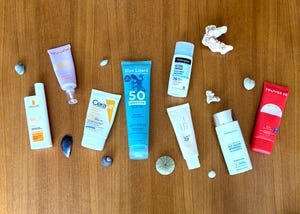
The sunscreens Anna tested.
Anna Gragert/CNETWellness editors Caroline and Anna tested over 87 face sunscreen products from about 60 different popular brands. They then narrowed it down to the best of the best, looking at each product’s SPF levels, ingredients, feel and price. To decide on the best face sunscreen, they applied each product to the face and went into the sun to see how each felt and protected.
Each facial sunscreen was tested on Caroline’s naturally acne-prone, sensitive skin on top of an everyday moisturizer. Anna also has sensitive, rosacea-prone skin, so they paid close attention to any sensitivity issues. Not every formula on this list will work for everyone. The goal is to give you a sense of the viscosity and scent of each product and how they feel on the skin.
The sunscreens Caroline tested.
Caroline Igo/CNET“Patients should look for broad-spectrum sunscreens,” explains Rimtepathip. “These sunscreens protect skin from both UVA and UVB rays. SPF is also an important factor. Sunscreen with at least SPF 30 is needed to adequately protect and prevent sunburn.”
The dermatologist adds that although some sunscreens are water resistant, this doesn’t make them waterproof or sweatproof. That’s why sunscreen should be reapplied at least every two hours. “If a person is sweating or swimming, sunscreen should be reapplied every 40 to 80 minutes,” she advises.
Dr. Sonia Batra, a board-certified dermatologist and founder of Batra Dermatology, agrees that broad-spectrum, SPF 30 daily sunscreens are essential, but adds that she also recommends sunscreens that are fragrance-free. “The main thing is finding a sunscreen with a texture and color that agrees with your skin when applied generously and that you will enjoy using,” she says.
As Rimtepathip mentioned, the best sunscreen is one that you will actually use and reapply. “There are still keywords to look for depending on a person’s skin type,” she adds. “If a person’s skin is dry, look for sunscreens that have moisturizing ingredients, such as hyaluronic acid. For oily skin, look for the words ‘oil-free’ or ‘noncomedogenic.’ These sunscreens are less likely to clog pores and cause outbreaks. Mineral sunscreens are less irritating to people with sensitive skin. They should also avoid sunscreens with added fragrances.”
If you have oily or acne-prone skin, sensitive skin or dry skin on your face, the best sunscreen for your face and particular needs exists — and may even be on this list. Many of these formulas are from higher-end skincare brands, with a few drugstore finds. We’re not saying you need to buy the more expensive options, but if you do, you’ll usually get a better formula that caters to your skin type, feels lightweight and blends well.
Dry skin: Use sunscreens that contain moisturizing ingredients including aloe, niacinamide, hyaluronic acid, coconut water, sunflower oil or various fruit extracts. The sunscreen can be added on top of moisturizer or on its own, depending on how dry your skin is.
Oily skin: Steer clear of any sunscreen that is not oil-free. You don’t want to add to the overall oil. Look for sunscreens that say “noncomedogenic” on the bottle, meaning it won’t clog pores.
Acne-prone skin: If you have oily skin, chances are you also have acne-prone skin. Similarly, pick sunscreens that are noncomedogenic, oil-free, fragrance-free, paraben-free and irritation-free.
Sensitive skin: Look for sunscreens that have minimal ingredients and that are, first and foremost, fragrance-free. It also helps if the sunscreen is dermatologist-tested, oil-free, paraben-free, irritation-free and noncomedogenic. “For sensitive or rosacea-prone skin, choose a mineral sunscreen with zinc oxide or titanium oxide, as these active ingredients tend to be less irritating,” recommends Batra.
Whether you use mineral sunscreen formulations or chemical ones, be sure you use one with broad spectrum SPF and skin-nurturing hyaluronic acid to provide both the sun protection and breathable skin comfort you need.
The most effective sunscreen for you will be any facial sunscreen of at least 30 SPF. On top of that, make sure to reapply every two hours. The most effective sunscreen is also SPF that you wear daily and that fits your lifestyle (e.g., wear waterproof sunscreen if you’re swimming or working out in the sun).
According to the American Academy of Dermatology Association, you should be using at least SPF 30. Sunscreens with SPF 30 protect the skin from 97% of the sun’s rays. “Higher SPF doesn’t always mean better, and above SPF 50, the efficacy plateaus,” says Batra. “For standard daily use, any sunscreen with an SPF 30 or greater is usually sufficient.”
The best sunscreen for rosacea is any sunscreen that is dermatology-tested, fragrance-free and safe for sensitive skin. I recommend EltaMD’s UV Clear Broad-Spectrum facial sunscreen, which is specifically formulated for skin types prone to acne, rosacea and hyperpigmentation.
When reapplying sunscreen, it is not necessary to wash your face beforehand. According to Arlington Dermatology, when you first apply sunscreen, you should wash your face beforehand to remove makeup and oil that may prevent the sunscreen from sticking.
It is recommended that sunscreen be the final step in your skincare routine, so you should apply it after moisturizer.
Yes. Not only should you be applying your sunscreen every day — you should also be reapplying your sunscreen every two hours to get the most protection out of your face sunscreen.
The best sunscreen for your face will depend on your skin type and personal preferences. Many experts prefer mineral sunscreen because it lacks certain chemicals and is more effective for sun protection, but it can leave behind a white cast. “Chemical sunscreens are sometimes more cosmetically elegant and blend into skin better, while mineral sunscreens are often better tolerated by sensitive skin types,” explains Batra.
If you’re not sure which sunscreen is best for your face, consult with your dermatologist.
According to the US Transportation Security Administration, sunscreens less than or equal to 3.4 oz or 100 ml can be carried on in carry-on bags. Aerosol devices with a button or nozzle must be protected by a cap to prevent accidental release.
The total quantity of medicinal and toiletry articles, including aerosols like spray sunscreen, in checked baggage cannot exceed 68 fluid ounces, and each container cannot exceed 17 fluid ounces.
“According to FDA standards, chemical sunscreens have been proven safe and effective,” answers Rimtepathip. “There is some concern expressed across social media about chemical sunscreens because of a 2019 FDA report. The FDA tested seven chemical sunscreens and found that chemical UV blockers are absorbed into people’s bloodstreams. Some lab studies found potential hormone-disrupting effects of common chemical sunscreen ingredients like oxybenzone and octinoxate, but these effects have not been definitively proven in humans. The FDA still considers them safe for consumers.”
Rimtepathip adds that while chemical sunscreens may be safe for human use, the chemicals in them can enter the natural environment. “Some states, like Hawaii, have banned certain chemical sunscreens because of their negative impact on coral reefs,” she explains.
According to Rimtepathip, the highest SPF you can usually find available is SPF 100, but a higher SPF does not necessarily mean better protection. “The difference between SPF 50 and SPF 100 is minimal, with only a 1% difference in its UV-blocking ability,” she says. “At a minimum, I recommend using SPF 30 and up to SPF 50 for adequate sun protection.”
“According to the Environmental Protection Agency, there is a minimal risk for sun damage when there is a low UV index of 1-2. However, cumulative sun exposure over time increases the risk for aging, sunspots, wrinkles, rough texture and other photoaging issues,” explains Rimtepathip. “I recommend my patients always wear sunscreen when they may be exposed to the sun. This includes when working indoors but facing a sunny window. The best treatment for aging, skin damage and skin cancer is prevention.”
Batra adds, “I recommend applying sunscreen every day regardless of the weather, but certainly when the UV index is 3 or above. It is important to remember that ultraviolet light can penetrate clouds, and sunscreen is still important in overcast weather.”
“No, expired sunscreen is not considered good or safe to use due to its decreased effectiveness in blocking the sun’s UV rays,” states Rimtepathip. “Using expired sunscreen could lead to inadequate sun protection. Expired sunscreen also increases the risk of sunburn and irritation of the skin.”
“The active ingredients degrade over time, especially if the bottle has been open or stored in a hot environment,” adds Batra.
Rimtepathip says that the most effective sunscreen for the face is one that has mineral ingredients. “Look for the ingredients zinc oxide or titanium dioxide, and use sunscreen with a minimum SPF of 30,” she advises, adding that people with sensitive or acne-prone skin should look for lightweight sunscreens that are noncomedogenic or oil-free.
