Close Menu

    Subscribe to Updates

    Get the latest creative news from FooBar about art, design and business.

    What's Hot

    How to transfer your games to the Nintendo Switch 2

    2025 Christmas Day NFL games: How to watch today, full streaming schedule and more

    Steam and Valve’s online games are partially down

    Facebook X (Twitter) Instagram
    • Artificial Intelligence
    • Business Technology
    • Cryptocurrency
    • Gadgets
    • Gaming
    • Health
    • Software and Apps
    • Technology
    Facebook X (Twitter) Instagram Pinterest Vimeo
    Tech AI Verse
    • Home
    • Artificial Intelligence

      AI has become the norm for students. Teachers are playing catch-up.

      December 23, 2025

      Trump signs executive order seeking to ban states from regulating AI companies

      December 13, 2025

      Apple’s AI chief abruptly steps down

      December 3, 2025

      The issue that’s scrambling both parties: From the Politics Desk

      December 3, 2025

      More of Silicon Valley is building on free Chinese AI

      December 1, 2025
    • Business

      Top 10 cloud computing stories of 2025

      December 22, 2025

      Saudia Arabia’s STC commits to five-year network upgrade programme with Ericsson

      December 18, 2025

      Zeroday Cloud hacking event awards $320,0000 for 11 zero days

      December 18, 2025

      Amazon: Ongoing cryptomining campaign uses hacked AWS accounts

      December 18, 2025

      Want to back up your iPhone securely without paying the Apple tax? There’s a hack for that, but it isn’t for everyone… yet

      December 16, 2025
    • Crypto

      Crypto Twitter Turns Bearish on 2026—but These 3 Sectors Could Still Win

      December 25, 2025

      Bitcoin’s Trading Pair Flashes Down to $24,000 on Binance: Why You Need to be Careful

      December 25, 2025

      Cardano’s 18% Breakdown Setup Is Clear — But So Is Its Only Escape Route

      December 25, 2025

      How a Major Source of Market Stress in 2025 May Be Diminishing

      December 25, 2025

      USDC Is Being Used for More Than Trading, and Bybit Is Expanding Support on XDC

      December 25, 2025
    • Technology

      How to transfer your games to the Nintendo Switch 2

      December 25, 2025

      2025 Christmas Day NFL games: How to watch today, full streaming schedule and more

      December 25, 2025

      Steam and Valve’s online games are partially down

      December 25, 2025

      Research shows ‘more agents’ isn’t a reliable path to better enterprise AI systems

      December 25, 2025

      Python 3.15’s interpreter for Windows x86-64 should hopefully be 15% faster

      December 25, 2025
    • Others
      • Gadgets
      • Gaming
      • Health
      • Software and Apps
    Check BMI
    Tech AI Verse
    You are at:Home»Technology»Self-referencing Page Tables for the x86-Architecture
    Technology

    Self-referencing Page Tables for the x86-Architecture

    TechAiVerseBy TechAiVerseDecember 25, 2025No Comments6 Mins Read0 Views
    Facebook Twitter Pinterest Telegram LinkedIn Tumblr Email Reddit
    Self-referencing Page Tables for the x86-Architecture
    Share
    Facebook Twitter LinkedIn Pinterest WhatsApp Email

    Self-referencing Page Tables for the x86-Architecture

    Almost fourteen months ago, I started working on my bachelor thesis.
    Although I finished it half a year ago, it’s still part of my work as a student research assistant.

    During my initial work, most of the code was written for an internal research kernel.
    I’m now happy that we were able to port it to an open source kernel called eduOS: /RWTH-OS/eduOS ).
    This minimal operating system is used for practical demo’s and assignments during the OS course at my university.
    There’s much more I could write about.
    So this will probably be another separate blog post.

    The motive for this article is an abstract I wrote for the student research competition of the ASPLOS conference which is held this year in Istanbul, Turkey.
    Unfortunately my submission got rejected.
    But as a nice side-effect, I’ve now the chance to present my work to an English audience as well:

    Download:Extended Abstract
    (PDF)

    Self-referencing Page Tables for the x86-Architecture

    Section titled “Self-referencing Page Tables for the x86-Architecture”

    A simple Paging Implementation for a minimalistic Operating System

    Section titled “A simple Paging Implementation for a minimalistic Operating System”

    Steffen Vogel

    Academic advisor: Dr. rer nat. Stefan Lankes Institute for Automation of Complex Power Systems E.ON Energy Research Center, RWTH Aachen University Mathieustr. 10, 52074 Aachen, Germany

    This was a submission for ASPLOS Student Research Competition ’15 Istanbul, Turkey1.

    The adoption of 64 bit architectures went along with an extension of the virtual address space (VAS).
    To cope with this growth, the memory management unit (MMU) had to be extended as well.
    For paging-based systems like Intel’s x86-architecture this was realized by adding more levels of indirection to the page table walk.

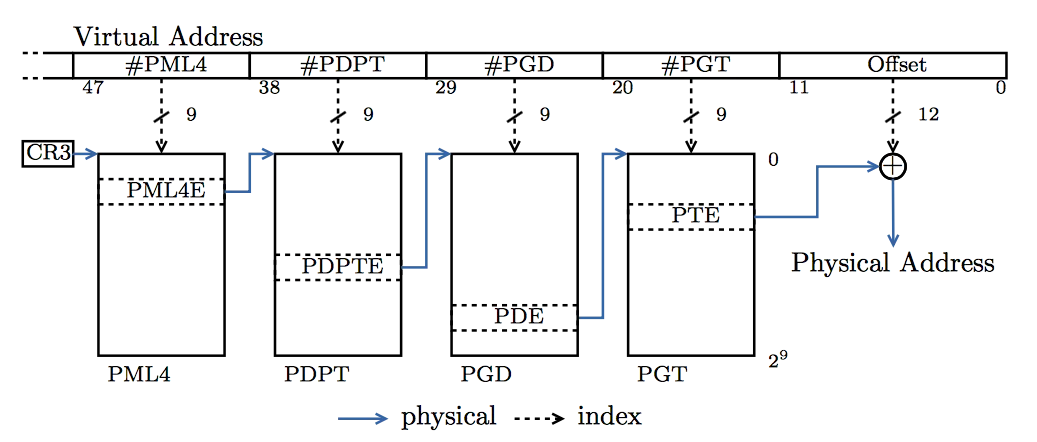
    This walk translates virtual pages to physical page frames (PF) by performing look-ups in a radix / prefix tree in which every node represents a page table (Figure 1a).
    Since the tables are part of the translation process, they must be referenced by physical page frame numbers (PFN, blue line).
    As the operating system is only eligible to access the VAS, it cannot follow the path of a walk.
    In order to allow the manipulation of page tables, it must provide:

    Figure 1a: Page table walk in the x86 64 longmode: Traditional, without self-reference.
    • Access to the table entries, by mapping the tables themselves to the VAS.
    • A mapping between physical references to corresponding locations in the VAS.

    Additionally, every level of the page table walk increases the complexity of managing these mappings.
    They also increase the memory consumption by occupying physical page frames.
    It is possible to avoid both drawbacks by the technique described in the following.

    In my bachelor thesis, I presented an approach, which is compatible with both the 32 bit and 64 bit version of Intel’s x86-architecture.
    This allows for a replacement of two code bases, one for each architecture, by one supporting both.
    Thus, results in a shorter, easier comprehensible, and maintainable code.
    As foundation for this implementation our teaching OS called “eduOS” was used2.
    “eduOS” supports only the 32 bit protected mode whereas the 64 bit longmode is only implemented for an internal research kernel.

    Thanks to the sophisticated design of Intel’s x86 MMU, it is possible to avoid most of the complexity and space requirements by using a little trick.
    Adding a self-reference in the root table (PML4 resp. PGD) automatically enables access to all page tables from the VAS without the need for manual mappings as described above (Figure 1b).
    The operating system does not need to manually follow the path of a page table walk, as this task is executed by the MMU for accessing individual tables instead of page frames.

    Figure 1b: Page table walk in the x86 64 longmode: With self-reference.

    An access to the VAS region covered by a self-reference causes the MMU to look up the root table twice (red line).
    Effectively, this shifts the whole page table walk by one level.
    Therefore, it stops with the PFN of page tables instead of page frames that are usually translated by the MMU.
    Here, both the PML4 and PDPT indexes are used to choose an entry out of the PML4 table.
    Therefore, it must be guaranteed that PML4 entries can be interpreted as PDPT entries, too.
    This demands for the following requirements:

    • Homogenous coding of paging flags across all paging levels.
    • Equal table sizes across all paging levels.

    Fortunately, the x86-architecture complies with this prerequisites as shown in Figure 2.
    Green colored flags are coded consistently across all paging levels.
    Only PAT, size and global flags have a slightly different meaning for entries in the PGT.
    My bachelor thesis shows that these deviations still allow maintaining full control caching and memory protection properties of self-mapped tables.
    This includes for common system calls like fork() and kill().

    Figure 2: Similar flags across all paging levels.

    By repeatedly addressing the self-reference, it is also possible to access tables of the upper levels (PGD to PML4).
    Table 1 shows the resulting virtual addresses of all page tables when using the last (512th) entry of the PML4 table for the self-reference3.
    This grants access to all possible page tables, including those which might not yet exist and may be allocated in the future.
    Hence, the self-reference reserves a fixed fraction of the VAS for the page tables.
    The size of this region is equal to 256 TiB / 512 = 512 GiB for 64 bit (resp. 4 GiB / 1024 = 4 MiB for 32 bit), which is negligible in comparison to the huge VAS of 248 byte.

    Table 1: Virtual addresses of self-mapped tables.

    For the manipulation of page table entries two approaches are feasible:

    • Top-down Use known tree traversals, starting at the root node, which corresponds to the PML4 respectively PGD.
    • Bottom-up Use the page fault handler to create new tables on-the-fly, when they are not yet present.

    But there are also other architectures which satisfy the prerequisites described above.
    One of these is the Alpha4 architecture, which suggests a similar approach in the reference manual.
    Intel and AMD do not mention the technique in their x86 manuals.
    In the field of operating systems, support is far more limited.
    There is only a single reference5 dated to 2010 indicating that Microsoft might use a similar approach for its NT kernel.
    Linux cannot profit because its paging implementation must support a broad selection of virtual memory architectures of which not all fulfill the requirements mentioned above.

    1. A full version of the thesis and slides are available in this post. ↩

    2. Description and source code at: www.os.rwth-aachen.de. ↩

    3. This is an arbitrary choice. All other entries are feasible, too. ↩

    4. Compaq Computer Corporation: Alpha Architecture Reference Manual. January 2002. ↩

    5. Dave Probert, Microsoft: Windows Kernel Architecture Internals. April 2010. ↩

    Share. Facebook Twitter Pinterest LinkedIn Reddit WhatsApp Telegram Email
    Previous ArticleThis Two-Faced Watch Band Lets You Hide an Apple Watch Under Your Rolex
    Next Article Quantum Error Correction Goes FOOM
    TechAiVerse
    • Website

    Jonathan is a tech enthusiast and the mind behind Tech AI Verse. With a passion for artificial intelligence, consumer tech, and emerging innovations, he deliver clear, insightful content to keep readers informed. From cutting-edge gadgets to AI advancements and cryptocurrency trends, Jonathan breaks down complex topics to make technology accessible to all.

    Related Posts

    How to transfer your games to the Nintendo Switch 2

    December 25, 2025

    2025 Christmas Day NFL games: How to watch today, full streaming schedule and more

    December 25, 2025

    Steam and Valve’s online games are partially down

    December 25, 2025
    Leave A Reply Cancel Reply

    Top Posts

    Ping, You’ve Got Whale: AI detection system alerts ships of whales in their path

    April 22, 2025538 Views

    Lumo vs. Duck AI: Which AI is Better for Your Privacy?

    July 31, 2025191 Views

    6.7 Cummins Lifter Failure: What Years Are Affected (And Possible Fixes)

    April 14, 202594 Views

    6 Best MagSafe Phone Grips (2025), Tested and Reviewed

    April 6, 202586 Views
    Don't Miss
    Technology December 25, 2025

    How to transfer your games to the Nintendo Switch 2

    How to transfer your games to the Nintendo Switch 2Upgrading to the Switch 2 is…

    2025 Christmas Day NFL games: How to watch today, full streaming schedule and more

    Steam and Valve’s online games are partially down

    Research shows ‘more agents’ isn’t a reliable path to better enterprise AI systems

    Stay In Touch
    • Facebook
    • Twitter
    • Pinterest
    • Instagram
    • YouTube
    • Vimeo

    Subscribe to Updates

    Get the latest creative news from SmartMag about art & design.

    About Us
    About Us

    Welcome to Tech AI Verse, your go-to destination for everything technology! We bring you the latest news, trends, and insights from the ever-evolving world of tech. Our coverage spans across global technology industry updates, artificial intelligence advancements, machine learning ethics, and automation innovations. Stay connected with us as we explore the limitless possibilities of technology!

    Facebook X (Twitter) Pinterest YouTube WhatsApp
    Our Picks

    How to transfer your games to the Nintendo Switch 2

    December 25, 20250 Views

    2025 Christmas Day NFL games: How to watch today, full streaming schedule and more

    December 25, 20250 Views

    Steam and Valve’s online games are partially down

    December 25, 20250 Views
    Most Popular

    What to Know and Where to Find Apple Intelligence Summaries on iPhone

    March 12, 20250 Views

    A Team of Female Founders Is Launching Cloud Security Tech That Could Overhaul AI Protection

    March 12, 20250 Views

    Senua’s Saga: Hellblade 2 leads BAFTA Game Awards 2025 nominations

    March 12, 20250 Views
    © 2025 TechAiVerse. Designed by Divya Tech.
    • Home
    • About Us
    • Contact Us
    • Privacy Policy
    • Terms & Conditions

    Type above and press Enter to search. Press Esc to cancel.