

How game storytelling needs to be done differently in VR
Coatsink’s narrative director Jon Davies explains why immersive technology demands a different approach to in-game narrative
Engaging with VR feels wholly different to traditional gaming. Even when playing a conventional first-person game, the interface, voice-over (VO) and occasional camera-grab all remind you that you’re portraying Booker DeWitt or Adam Jensen or Indiana Jones. But crucially, the space between you and the screen reinforces that separation. Booker’s over there, in Columbia, while I’m in my living room, seeing the world from his perspective.
Step into VR and that separation is removed – in a strange and paradoxical way. Yes, you feel like you’re inhabiting the world to a greater degree, but not the fictional character; you don’t suddenly possess their knowledge and memories. When I played Resident Evil 7 in VR, Mia Baker wasn’t stumbling with a chainsaw towards Ethan, she was stumbling towards me. And at the time I wasn’t thinking, ‘Wow, Ethan’s gonna get it.’ Instead I was wondering why I chose this terrifying way to spend a Sunday afternoon.
Storytelling in this new medium poses some unique challenges. And after almost ten years writing for Coatsink, a UK-based game developer with extensive VR experience, I’d like to share some insights.
Externalise the Protagonist
At its core, a story is fundamentally about a character making decisions. A character arc is then conveyed by them making different decisions as the story progresses. How then do you accomplish this when the protagonist is controlled by the player? You can’t impose this growth or force them to make one decision over another. This issue isn’t unique to VR and there’s obviously a case to be made that an interactive journey is a new type of narrative altogether. But conventionally, stories happen to characters. And in VR, you can’t even see the main character’s face.
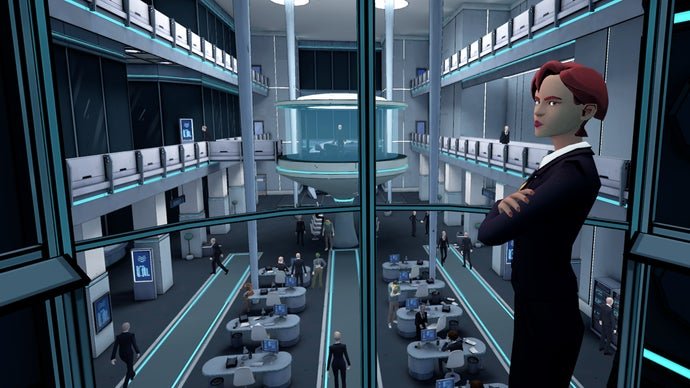
My solution is to externalise the protagonist: to separate the player (the gameplay agent) from the story’s protagonist (the story agent). In Augmented Empire, the player-character Craven makes all the tactical decisions but the story’s protagonist is Willa, who develops from being a cold and self-righteous loner to an personable revolutionary leader. In Shadow Point you play as Alex as you solve puzzles and discover new worlds (the gameplay agent), but it’s Lorna McCabe who we observe change from a selfish and entitled brat to a wise and generous adult (the story agent).
Player-character VO adds an additional wrinkle. Hearing your own character speak can be confusing, at least initially, like there’s a ghost nearby or an invading parasite has taken control of your vocal chords. MIB: Most Wanted is Coatsink’s first VR game with a talking player-character and the solution we employed was to make the player perform a positive action before hearing them speak. Whether this is a button prompt or a neuralizer activation, this ensured a direct connection between input and dialogue. Furthermore, we recorded two full versions of the script to allow players to choose their ‘voice’.
Consider the Costs
Narrative delivery is an important factor when evaluating costs (assuming there’s story information to convey beyond gameplay). Text is cheap but suboptimal in VR. Recorded dialogue, you get what you pay for. Rendering characters to then convey that dialogue can drastically increase scope depending on the approach.
Augmented Empire’s birds-eye perspective kept the characters small and low-poly. So we added 2D portraits of the main cast with a variety of expressions – to emphasise tone. Compare this approach to Shadow Point in which Lorna was granted a significant physical presence and lip-synched sequences but at a greater developmental cost. In fact, the cutscene dialogue was recorded a full nine months ahead of the rest of the script to give the animation team sufficient time. Meanwhile, They Suspect Nothing featured a host of visible talking characters: elaborate robots with bold and expressive actions that didn’t require lip-synch.
In Jurassic World Aftermath we took another approach. You play as professional thief Sam (gameplay agent) under the guidance of Mia Everett (story agent). But Mia’s arc is conveyed entirely through VO which allowed the art and animation teams to focus on the real stars – the dinosaurs. This was a conscious early decision with significant narrative consequences because, like Campo Santo’s Firewatch (2016), it takes time getting players emotionally invested in someone they never see and whose primary function is to tell you what to do.
Scope-out the Cutscenes
Character interactions are the backbone of drama and cutscenes are a useful tool that provide rewards and gameplay breaks. However, they’re an uneasy proposition in VR and introduce a huge set of questions:
How do we ensure the player is looking in the right direction? Should we teleport them to the ideal position or restrict their movement? At what distance or elevation is the action taking place? Will the player still comprehend the story if they miss something? How is the action framed? What other ways might we engage the player?
There are no right or wrong answers, they’re all situational. But they’re indicative of one of the greatest contradictions when writing for the medium: spectacle is cheaper than drama. Displaying a set-piece explosion may be relatively straightforward. But conveying emotion – having a character talk and emote in front of you – can be extremely difficult.
The solution: lock cutscene scope early and determine the amount of minutes and words with art and animation. Then ensure only the most important or consequential story beats are delivered this way. In Shadow Point, they’re the most emotional turning points of Lorna’s life. In Jurassic World Aftermath, they showcase the dinosaurs.
Build Meaningful Worlds
Environmental storytelling is a fundamental tool in the developer’s arsenal. At their finest, environments impart lore and backstory and reward the player’s attention. In VR, environments are immediate and tactile. When you’re physically moving through a fictional space, even the most mundane objects – a cup, a vase – take on new significance. It’s not simply background flavour, it’s an object the developers put there for a reason, and one you can examine from any distance and potentially pick up and smash.
My advice: create specific and detailed notes for the artists, explaining the location’s narrative, significance and how we’re supposed to feel. Importantly, note any unusual or unexpected aspects because anomalies impart the most information. If a player is naturally inclined to look for details, those details should have something to say. Leap on every opportunity to include some exposition, world-building or even just a joke.
This all comes back to one simple rule: respect the player’s time. Movies are passive, they’ll play to themselves in an empty room. Games require attention and input. VR games require attention, input, a device attached to your head, and to move around in physical space. And once the novelty of inhabiting your new world has waned, narrative fulfilment can be one of the most compelling driving forces.
Respect the Licence
Writing for established IP involves striking the balance between expectation and innovation. Fans expect to see the iconic aspects of a franchise, whether it’s the prominence of specific characters, locations or items, or gameplay actions and objectives. Find the alien, neuralyze the witness. Confront Megatron, protect the AllSpark.
Tone is crucial. Jurassic World Aftermath has moments of beauty, curiosity and wonder accompanying all the terrifying raptor chases. MIB: Most Wanted is generally comedic, with moments of high action and pathos. While tone is trickier to encapsulate than a De-Atomiser you can hold and wave around, it’s ultimately what makes an experience feel authentic. Music, art style, gameplay pace… even the rhythm and vocabulary of dialogue all contribute.
But at the same time, audiences want something new. Whether it’s a fresh spin on established mechanics, an original story, or the expression of a particular theme. Every IP has thematic parameters, topics or ideas the game can potentially examine. You wouldn’t expect a Jurassic World game to examine the nature of tyranny or the struggle between good and evil. But Transformers, sure, absolutely. Theme is ultimately what gives a story substance and what players will take away once the credits have rolled. So pick a theme appropriate to the franchise and let it be your lodestar.
